Why Retail Option Strategies Underperform: Payoffs, Probabilities, and the Cost of Speculation

Alexandre LANGEVIN

In this article, Alexandre LANGEVIN (ESSEC Business School, Global Bachelor in Business Administration (BBA), 2022-2026) examines why retail option strategies frequently underperform — that is, generate returns below a passive buy-and-hold benchmark or lose money outright — despite offering payoff profiles that appear attractive on paper. The article explains the structural mechanics behind four common strategies, identifies the sources of systematic drag, and illustrates how the gap between theoretical upside and realized performance emerges even before behavioral factors are considered.

Introduction

Options are among the most versatile yet complex instruments in financial markets. They can hedge risk, generate income, or express a directional view with defined downside (Hull, 2012). Yet a growing body of evidence suggests that retail investors who trade options systematically underperform both the market and their own expectations (Barber and Odean, 2000; de Silva, So and Smith, 2024). The question is not whether options are useful tools; they plainly are. The question is whether the specific strategies retail investors tend to favor are structurally suited to delivering the outcomes they expect.

The answer, in most cases, is that they are not. The gap between the payoff diagram and realized performance is not primarily attributable to adverse price realizations. It is embedded in the mechanics of how options are priced, how time erodes their value, and how the probability of profit is systematically lower than the shape of the payoff curve implies. Understanding these mechanics is the first step toward using options more deliberately.

How an Option Payoff Works

An option gives its buyer the right, but not the obligation, to buy (call) or sell (put) an underlying asset at a fixed price — the strike — on or before expiry. The buyer pays a premium for this right. At expiry, the profit or loss is determined entirely by the final price of the underlying relative to the strike.

For a long call: the option expires worthless if the underlying finishes below the strike. Above the strike, the buyer receives the difference between the final price and the strike. The buyer pays the premium upfront when entering the position; profit or loss at expiry therefore equals the intrinsic value minus this initial cost. The breakeven is therefore the strike plus the premium. For a long put, the logic is symmetric: the option has value if the underlying falls below the strike, and the breakeven is the strike minus the premium. Throughout this article, net profit or loss refers to the outcome at expiry after accounting for the premium paid upfront. The net profit or loss formula for a long call is:

Long call payoff formula

These payoff diagrams look appealing. The downside is capped at the premium paid; the upside is theoretically unlimited for calls and capped at the strike price minus the premium paid for puts (since the underlying cannot fall below zero) for puts. What the diagram does not show is the probability attached to each outcome.

The Four Strategies: Structure and Mechanics

The Excel model accompanying this article covers four strategies commonly used by retail investors. Each illustrates a distinct structural trade-off.

The following four strategies represent the most common approaches used by retail option traders, ranging from directional speculation to income generation.

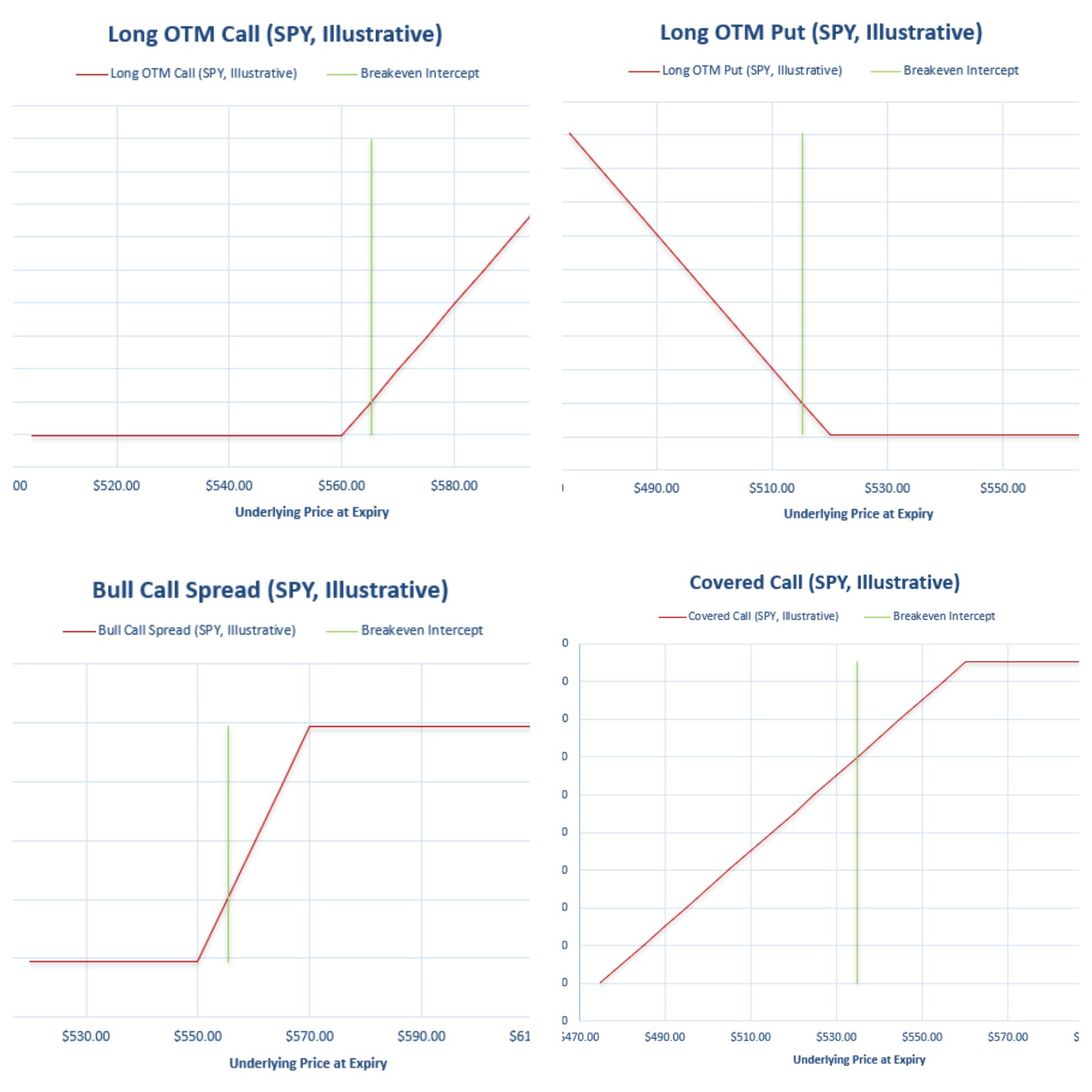
Long Out-of-the-Money (OTM) Call. An option is out-of-the-money when exercising it immediately would produce no value — the strike is above the current price for a call, or below it for a put. In the illustrative example, SPY trades at $540. A call with a $560 strike costs $5.20. Breakeven is $565.20, requiring a 4.7% move in the underlying just to recover the premium. Below $560 at expiry, the entire $5.20 is lost. Above $565.20, the trade turns profitable. The net profit or loss is positively skewed and theoretically unlimited, which explains its appeal. The structural problem is that an OTM call requires the underlying to move by more than the market already expects, because the premium reflects that expected move.

A worked example illustrates the arithmetic. Suppose SPY closes at $575 at expiry. The intrinsic value of the $560 call is $575 − $560 = $15. Net profit per share = $15 − $5.20 = $9.80, or $980 per contract (one contract = 100 shares) — a return of 188% on the premium paid. Now suppose SPY closes at $550 instead. The call expires worthless; the loss is the full premium of $5.20 per share, or −$520 per contract. These two outcomes — $980 profit vs. −$520 loss — illustrate the asymmetry. The upside is real, but the full loss scenario is far more probable: SPY must rise more than 4.7% simply to break even, and more than that to generate meaningful profit.

Long OTM Put. A $520 put on SPY trading at $540 costs $4.80. Breakeven is $515.20, requiring a 4.6% decline. Like the OTM call, the put must overcome both the out-of-the-money gap and the premium cost before generating any return. In calm markets, the probability of hitting breakeven by expiry is well below what the payoff diagram implies.

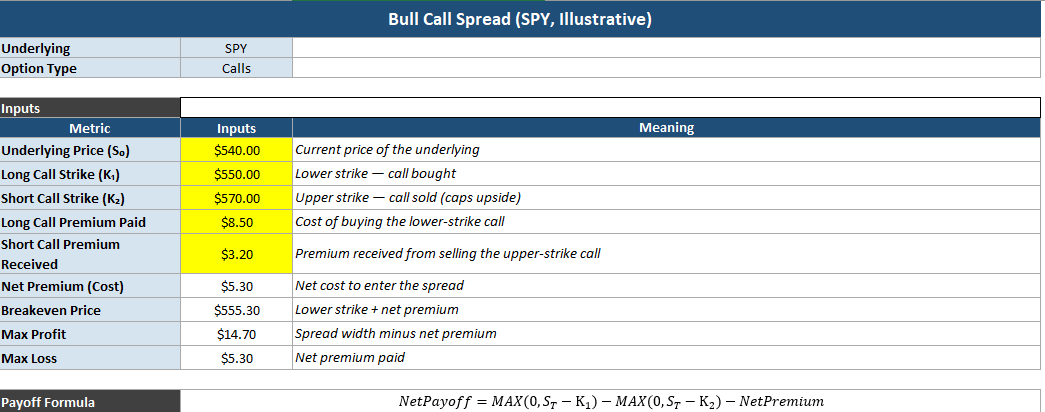
Bull Call Spread. Buying the $550 call and selling the $570 call reduces the net cost to $5.30 (long premium $8.50 minus short premium $3.20). Breakeven falls to $555.30, and maximum profit is capped at $14.70 per share if SPY finishes above $570. The spread trades unlimited upside for a lower entry cost and a higher probability of profit compared to the naked call. The payoff formula is:

Bull call spread payoff formula

It is a more disciplined structure, but it still requires a meaningful directional move, and the profit ceiling is fixed regardless of how far the underlying moves above the upper strike.

Covered Call. An investor who holds 100 shares purchased at $540 sells a $560 call for $5.20. Breakeven falls from $540 to $534.80. If SPY finishes below $560, the investor keeps the premium and the position. If SPY finishes above $560, the shares are called away and the investor captures only $25.20 per share in total profit, regardless of how far the stock has risen. The strategy generates income but structurally caps the upside.

Figure 1. Payoff diagrams at expiry for the four strategies (illustrative inputs).
Option payoff diagrams
Source: computation by the author.

The Structural Sources of Underperformance

Three structural factors — theta decay, the volatility risk premium, and breakeven mechanics — explain why retail option strategies systematically underperform, independently of any behavioral bias.

Theta decay. Options lose value over time as expiry approaches. This decay is not linear; it accelerates sharply in the final weeks before expiry. A 30-day option that has lost 30% of its value in the first two weeks may lose the remaining 70% in the last two. Retail investors who buy short-dated options and hold them without a clear exit plan are running against the clock. The underlying must move quickly and decisively; a slow drift in the right direction is often not enough to overcome the daily erosion in time value. De Silva, So and Smith (2024) document that retail investors systematically purchase options ahead of anticipated volatility spikes, only to suffer double-digit percentage losses as volatility collapses and time value erodes post-announcement.

The volatility risk premium. Implied volatility — the level of volatility priced into an option’s premium — is persistently higher than realized volatility on average. This gap is the volatility risk premium, and it represents a systematic transfer of wealth from option buyers to option sellers. When you buy an option, you are paying for a level of volatility that, on average, does not materialize. Market makers and institutional sellers collect this premium consistently over time; retail buyers pay it. Broadie, Chernov and Johannes (2009) show that the apparently large returns to put-selling strategies are fully explained by compensation for bearing this volatility risk — what looks like alpha is largely a risk premium that option buyers are systematically on the wrong side of.

Breakeven mechanics. The breakeven calculation makes the structural difficulty explicit. For a long OTM call with a 4.7% breakeven requirement, the underlying must rise by 4.7% before expiry simply to recover costs. Historically, the probability of a large-cap equity index moving 5% or more in a given month is well below 50%. The payoff diagram shows what happens if the move occurs; it does not show how often it does. Most retail option buyers look at the profit region of the diagram without adequately pricing in the probability of reaching it. Barber and Odean (2000) document a closely related pattern in equity trading: retail investors systematically overestimate their ability to generate above-market returns, a bias that is amplified in options markets by the apparent leverage and lottery-like payoffs.

Transaction costs and taxes. A fourth source of drag, often overlooked, is the cost of trading itself. Retail investors typically pay per-contract commissions, and bid-ask spreads on options are wide relative to the premium — particularly for short-dated or illiquid contracts. On a $5.20 premium, a $0.10 spread represents nearly 2% of the position cost before any price move occurs. Capital gains taxes on short-term option profits further reduce net returns. These costs do not appear on payoff diagrams but compound the structural disadvantages described above.

Excel Model

The Excel model below contains four sheets — Long OTM Call, Long OTM Put, Bull Call Spread, and Covered Call — each following the same structure: an input table with yellow input cells, a payoff table across a range of expiry prices, and a payoff diagram with a breakeven marker. All inputs are illustrative and can be modified freely. The payoff columns and chart update automatically when inputs change.

Figure 2. Bull Call Spread sheet: inputs table and payoff formula.
Bull Call Spread inputs table
Source: computation by the author.

Download the Excel file

Why should I be interested in this post?

Options appear in equity research, derivatives desk interviews, and structured product discussions at banks and asset managers. Beyond the professional context, understanding why certain strategies structurally underperform is relevant for anyone who trades independently or advises clients on portfolio construction. The payoff diagram is the beginning of the analysis, not the end. Knowing how to read the probability distribution behind it is what separates informed use from speculation.

Related posts on the SimTrade blog

   ▶ Shengyu ZHENG Pricing barrier options with simulations and sensitivity analysis with Greeks

   ▶ Luis RAMIREZ Understanding Options and Options Trading Strategies

   ▶ Alexandre VERLET Understanding financial derivatives: options

   ▶ Saral BINDAL Implied Volatility and Option Prices

   ▶ All posts about Financial techniques

Useful resources

Academic research

Barber, B.M. and Odean, T. (2000) Trading Is Hazardous to Your Wealth: The Common Stock Investment Performance of Individual Investors, Journal of Finance, 55(2), 773-806. Available at https://faculty.haas.berkeley.edu/odean/papers%20current%20versions/individual_investor_performance_final.pdf

de Silva, T., So, E.C. and Smith, K. (2024) Losing is Optional: Retail Option Trading and Expected Announcement Volatility, Review of Finance, 30(2), 489-535. Available at https://www.timdesilva.me/files/papers/losing_optional.pdf

Broadie, M., Chernov, M. and Johannes, M. (2009) Understanding Index Option Returns, Review of Financial Studies, 22(11), 4493-4529. Available at https://business.columbia.edu/sites/default/files-efs/pubfiles/3964/broadie_chernov_johannes.pdf

Hull, J.C. (2012) Options, Futures, and Other Derivatives, 8th edition, Pearson.

About the author

This post was written in April 2026 by Alexandre LANGEVIN (ESSEC Business School, Global Bachelor in Business Administration (BBA), 2022-2026). Alexandre is interested in derivatives markets, options trading, and quantitative approaches to portfolio analysis.

   ▶ Discover all articles by Alexandre LANGEVIN.

The Shiller P/E (CAPE) Ratio: Measuring Long-Run Market Valuation

Alexandre LANGEVIN

In this article, Alexandre LANGEVIN (ESSEC Business School, Global Bachelor in Business Administration (BBA), 2022-2026) explains the Shiller P/E ratio, also known as the CAPE ratio: a valuation tool that adjusts for the business cycle to give a more reliable picture of whether equity markets are cheap or expensive.

Introduction

Every investor knows the price-to-earnings (P/E) ratio: divide the current market price by earnings per share and you get a simple measure of how much the market is paying for each dollar of profit. It is one of the most widely quoted metrics in equity analysis. But it has a structural flaw: earnings are cyclical. In a recession, they collapse, making the P/E look artificially inflated even when prices have barely moved. In a boom, they surge, making markets appear cheap when they may not be. A single year of earnings is a poor basis for a long-term valuation judgment.

Robert Shiller, a Yale professor and 2013 Nobel laureate in economics, proposed a simple fix. His ratio replaces one year of earnings with the average of the past ten years, adjusted for inflation. The result is a smoother, more stable measure of valuation that filters out the noise of the business cycle and allows for meaningful comparisons across time.

The Problem with Standard P/E

Consider the S&P 500 in 2009, shortly after the financial crisis. Prices had fallen sharply, but earnings had fallen even further, with many companies reporting losses. Standard P/E spiked above 100 at certain points, not because markets were expensive, but because the denominator had collapsed. An investor reading that number at face value might have concluded the market was dangerously overvalued, when it was near a generational buying opportunity.

The opposite problem occurs at cycle peaks. Strong earnings in boom years compress P/E ratios, making markets look reasonable just before a downturn. Standard P/E captures both price and the cyclical position of earnings simultaneously, making it hard to separate valuation from timing.

The CAPE Ratio: Construction and Formula

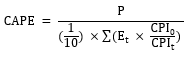
Shiller’s solution is to replace single-year earnings with the average of real earnings over the previous ten years. A ten-year window spans a full business cycle, smoothing out both recessions and booms. The formula is:

CAPE ratio formula

where P is the current market price, Et are reported earnings in year t, CPI0 is the current price index, and CPIt is the price index in year t. The inflation adjustment ensures that past earnings are expressed in today’s dollars, making them directly comparable to recent figures.

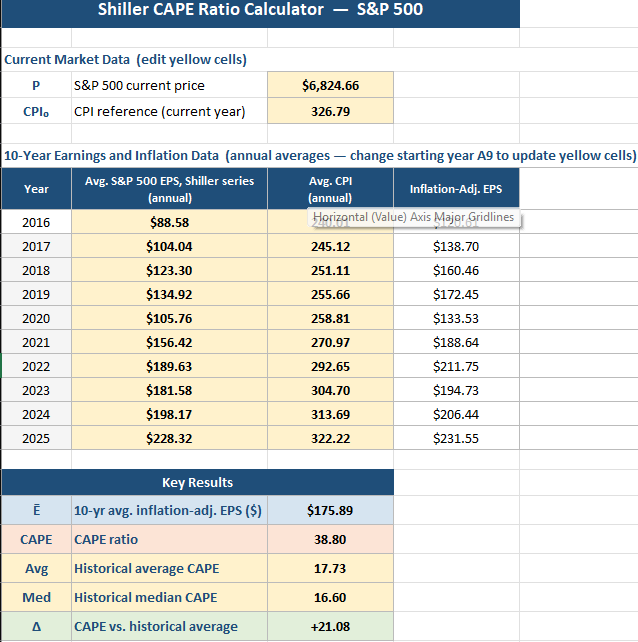
In the Excel model, each annual earnings figure is the average of the 12 monthly observations in Shiller’s dataset. Shiller himself constructs monthly earnings by interpolating S&P four-quarter totals, so the monthly series is a smooth continuous estimate rather than actual reported monthly results. The current S&P 500 price used is the April 9, 2026 closing price of $6,824.66, sourced from Yahoo Finance. The CPI reference is the February 2026 release from the U.S. Bureau of Labor Statistics.

Historical Record and Market Signals

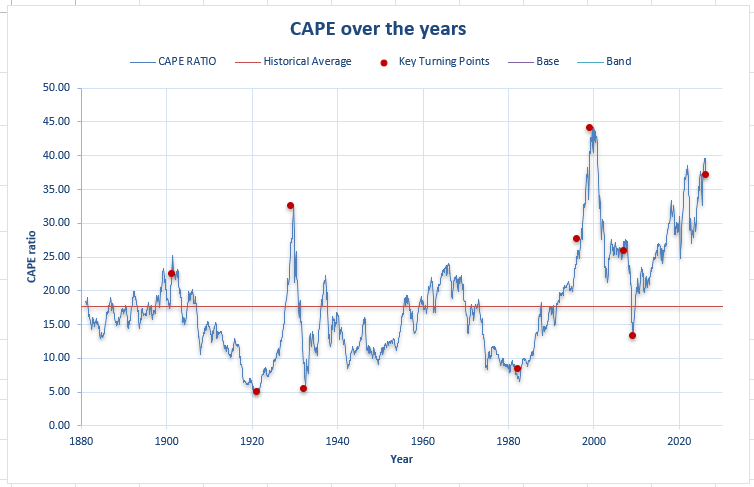
Shiller’s dataset goes back to 1871, giving the ratio an exceptionally long historical record. The average CAPE over that full period is approximately 17.7 and the median around 16.6. These serve as rough benchmarks: readings significantly above the average suggest the market is expensive relative to long-run earnings capacity, while readings well below suggest the opposite.

The ratio’s most cited applications came before two of the largest crashes of the modern era. In December 1999, at the peak of the dot-com bubble, the S&P 500 CAPE reached 44.2, more than double its historical average. Shiller published Irrational Exuberance that same year, arguing on the basis of CAPE that US equities were severely overvalued. The S&P 500 subsequently fell by nearly 50% over the following two years. In August 2007, CAPE rose above 26 before the financial crisis and another major decline.

At the other extreme, CAPE dropped to around 8.5 in August 1982, one of its lowest post-war readings, preceding one of the strongest bull markets in US history. As of April 9, 2026, our model gives a CAPE of approximately 38.8, well above the historical average.

Figure 1. CAPE ratio at key historical market turning points (S&P 500, selected monthly readings). Source: Robert J. Shiller, econ.yale.edu; computation by the author.
CAPE historical chart
Source: computation by the author.

Excel Model

The Excel model below computes the CAPE ratio from Shiller’s raw data. It contains four sheets: a source data sheet copied directly from Shiller’s dataset, a CAPE Calculator that pulls ten-year annual averages and applies the inflation adjustment, a Historical Context sheet with key turning points, and a Read Me. The starting year of the ten-year window is adjustable, and the model updates automatically when price or CPI inputs are changed.

Figure 2. CAPE Calculator: ten-year window of inflation-adjusted earnings and resulting CAPE ratio.
CAPE calculator Excel screenshot
Source: computation by the author.

Download the Excel file

Interpretation and Limitations

What CAPE tells you. Shiller’s own research found a strong negative relationship between starting CAPE and subsequent 10-year real returns for the S&P 500: high CAPE tends to precede lower decade-long returns, and low CAPE tends to precede higher ones. The relationship is not mechanical and does not predict timing, but it is one of the more robust long-run return predictors in the academic literature.

The interest rate objection. The most common criticism is that CAPE ignores the level of interest rates. When rates are structurally low, investors rationally accept higher valuations because the alternatives offer little return. Some analysts argue that elevated CAPE readings since 2010 partly reflect lower rates rather than pure overvaluation. This debate is unresolved.

Accounting changes. Reporting standards for earnings have evolved significantly since the 1870s, particularly around goodwill and write-offs. Some researchers argue that modern reported earnings are not strictly comparable to historical figures, making century-long CAPE comparisons imperfect.

Not a timing tool. Investors who sold equities in 1996 because CAPE was already above its long-run average missed four more years of exceptional gains before the dot-com peak. CAPE is a signal about long-run expected returns, not a predictor of short-term price moves.

Why should I be interested in this post?

Valuation metrics appear in equity research, asset allocation decisions at investment managers, and macro discussions at private banks. The CAPE ratio is referenced in strategy notes, central bank research, and academic papers on return predictability. Understanding what it measures, how it is built, and what its limits are is practical knowledge for anyone working in equities or asset management — and one of the cleaner examples of how academic research translates directly into a practitioner tool.

Related posts on the SimTrade blog

   ▶ Hadrien PUCHE “The stock market is filled with individuals who know the price of everything, but the value of nothing.” – Philip Fisher

   ▶ Jorge KARAM DIB Multiples valuation method for stocks

   ▶ Bijal GANDHI Earnings per share

   ▶ All posts about Financial techniques

Useful resources

Academic research

Campbell, J.Y. and Shiller, R.J. (1988) Stock Prices, Earnings, and Expected Dividends, Journal of Finance, 43(3), 661-676. Available at scholar.harvard.edu.

Bunn, O. and Shiller, R.J. (2014) Changing Times, Changing Values: A Historical Analysis of Sectors within the US Stock Market 1872-2013, NBER Working Paper No. 20370. Available at nber.org.

Data sources

Shiller, R.J. Online Data, Yale University. S&P 500 price, earnings, CPI, and CAPE data from 1871 to present.

S&P 500 current price: Yahoo Finance.

CPI reference: U.S. Bureau of Labor Statistics, Consumer Price Index release.

SimTrade

SimTrade

SimTrade Courses

About the author

The article was written in April 2026 by Alexandre LANGEVIN (ESSEC Business School, Global Bachelor in Business Administration (BBA), 2022-2026).

   ▶ Discover all articles by Alexandre LANGEVIN.

Duration and Convexity: Measuring Bond Price Sensitivity to Interest Rates

Alexandre LANGEVIN

In this article, Alexandre LANGEVIN (ESSEC Business School, Global Bachelor in Business Administration (BBA), 2022-2026) explains how duration and convexity allow investors and risk managers to measure and anticipate how bond prices react to changes in interest rates, and why the distinction between the two matters in practice.

Introduction

Bond markets sit at the heart of the global financial system, with outstanding fixed income markets exceeding $145 trillion worldwide (SIFMA, 2025). Yet one of the most fundamental challenges in fixed-income investing is deceptively simple to state: when interest rates move, bond prices move in the opposite direction. The harder question is by how much, and how accurately can we predict it?

Two risk measures answer that question: duration and convexity. Duration provides a first-order, linear approximation of price sensitivity to yield changes. Convexity accounts for the curvature in the price-yield relationship, improving accuracy when rate moves are large. Together, they form the analytical backbone of fixed-income risk management, from portfolio construction to regulatory capital requirements at banks.

Bond Pricing: The Starting Point

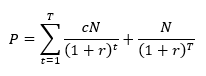
The price of a fixed-rate bond is the present value of all its future cash flows: periodic coupon payments and repayment of the face value at maturity, discounted at the bond’s yield-to-maturity. The yield-to-maturity (YTM) is the single discount rate that equates the present value of all cash flows to the current market price. With nominal value N, annual coupon rate c, maturity T, and YTM r, the bond price P is:

Bond price formula

As r rises, each discount factor grows, reducing the present value of every future cash flow and pushing the total price down. A useful benchmark: when the coupon rate equals the YTM, the bond prices at par. When the coupon rate exceeds the YTM, the bond trades above par — this is a premium bond, identifiable directly from the parameters before computing anything.

Duration

Macaulay Duration

Duration was formalized by Frederick Macaulay in 1938. Macaulay duration is the weighted average of the times at which a bond pays its cash flows, where each weight is the share of total present value arriving at that date. It answers: on average, how long does an investor wait to receive their money back?

A zero-coupon bond has a duration equal to its maturity, since all cash flow arrives at the end. A coupon bond always has a shorter duration than its maturity, because intermediate coupon payments pull the weighted average forward. For a given maturity, a higher coupon rate or a higher yield both reduce duration.

Modified Duration

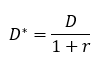
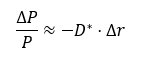
Modified duration is Macaulay duration adjusted by dividing by (1 + r). It has a direct use as a price sensitivity measure: a bond’s percentage price change is approximately equal to minus its modified duration multiplied by the change in yield.

Modified duration definition

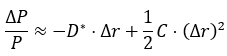
Duration price approximation

If a bond has a modified duration of 6, a 1% rise in yield reduces its price by roughly 6%. This is practical and widely used, but it is only a linear approximation and loses accuracy as yield changes grow larger.

In practice, traders and risk managers also use DV01 (Dollar Value of a Basis Point): the monetary price change for a 1 basis point (0.01%) shift in yield, equal to D* × P × 0.0001. DV01 is the standard unit for setting position limits on bond desks and for computing interest rate risk under Basel III.

Convexity

Why Duration Is Not Enough

The price-yield relationship of a bond is not a straight line — it is a convex curve. Duration approximates this curve with a tangent line at the current yield. For small yield moves this works reasonably well, but for larger moves the error accumulates in a predictable direction: duration always underestimates the true price. When rates fall, the actual price gain is larger than duration predicts. When rates rise, the actual price loss is smaller. This asymmetry, always working in the bondholder’s favor, is the essence of convexity.

The Convexity Correction

Convexity is the second derivative of the bond price with respect to the yield, divided by the price. Adding it as a second-order correction gives a substantially more accurate estimate:

Duration and convexity price approximation

The convexity term is always positive regardless of yield direction, which creates the favorable asymmetry: it always adds to the price estimate, making gains larger and losses smaller than the duration-only figure.

A Numerical Illustration

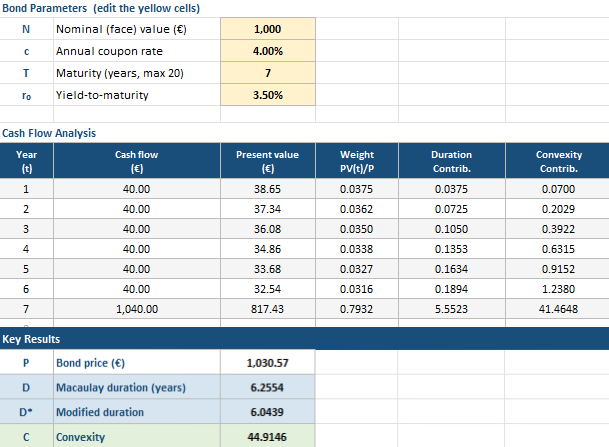
Consider a 7-year bond with a face value of $1,000, an annual coupon rate of 4%, and a current YTM of 3.5%. Since the coupon exceeds the yield, this is a premium bond. The Excel model gives a bond price of $1,030.57, a Macaulay duration of 6.26 years, a modified duration of 6.04, and a convexity of 44.91.

Figure 1. Cash Flow Analysis table and key results (N = $1,000, c = 4%, T = 7 years, r₀ = 3.5%).
Excel bond calculator screenshot
Source: computation by the author.

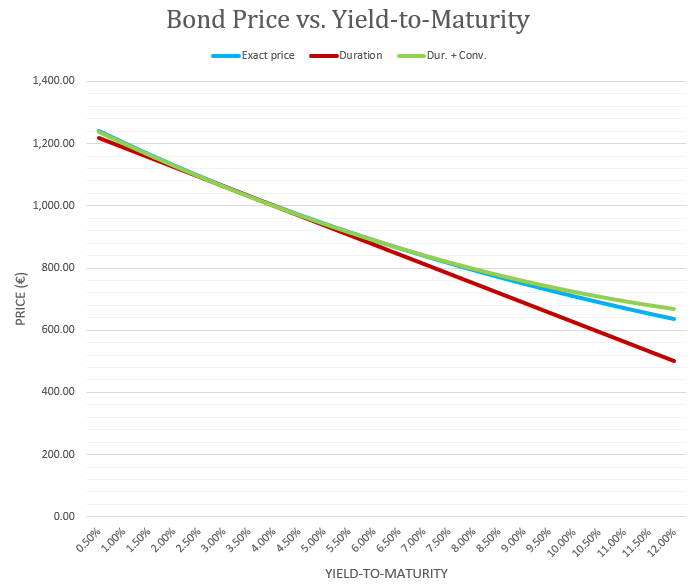
Now suppose the yield rises 2 percentage points, from 3.5% to 5.5%. The exact bond price falls to $914.76, a decline of 11.24%. The duration approximation predicts $906.00, overestimating the loss by nearly $9. The duration-convexity approximation gives $915.26, bringing the error down to under $0.50. Figure 2 shows this comparison across the full yield range.

Figure 2. Bond price as a function of YTM (N = $1,000, c = 4%, T = 7 years, r₀ = 3.5%): exact price (blue), duration approximation (red), duration + convexity approximation (green).
Bond price vs yield chart T=7
Source: computation by the author.

Excel Model

The Excel file below replicates these calculations for any bond. It contains a Cash Flow Analysis sheet computing present value, duration contribution, and convexity contribution for each year; a Price-Yield Chart comparing all three methods; and a Read Me tab. All inputs are editable in yellow cells, and the model supports maturities from 1 to 20 years.

Download the Excel file

A Note on Long-Duration Bonds

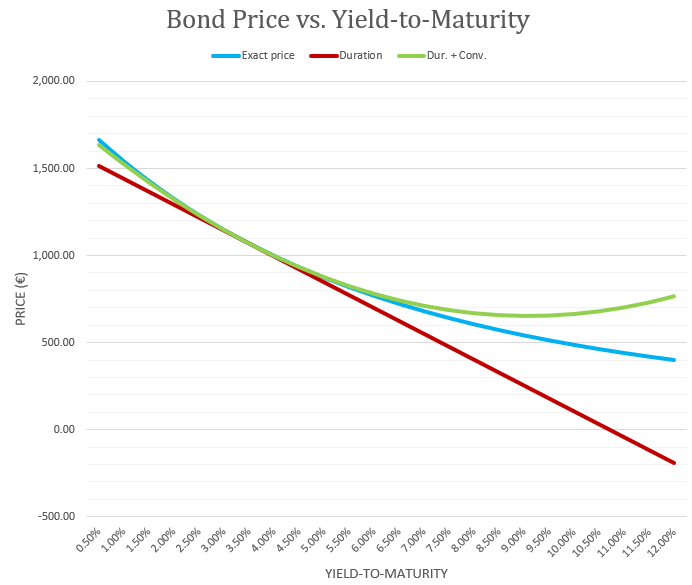
The limitations of the duration approximation become more pronounced for longer-maturity bonds. A 20-year bond with the same 4% coupon carries a modified duration of roughly 13-14 years. Applied to a large yield shift, the linear formula can produce a negative estimated price, because the correction term eventually exceeds the bond’s starting price. This does not happen in reality. It is simply a demonstration of how far the linear approximation strays when pushed outside its valid range. The duration-convexity approximation remains far better behaved across the same range. For long-duration bonds in volatile rate environments, accounting for convexity is not optional.

Figure 3. Price-Yield chart for a 20-year bond: the duration approximation turns negative at high yields while the convexity approximation tracks the exact price.
Bond price vs yield T=20
Source: computation by the author.

Applications in Fixed-Income Risk Management

Portfolio immunization. A portfolio manager protecting a bond portfolio against parallel rate shifts will match portfolio duration to the investment horizon. Price losses from rising rates are offset by higher reinvestment income on coupons, leaving total return roughly unchanged.

Risk limits and regulatory capital. Banks use DV01 to set position limits for fixed-income traders and to estimate interest rate risk under Basel III. A trader might be authorized to hold a maximum DV01 of $50,000, meaning no more than $50,000 of profit or loss per basis point move.

Convexity as a source of value. In volatile rate environments, investors seek bonds with high convexity. The asymmetric payoff profile — larger gains than losses for equal rate moves in either direction — is a property the market prices accordingly. Long-dated government bonds are a typical example.

Limitations. Both measures assume a parallel shift in the yield curve. In practice, the curve can steepen, flatten, or twist. For more granular risk measurement, practitioners use key rate durations, which isolate sensitivity at individual maturities. Duration and convexity remain the essential starting point.

Why should I be interested in this post?

Duration and convexity appear in fixed-income interviews, in the CFA curriculum, and in the daily work of bond traders and risk officers. Whether you are targeting investment banking, asset management, or financial risk management, these are concepts you will encounter early. The distinction between linear and non-linear sensitivity also recurs throughout quantitative finance, from option Greeks to credit portfolio models. Being able to work through it from first principles and build a functioning model is a meaningful differentiator at the MSc Finance level.

Related posts on the SimTrade blog

   ▶ Nithisha CHALLA US Treasury Bonds

   ▶ Georges WAUBERT Bond risks

   ▶ Georges WAUBERT Introduction to bonds

   ▶ Georges WAUBERT Bond valuation

   ▶ All posts about Financial techniques

Useful resources

Academic research

SIFMA (2025) Capital Markets Fact Book 2025. Available at sifma.org.

Cerovic, S., Pepic, M., Cerovic, S. and Cerovic, N. (2014) Duration and Convexity of Bonds, Singidunum Journal of Applied Sciences, 11(1), 52-66. Available at journal.singidunum.ac.rs.

Winkel, M. (2011) Duration, Convexity and Immunisation, Lecture Notes, Department of Statistics, University of Oxford. Available at stats.ox.ac.uk.

Crack, T.F. and Nawalkha, S.K. (2000) Common Misunderstandings Concerning Duration and Convexity, Working Paper. Available at ssrn.com.

Jeffrey, A. (2000) Duration, Convexity and Higher Order Hedging (Revisited), Yale International Center for Finance, Working Paper No. 00-22. Available at ssrn.com.

SimTrade

SimTrade

SimTrade Courses

About the author

The article was written in April 2026 by Alexandre LANGEVIN (ESSEC Business School, Global Bachelor in Business Administration (BBA), 2022-2026).

   ▶ Discover all articles by Alexandre LANGEVIN.

“Markets can remain irrational longer than you can remain solvent” – John Meynard Keynes

Hadrien Puche

Is it possible to be right too early? In the world of finance, the answer is often yes. We frequently assume that if our analysis is sound, and if the data is on our side, profit is inevitable. However, history is littered with brilliant minds who correctly identified a market bubble, but got crushed by the weight of markets that refused to see their truth.

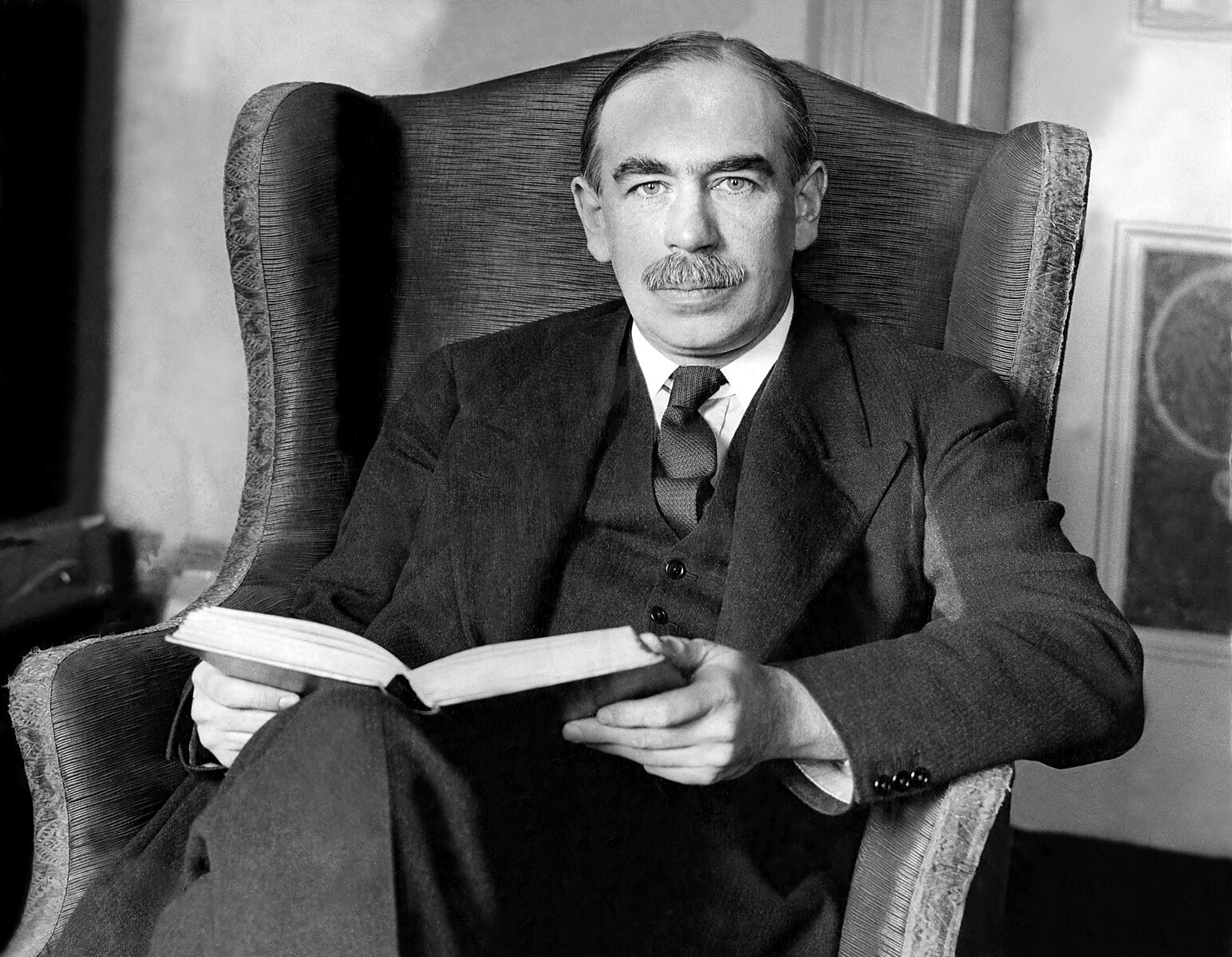
John Maynard Keynes, father of modern macroeconomics, learned this the hard way in the 1920s, as he nearly went bankrupt betting against the German Mark. He discovered that even his expert theories could be steamrolled by the sheer momentum of a crowd who does not care about mathematics or economics. In one sentence, “Markets can remain irrational longer than you can remain solvent”.

In this article, Hadrien Puche (ESSEC Business School, Grande École Program, Master in Management, 2023-2027) explores the limits of arbitrage, and why timing is just as important as being correct.

About Keynes and this quote

John Maynard Keynes
John Maynard Keynes
Source : Cambridge

John Maynard Keynes (1883–1946) was a British economist. In his 1936 work, The General Theory of Employment, Interest, and Money , he argued that aggregate demand (the total spending in an economy) is its primary engine of growth. He observed that during crises, a “liquidity trap” can occur, where individuals and businesses hoard cash, causing a cycle of stagnation that the “invisible hand” of the free market fails to fix without external intervention.

Another central pillar of his theory is the idea of “Animal Spirits,” the human emotions and instincts that drive financial decisions. Keynes argued that because the future is uncertain, investment is guided more by waves of optimism or pessimism than by cold calculation. To counter all of this, Keynes advocated active fiscal policy: governments should use deficit spending to stimulate demand. His focus was on short-run intervention, famously remarking that “in the long run, we are all dead.”

While the quote “Markets can remain irrational longer than you can remain solvent” is frequently linked to him, its true origin is a matter of historical debate. Some credit A. Gary Shilling, an American financial analyst who has claimed paternity of the phrase since the early 1970s.

Analysis of this quote

This quote is above all a warning against the limits of arbitrage.

Being right about, for example, a bubble, such as the Dutch tulip mania (1636) or the dot-com (2000), is irrelevant if you cannot survive the journey to the correction. A market can remain detached from reality for years, during which three specific pressures act against the contrarian investor:

  • Capital constraints and margin calls: if you short a stock at $100 because it is “irrationally” high, and it climbs to $200, your broker will ask for more collateral. If you cannot provide it, your position will be liquidated at a massive loss, even if you are just days ahead of the eventual crash.
  • Opportunity cost: tying up capital in a “correct” bet that takes five years to materialize can be devastating; losses incurred from inflation and missed gains in other sectors may outweigh the final profit of the trade.
  • Momentum and “animal spirits”: irrationality is frequently self-reinforcing. When prices rise, more and more less sophisticated investors enter the market, creating momentum that pushes valuations even further from fair value, and crushing those betting on a return to sanity.

The term ‘solvent’ in the quote is very important. It is about the investor’s ability to stay alive (at a financial level). In finance, being insolvent is almost the same as being dead. The market does not have to be rational on your timeline; it only has to stay irrational long enough to exhaust your resources.

The GameStop (GME) Short Squeeze

The 2021 GameStop saga remains the most violent modern illustration of Keynes’s warning. From a fundamental perspective, analysts were “right”: the company was a struggling brick-and-mortar retailer with a declining business model and falling revenues. However, “animal spirits” fueled by social media created a decoupled valuation where the stock price surged by over 2,700% in weeks.

This irrationality triggered a short squeeze, a technical phenomenon where rising prices force short sellers to buy back shares to cover their positions. This involuntary buying creates a self-reinforcing loop: the more short sellers exit to limit losses, the higher the price climbs, triggering further margin calls. This had lethal solvency consequences: hedge funds like Melvin Capital, despite their sound fundamental thesis, were caught in a liquidity squeeze. They were crushed not by being wrong about the company, but by being insolvent before the market’s timeline aligned with their own. This example highlights the brutal reality of timing: a short position has a “bleeding” cost that fundamental truth cannot always outrun.

Financial concepts linked to this quote

This quote is a perfect opportunity to go deeper into three financial concepts that you may find useful to know more about: short selling, the Efficient Market Hypothesis (EMH) and the time value of money and opportunity cost.

Short selling

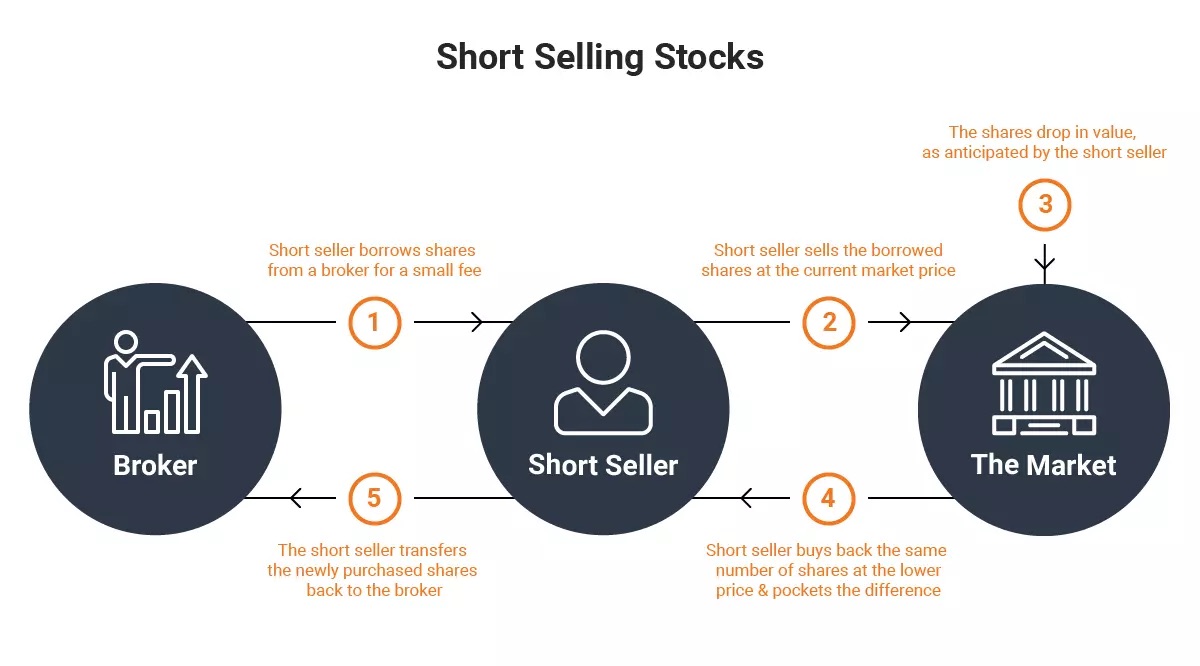
To bet against an “overpriced” market, you can short sell something. If we keep the example of stocks, the idea is that you can borrow one Tesla share from someone, and then sell this share on the open market. If the price drops as you planned, you buy back the share for cheaper and give it back to its original owner, and pocket the difference (minus a borrowing fee for whoever owned the share).

Unlike buying a stock, where your risk is limited to your initial investment (the stock can’t be worth less than 0), shorting carries theoretically infinite risk, because there is no ceiling on how high a price can climb.

Short selling explanation
Source : IG Group

But maintaining a short position is not a passive endeavor; it is a “bleeding” process characterized by several layers of costs and pressure:

  • Stock borrow fees: shorting requires you to borrow shares from a lender. In highly speculative or “hard-to-borrow” markets, the interest rates on these loans can spike significantly, eroding your potential profits every day the market refuses to correct.
  • Dividend liability: if the company you are shorting pays a dividend, you need to pay this amount out of your own pocket to the person you borrowed the shares from.
  • The short squeeze risk: as an irrational market climbs, short sellers may be forced to buy back shares to cover their losses, creating even more buying pressure. If too many investors short-sold the stock, if they all want to buy back their positions at the same time, and if not enough shares are available on the market, prices can suddenly surge to absurd levels. This is what we discussed earlier with the GameStop example.

The Efficient Market Hypothesis (EMH) vs. the Keynesian reality

The Efficient Market Hypothesis (EMH) suggests that markets are always rational and instantaneously reflect all available information. Under this framework, there should not be any bubble in the market, because arbitrageurs would immediately correct any deviation from the “fair value”. Keynes’ quote serves as a direct challenge to this theory: it suggests that while markets should be rational, they are frequently driven by “animal spirits”; the human emotions and herd behavior that makes people take irrational decisions.

This creates a dangerous environment where the fundamental value remains decoupled from the market price for extended periods. This divergence is sustained by two primary factors that the EMH often overlooks:

  • Noise trading: Many participants buy based on trends, rumors, or social proof rather than data. This “noise” creates a momentum that rational analysis cannot easily break.
  • The “Greater Fool” theory: some (if not many) investors do not buy assets because they believe they are buying at a good price, but because they expect to be able to resell them at awhat we talked earlier higher price to someone else. Check out this article to see the example of NFTs.

Time Value of Money & Opportunity Cost

Identifying a 10% mispricing in the market is only half the work; you also need to actually profit from it. This means committing capital, and in finance, capital is never free. Every dollar tied up in a trade is a dollar that isn’t earning a return elsewhere. This means your trade must not only be “correct,” but it must also clear a specific hurdle rate to be considered a success.

  • The risk-free benchmark & opportunity cost: in a rational portfolio, the baseline for any investment is the risk-free rate (typically the yield on 10-year treasury bonds for US investors, or German bunds for EU investors). If the risk-free rate is 3% per year, you need to earn significantly more than an annualized 3% on any given trade to justify the risk of not simply sitting in “safe” government debt.
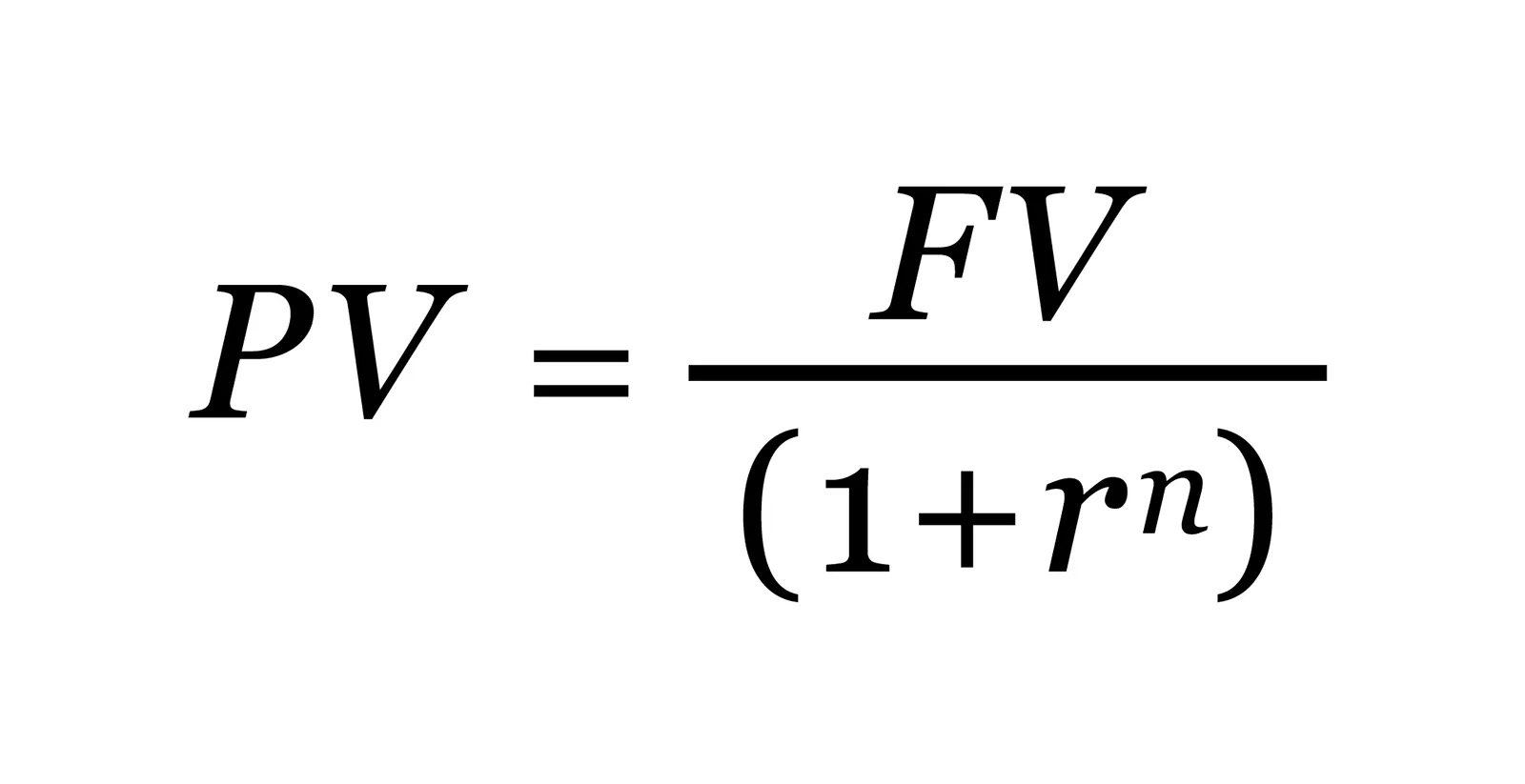
  • Time-adjusted returns: a practical way to see if your trade actually generated a real return is to use proper discounting through the present value formula. It allows you to calculate what a future sum of money (what you will have after the trade) should be worth to you today, to better compute your time-adjusted returns:

PV Formula

As a final example, if you identify a 10% mispricing today, but it takes you four years for the market to correct while the risk-free rate is 3%, your “safe” alternative would have grown to roughly 112.5% of your initial capital. By making only 10%, you have technically lost 2.5% in relative wealth, despite being “right” about the market’s irrationality.

My view on this quote

In addition to the structural limits of arbitrage, this quote serves as a stark reminder of the dangers of leverage. Whether through margin accounts or derivatives, leveraging capital allows you to trade as if you had a much larger balance; however, this acts as a double-edged sword that multiplies both gains and losses.

Because markets can stay irrational for an indefinite period, leverage significantly accelerates the path to insolvency. The market does not have to become rational on your specific timeline—or even at all. This becomes particularly dangerous when market irrationality persists longer than your loan agreement, your margin maintenance requirements, or your hedge fund mandate allows.

We see this frequently in highly speculative assets like cryptocurrencies or stocks with high price-to-earnings ratios, such as Palantir, MicroStrategy, or Tesla. You might be fundamentally correct that a specific valuation is a fantasy, but if you use borrowed money to bet against it, you are playing a high-stakes game. The house (the market) only needs to stay irrational one day longer than you can afford to pay your interest or meet your collateral calls.

Why should you keep this quote in mind?

For students, this is a vital warning against hubris. In your career, you will often see things that don’t make sense. You will be tempted to bet against them. But remember the following principles:

  • Risk management is key: never assume being “right” protects you from being “broke.” Always consider the possibility of being wrong for a very long time.
  • The market is a voting machine: in the short run, it doesn’t matter what the “fair value” is; what matters is what the average investor thinks. You most likely cannot sway the vote alone.
  • Solvency is survival: the most successful professionals are not those who are the most “right,” but those who are still standing when the correction finally arrives.

Ultimately, Keynes’ warning reminds us that the market is a psychological arena as much as a mathematical one. Surviving irrationality is the only way to eventually profit from the rationality.

Related posts on the SimTrade blog

Quotes

All posts about Quotes

   ▶ Hadrien PUCHE “The stock market is designed to transfer money from the impatient to the patient.” – Warren Buffett

   ▶ Hadrien PUCHE The market is never wrong, only opinions are.” – Jesse Livermore

   ▶ Hadrien PUCHE “The four most dangerous words in investing are, it’s different this time.” – John Templeton

Financial techniques

   ▶ Ian DI MUZIO Leverage in LBOs: How Debt Creates and Destroys Value in Private Equity Transactions

   ▶ Raphaël ROERO DE CORTANZE Gamestop: how a group of nostalgic nerds overturned a short-selling strategy

   ▶ Lang Chin SHIU The “lemming effect” in finance

Useful resources

Academic research

Shiller, R. J. (2000) Irrational Exuberance. Princeton: Princeton University Press.

Keynes, J. M. (1936) The General Theory of Employment, Interest, and Money. London: Macmillan.

Shleifer, A., Vishny, R. W. (1997) The Limits of Arbitrage The Journal of Finance, 52(1) 35-55.

Other resources

YouTube Video Fear the Boom and Bust: Keynes vs. Hayek – The Original Economics Rap Battle!.

About the Author

This article was written in April 2026 by Hadrien PUCHE (ESSEC Business School, Grande École Program, Master in Management, 2023-2027).

   ▶ Discover all articles by Hadrien PUCHE

“Diversification is protection against ignorance. It makes little sense if you know what you are doing.” – Warren Buffett

Hadrien Puche

In any asset management class, students are taught that diversification is a key to unlock mathematically optimal risk-adjusted returns. However, Warren Buffett, one of the world’s most successful investors, would beg to disagree: to him, “diversification is protection against ignorance. It makes little sense if you know what you are doing.”

In this article, Hadrien PUCHE (ESSEC Business School, Grande École Program, Master in Management, 2023-2027) discusses Buffett’s challenge to modern portfolio theory, and explains why, for a sophisticated investor, concentration may sometimes also be an option.

About Warren Buffett and this quote

Warren Buffett is the chairman and CEO of Berkshire Hathaway, a multinational holding company, that he transformed over the years into a conglomerate businesses (Geico, dairy queen…) and large equity stakes in listed companies (Coca-Cola, Apple…). He is widely considered the most successful value investor in history. He is known for his discipline, long-term perspective, and his ability to distinguish between market price and intrinsic value. This specific quote originates from his 1993 annual shareholder meeting, where he addressed the difference between a “know-nothing” investor and a “know-something” investor.

Warren Buffett

Source : CNBC

This also suggests that the reason Buffett said that isn’t to give a valuable lesson to investors, but to convince them that instead of looking for diversification and investing themselves, they should entrust their money to Berkshire Hathaway, because they have the informational edge to overperform a simply well-diversified portfolio.

Analysis of the quote

The core of Buffett’s idea is that risk is not a statistical measurement of price volatility, but rather a function of knowledge. If you have three companies you know perfectly (meaning you understand their business model, their management, and their competitive moat) then adding a fourth company “at random” just to diversify will actually increase your overall probability of loss.

Having more diversified portfolios lead to two critical issues:

  • The dilution of quality: your best investment idea is, by definition, better than your tenth best idea. By adding more stocks, you are moving away from your highest-conviction choices toward relatively more mediocre ones, watering down the potential returns of your portfolio.
  • Knowledge risk: spreading your attention across too many holdings dilutes your ability to monitor each one perfectly. You are more likely to miss a fundamental change in a business if you are tracking fifty companies instead of five.

Essentially, diversification only reduces risk when you add an asset you know nothing about to a portfolio of other assets you know nothing about. It is a great tool for the “ignorant” (in the financial sense) to protect themselves from a total wipeout, but it is a “downgrade” for anyone with a true informational edge.

Financial concepts linked to this quote

To better understand this tension between concentration and diversification, we can look at three key concepts that are very important to modern finance.

Modern Portfolio Theory (MPT) & Diversification

In every finance textbook, Modern Portfolio Theory (MPT) is presented as the “only free lunch” in investing. It suggests that by holding a large number of non-correlated assets, an investor can eliminate “idiosyncratic risk” (the risk specific to a company), leaving only the systematic risk of the market.

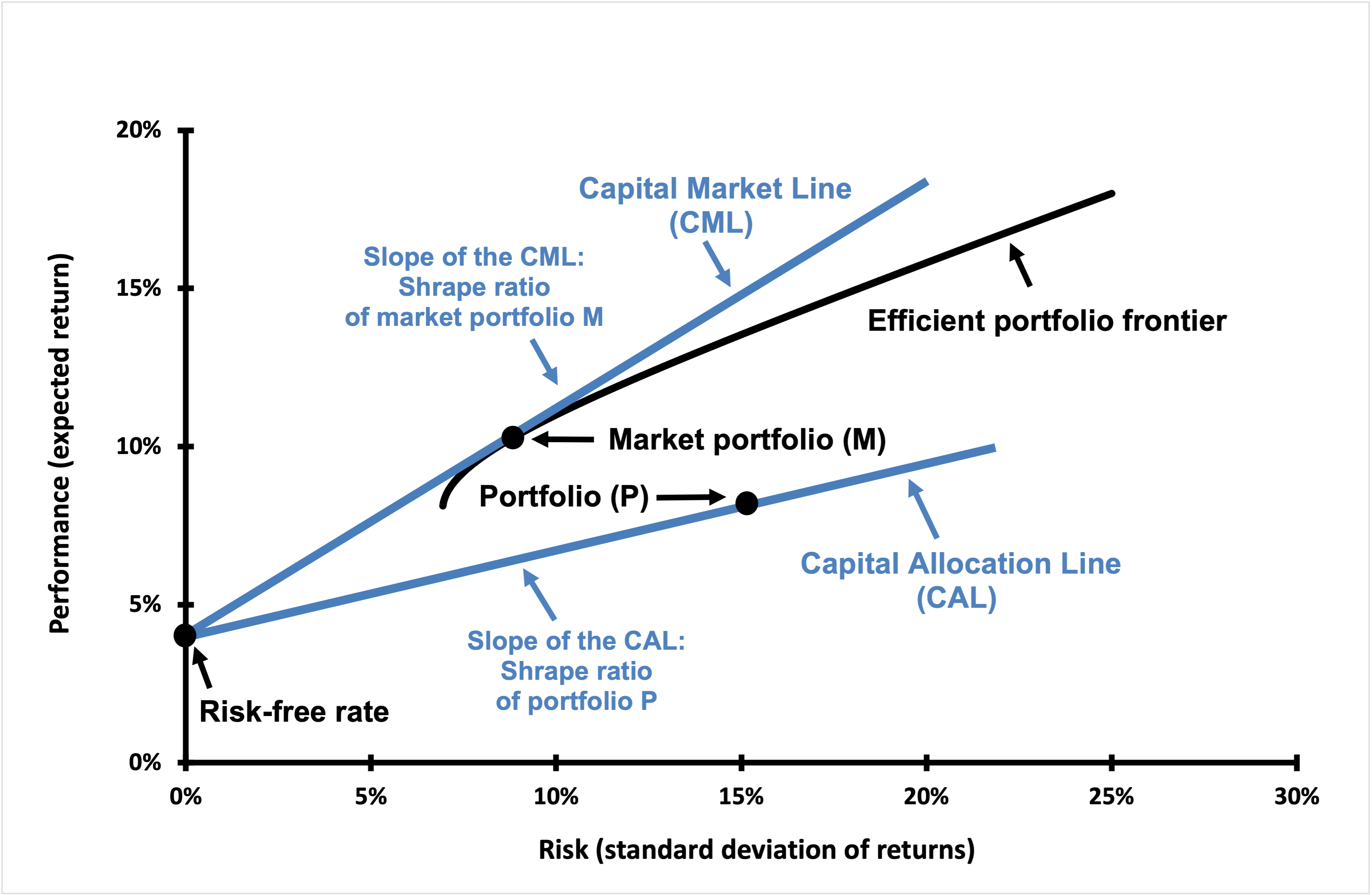
The Capital Market Line (CML) represents the most efficient combinations of the risk-free asset and the market portfolio. As shown in the graph below, every point on this line offers the highest possible (expected) return for a specific level of risk, effectively defining the “best” available trade-off. In the world of MPT, any portfolio falling to the right of this line is sub-optimal, while the area to the left remains mathematically unreachable.

The capital market line

However, MPT focuses almost entirely on the mathematical “co-variance” of stock prices rather than the underlying business quality. Buffett’s quote acts as a philosophical counter-weight to this academic standard: he suggests that MPT is a defensive tool, designed for those who cannot identify intrinsic value. If you cannot tell a good business from a bad one, MPT is your best protection; but if you can, it is nothing more than a constraint.

The Kelly Criterion

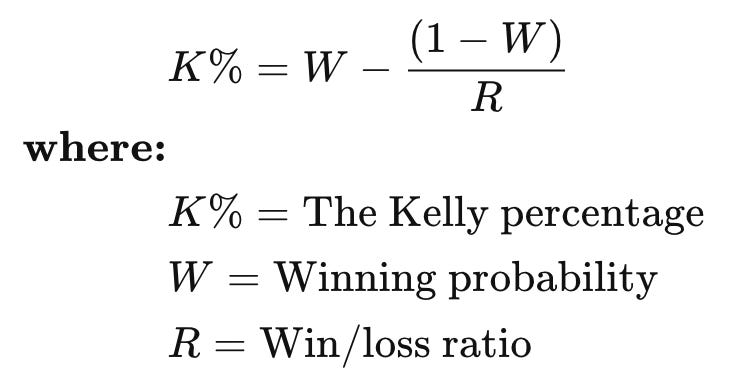
While MPT seeks to minimize variance, the Kelly Criterion seeks to maximize the growth of wealth. Originally developed by John Kelly at Bell Labs, this formula determines the optimal size of a series of bets based on the probability of success and the “edge” the bettor has.

Kelly criterion formula

Unlike the MPT, which would suggest a small allocation to any single stock to keep the portfolio “balanced,” the Kelly Criterion supports heavy concentration. It suggests that when the odds are heavily in your favor, the “bet” should be significantly larger, and can represent a significant portion of your capital. It is the mathematical foundation for the “betting big” philosophy that Buffett has applied throughout his career at Berkshire Hathaway.

Market Imperfection and Information Asymmetry

The Efficient Market Hypothesis (EMH) assumes that all information is already reflected in stock prices. However, Buffett’s success is built on the reality of market imperfections. For an investor to have a true edge, there must be a gap in how information is processed. If you spend hundreds of hours studying a specific niche, you may identify a ‘valuation gap’ that the average market participants missed. But you can’t do this work on all industries and all assets. Because of that, concentration allows you to maximize the financial value of that specific information.

Diversification, by contrast, “washes away” that hard-earned advantage, by blending your good insights with the general noise of the market average.

My view on this quote

While the logic of concentration is mathematically sound, its execution faces a major practical limit: intellectual honesty. To apply Buffett’s philosophy, you need to understand if you are yourself one of the professional managers who can overperform, or a simple retail saver who should go to diversification for protection against your own ignorance.

For an individual investor: humility as a strategy

For the vast majority of retail investors, diversification remains the “wisest default.” The “ignorance” Buffett mentions is not pejorative, but simply a realistic assessment of the time and resources one can dedicate to market analysis. Without a professional informational edge, concentration can often lead to a martingale trap, where an investor doubles down on loosing positions, based on an emotional conviction that the market is wrong and refusal to accept defeat. For this group, Modern Portfolio Theory (MPT) is not a constraint, but a necessary safeguard.

The institutional management problem

For an aspiring asset manager, the reality is a bit more complex, and highlights a structural paradox in the industry, where career incentives are more towards diversifying a portfolio than making a small number of concentrated bets.

  • Career risk versus absolute risk: If a concentrated portfolio underperforms, the manager risks being “wrong alone” and losing their job. If a diversified portfolio fails, they are “wrong with the crowd,” and no one will really consider that the loss is their responsibility.
  • The “closet indexing” trap: To minimize tracking error, many professionals choose the safety of the average. However, Buffett’s logic suggests that if you are not prepared to know your holdings better than the rest of the market, you are merely charging active management fees for a passive result, effectively selling the “market average” at a premium price.

Buffet’s call to invest with berkshire hathaway

Finally, we must consider context behind Buffett’s rhetoric. As we already stated, by framing diversification as a “protection against ignorance,” he is not just teaching finance, but also subtly positioning Berkshire Hathaway as the ideal destination for capital. He encourages investors to recognize their own limitations and, instead of buying a “know-nothing” index, to entrust their wealth to a firm that possesses the rare informational edge required to concentrate effectively. In essence, this quote is also a good lesson in brand positioning: it justified Berkshire Hattaway’s market concentration as the key to overperforming the market.

Why should you keep this quote in mind?

This principle forces you to ask a fundamental question: “Do I have a true edge, or am I just guessing?” If you are a student or a retail investor, recognizing your own ignorance is the first step toward safety. Diversification is your best friend when you are learning.

However, and this is where Buffett’s spirit is very important, if you want to achieve extraordinary results, you must first develop the analytical rigor to know your investments better than the rest of the market. Knowing the “average” only gets you the “average” return.

Related posts on the SimTrade blog

Business & Finance quotes

   ▶ All posts about Quotes

   ▶ Hadrien PUCHE Price is what you pay, value is what you get – Warren Buffett

   ▶ Hadrien PUCHE The stock market is designed to transfer money… – Warren Buffett

Useful resources

Academic research

Kelly J. L. Jr. (1956) A New Interpretation of Information Rate, Bell System Technical Journal 35(4) 917–926.

Markowitz, H. (1952) Portfolio Selection, The Journal of Finance 7(1): 77-91.

Sharpe W.F. (1991) The Arithmetic of Active Management, Financial Analysts Journal 47(1) 7-9.

Business resources

Buffett, W.E. Berkshire Hathaway Shareholder Letters

S&P Global. SPIVA Scorecards

About the Author

This article was written in April 2026 by Hadrien PUCHE (ESSEC Business School, Grande École Program, Master in Management, 2023-2027).

   ▶ Discover all articles by Hadrien PUCHE

Managing Corporate Risk: How Consulting and Financial Analysis Complement Each Other

Bochen LIU

In this article, Bochen LIU (Queen’s Smith School of Business, BCom 2023–2027; ESSEC BBA Exchange Program, Fall 2025) explains how corporate risk is understood, managed, and priced in practice, drawing on concrete experience from consulting frameworks and financial analysis at the Agricultural Bank of China.

What is corporate risk?

Corporate risk refers to the uncertainty that affects a firm’s ability to achieve its objectives. In practice, this includes credit risk, operational risk, market volatility, and strategic uncertainty. Rather than being purely theoretical, these risks directly influence financial performance, investment decisions, and long-term sustainability.

During my internship at the Agricultural Bank of China (ABC), risk was not treated as an abstract concept but as a measurable factor embedded in every lending decision. For example, when evaluating a corporate borrower, analysts examine cash flow stability, debt ratios, and industry exposure to determine the likelihood of default. This transforms uncertainty into a structured assessment.

From abstract risk to concrete decisions

One of the main limitations of theoretical discussions of risk is their level of abstraction. In practice, risk appears through specific operational situations. At ABC, I worked with customer financial data and observed how inconsistencies or missing information could directly affect credit evaluation. For instance, incomplete revenue records or irregular cash flows signaled higher uncertainty, which required further verification or stricter lending conditions.

This illustrates how risk is identified through data quality, financial transparency, and operational consistency. Rather than being a general concept, risk becomes visible through concrete indicators that influence real decisions such as loan approval, pricing, and collateral requirements.

Consulting: structuring and reducing uncertainty

Consulting plays a key role in transforming uncertainty into manageable components. In academic case work and consulting-style analysis, organizations improve risk exposure by refining reporting systems, standardizing processes, and strengthening internal controls.

A concrete example is the implementation of standardized reporting templates. During my internship, structured weekly reporting reduced inconsistencies in financial data and improved processing efficiency. This type of intervention does not eliminate uncertainty but reduces information asymmetry, making risks easier to monitor and manage.

Consulting therefore operates upstream: it improves the quality of information and decision-making structures, allowing firms to anticipate risks instead of reacting to them.

Financial analysis: measuring and pricing risk

While consulting structures risk, financial analysis quantifies and prices it. At ABC, credit assessment involved evaluating repayment capacity, industry volatility, and macroeconomic exposure. These factors were translated into measurable indicators such as probability of default and expected loss.

A concrete outcome of this process is interest rate determination. A firm with stable cash flows and low leverage receives favorable lending terms, while a firm with volatile earnings or weak financial transparency faces higher borrowing costs. In this sense, risk is directly converted into a financial price.

This demonstrates that risk is not only managed but monetized. Financial institutions assign a cost to uncertainty, aligning pricing with the level of exposure.

Risk vs uncertainty and the role of black swans

A deeper understanding of risk requires distinguishing it from uncertainty. Following Frank Knight’s framework, risk refers to situations where probabilities can be estimated, while uncertainty refers to events that cannot be predicted or quantified.

In practice, most financial models at ABC operate within the domain of measurable risk. Credit scoring, financial ratios, and industry benchmarks all assume that future outcomes can be approximated using historical data. However, these models have limits.

This is where the concept of “black swan” events, developed by Nassim Taleb, becomes critical. Events such as the 2008 financial crisis or the COVID-19 pandemic fall outside standard risk models yet have massive impacts on financial systems. These events expose the limitations of purely quantitative approaches.

From a practical perspective, this means that organizations must complement risk measurement with resilience. For example, banks require capital buffers and stress testing not because all risks can be predicted, but because extreme scenarios cannot be fully modeled.

From managing risk to building resilience

The interaction between consulting and financial analysis reveals a broader shift: firms no longer aim to eliminate risk but to manage and absorb it. Consulting improves internal structures and information quality, reducing controllable risks. Financial analysis evaluates and prices exposure, enabling informed decision-making.

However, neither approach fully addresses uncertainty. The presence of black swan events requires organizations to build adaptive capacity—through diversification, liquidity management, and strategic flexibility.

Risk management therefore evolves from a defensive function into a strategic capability. Firms that understand both measurable risk and unmeasurable uncertainty are better positioned to sustain performance in volatile environments.

Why should I be interested in this post?

For students and professionals in business and finance, understanding how risk operates in practice is essential. This post shows how theoretical concepts such as risk, uncertainty, and black swans translate into real-world decisions in consulting and banking.

It provides a concrete perspective on how organizations evaluate information, price uncertainty, and prepare for extreme events—skills that are directly relevant for careers in finance, consulting, and strategic management.

Related posts on the SimTrade blog

   ▶ Bryan BOISLEVE Principal Component Analysis (PCA) in Quantitative Finance

   ▶ Mathis HOUROU Client segmentation in private banking: marketing strategy or risk shield?

   ▶ Lokendra RATHORE Good-til-Cancelled (GTC) order and Immediate-or-Cancel (IOC) order

   ▶ Bochen LIU All posts by Bochen LIU

Useful resources

Agricultural Bank of China official website

Knight, F. H. (1921). Risk, Uncertainty and Profit. Houghton Mifflin.

Taleb, N. N. (2007). The Black Swan: The Impact of the Highly Improbable. Random House.

Hull, J. (2018). Risk Management and Financial Institutions. Wiley.

Bluhm, C., Overbeck, L., & Wagner, C. (2016). Introduction to Credit Risk Modeling. CRC Press.

Bank for International Settlements (BIS)

International Monetary Fund (IMF)

About the author

The article was written in April 2026 by Bochen LIU (Queen’s Smith School of Business, BCom 2023–2027; ESSEC BBA Exchange Program, Fall 2025).

   ▶ Discover all posts by Bochen LIU

April 2026: Inflation – Monthly Selection from the SimTrade blog

Most Read Articles about Inflation on the SimTrade Blog

This monthly selection highlights key articles on inflation, chosen based on their pedagogical value, practical relevance, and readership engagement. Inflation has been selected as a central theme due to its critical role in shaping monetary policy, asset pricing, and investment strategies in the current macro-financial environment. It is also a timely issue, as renewed geopolitical tensions—particularly involving Iran—may exert upward pressure on inflation through energy prices and supply chain disruptions.

   ▶ Anant JAIN Understanding Hyperinflation: Causes, Effects And Examples

   ▶ Raphaël ROERO DE CORTANZE Inflation & deflation

   ▶ Bijal GANDHI Inflation Rate

   ▶ Alexandre VERLET The return of inflation

Historical events about inflation

   ▶ Anant JAIN Hyperinflation in Hungary: 1945-1946

   ▶ Anant JAIN Hyperinflation In Argentina Since 2018: A Deep Dive Into The Economic Crisis

   ▶ Anant JAIN The Ongoing Hyperinflation In Turkey And Its Ripple Effects On European Union

A solid understanding of inflation is essential for interpreting macroeconomic developments, assessing monetary policy, and making informed financial decisions, which makes these articles particularly valuable for students and aspiring finance professionals.