My internship experience at HSBC

Langchin SHIU

In this article, SHIU Lang Chin (ESSEC Business School, Global Bachelor in Business Administration (GBBA), 2024-2026) shares her professional experience at HSBC in Hong Kong.
About the company

HSBC (The Hongkong and Shanghai Banking Corporation) is one of the world’s largest banking and financial services organisations, serving millions of customers through Retail Banking, Wealth Management, Commercial Banking, Global Banking and Markets, and other specialised businesses.

In Hong Kong, HSBC plays a key role as a leading provider of corporate and investment banking, trade finance, and wealth management products, making it a central player in the regional and global financial system.

Logo of HSBC.
Logo of HSBC
Source: the company.

My internship

During my internship in the Wealth and Personal Banking team in Hong Kong, I assisted with daily operations supporting client relationship managers and investment advisors. My work involved preparing client onboarding documents, updating records in the bank’s management system, and ensuring compliance with Know Your Customer (KYC) and internal policy requirements. I also helped compile client portfolio summaries, draft investment proposals, and conduct market research to support financial planning and investment recommendations.

Beyond these tasks, I gained exposure to a wide range of wealth management products including mutual funds, equity and bonds, structured products, and insurance solutions. I participated in internal meetings to observe how product specialists, compliance officers, and relationship managers collaborate to deliver integrated services for clients. Additionally, I contributed to the preparation of client presentations and market updates, which strengthened my understanding of how macroeconomic trends influence individual investment strategies.

My missions

My missions included supporting relationship managers and product managers with the preparation of client materials, such as simple financial summaries and presentation slides for internal and external meetings. I also assisted with internal reports, helped update client information in our internal systems, and observed calls and meetings to understand client needs and identify follow-up actions.

Required skills and knowledge

This internship required strong analytical skills, attention to detail and a solid foundation in finance and banking concepts, such as understanding financial statements, basic risk metrics and common banking products. At the same time, soft skills such as communication, time management, and professionalism were crucial, as I had to collaborate with different team members, handle confidential information carefully, and deliver work under tight deadlines.

What I learned

Through this experience, I learned how front-office and support teams interact to serve clients and manage risks within a large universal bank. I developed a more concrete understanding of how theoretical concepts from corporate finance and financial markets are applied in real transactions and client discussions, and I improved my ability to structure quantitative information clearly in reports.

Financial concepts related to my internship

Three financial concepts related to my internship: relationship banking, risk-return and capital allocation, and regulation and compliance. These concepts help explain how my daily tasks fit into the broader functioning of the bank.

Relationship banking

Relationship banking refers to building long-term relationships with clients rather than focusing only on individual transactions. In practice, this means understanding clients’ businesses, industries and strategic priorities to provide tailored solutions over time. By helping prepare client materials and following up on information requests, I contributed to the relationship-building process that supports client retention and opportunities.

Risk-return and capital allocation

Banks constantly balance risk and return when they grant loans, underwrite deals or hold assets on their balance sheet, subject to capital and liquidity constraints. Internal analyses, credit information, and financial ratios are used to assess whether the expected return of a client or transaction justifies the associated risk and capital consumption. My exposure to simple financial analysis and internal reporting showed how data and models support these risk-return decisions.

Regulation and compliance

Banking is a highly regulated industry, with strict rules on capital, liquidity, anti-money laundering (AML), know-your-customer (KYC) and conduct. Many processes in the bank, from onboarding to reporting and product approval, are shaped by these regulatory requirements. During my internship, I observed how documentation, data accuracy, and internal controls are integrated into daily workflows to ensure that business growth aligns with regulatory expectations and internal risk appetite.

Why should I be interested in this post?

An internship at HSBC offers exposure to a global banking environment, sophisticated financial products and real client situations. It also provides a strong platform to develop quantitative skills, professional communication and an understanding of how large financial institutions create value while managing complex risks—skills that are highly transferable to careers in banking, consulting, corporate finance and risk management.

Related posts on the SimTrade blog

All posts about Professional experiences

Useful resources

HSBC – Official website

HSBC Internships for students and graduates

HSBC Financial Regulation

About the author

The article was written in December 2025 by SHIU Lang Chin (ESSEC Business School, Global Bachelor in Business Administration (GBBA), 2024-2026).

   ▶ Read all articles by SHIU Lang Chin.

My Apprenticeship Experience at Capgemini Invent

Zineb ARAQI

In this article, Zineb ARAQI (ESSEC Business School, Global Bachelor in Business Administration (GBBA), 2021-2025) shares her experience as an apprentice at Capgemini Invent within the Data & AI practice for Financial Services, where she contributed to major digital transformation programs across global banking institutions.

About the company

Capgemini Invent is the digital innovation, design and transformation brand of the Capgemini Group. Created in 2018, it combines strategy, technology, data, and creative design to help organizations reinvent their business models. Capgemini Invent operates in more than 30 countries and brings together over 10,000 consultants, data scientists, designers, and industry experts.

Capgemini Invent works at the intersection of strategy and execution, supporting clients through their end-to-end transformation journeys. Its expertise spans digital transformation, artificial intelligence, cloud modernization, sustainability strategy, customer experience, and data-driven operating models.

Within the wider Capgemini Group (over 340,000 employees worldwide), Invent plays a critical role in bridging management consulting with advanced technological execution. This unique positioning allows consultants to work on strategic topics while staying close to the technical realities of implementation, particularly in fast-evolving domains like AI, data governance, and digital banking.

Logo of Capgemini.
Logo Capgemini
Source: Capgemini Invent

About the department: Data & AI for Financial Services

I completed my apprenticeship within the Data & AI Financial Services practice, the division supporting major French and international banks in their data strategy and AI-driven transformation. This department works closely with Chief Data Officers (CDOs), Chief Analytics Officers, and executive committees to design, deploy, and govern enterprise-wide data architectures and AI solutions.

During my apprenticeship, I worked on strategic missions covering Europe, Middle East, and Africa, the Americas, and Asia-Pacific. Our team addressed high-impact topics such as data governance, regulatory compliance and Environmental, Social, and Governance reporting, customer intelligence, risk modelling, AI use-case acceleration, cloud migration, and the operationalization of large-scale data platforms. The practice serves flagship clients across retail banking, corporate & investment banking, insurance, and payments.

My apprenticeship experience at Capgemini Invent

My Missions

Throughout my apprenticeship, I contributed to large digital transformation programs for top French banks. My work spanned across all regions, EMEA, the Americas, and Asia reflecting the global scale of modern banking operations and the cross-regional governance challenges faced by CDOs.

My missions included:

  • Supporting Chief Data Officers in defining and implementing enterprise-wide data governance frameworks (metadata, lineage, quality, operating models).
  • Designing AI use-case portfolios, including prioritization matrices, feasibility assessments, and Return on Investment evaluations for retail and corporate banking.
  • Analyzing cross-regional data issues across APAC, the Americas, and EMEA to harmonize data standards and reporting structures.
  • Contributing to ESG & sustainable finance reporting, helping banks adapt to emerging CSRD (the EU’s new mandatory sustainability reporting directive), TNFD (the global framework for nature-related risk disclosures) and ESRS (the detailed European sustainability reporting standards) requirements using improved data pipelines.
  • Supporting cloud transformation initiatives by assessing data migration readiness and defining new operating models for data platforms.
  • Supporting cloud transformation initiatives by assessing data migration readiness and defining new operating models for data platforms.
  • Building dashboards and analytics tools using SQL, PowerBI, and Python to transform raw data into clear insights that support risk, compliance, and business teams in their decision-making.

These projects exposed me to the complexity of financial data ecosystems, the challenges of legacy infrastructures, and the role of AI in reshaping operational models at scale.

Required skills and knowledge

Working at the intersection of consulting, data governance, and financial services required a combination of analytical, technical, and communication skills. On the technical side, I relied on knowledge of banking business lines (retail, Corporate & Investment Banking, payments), data modelling fundamentals, SQL, cloud concepts, and AI/ML logic. Understanding regulatory frameworks and risk data aggregation standards was essential, especially when advising CDOs on compliance or data lineage workflows.

Soft skills were equally important: client communication, structured problem-solving, stakeholder management, and the ability to translate complex data topics into actionable recommendations. Working across multiple regions strengthened my adaptability and cross-cultural communication, as I collaborated with teams in Europe, the U.S., and Asia.

What I learned

This apprenticeship taught me how central data has become to the competitiveness and resilience of financial institutions. I learned how banks leverage data to enhance customer experience, reduce risk, improve compliance, and accelerate digital transformation. I also gained firsthand exposure to how global banks structure their operating models, from governance to platforms to analytics, and how AI can be responsibly integrated into decision-making processes.

Most importantly, working with CDO organizations helped me understand the strategic importance of data leadership and the challenges of transforming legacy institutions into data-driven organizations. This experience reinforced my interest in financial technology, analytics, and sustainable finance.

Business concepts related to my internship

I present below three financial, economic, and management concepts related to my apprenticeship. These concepts illustrate how data strategy, regulatory expectations, and AI-driven transformation shape the operating models of large financial institutions and how my work experience aligned with these challenges.

Data Governance and Regulatory Compliance (BCBS 239, CSRD, ESRS)

During my missions, the concept of data governance was central. Financial institutions operate under strict regulatory expectations such as BCBS 239 (risk data aggregation), CSRD (corporate sustainability reporting), and ESRS (European sustainability standards). These frameworks require banks to demonstrate full control of their data including lineage, quality, documentation, accessibility in order to produce reliable regulatory reports. My role consisted in helping banking groups structure governance models, build data quality controls, and harmonize data definitions across regions. This concept is at the heart of banking transformation, as regulatory pressure and data modernization are now inseparable.

AI Use-Case Prioritization and ROI Evaluation

A second concept I applied throughout my apprenticeship is the prioritization of AI use-cases based on business value, feasibility, and risk. Banks often have dozens of potential AI initiatives, but only a fraction deliver measurable Return on Investment (ROI). My work involved constructing prioritization matrices, evaluating data readiness, estimating financial impact, and supporting executive committees in building realistic AI roadmaps. This required balancing quantitative evaluation (cost savings, efficiency gains) with qualitative factors (regulatory risk, bias mitigation, ethical constraints). This concept is fundamental to ensuring that AI programs are scalable, responsible, and aligned with strategic objectives.

Operating Model Transformation for Data Platforms and Cloud Migration

The third concept closely linked to my missions is the transformation of operating models for data platforms migrating to the cloud. Banks are progressively replacing legacy infrastructure with modern cloud-based architectures to improve scalability, reduce costs, and accelerate analytics capabilities. My work consisted in assessing migration readiness, defining roles and responsibilities, and designing new governance processes adapted to cloud environments. This concept is essential because technology alone cannot transform an organization, it must be accompanied by clear processes, change management, and redesigned workflows.

Related posts on the SimTrade blog

   ▶ All posts about Professional experiences

   ▶ Nicolas SCHULZ-SEMBTEN My experience as a Working Student in Infrastructure Investment Inhouse Consulting at Munich Re

   ▶ Julien MAUROY My internship experience at BearingPoint – Finance & Risk Analyst

   ▶ Rohit SALUNKE My professional experience as Business & Data Analyst at Tikehau Capital

About the author

This article was written in December 2025 by Zineb ARAQI (ESSEC Business School, Global Bachelor in Business Administration (GBBA), 2021–2025).

   ▶ Read all articles by Zineb ARAQI.

My apprenticeship experience as a Junior Financial Auditor at EY

Iris ORHAND

In this article, Iris ORHAND (ESSEC Business School, Global Bachelor in Business Administration (GBBA), 2021-2026) shares her professional experience as a Junior Financial Auditor at Ernst & Young.

About the company

EY (Ernst & Young) is one of the “Big Four” professional services firms, supporting companies across audit, consulting, strategy, tax, and transactions. In audit, EY’s mission is to provide reasonable assurance on financial statements, bringing together financial analysis, an understanding of risks, internal control review, and clear, structured documentation to back audit opinions and reinforce stakeholder trust. Today, the firm brings together nearly 400,000 professionals across more than 150 countries and generated around USD 51.2 billion in revenue in its 2024 fiscal year.

Logo of EY
Logo of EY
Source: the company.

My internship

In 2024, I joined EY in Paris La Défense as a Junior Financial Auditor on a 12-month apprenticeship. This experience gave me hands-on exposure to the audit cycle, from planning to fieldwork to final deliverables, and helped me understand how auditors balance technical rigor, deadlines, and client interaction.

My missions

Over the year, I worked on the financial analysis of seven companies, ranging from €10 million to €1.5 billion in revenue. I was part of a business unit focused on associations and the public sector, which allowed me to discover organizations with very different missions and financial setups. My largest and longest engagement was with Universal, where I really had the chance to follow a full audit cycle and understand how such a large structure operates. On a daily basis, I reviewed financial statements like the P&L, balance sheet and cash flow, identified unusual trends, dug into variances, and tried to understand the story behind the numbers. I also prepared financial analyses and draft audit conclusions for internal teams as well as for client discussions.

Even though my main focus was on the non-profit and public sector, EY gives motivated juniors the chance to work with other business units from time to time, and I really wanted to take advantage of that. Thanks to this, I was able to join a mission in the defense sector for Thalès, which was a completely different environment and pushed me to adapt quickly and broaden my understanding of industry specific risks.

Throughout the year, I relied a lot on audit tools and automation, using audit software, macros and advanced Excel to structure testing, make our work more traceable, and gain efficiency during busy periods. I was also involved in internal control assessments and risk management topics, which helped me understand how processes and day to day workflows can directly impact the reliability of financial reporting. I also participated in reviewing management forecasts, comparing them with historical results, challenging assumptions and pointing out areas where further evidence was needed. Overall, this experience helped me build a strong analytical mindset and gave me a much clearer view of how different types of organizations operate behind their financial statements.

Required skills and knowledge

This role required a combination of both hard and soft skills, and I quickly realized how important it was to balance the two. On the technical side, I relied a lot on advanced Excel, basic automation and macro logic, and a structured approach to financial analysis. A solid understanding of accounting fundamentals was essential, as well as developing strong documentation habits to keep our work clear, traceable, and easy for reviewers to follow. But beyond the technical knowledge, soft skills mattered just as much, if not more. Attention to detail was key, as was maintaining a sense of professional skepticism without falling into mistrust. Clear and calm communication helped a lot, especially when dealing with tight deadlines or last-minute requests during busy periods. I also learned how important it is to be pedagogical and professional with clients. Sometimes, audit questions can make clients feel like they are being challenged or judged, even when that’s not the intention. Taking the time to explain why we need certain information, reassuring them, and keeping the conversation constructive made the whole process smoother and helped build trust. Overall, this mix of technical rigor and human sensitivity was at the core of the role.

What I learned

This apprenticeship strengthened my ability to turn raw financial data into meaningful audit insights. Over time, I became much more comfortable linking business reality to accounting outcomes, understanding why a number moved, what it implied, and what kind of evidence was needed to support it. I also learned to think with a risk-based mindset, focusing my attention on the areas that had the greatest impact on the reliability of the financial statements. Finally, working under tight deadlines taught me how to stay organized and efficient while still maintaining high quality standards and keeping my work clear and ready for review. This combination of technical understanding, prioritization, and discipline is something I really developed throughout the year.

Financial concepts related to my internship

I present below three financial concepts related to my internship: financial statement analysis, internal control and audit risk, and forecasts, assumptions and professional skepticism.

Financial statement analysis

Audit work involves understanding not only the numbers, but also the story behind them and the operational reality that drives financial performance. Financial statement analysis played a central role throughout my apprenticeship. Trend analysis, ratio analysis, and variance explanations were essential tools to detect anomalies, identify risks, and guide the direction of our testing. By comparing periods, analyzing shifts in key indicators, and questioning unusual movements, I learned to form a more accurate picture of how an organisation truly operates.

This analytical process goes far beyond reading figures. It requires understanding the client’s business model, the context behind certain decisions, and the internal processes that ultimately shape the financial statements. Through this approach, I learned to prioritize the most sensitive areas, challenge assumptions that did not align with expectations, and connect accounting outcomes to the real functioning of the organisation. This ability to translate raw numbers into meaningful insights became one of the most valuable skills I developed during the apprenticeship.

Internal control and audit risk

Internal control quality plays a key role in shaping audit strategy. Throughout my apprenticeship, I saw how understanding a client’s processes, identifying where the risks lie, and evaluating the controls in place helps determine the likelihood of misstatements. When controls are strong and consistently applied, the risk is lower, which allows auditors to adjust their testing. When controls are weak or not operating as intended, the audit must be more detailed and rely on additional evidence.

In practice, this involved mapping processes, speaking with client teams, and observing how transactions were handled on a daily basis. It also required professional judgment to identify the areas where real vulnerabilities might exist. This experience helped me understand how internal control and audit risk are linked, and how this relationship influences the entire audit approach.

Forecasts, assumptions and professional skepticism

Comparing forecasts with historical figures is a practical way to assess the reasonableness of management’s assumptions, whether they relate to growth, margins, or cash generation. This exercise helps identify when projections are aligned with past performance and market dynamics, and when they seem overly optimistic or require stronger supporting evidence. It is also a direct application of professional skepticism, since the auditor must question the logic behind the assumptions without falling into mistrust. Over time, this analysis strengthens judgment and helps determine what is reasonable, what needs to be challenged, and where additional documentation or explanations are necessary.

Why should I be interested in this post?

This experience is especially valuable for anyone interested in audit, accounting, corporate finance, risk, or advisory. It gave me a strong understanding of financial statements, but also taught me discipline, structure, and a more analytical way of thinking. Throughout the year, I learned how to interpret numbers in a real-life context, how to stay organised under pressure, and how to communicate clearly with both clients and team members. What I liked is that these skills are not limited to audit. They can be applied in many areas such as transaction services, FP&A, or even banking. Being able to analyze financial data, understand risks, and form a well-reasoned judgment is useful in almost any finance role, which makes this apprenticeship a great foundation for whatever comes next in a finance-related career.

Related posts on the SimTrade blog

Professional experiences

   ▶ Posts about Professional experiences

   ▶ Iris ORHAND My apprenticeship experience as an Executive Assistant in Internal Audit (Inspection Générale) at Bpifrance

   ▶ Annie YEUNG My Audit Summer Internship experience at KPMG

   ▶ Mahé FERRET My internship at NAOS – Internal Audit and Control

Financial techniques

   ▶ Federico MARTINETTO Automation in Audit

Useful resources

EY Official website

L’Expert-comptable.com La méthodologie d’audit : Les assertions

Wikipedia EY (entreprise)

Wikipedia Big Four (audit et conseil)

About the author

The article was written in December 2025 by Iris ORHAND (ESSEC Business School, Global Bachelor in Business Administration (GBBA), 2021-2026).

   ▶ Read all articles by Iris ORHAND

The four most dangerous words in investing are, it’s different this time.

Financial markets are filled with stories of bubbles, crashes, and periods of extreme optimism or pessimism. Yet human nature remains surprisingly constant, as we are prone to believe that “this time is different.” Sir John Templeton’s famous quote reminds investors that historical patterns, lessons, and cautionary tales are often ignored in the face of conviction, novelty, or excitement.

In this article, Hadrien Puche (ESSEC, Grande École, Master in Management, 2023 / 2027) comments on this quote, exploring why believing that history will not repeat itself can be one of the most dangerous biases in investing.

About Sir John Templeton

Sir John Templeton
Sir John Templeton

Source: John Templeton Foundation

Sir John Templeton was a legendary investor and philanthropist, renowned for his disciplined approach to value investing, a strategy that involves seeking out companies, markets or assets that are deeply undervalued compared to their true long term potential. Rather than following the crowds, value investors analyze the fundamentals of companies (earnings, balance sheets, management…) to make investment decisions.

Born in 1912 in the United States, he built a global investment career by seeking opportunities where others saw only risk. In 1939, at the outbreak of WW2, he borrowed money to buy shares when the market was at its lowest, including shares in 34 bankrupted companies, only 4 of which turned out to be worthless. In 1954, he founded the Templeton Growth Fund, a diversified mutual fund that sought bargains in depressed markets around the world.

Although the exact origin of this quote is unclear, it reflects Templeton’s belief that market cycles tend to repeat themselves. Investors often dismiss historical lessons when conditions seem unprecedented. In periods of optimism, they believe innovation or policy changes make downturns impossible. But Templeton argued this mindset is even more dangerous during crises: each time recession, war or financial turmoil hits, people insist the situation is entirely different from past downturns and ignore proven patterns of recovery. This leads to panic selling and missed opportunities at the moment of greatest long term value. Markets may change, but human psychology and systemic risks tend to repeat in predictable ways.

Analysis of the quote

At the heart of Templeton’s statement lies a timeless observation about human behavior. Investors frequently convince themselves that new technologies, policies, or financial instruments render past risks irrelevant. They see bubbles in real time but rationalize them as unique and unrepeatable events.

This attitude is perilous. By assuming “it is different this time,” investors often take excessive risk, neglect proper analysis, and overvalue assets. History shows that the same patterns, including leverage, speculation, overconfidence, and panic, tend to recur regardless of the era or instrument. The global financial crisis of 2008, the dot com bubble of 2000, and the 1929 crash illustrate the consequences of ignoring these lessons.

Templeton’s advice is simple yet profound. Treat each investment with humility, respect historical precedents, and avoid the hubris of believing novelty exempts you from risk. Recognizing that “this time” may not be different is not a rejection of innovation or change. It is an acknowledgment of patterns, limits, and the laws of risk.

Economic and financial concepts related to the quote

Let’s go into more details over three interesting financial concepts that are linked to this quote.

Market cyclicity

Financial markets naturally tend to move in cycles. Bull markets are followed by corrections; recessions are followed by recoveries. This inherent cyclicity explains why Templeton’s warning is so critical: periods of euphoria are often followed by downturns regardless of how unique the circumstances appear.

This cyclical pattern is most vividly illustrated by the formation of financial bubbles; situations where asset prices rise far above their intrinsic value due to speculation and excessive optimism. Investors frequently underestimate these cycles when past trends have been unusually profitable. For example, during the dot com boom, many believed that technology’s growth would render traditional valuation metrics irrelevant. The result was a speculative bubble followed by a sharp market correction.

As documented by economist Charles P. Kindleberger in his classic work, Manias, Panics, and Crashes: A History of Financial Crises, these bubbles follow a predictable, recurring pattern.

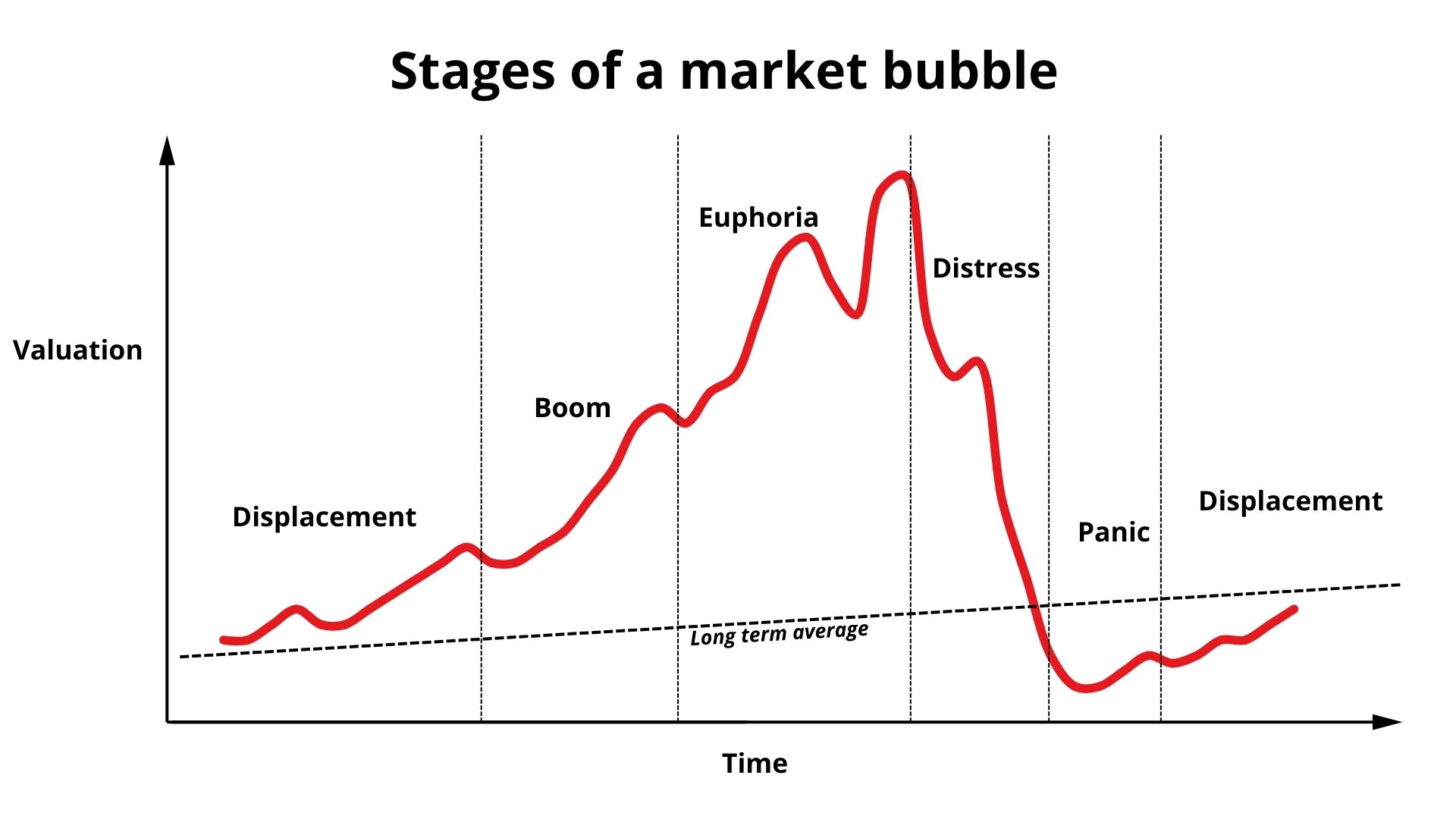
Stages of a market bubble

He argued that financial crises typically progress through phases of displacement, boom, euphoria, and eventually distress and panic. By ignoring history and assuming that novelty exempts them from these fundamental laws, investors risk participating in the formation and painful bursting of the bubble.

Understanding market cyclicity encourages investors to remain vigilant, diversify their holdings, and respect the natural flow of markets even when conditions seem unprecedented.

The Tranquility Paradox and Minsky’s Hypothesis

The tranquility paradox describes a simple but dangerous human habit: when the economy feels stable for long enough, we start believing that this stability will last forever. Rising markets, low volatility, and strong indicators give investors a sense of comfort. They begin to assume that risk has disappeared, that the system is safer than ever, and that the future will look just like the present.

This mindset is exactly what Templeton warned against, and it sits at the center of economist Hyman P. Minsky’s Financial Instability Hypothesis. Minsky’s core idea is counterintuitive: periods of stability create the conditions for instability. In other words, stability is not the end of risk, it’s the beginning of the next one.

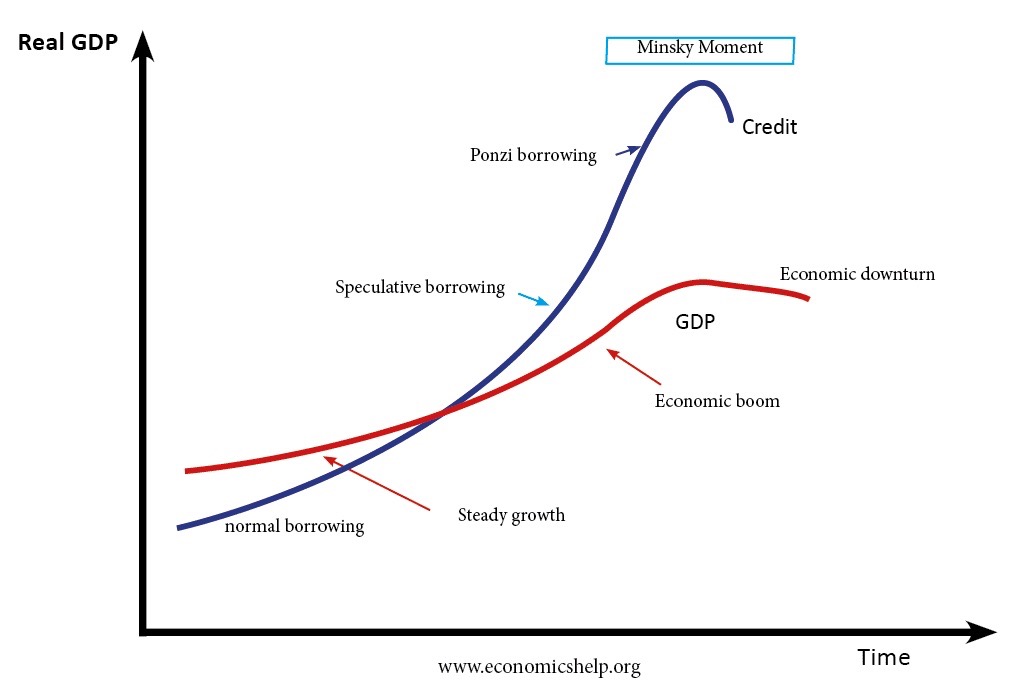
The graph below illustrates this dynamic. When things look calm for long enough, investors slowly shift from safe financing to riskier forms, without even realizing it.

Graph of the Minsky moment

Minsky identified three stages:

  • Hedge financing, the safe zone: Cash flow covers both interest and principal.
  • Speculative financing, the risky zone: Cash flow covers interest only; principal is rolled over.
  • Ponzi financing, the danger zone: Cash flow covers neither interest nor principal. Survival depends on continuous borrowing or rising asset prices.

Over time, more and more activity moves into those speculative and Ponzi stages, pushing the system closer to what Minsky called a Minsky Moment, the sudden realization that debts can’t be serviced, asset values drop, confidence collapses, and panic selling begins.

This is the heart of the paradox: calm markets create overconfidence, overconfidence leads to excessive risk taking, and excessive risk taking triggers the crisis. Understanding this pattern helps investors maintain discipline, stay cautious during good times, and avoid falling for the seductive idea that “this time is different.”

Historical bias in personal finance

Templeton’s warning is not limited to market professionals; personal finance and long term investing are equally susceptible to the belief that history will not repeat itself. This risk is rooted in historical bias, a cognitive shortcut where many individuals assume that high past returns on stock indexes, real estate, or other assets will continue indefinitely, often ignoring the possibility of lower future growth or structural changes in the economy.

This bias, a form of extrapolation bias, can be highly dangerous in retirement planning, risk allocation, and portfolio construction. Relying solely on historical equity returns may lead to severe overestimation of future wealth and underestimation of risks during periods of low growth or inflation.

As articulated by economist Burton Malkiel in A Random Walk Down Wall Street, the historical record provides valuable context, but it must not be treated as a definitive forecast. Malkiel’s work supports the idea that, in an efficient market, all available information is already reflected in current prices, meaning past price movements hold no predictive power for the future.

Therefore, Templeton encourages reflection: a disciplined investor balances cautious optimism about the future with a realistic understanding of historical realities, recognizing that past performance of market indexes does not guarantee future results.

My opinion about this quote

Templeton’s insight is essential for both students and seasoned professionals. It serves as a reminder that neither euphoria nor fear should dictate investment decisions. Markets will always fluctuate, and history often rhymes if it does not repeat exactly.

However, it is also true that sometimes conditions are different, and excessive caution can prevent individuals from capitalizing on genuine opportunities. Innovation, technological change, and macroeconomic shifts can justify deviations from historical trends. The challenge lies in distinguishing between real novelty and wishful thinking.

In personal finance, this principle is particularly relevant. Many investors assume that past returns on broad indexes such as the S&P 500 are a reliable guide for the future. Structural changes, low interest rates, and demographic shifts may produce different outcomes.

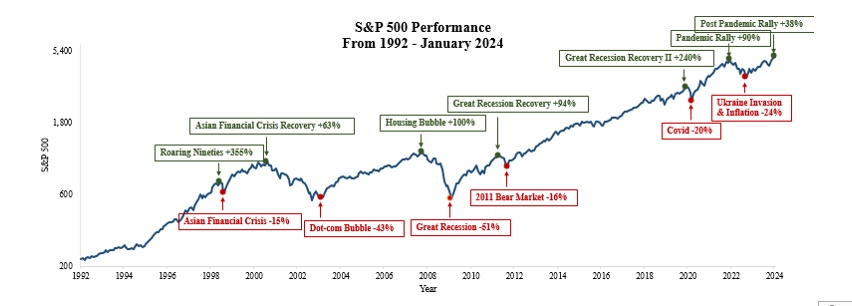
Market performance of the SP500 over 30 years and different crises

Although global stock markets have historically recovered after crises, this cannot be taken as definitive evidence that they will always do so in the future.

Balancing historical awareness with flexibility and critical thinking is the essence of sound investing.

Why should you be interested in this post?

Templeton’s warning is not only a lesson in investing. It is a lesson of humility, discipline, and critical thinking. Believing “this time is different” can blind both students and professionals to risks, patterns, and opportunities. Studying history, understanding cycles, and acknowledging psychological biases improves decision making in finance and beyond.

Whether you are building a portfolio, analyzing market trends, or planning for the future, this insight encourages you to respect the lessons of the past while remaining vigilant and adaptable.

Related posts

Useful resources

Investment Wisdom & Discipline

These resources provide practical advice on long term, non emotional investing and avoiding market fads.

  • Templeton, John. The Templeton Plan.
  • Malkiel, Burton G. A Random Walk Down Wall Street.

History of Financial Crises

These essential books and papers explain why markets crash and the patterns those crises follow.

  • Kindleberger, Charles P. (1978). Manias, Panics, and Crashes: A History of Financial Crises.
  • Minsky, Hyman P. (1992). The Financial Instability Hypothesis, Working Paper No. 74, Jerome Levy Economics Institute.

Market Psychology & Valuation

These sources examine the role of human behavior, psychology, and valuation issues in speculative bubbles.

  • Shiller, Robert. Irrational Exuberance.
  • Blanchard, Olivier J., and Mark W. Watson. (1982). “Bubbles, Rational Expectations and Financial Markets.”
  • Tirole, Jean. (1982). On the Possibility of Speculation under Rational Expectations, Econometrica, 50(5) 1163–1181.

About the Author

This article was written in 2025 by Hadrien Puche (ESSEC, Grande École, Master in Management 2023 / 2027)

My apprenticeship experience as an Executive Assistant in Internal Audit (Inspection Générale) at Bpifrance

Iris ORHAND

In this article, Iris ORHAND (ESSEC Business School, Global Bachelor in Business Administration (GBBA), 2021-2026) shares her professional experience as an Executive Assistant in Internal Audit (Inspection Générale) at Bpifrance (January – December 2025).

About the company

Bpifrance is France’s public investment bank, created in 2012 through the merger of several state-backed institutions, and today it plays a central role in financing and supporting French companies at every stage of their development. With around €60 billion deployed in 2024 and a workforce of roughly 2,300 employees, Bpifrance combines public policy objectives with financial expertise to help businesses innovate, grow, and expand internationally. Its mission goes far beyond lending, as it also provides guarantees, equity investments, innovation funding, export support, and advisory services, making it a one-stop partner for entrepreneurs. Because it operates at the intersection of public funds and financial markets, strong governance and a solid control environment are essential, which is why functions such as Risk, Compliance, Internal Control and Internal Audit play a crucial role in ensuring responsible decision-making, transparency and the long-term protection of public interests.

Logo of Bpifrance
Logo of Bpifrance
Source: the company.

My internship

In 2025, I completed a 12-month apprenticeship as an Executive Assistant in the Internal Audit Department, known at Bpifrance as “Inspection Générale”. This department is responsible for independently assessing the quality of the bank’s processes, controls and risk management, and for providing recommendations to strengthen the organization’s overall governance. My role combined operational coordination, process improvement and analytical support, which gave me practical exposure to how an internal audit function prepares and delivers missions, follows strict methodologies and ensures the consistency and quality of its work. Through this experience, I had the opportunity to see how internal auditors challenge processes, analyze risks, and help the organization operate more securely and efficiently.

My missions

During my apprenticeship, I contributed to the strategic optimization of internal audit processes, participated in internal audit missions, developed indicators and reporting tools, and implemented and executed a new internal audit quality review process, which is now used to assess the work of more than 30 internal auditors at each end-of-mission review period.

Required skills and knowledge

This role required a combination of both hard and soft skills, and I quickly realized how important it was to balance the two. On the technical side, I relied a lot on advanced Excel, basic automation and macro logic, and a structured approach to financial analysis. A solid understanding of accounting fundamentals was essential, as well as developing strong documentation habits to keep our work clear, traceable, and easy for reviewers to follow. But beyond the technical knowledge, soft skills mattered just as much, if not more. Attention to detail was key, as was maintaining a sense of professional skepticism without falling into mistrust. Clear and calm communication helped a lot, especially when dealing with tight deadlines or last-minute requests during busy periods. I also learned how important it is to be pedagogical and professional with clients. Sometimes, audit questions can make clients feel like they are being challenged or judged, even when that’s not the intention. Taking the time to explain why we need certain information, reassuring them, and keeping the conversation constructive made the whole process smoother and helped build trust. Overall, this mix of technical rigor and human sensitivity was at the core of the role.

What I learned

During the year, I contributed to several projects aimed at improving both efficiency and audit quality within the Internal Audit Department. I worked on initiatives that strengthened the organization and standardization of internal audit processes, which helped teams work more consistently across missions. I also took part in internal audit assignments, supporting the different steps of the mission lifecycle and helping prepare and structure the deliverables. Another part of my work involved developing indicators and reporting tools to give management better visibility over activity levels, deadlines and key metrics. Finally, I helped implement and run a new internal audit quality review process, now used by more than thirty internal auditors, which significantly improved consistency, clarity and review readiness across the department.

Financial concepts related to my internship

I present below three financial concepts related to my internship: credit risk and portfolio quality, liquidity risk, and market risk.

Credit risk and portfolio quality

Credit risk refers to the possibility that a borrower may be unable to meet its obligations, which makes it one of the core risks for any bank. In internal audit, the objective is not to take or challenge credit decisions, but to assess whether the credit process itself is robust and well controlled. This involves reviewing how credit approvals are granted, whether delegation levels are respected, and whether all required documentation is complete, coherent and properly justified. Internal Audit also examines how exposures are monitored over time, looking at the quality of follow-up procedures, the detection of early warning indicators and the responsiveness of teams when a situation starts to deteriorate. Together, these elements help determine whether the bank’s credit processes provide a reliable framework for managing risk and maintaining a healthy loan portfolio.

Liquidity risk

Liquidity risk refers to the possibility that a financial institution may not be able to meet its short-term obligations when they fall due. In traditional banks, this risk is often linked to customer deposits, which can fluctuate and create sudden funding pressures. At Bpifrance, liquidity risk exists as well, but in a different form. The organisation does not rely on retail deposits and instead operates with stable funding sources such as the State, the Caisse des Dépôts or long-term market issuances. This structure makes liquidity risk generally less acute than in commercial banks. However, it remains a critical area because Bpifrance must still manage significant cash outflows related to loans, guarantees and investment operations, and must ensure that its funding plans and liquidity buffers remain robust and aligned with its long-term missions.

Market risk

Market risk is the risk of losses arising from changes in market variables such as interest rates, exchange rates or the value of financial assets. In many banks, it is closely linked to trading activities and exposure to volatile financial markets. At Bpifrance, market risk is present but within a much narrower scope. The institution does not operate trading desks and does not take speculative positions. Instead, its exposure comes from treasury management, the valuation of certain financial instruments and, more importantly, the evolution of the value of its equity investments. For this reason, market risk at Bpifrance is less about short-term volatility and more about the prudent management of long-term financial assets and the stability of the institution’s balance sheet over time.

Why should I be interested in this post ?

This role is highly relevant for students interested in risk, governance, internal control, compliance, audit or operational excellence. It provides a concrete view of how financial institutions identify vulnerabilities, strengthen their control environment and improve resilience over time. Working at Bpifrance also adds a meaningful dimension to the experience, because the organisation supports the french economy and operates with a clear public mission. It is also known as a responsible employer with strong working conditions and a culture that values collaboration, learning and employee wellbeing. Altogether, this makes the experience both professionally valuable and personally rewarding.

Related posts on the SimTrade blog

Professional experiences

   ▶ Posts about Professional experiences

   ▶ Alexandre GANNE My apprenticeship as Depositary Control Auditor at CACEIS Bank

   ▶ Mahé FERRET My internship at NAOS – Internal Audit and Control

   ▶ Margaux DEVERGNE My experience as an apprentice student in internal audit at Atos SE, during the split of the company

   ▶ Julien MAUROY My internship experience at Bpifrance – Finance Export Analyst

Financial techniques

   ▶ Federico MARTINETTO Automation in Audit

Useful resources

Bpifrance Official website

About the author

The article was written in December 2025 by Iris ORHAND (ESSEC Business School, Global Bachelor in Business Administration (GBBA), 2021-2026).

   ▶ Read all articles by Iris ORHAND

My internship experience at HKTDC

Langchin SHIU

In this article, SHIU Lang Chin (ESSEC Business School, Global Bachelor in Business Administration (GBBA), 2024-2026) shares her professional experience as a summer intern in the Exhibition and Digital Business Department at the Hong Kong Trade Development Council (HKTDC) in Hong Kong, China.

About the company

The Hong Kong Trade Development Council (HKTDC) is a statutory body established in 1966 to promote, assist and develop Hong Kong’s trade. It serves as the international marketing arm for Hong Kong-based traders, manufacturers and service providers, with a strong focus on supporting small and medium-sized enterprises.

HKTDC operates a global network of around 50 offices, including multiple offices in Mainland China, to position Hong Kong as a two-way global investment and business hub. Through international exhibitions, conferences and business missions, it creates business opportunities for companies by connecting them with partners and buyers worldwide.

Logo of HKTDC.
Logo of HKTDC
Source: the company.

My internship

I joined HKTDC as a summer intern in the Exhibition and Digital Business Department in Hong Kong, which is responsible for organising large-scale trade fairs and public exhibitions. During my internship at the Hong Kong Trade Development Council (HKTDC), I joined the Exhibition and Digital Business Department, which is responsible for organising large-scale trade fairs and public exhibitions connecting global enterprises and Hong Kong’s business community. The HKTDC is a statutory body that promotes Hong Kong as an international business hub, with over 30,000 exhibitors and 400,000 trade buyers participating in its annual exhibitions.

The department I served in manages both B2B and B2C events, such as the Hong Kong Book Fair, Sports and Leisure Expo, and World of Snacks, which together attracted over 1 million visitors in 2024. These fairs not only generate significant foot traffic and publicity but also foster cross-sector collaboration and cultural exchange. For instance, the Hong Kong Book Fair alone featured more than 760 exhibitors from 30 countries and regions, drawing over 990,000 visitors across seven days at the Hong Kong Convention and Exhibition Centre (HKCEC), with estimated sales revenue exceeding HK$50 million in direct transactions and book sales.

My missions

My main missions were to assist in organising three of HKTDC’s public exhibitions — the Hong Kong Book Fair, World of Snacks, and the Hong Kong Sports & Leisure Expo. I supported the planning, coordination, and on-site execution of these events, including exhibitor liaison, logistics management, and handling visitor enquiries. My responsibilities also involved preparing fair materials, checking booth setups, coordinating with contractors and internal teams, and ensuring each exhibition zone operated smoothly throughout the event period.

In addition to operational tasks, I assisted in marketing and promotional efforts, such as preparing sponsorship materials for the Book Fair Lucky Draw and helping the marketing team create social media posts and reels to attract younger visitors. I also served as an emcee for public seminars and workshops, enhancing event engagement and communication between speakers and the audience. Through these assignments, I gained valuable exposure to event management processes, from preparation to live execution, and developed a deeper understanding of how the HKTDC integrates marketing, logistics, and stakeholder relations to deliver large-scale exhibitions.

Working at an exhibition

Required skills and knowledge

This internship required a combination of soft and hard skills. On the soft-skills side, communication, teamwork, adaptability, and customer orientation were essential, as I interacted with colleagues from different units, exhibitors from diverse backgrounds, and a high volume of visitors within tight time constraints. On the hard skills side, I benefited from having a basic knowledge of marketing and event management, as well as an understanding of how trade fairs support business development and branding.

What I learned

During the internship, I learned how large exhibitions are structured from planning stages to on-site execution and post-event follow-up. I also gained confidence in handling operational issues under pressure, prioritising tasks and communicating clearly with stakeholders who have different expectations and constraints. Ultimately, the experience deepened my interest in marketing, events, and digital business by demonstrating how well-designed exhibitions can create value for both companies and the general public.

Business and economic concepts related to my internship

I present below three business and economic concepts related to my internship: market matching and platforms, experiential marketing, and capacity/operations management. Each helps to understand how HKTDC create value for participants and how my daily tasks are connected to broader economic mechanisms.

Market matching and platforms

HKTDC is a platform that facilitates matching between buyers and sellers, particularly for SMEs looking to reach new markets. Trade fairs reduce search and transaction costs by concentrating information, products and potential partners in one place. In my missions, supporting exhibitor coordination and visitor flow contributed to making this matching process smoother and more efficient.

Experiential marketing

The Hong Kong Book Fair, World of Snacks and the Hong Kong Sports & Leisure Expo are strong examples of experiential marketing in practice. These fairs are not only about selling products; they create immersive experiences through themed zones, demonstrations, workshops and special programmes that engage visitors emotionally and physically. By helping with on-site operations and visitor interactions, I saw how layout, signage, activities and staff behaviour influence the customer journey and can strengthen brand perception and purchase intention.

Capacity and operations management

Large exhibitions require careful capacity and operations management to handle fluctuating visitor numbers while maintaining safety and service quality. Concepts such as peak-load management, queuing, crowd control, and resource allocation are evident in the way entrances, halls, and activity zones are organised. My tasks related to monitoring visitor traffic, guiding flows and coordinating with different teams were directly linked to these operational decisions, which ultimately affect exhibitors’ satisfaction and the overall performance of the event.

Why should I be interested in this post?

For a business student interested in careers related to marketing, events, consulting or trade promotion, an internship at an organisation like HKTDC offers a unique combination of public and private sector exposure. You can observe how strategic objectives are translated into concrete event formats and marketing actions, while developing practical skills in project management, communication, and data-driven decision-making. This type of experience can be a strong asset when applying for roles in event management, business development, corporate marketing or international trade-related positions.

Related posts on the SimTrade blog

   ▶ All posts about Professional experiences

   ▶ William LONGIN My experience as a leisure tourism management assistant in the French Tourism Development Agency

Useful resources

Hong Kong Trade Development Council

HKTDC Hong Kong Book Fair

HKTDC World of Snacks

HKTDC Hong Kong Sports & Leisure Expo

About the author

The article was written in December 2025 by SHIU Lang Chin (ESSEC Business School, Global Bachelor in Business Administration (GBBA), 2024-2026).

   ▶ Read all articles by SHIU Lang Chin.

My Internship as a Junior Consultant in Marketing & Finance Studies at Eres Gestion

Emmanuel CYROT

In this article, Emmanuel CYROT (ESSEC Business School, Global Bachelor in Business Administration (GBBA), 2021-2026) shares his professional experience as Junior Consultant in Marketing & Finance Studies at Eres Gestion.

About the company

Eres Gestion is a leading independent player in the French employee savings (épargne salariale) and retirement savings (épargne retraite) markets. The company is part of the Eres Group, which offers a unique open-architecture approach, allowing them to select and combine the best investment funds from various management companies. With over €7 billion in assets under management (as of 12/31/2024), Eres is known for its expertise in designing and implementing profit-sharing schemes, employee share ownership plans, and individual retirement solutions (Plan Epargne Retraite or PER). Eres Gestion places a strong emphasis on socially responsible investing (SRI) and solidarity funds.

Logo of Eres Gestion
Source: the company.

My internship

I worked as a Junior Consultant in charge of Marketing & Finance Studies at Eres Gestion from September 2024 to February 2025 in Paris. I was within the company’s dual-focused research team, bridging the gap between deep financial analysis and market strategy. My role involved quantitative modeling, competitive benchmarking, and the creation of strategic content aimed at supporting sales and marketing efforts. I was reporting to Mirela Stoeva, Head of Studies and Offer at Eres Gestion.

My missions

My primary technical mission involved comprehensive Regulatory Intelligence and Data Analysis, specifically leading the update of the L’Observatoire Européen des Retraites study. This required consolidating data to quantify the evolution of retirement savings assets focusing on the post-Loi Pacte growth of the PER (Plan d’Épargne Retraite). I also conducted crucial Competitive Benchmarking by analyzing various third-party funds based on their retrocession rates to optimize Eres’s offerings. Finally, I supported the firm’s thought leadership on Employee Share Ownership (SBF 120 companies) by drafting expert articles and maintaining all key analytical supports, including the Le panorama de l’actionnariat salarié. I was tasked by the Marketing Director to conduct an internal study on the Retail’s Structured Product Environment in France.

Required skills and knowledge

My experience as a Junior Consultant in Marketing & Finance Studies at Eres Gestion was characterized by a high degree of autonomy and a constant curiosity, which were essential for navigating the complex sector of employee savings (épargne salariale) and employee share ownership. The role required me to conduct in-depth studies on the Pacte Law (Loi Pacte), fund performance analysis, and the valuation of unlisted companies. The intensive work on Excel to model these assets and flows cultivated methodical rigor and discipline, enabling me to become perfectly fluid with numbers and ensure the accuracy of strategic deliverables for the teams.

What I learned

This experience provided me with a comprehensive understanding of the French employee savings and retirement ecosystem, particularly the strategic implications of the Loi Pacte and the development of value-sharing initiatives. I significantly enhanced my skills in quantitative market analysis, competitive benchmarking, and translating complex financial information into accessible, strategic content for both internal and external stakeholders. Working closely with both the finance and marketing teams offered invaluable insight into the product life cycle, from regulatory impact assessment to market positioning.

Business and financial concepts related to my internship

I present below three business and financial concepts related to my internship: The French Retirement Savings Reform (Loi Pacte), Employee Share Ownership Plans (ESOPs), and Structured Products.

The French Retirement Savings Reform (Loi Pacte)

The 2019 Pacte Law (Plan d’Action pour la Croissance et la Transformation des Entreprises) is a major French reform aimed at simplifying the country’s complex retirement savings landscape. Its main component is the creation of the Retirement Savings Plan (Plan d’Épargne Retraite or PER), a unified and portable product replacing previous schemes. The law aimed to channel more of the French population’s savings into long-term investments, including unlisted assets like private equity, to support corporate financing and economic growth.

Employee Share Ownership Plans (ESOPs)

Employee Share Ownership Plans (ESOPs) are incentive programs that allow employees to acquire shares in their company. In France, this is a key component of the employee savings system (épargne salariale). The benefits include aligning the interests of employees and shareholders, increasing organizational commitment, and strengthening the company’s capital structure. Recent French legislation also focuses on developing and simplifying various value-sharing and profit-sharing schemes.

Structured Products

Structured products are complex financial instruments whose performance is linked to an underlying asset, index, or basket of assets. They are typically issued by banks and are essentially a combination of a “riskless” bond (to provide capital protection) and one or more derivative instruments (like options) (to provide market exposure and enhance return). They are customized to offer a specific risk/return profile, but their complexity necessitates thorough internal analysis, which was a core part of my mission.

Why should I be interested in this post?

The experience provides unique Business Intelligence training: you won’t just be supporting one study but rather working on at least two of the four major annual publications, such as the L’observatoire Européen des Retraites or the Le panorama de l’actionnariat salarié. This direct involvement gives you a unique, 360-degree insight into the strategic data, market trends, and competitive landscape of French employee savings and share ownership that few junior roles offer. Furthermore, the requirement for high autonomy and rigorous Excel work on fund benchmarking and asset modeling forces the development of methodical discipline and fluency with numbers necessary for demanding quantitative roles after graduation.

Related posts on the SimTrade blog

Professional experiences

   ▶ All posts about Professional experiences

   ▶ Alexandre VERLET Classic brain teasers from real-life interviews

Financial techniques

   ▶ David-Alexandre BLUM The selling process of funds

   ▶ Shruti CHAND Pension Funds

   ▶ Mahé FERRET Selling Structured Products in France

Useful resources

Blog Eres Gestion

H24 Finance

About the author

The article was written in December 2025 by Emmanuel CYROT (ESSEC Business School, Global Bachelor in Business Administration (GBBA), 2021-2026).

   ▶ Read all articles by Emmanuel CYROT.

My Internship as a Product Development Specialist at Amundi ARA

Emmanuel CYROT

In this article, Emmanuel CYROT (ESSEC Business School, Global Bachelor in Business Administration (GBBA), 2021-2026) shares his professional experience as a Product Development Specialist within the marketing team at Amundi ARA under the Senior Product Development Specialist and the Director of Marketing and Communication.

About the company

Amundi Alternative & Real Assets (ARA) is a specialized business line within the Amundi Group dedicated to private market investment solutions, managing approximately €66.1 billion in assets as of late 2025. Formally established in 2016 to consolidate the group’s capabilities, ARA employs a team of roughly 330 professionals operating across eight European investment hubs (including Paris, London, Milan, and Zurich). The division provides institutional and retail investors with access to the real economy through a diverse range of products, including real estate (its largest segment), private debt, private equity, and infrastructure, as well as fund of funds strategies and Hedge Funds UCITS (Undertakings for Collective Investment in Transferable Securities) which are a liquid versions of hedge fund strategies to a broad base of retail investors in Europe.

Logo of Amundi Investment Solutions.
Logo of Amundi Investment Solutions
Source: the company.

The Marketing team at Amundi ARA, comprising approximately 15 members (including a robust cohort of interns and apprentices), acts as a specialized bridge connecting Clients with the Sales team. Their primary mandate is to translate complex private market strategies into commercially viable investment solutions tailored for both institutional and retail investors. The team utilizes a highly structured support model where every specific area of expertise is represented by a dedicated “Investment Specialist,” each of whom is directly supported by an assigned intern.

My internship

The internship lasted 6 months between March and August 2025 and was reporting directly mostly reporting to the Senior Product Development Specialist in the team and monitoring new fund launches across to all teams within ARA: Sales, structuring, Investments Teams, Business Development, etc.

My missions

My primary mission was to participate in the conception, structuring, and launch of two new funds within the ARA range. To support this, I conducted detailed market analyses and competitive studies, specifically benchmarking French and Luxembourgish evergreen funds using professional terminals like Preqin, Pitchbook, and Bloomberg, which provided access to crucial data on performance, management fees, Assets under management, redemption gates, lock-up periods, etc.

I was also responsible for the collection, analysis, and dissemination of sectoral Business Intelligence data. I produced reports designed for the Sales, Marketing, Management teams to aid in decision-making for meetings internally and externally.

Another major part of my mission was the creation and updating of marketing materials, including pitchbooks, brochures, and product sheets. This ensured that the sales teams had accurate and compelling documentation to promote the funds to investors.

Required skills and knowledge

This role required strong communication and organizational skills to coordinate effectively across diverse teams and manage product launch deadlines. Intellectual curiosity and discipline were essential for synthesizing complex market studies without external AI assistance, alongside the ability to filter relevant business intelligence from general noise. Finally, technical proficiency in Excel and data providers (Bloomberg, Preqin, Pitchbook) was critical, coupled with a rapid understanding of the specificities of Private Assets vehicles.

What I learned

Through the benchmarking and product launch support, I gained a systematic understanding of how private asset funds are structured and positioned in a competitive market. I developed the ability to assess market needs and translate them into product features.

My contribution helped streamline the flow of Business Intelligence between the structuring and sales teams. I also deepened my understanding of the regulatory and commercial requirements for launching funds in the European market. Overall, this internship strengthened my skills in market analysis, product marketing, and strategic communication.

Financial concepts related to my internship

I present below three financial concepts related to my internship: Evergreen funds, UCITS hedge funds, and Private Equity funds.

Evergreen Funds

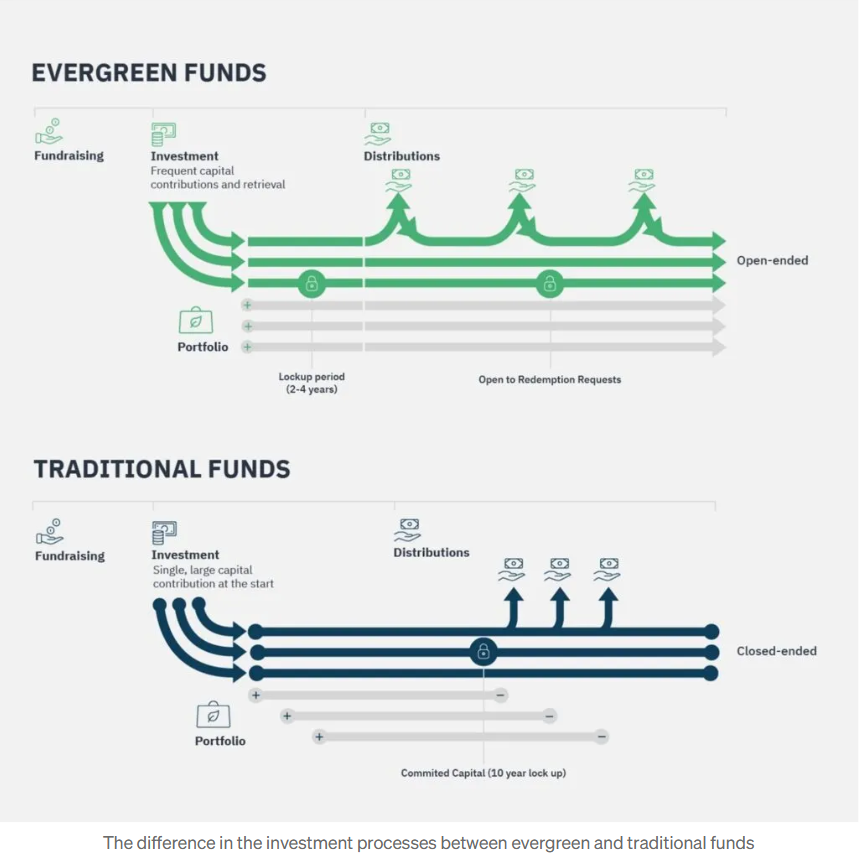
Unlike traditional closed-ended Private Equity or Private Debt funds with finite terms and J-curve effects, evergreen funds function as semi-liquid open-ended vehicles allowing for continuous capital recycling. My work focused on benchmarking the liquidity management mechanisms of French and Luxembourgish vehicles such as ELTIF 2.0, which is the European Long-Term Investment Fund regulation designed to increase retail and institutional investor participation in long-term, illiquid assets. I analyzed key technical features including NAV (Net asset Value) calculation frequency, the calibration of redemption gates, notice periods, and the implementation of liquidity sleeves to mitigate the asset-liability mismatch inherent in offering liquidity on illiquid underlying assets.

UCITS Hedge Funds

Alternative UCITS (often referred to as “Liquid Alts”) democratize access to hedge fund strategies (e.g., Long/Short Equity, Global Macro) by wrapping them in a regulated UCITS framework. My benchmarking work involved analyzing how these funds offer weekly or daily liquidity and high transparency to investors, unlike their offshore Cayman or BVI counterparts which often impose lock-up periods and gates.

Private Equity Funds

A central part of this role involved the strategic overhaul and tailoring of investor pitchbooks and marketing materials. This required translating complex fund structures and performance data into clear, compelling narratives for both institutional and retail investors. In that context, I learned the key concepts of Private Equity Funds alongside helpful formations that were provided by Amundi. This allowed me to familiarize well with metrics used to analyze PE funds (DPI, TVPI, J-Curve…) and different strategies (Mid-market, Impact).

Why should I be interested in this post?

This post is for you if you want to be at the forefront of asset management, specializing in the growing world of Private Markets (Private Equity, Infrastructure, Impact). It’s an excellent chance to learn deeply about product structuring and the commercial lifecycle of funds, all within a honestly great, supportive environment that ensures you gain hands-on experience and valuable strategic insight.

Related posts on the SimTrade blog

   ▶ All posts about Professional experiences

   ▶ Alexandre VERLET Classic brain teasers from real-life interviews

   ▶ Lilian BALLOIS Discovering Private Equity: Behind the Scenes of Fund Strategies

   ▶ Matisse FOY Key participants in the Private Equity ecosystem

Useful resources

Opalesque Alternative Market Briefing

Citywire

France Invest

About the author

The article was written in December 2025 by Emmanuel CYROT (ESSEC Business School, Global Bachelor in Business Administration (GBBA), 2021-2026).

   ▶ Read all articles by Emmanuel CYROT.

Interest Rates and M&A: How Market Dynamics Shift When Rates Rise or Fall

 Emanuele BAROLI

In this article, Emanuele BAROLI (MiF 2025–2027, ESSEC Business School) examines how shifts in interest rates shape the M&A market, outlining how deal structures differ when central banks raise versus cut rates.

Context and objective

The purpose is to explain what interest rates are, how they interact with inflation and liquidity, and how these variables shape merger and acquisition (M&A) activity. The intended outcome is an operational lens you can use to read the current monetary cycle and translate it into cost of capital, valuation, financing structure, and execution windows for deals, distinguishing—when useful—between corporate acquirers and private-equity sponsors.

What are interest rates

Interest rates are the intertemporal price of funds. In economic terms they remunerate the deferral of consumption, insure against expected inflation, and compensate for risk. For real decisions the relevant object is the real rate because it governs the trade-off between investing or consuming today versus tomorrow.

Central banks anchor the very short end through the policy rate and the management of system liquidity (reserve remuneration, market operations, balance-sheet policies). Markets then map those signals into the entire yield curve via expectations about future policy settings and required term premia. When liquidity is ample and cheap, risk-free yields and credit spreads tend to compress; when liquidity becomes scarcer or dearer, yields and spreads widen even without a headline change in the policy rate. This transmission, with its usual lags, is the bridge from monetary conditions to firms’ investment choices.

M&A industry — a definition

The M&A industry comprises mergers and acquisitions undertaken by strategic (corporate) acquirers and by financial sponsors. Activity is the joint outcome of several blocks: the cost and elasticity of capital (both debt and equity), expectations about sectoral cash flows, absolute and relative valuations for public and private assets, regulatory and antitrust constraints, and the degree of managerial confidence. Interest rates sit at the center because they enter the denominator of valuation models—through the discount rate—and they shape bankability constraints through the debt service burden. In other words, rates influence both the price a buyer can rationally pay and the feasibility of financing that price.

Use of leverage

Leverage translates a given cash-flow profile into equity returns. In leveraged acquisitions—especially LBOs—the all-in cost of debt is set by a market benchmark (in practice, Term SOFR at three or six months in the U.S., and Euribor in the euro area) plus a spread reflecting credit risk, liquidity, seniority, and the supply–demand balance across channels such as term loans, high-yield bonds, and private credit. That all-in cost determines sustainable leverage, shapes covenant design, and fixes the headroom on metrics like interest coverage and net leverage. It ultimately caps the bid a sponsor can submit while still meeting target returns. Corporate acquirers usually employ more modest leverage, yet remain rate-sensitive because medium-to-long risk-free yields and investment-grade spreads feed both fixed-rate borrowing costs and the WACC used in DCF and accretion tests, and they influence the value of stock consideration in mixed or stock-for-stock deals.

How interest rates impact the M&A industry

The connection from rates to M&A operates through three main channels. The first is valuation: holding cash flows constant, a higher risk-free rate or higher term premia lifts discount rates, lowers present values, and compresses multiples, thereby narrowing the economic room to pay a control premium. The second is bankability: higher benchmarks and wider spreads raise coupons and interest expense, reduce sustainable leverage, and shrink the set of financeable deals—most visibly for sponsors whose equity returns depend on the spread between debt cost and EBITDA growth. The third is market access: heightened rate volatility and tighter liquidity reduce underwriting depth and risk appetite in loans and bonds, delaying signings or closings; the mirror image under easing—lower rates, stable curves, and tighter spreads—reopens windows, enabling new-money term funding and refinancing of maturities. The net effect is a function of level, slope, and volatility of the curve: lower and calmer curves with steady spreads tend to support volumes; high or unstable curves, even with unchanged spreads, enforce selectivity.

Evidence from 2021–2024 and what the chart shows

M&A deals and interest rates (2021-2024).
M&A deals and interest rates (2021-2024)
Source: Fed.

The global pattern over 2021–2024 is consistent with this mechanism. In 2021, deal counts reached a cyclical peak in an environment of near-zero short-term rates, abundant liquidity, and elevated equity valuations; frictions on the cost of capital were minimal and access to debt markets was easy, so the economic threshold for completing transactions was lower. Between 2022 and 2024, monetary tightening lifted short-term benchmarks rapidly while spreads and uncertainty rose; global deal counts fell materially and the market became more selective, favoring higher-quality assets, resilient sectors, and transactions with stronger industrial logic. Over this period, global deal counts were 58,308 in 2021, 50,763 in 2022, 39,603 in 2023, and 36,067 in 2024, while U.S. short-term rates moved from roughly 0.14% to above 5%; the chart shows an inverse co-movement between the cost of money and activity. Correlation is not causation—antitrust enforcement, energy shocks, equity multiple swings, and the rise of private credit also mattered—but the macro signal aligns with monetary transmission.

What does academic research say

Academic research broadly confirms the mechanism sketched above: when policy rates rise and financing conditions tighten, both the volume and composition of M&A activity change. Using U.S. data, Adra, Barbopoulos, and Saunders (2020) show that increases in the federal funds rate raise expected financing costs, are followed by more negative acquirer announcement returns, and significantly increase the probability that deals are withdrawn, especially when monetary policy uncertainty is high. Fischer and Horn (2023) and Horn (2021) exploit high-frequency monetary-policy shocks and find that a contractionary shock leads to a persistent fall in aggregate deal numbers and values—on the order of 20–30%—with the effect concentrated among financially constrained bidders; at the same time, the average quality of completed deals improves because weaker acquirers are screened out. Work on leveraged buyouts links this to credit conditions: Axelson et al. (2013) document that cheap and abundant credit is associated with higher leverage and higher buyout prices relative to comparable public firms, while theoretical models such as Nicodano (2023) show how optimal LBO leverage and default risk respond systematically to the level of risk-free rates and credit spreads.

Related posts on the SimTrade blog

   ▶ Bijal GANDHI Interest Rates

   ▶ Nithisha CHALLA Relation between gold price and interest rate

   ▶ Roberto RESTELLI My internship at Valori Asset Management

Useful resources

Academic articles

Adra, S., Barbopoulos, L., & Saunders, A. (2020). The impact of monetary policy on M&A outcomes. Journal of Corporate Finance, 62, 1-61.

Fischer, J. and Horn, C.-W. (2023), Monetary Policy and Mergers and Acquisitions, Working paper Available at SSRN

Horn, C.-W. (2021) Does Monetary Policy Affect Mergers and Acquisitions? Working paper.

Axelson, U., Jenkinson, T., Strömberg, P., & Weisbach, M. S. (2013) Borrow Cheap, Buy High? The Determinants of Leverage and Pricing in Buyouts, The Journal of Finance, 68(6), 2223-2267.

Financial data

Federal Reserve Bank of New York Effective Federal Funds Rate (EFFR): methodology and data

Federal Reserve Bank of St. Louis Effective Federal Funds Rate (FEDFUNDS)

OECD Data Long-term interest rates

About the author

The article was written in November 2025 by Emanuele BAROLI (ESSEC Business School, Master in Finance (MiF), 2025–2027).

   ▶ Read all articles by Emanuele BAROLI.

Drafting an Effective Sell-Side Information Memorandum: Insights from a Sell-Side Investment Banking Experience

 Emanuele BAROLI

In this article, Emanuele BAROLI (ESSEC Business School, Master in Finance (MiF), 2025–2027) explains how to draft an M&A Information Memorandum, translating sell-side investment-banking practice into a clear, evidence-based guide that buyers can use to progress from interest to a defensible bid.

What is an Info Memo

An information memorandum is a confidential, evidence-based sales document used in M&A processes to enable credible offers while safeguarding the sell-side process. It sets out what is being sold, why it is attractive, and how the deal is framed, and it is structured—consistently and without redundancy—around the following chapters: Executive Summary, Key Investment Highlights, Market Overview, Business Overview, Historical Financial Performance and Current-Year Budget, Business Plan, and Appendix. Each section builds on the previous one so that every claim in the narrative is traceable to data, definitions, and documents referenced in the appendix and the data room.

Executive summary

The executive summary is the gateway to the memorandum and must allow a prospective acquirer to grasp, within a few pages, what is being sold, why the asset is attractive, and how the transaction is framed. It should state the perimeter of the deal, the nature of the stake or assets included, and the essence of the equity story in language that is direct, verifiable, and consistent with the evidence presented later. The narrative should situate the company in its market, outline the recent trajectory of scale, profitability, and cash generation, and articulate—in plain terms—the reasons an informed buyer might assign strategic or financial value. Nothing here should rely on empty superlatives; every claim in the summary must be traceable to supporting material in subsequent sections and to documents made available in the data room. Clarity and internal consistency matter more than flourish: the reader should finish this section knowing what the asset is, why it matters, and what next steps the process anticipates.

Key investment highlights

This section filters the equity story into a small number of decisive arguments, each of which combines a clear assertion, hard evidence, and an explicit investor implication. The prose should explain, not advertise sustainable growth drivers, defensible competitive positioning, quality and predictability of revenue, conversion of earnings into cash, discipline in capital allocation, credible management execution, and identifiable avenues for organic expansion or bolt-on M&A. Each highlight should read as a self-contained reasoning chain—statement, proof, consequence—so that a buyer can connect operational facts to valuation logic.

Market overview

The market overview demonstrates that the asset operates within an addressable space that is sizeable, healthy, and legible. Begin by defining the market perimeter with precision so that later revenue segmentations align with it. Describe the current size and structure of demand, the expected growth over a three-to-five-year horizon, and the drivers that sustain or threaten that growth—technological shifts, regulatory trends, customer procurement cycles, and macro sensitivities. Map the competitive landscape in terms of concentration, barriers to entry, switching costs, and price dynamics across channels. Distinguish between the immediate market in which the company competes and the broader industry environment at national or international level, explaining how each influences pricing power, customer acquisition, and margin stability. All figures and characterizations should be sourced to independent references, allowing the reader to verify both methodology and magnitude.

Business overview

The business overview explains plainly how the company creates value. It should describe what is sold, to whom, and through which operating model, covering products and services, relevant intellectual property or certifications, customer segments and geographies served, and the logic of revenue generation and pricing. The text should make the differentiation intelligible—quality, reliability, speed, functionality, service levels, or total cost of ownership—and then connect that differentiation to commercial traction. Operations deserve a concise, concrete treatment: footprint, capacity and utilization, supply-chain architecture, service levels, and, where material, the technology stack and data security posture. The section should close with the people who actually run the company and are expected to remain post-closing, outlining roles, governance, and incentive alignment. The aim is not to impress with jargon but to let an investor see a coherent engine that turns inputs into outcomes.

Historical financial performance and budget

This chapter turns performance into an intelligible narrative. Present the historical income statement, balance sheet, and cash flow over a three-to-five-year window—preferably audited—and reconcile management accounts with statutory figures so that definitions, policies, and adjustments are transparent. Replace tables-for-tables’ sake with analysis: show where growth and margins come from by decomposing revenue into volume, price, and mix; explain EBITDA dynamics through efficiency, pricing, and non-recurring items; separate maintenance from growth capex; and trace how earnings convert into cash by discussing working-capital movements and seasonality. In a live process, the current-year budget should set out the explicit operating assumptions behind it, the key milestones and risks, and a brief intra-year read so a buyer can compare budget to year-to-date performance. If carve-outs, acquisitions, or other discontinuities exist, present clean pro forma views so the time series remains comparable.

Business plan

The business plan translates the equity story into forward-looking numbers and commitments that can withstand diligence. Build the plan from drivers rather than percentages: revenue as a function of volumes, pricing, mix, and retention; costs split between fixed and variable components with operational leverage and efficiency initiatives laid out; capital needs expressed through capex, working-capital discipline, and any anticipated financing structure. Provide a three-to-five-year view of P&L, cash flow, and balance-sheet implications, making explicit the capacity constraints, hiring requirements, and lead times that link initiatives to outcomes. A sound plan includes a base case and either sensitivities or alternative scenarios, together with risk mitigations that are actually within management control. If bolt-on M&A features in the strategy, describe the screening criteria, integration capability, and the nature of the synergies in a way that distinguishes aspiration from execution.

Appendix

The appendix holds detail without overloading the core narrative and preserves auditability. It should contain the full legal disclaimer and confidentiality terms, a glossary of definitions and KPIs to eliminate ambiguity, detailed financial schedules and reconciliation notes, methodological summaries and citations for market data, concise contractual information for key customers and suppliers where material, operational and ESG indicators that genuinely affect value, and a process note with timeline, bid instructions, Q&A protocols, and site-visit guidance. The organizing principle is traceability: any figure or claim in the memorandum should be traceable to a line item or document referenced here and made available in the data room.

Why should you be interested in this post?

For students interested in corporate finance and M&A, this post shows how to translate sell-side practice into a rigorous structure that investors can actually diligence—an essential skill for internships and analyst roles.

Related posts on the SimTrade blog

   ▶ Roberto RESTELLI BCapital Fund at Bocconi: building a student-run investment fund

   ▶ Louis DETALLE A quick presentation of the M&A field…

   ▶ Ian DI MUZIO My Internship Experience at ISTA Italia as an In-House M&A Intern

Useful resources

Corporate Finance Institute – (CFI) Confidential Information Memorandum (CIM)

DealRoom How to Write an M&A Information Memorandum

About the author

The article was written in December 2025 by Emanuele BAROLI (ESSEC Business School, Master in Finance (MiF), 2025–2027).

   ▶ Read all articles by Emanuele BAROLI.

“It’s not whether you’re right or wrong that’s important, but how much money you make when you’re right and how much you lose when you’re wrong.” – George Soros

Hadrien Puche

In financial markets, everyone wants to be right. The temptation to make accurate predictions, about earnings, interest rates, recessions, or stock prices, is universal. But as George Soros reminds us, accuracy alone is meaningless. What truly matters is how much you profit when you’re right, and how much you lose when you’re wrong.

This quote challenges one of the deepest misconceptions in trading: the belief that success depends on predicting the future. In reality, trading success mostly depends on risk management, position sizing, and the discipline to adjust when the market proves you wrong.

About George Soros

George Soros
Warren Buffett

Source: EU

George Soros (born in 1930) is a Hungarian-American investor and philanthropist. He founded Soros Fund Management, a global macro hedge fund known for making large, directional bets across currencies, bonds, equities, and commodities.

Soros became globally famous in 1992 when he “broke the Bank of England” by shorting the British pound, a trade widely reported to have earned over $1 billion.

The European Exchange Rate Mechanism (ERM) was created to stabilize European currencies ahead of the future monetary union by keeping exchange rates within narrow fluctuation bands. When the UK joined, it agreed to maintain the pound within this band, but entered at a rate that many considered overvalued.

Seeing this imbalance, George Soros spent months building a large short position against the pound. On “Black Wednesday” in 1992, the British government failed to defend the currency through interest-rate hikes and interventions, forcing a devaluation. Soros reportedly earned over $1 billion and became known as “the man who broke the Bank of England.”

Not all of Soros’s trades were successful. In 2016, he reportedly lost close to $1 billion after wrongly predicting that markets would fall following Donald Trump’s election.

Beyond trading, Soros developed the theory of reflexivity, which argues that markets are shaped by feedback loops between perceptions and fundamentals. His philosophy emphasizes uncertainty, adaptability, and the psychological drivers behind market behavior.

The context behind this Quote

This quote is not actually from Soros. It comes from Stanley Druckenmiller—Soros’s former chief strategist—in The New Market Wizards (1994). Druckenmiller explains that the most important lesson he learned from Soros was not the importance of being right, but of structuring trades so that being right pays off and being wrong costs little.

Book cover of the new market wizards

The quote therefore reflects Soros’s investment philosophy: markets cannot be predicted with certainty, so success depends more on managing risk than on forecasting.

This mindset is foundational to modern risk management and a key reason Soros is considered one of the most influential investors of the past century.

Analysis of the Quote

The quote captures three essential ideas:

  • asymmetric returns
  • risk management
  • intelligent position sizing

Being right doesn’t matter unless it pays. For example, even if you forecast Nvidia’s earnings perfectly, you may still fail to profit because:

  1. You may not have any position.
  2. Your position may be too small.
  3. The market may behave irrationally.
  4. Losses on other trades may outweigh this one win.

This is the essence of risk management: structuring positions so that winners meaningfully contribute to performance while losers remain contained.

Let’s introduce three key financial ideas that relate to this quote.

1. Diversification and Position Timing

Even if your analysis is correct, the market might not react as expected, or not at the right time. This is where the distinction between trading and investing matters.

Soros’s quote speaks the language of trading: position sizing, timing, and controlling downside on each bet.

Investing, by contrast, relies less on precise timing and more on diversification, which reduces exposure to unpredictable events and smooths returns across different regimes.

Mathematically, diversification lowers portfolio variance because asset returns are imperfectly correlated. Even when individual positions behave unpredictably, a well-constructed portfolio can achieve far better risk-adjusted results than any single trade. In that sense, diversification plays a similar role for investors as stop-losses and disciplined position sizing do for traders: it manages the impact of being wrong.

The following graph illustrates how adding more independent positions reduces overall portfolio risk.

A graph representing the overall risk of a portfolio as a function of the number of positions

2. Avoid cutting winners to reinforce losers

This behavioral trap affects most investors. Soros’s approach is the opposite:

  • cut losing positions quickly
  • let winners run

Yet, due to loss aversion (as formalized by Kahneman & Tversky (1979) in Prospect Theory), investors often do the reverse:

  • sell winners too early
  • hold losers too long

This pattern is well-documented in the literature. Shefrin & Statman (1985) termed it the disposition effect: the systematic tendency to “sell winners too early and ride losers too long.” The emotional discomfort of realizing a loss often outweighs the rational need to exit a bad position.

Momentum works partly for this reason. Rising prices attract reluctant investors who delayed selling their winners, amplifying trends; meanwhile, stubbornly held losers can drift downward for longer than fundamentals alone would justify.

3. Quantitative trading: the power of averaging out

Quantitative trading is built on making many small, systematic bets with a positive expected value. The goal is not to win every trade, but to win more (or bigger) on average.

This is the practical application of the idea that:

  • being right occasionally with large wins
    is more valuable than
  • being right frequently with small gains.

This also echoes Jesse Livermore’s famous line: “The market is never wrong, only opinions are.” (link)

My view on this quote

One limitation of Soros’s statement is that it implicitly assumes the reader is an active trader. In reality, today’s markets are dominated by algorithms, quantitative models, and high-frequency strategies, an environment in which most individuals are unlikely to outperform professional traders. For traders, Soros’s point is straightforward: you will often be wrong, so what matters is how you size positions and manage risk when you are.

At a literal level, the quote may also seem paradoxical: you cannot know in advance which trades will be winners or losers. But the message isn’t about prediction, it’s about discipline.

This distinction becomes especially clear when you contrast trading with investing.

  • Traders live in a world of short-term uncertainty and constant position adjustments, where the asymmetry between gains and losses determines survival.
  • Investors, on the other hand, think in years, not minutes. They rely less on timing and more on letting fundamentals and compounding work over time. For them, the “how much you lose when you’re wrong” part translates into diversification, staying invested, and avoiding irreversible mistakes rather than optimizing each individual decision.

Seen this way, Soros’s line applies to both groups, just at different scales: traders manage outcomes trade by trade; investors manage them across decades. Either way, the principle holds: success depends less on being right and more on controlling the cost of being wrong.

Why should you care about this quote ?

The lesson is not about predicting markets or mastering sophisticated position sizing. The deeper message is:

  • Don’t rely on being right.
  • Structure your trades so that mistakes are limited and successes compound.

A diversified ETF strategy naturally achieves this.
In cap-weighted indices:

  • winners grow in weight
  • losers shrink, limiting their impact
  • the portfolio trends with long-term market growth

This simple, robust approach aligns with Soros’s philosophy: control the downside, let the upside work.

Related Posts

Useful Resources

  • Soros, George (1987). The Alchemy of Finance. Soros explains reflexivity, asymmetry of payoff, and his macro-trading framework.
  • Schwager, Jack (1994). The New Market Wizards. Contains Stanley Druckenmiller’s interview where the famous quote originates.
  • The Disposition to Sell Winners Too Early and Ride Losers Too Long: Theory and Evidence — Hersh Shefrin & Meir Statman (Journal of Finance, 1985, 40(3), 777–790).
  • Kahneman, D., & Tversky, A. (1979). Prospect Theory: An Analysis of Decision under Risk. Econometrica, 47(2), 263–291.

To learn more about Soros’s famous 1992 British pound trade:

  • Eichengreen, Barry & Wyplosz, Charles (1993). “The Unstable EMS.” A leading academic analysis of why the European Exchange Rate Mechanism (ERM) became vulnerable and how the 1992 crisis unfolded.
  • Bank of England (1993). Report on the Withdrawal of Sterling from the ERM. Official institutional account of the events surrounding Black Wednesday.

About the Author

This article was written in December 2025 by Hadrien Puche (ESSEC, Grande École Program, Master in Management – 2023–2027).

November 2025: Top Posts of the SimTrade Blog

Most Read Posts

Please find below the top 5 read posts from the SimTrade blog:

   ▶ Anant JAIN Top 12 FMCG Companies Worldwide: Growth, Market Share, and Investment Opportunities

   ▶ Akshit GUPTA Analysis of the Margin Call movie

   ▶ Liner SHI Analysis of Visa’s Business Model and Market Prospects

   ▶ Federico DE ROSSI Understanding the Order Book: How It Impacts Trading

   ▶ Akshit GUPTA Was there insider trading before September 11?

SimTrade choice

Have a look on the post below!

   ▶ Michel VERHASSELT Difference between market profiles and volume profiles