
Will Trump be a blip in history?

Hubert Rodarie

In this article, Hubert RODARIE (Honorary President of the French Association of Institutional Investors — Af2i) introduces his latest book, Europe Confronting Trump, published by ESKA in May 2026.

This question lies at the heart of the analyses circulating in the media. Should Donald Trump’s election be viewed as an anomaly? Are all his decisions destined to be overturned by a new president, who will then be portrayed as responsible and serious?

Since 2016, the debate regarding Donald Trump has focused primarily on his personality, his provocations, and his excessive behavior. Most of his actions are described as erratic, questionable, and, above all, ineffective. Yet a fundamental question arises: how can we explain the bewilderment currently gripping Democrats in the United States, as well as leaders in the European Union and Washington’s Asian allies? A second question follows: how can we explain that, despite the Supreme Court’s overturning of the tariffs, the agreements reached in exchange for their adjustment or elimination have not been called into question but, on the contrary, have been confirmed (see, in particular, the European Parliament’s recent decision ratifying the July 2025 agreements)?

On May 14, 2026, L’Europe face à Trump (Europe Facing Trump) was published by ESKA. This book aims precisely to move beyond a superficial interpretation of events.

L’Europe face à Trump by Hubert Rodarie.
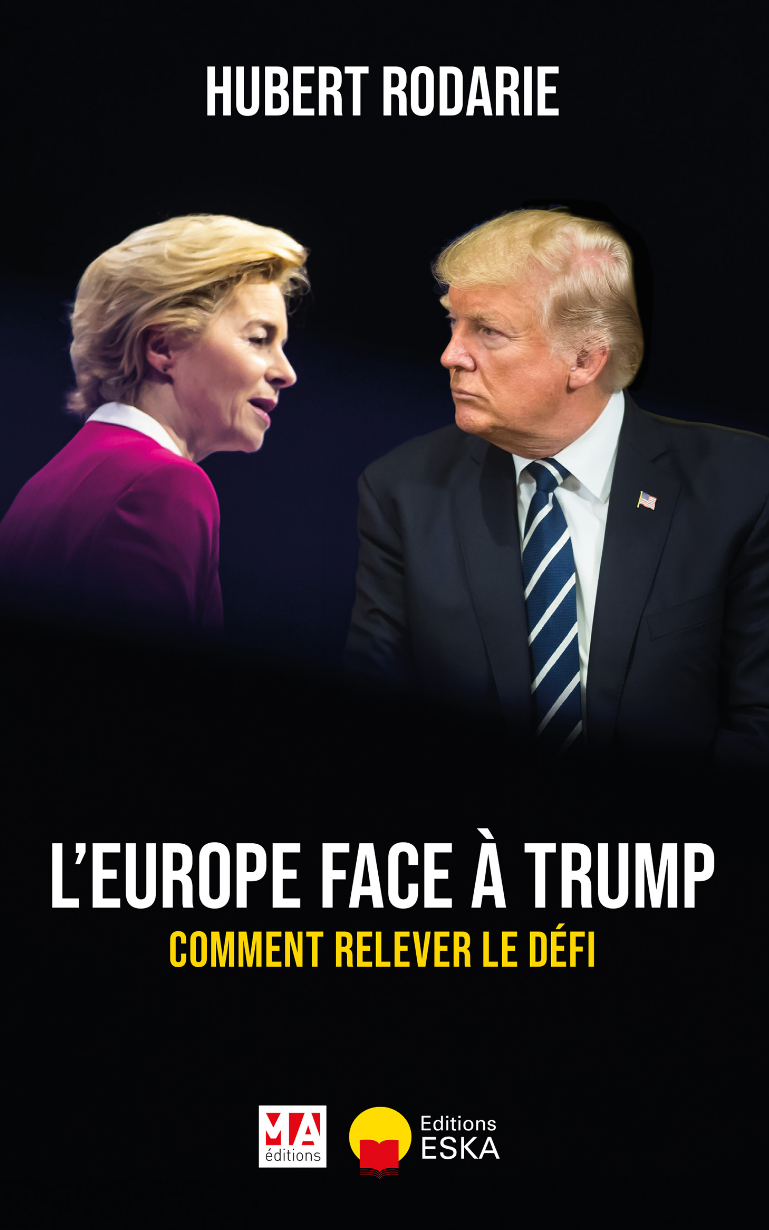
Couverture de l’ouvrage L’Europe face à Trump, par Hubert Rodarie
Source : ESKA Editions.

The author first demonstrates that Trump is neither an anomaly nor merely a media phenomenon. He derives his power from his ability to rally a majority of Americans who are currently dissatisfied with their living conditions. This ability is characteristic of demagogues, one of the most famous of whom was Pericles, yet he is considered one of the fathers of democracy. Trump and Pericles, the United States and Athens, do indeed share many similarities. Moreover, Trump relies heavily, in his actions, on a long-standing trend toward the concentration of executive powers at the federal level in the hands of the president. Yet this trend is common to both Democratic and Republican administrations. Trump thus acts by both mobilizing popular support and exploiting the underlying logic of the United States’ political organization.

Next, the author analyzes the foundations of a strategic project driven by a single ambition: to rebuild an autonomous American power. Unlike previous administrations, which continued the policies pursued over several decades, this strategy rests on three pillars that can be described as innovative:

  • The rebuilding of strategic power in the face of China, recognized as a systemic competitor. This is the direction set forth by the National Security Strategy of December 2025.
  • A trade policy, inspired by the Hamilton doctrine, to rebuild the United States’ capacity to produce goods and services. Presented in Davos in late January 2026, this doctrine signals the United States’ commitment to returning to the principles of the early GATT agreements: the American worker is once again the priority.
  • A monetary policy based on reaffirming the role of the dollar, abandoning unconventional monetary policies, returning to Treasury-led industrial policies, and prioritizing support for labor income over asset values. This direction, first outlined in late 2024, was confirmed by the appointment of Kevin Warsh as Chair of the Federal Reserve.

This therefore represents a historic attempt to overturn not only the principles that have governed the U.S. economy and its relations with the rest of the world for the past forty years, but also the balance of power within the U.S. executive branch, by further strengthening federal power relative to that of the states. In short, a radical transformation of American society is underway.

In parallel, this book examines the European Union’s capacity to respond, its vulnerabilities, and the essential transformation it must undertake in the face of this upheaval. Faced with a strategy that is as clear as it is unapologetic, the European Union must assert itself. But is it capable of doing so? Do its leaders truly have the will to do so?

An incisive essay that helps us understand, beyond the turmoil, the logic behind a major transformation.

About the author

This article was written in July 2026 by Hubert RODARIE (Honorary President of the French Association of Institutional Investors — Af2i).

   ▶ Discover all articles by Hubert RODARIE.

Understanding organizations’ role in bargaining tariffs

Annie YEUNG

In this article, Annie YEUNG (ESSEC Business School, Global Bachelor in Business Administration (GBBA) – Exchange Student, 2025) explains about understanding tariff bargaining that involves international organizations, governments, and industries..

The World Trade Organization (WTO)

The WTO was established in 1995 and is the most influential international organization in managing and negotiating for global trade. The WTO includes 164 member countries, and its main goal includes facilitating trade negations and monitor trade policies, especially tariffs. There has been statistics showing that average global tariffs has decreased since the establishment of WTO. For example, average bound tariffs for decreased by nearly 3 percent from 1995 to 2023.

The WTO is also plays an important role in bargaining tariffs. For example, the Doha Development Round, launched in 2001 under the WTO has focused on improving trading for developing nations. This negotiation, initiated by the WTO, has aimed to make global trade equitable. Its missions include reducing agricultural subsidies, lowering tariffs, which all have effect in order to help developing nations improve access to trading in the global market. There has been negotiations created amongst developed and undeveloped countries, with these negotiations focusing on farm subsidies and market access, as well as lowering industrial tariffs to allow developed nations to better participate in global trading activities . however it is important to note that despite ongoing talks, this round of negotiation has not been successful in delivering an agreement. This failure could have been attributed to the challenges in different trading activity interests amongst different countries. For example, there has been different perspectives in trading such as agricultural subsidies, and tariffs on services, resulting in unresolved conflicts despite negotiation.

WTO negotiations reflect deeper global power imbalances, which are manifested in trading activities and tariffs imposed. The more influential and wealthier nations often hold more bargaining power and power in the global trading market landscapes. For example, these influential countries, particularly those in the G20, often set agenda in the trade negotiations and possess more negotiating capacity. As a result these countries often dominate in negotiations, setting a dynamic that advocate for their trade interests during the process of bargaining of tariffs.

The African Group, the Association of Southeast Asian Nations (ASEAM) are organizations that have become more active, which these countries have formed organizations in order to bargain for equity in the global trading landscape. These organizations that are forming alliances in order to bargain for equitable trading systems that are recognizing asymmetries between economies to push for stabilization for less developed countries. While developed nations are pushing for lower tariffs across all sectors. However, the countries with large economies often contend that decreased tariffs will destabilize economies. As a result, the WTO plays a crucial role to address this imbalance. For example, the “Special Differential Treatment” proposed by the WTO framework promotes more support for developing countries in implementing trade agreements and reducing tariffs. This could reduce unfair trade advantages and reconcile global trade liberalization amongst developed and undeveloped countries..

Trade Negotiation Teams – Representatives

Trade negotiations are often led by high-ranking officials representing their nations. For example, the U.S. Trade Representative (USTR) is a team of experts that are specializing in multiple fields in industries, including agriculture, technology, labor, environment etc. For example, the negotiation team participating in the 2024 Trade Policy Agenda which the USTR emphasized on commitments for their countries interests, negotiating for high-standard commitments in sustainable trade practice to bolster supply chain resilience. The USTR also participates in the World Trade Organization to unify positions with other organizations such as the African Group and the ASEAN to implement trade agreements with other developing countries.

For example, the United States imposes an average agricultural tariff of 5.1%. India has an average agriculture tariff of 38% to protect domestic producers. The European Union imposes 11% in agricultural tariffs. These disparities often lead complex negotiations, especially with agriculture which is crucial for food security .Hence, negotiation objectives often focus on reciprocity. This means to maximize benefits, which trading partners much seek for equivalent concessions, and negotiate on agreements to match others. For example, if one agrees to lower tariffs, the trading partner shall agree to provide benefits on a similar traded product. This ensures mutual benefit in policy making and reaching political goals. However, reciprocity could sometimes be challenging when two countries are under asymmetrical power dynamics, such as negotiating between developed and developing countries, Furthermore, during negotiation, while trade liberation is a long-term mission in tariff negotiations, each country approaches tariff negotiation seeking to protect strategic sectors, preserve jobs, and ensuring their own country’s interests. In negotiating for tariff cuts, some countries may insist on tariffs in protection for their own domestic producers, or in goal to safeguard their own strategic sectors.

Examples of governments’ Tariffs – a case study

Trump – the U.S. – China Trade War during 2018 to 2020

The U.S. China trade war during the 2018-2020 led to higher prices for American consumers. China responded with retaliatory tariffs on U.S. goods, and global trade dynamics were disrupted. The trade wars between U.S. and China also casted an effect on the economies globally, as the two countries have such large economies.

As a result from the trade war, both the U.S. and China have experienced profound effects in multiple perspectives of their economies. The U.S> economy were affected in their GDP and employment. According to a report from Bloomberg Economics, the trade war in 2019 has costed the US economy at $316 billion. The trade wars has also resulted U.S. in stock market losses, with research from the federal reserve Bank of New York finding U.S. firms losing at least $1.7 trillion in market value as a result from the tariffs imposed on imports from China. China has also experienced economic challenges as a result from the trade wars, with export decline and experiencing economic pressures. China has experienced an export growth slow-down, indicating deepened economic challenges.

Furthermore, the trade wars has casted a great effect to the global economic markets. With the two countries being two of the world’s largest economies, their trade tensions has led to significant shifts in market dynamics and economic growth on a global scale. According to data from Banque de France, 10 percent increase in tariffs could reduce global GDP by 3%. This decline as a result from the trade wars and increased tariffs is a result of increased prices that leads to decreased productivity, higher financing costs and reduced investment demand. According to data from The World Economic Forum, it is documented that the trade war has resulted a decrease of global GDP growth to 2.8% in 2019.

Related posts on the SimTrade blog

   ▶ Shruti CHAND Balance of Trades

   ▶ Marine SELLI Trump Trade

   ▶ Louis DETALLE Understand the mechanism of inflation in a few minutes?

Useful resources

A Quick Review of 250 Years of Economic Theory About Tariffs

Tariff Negotiations and Renegotiations under the GATT and the WTO — Procedures and Practices

A quantitative analysis of multi-party tariff negotiations

About the author

This article was written in June 2025 by Annie YEUNG (ESSEC Business School, Global Bachelor in Business Administration (GBBA) – Exchange Student, 2025).

   ▶ Read all posts written by Annie YEUNG