Haste Does Not Bring Success”: What SimTrade Taught Me About Patience, Discipline, and Market Judgment

Feitong GUO

In this article, Feitong GUO (The Chinese University of Hong Kong, Shenzhen, Accounting and Data Analytics, 2023–2027; ESSEC Business School, BBA Exchange Program, Spring 2026) explains how SimTrade changed her understanding of patience, risk and decision-making under uncertainty.

“欲速则不达”: haste does not bring success

Confucius warned that “欲速则不达,见小利则大事不成”: if we pursue speed or become distracted by small gains, we may fail to achieve the larger objective. Before taking SimTrade, I was often impatient in simulations. A short-term profit could make me close a position too early, while an unexpected loss could make me abandon my reasoning and rush into the next round. The course taught me that good trading is not constant action. It is the discipline to observe, form a view, define acceptable risk and wait until the evidence justifies a decision.

What the simulations revealed

Across market-making exercises in an order-driven market with a limit book, I experienced both premature exits and positions that moved sharply against me. I also learned that quoting a wider spread does not automatically create profit: other participants may offer better prices, execution is uncertain and inventory can become risky when the market changes direction. I therefore stopped treating every price movement as a command to act. Instead, I began to ask what information had changed, whether the movement was ordinary noise or a regime shift, and whether my original assumptions still held.

This distinction also clarified the difference between patience and procrastination. Procrastination means neither acting nor thinking. Patience is active: observing the market, updating expectations, defining price and risk limits, and being ready to act. It is not stubbornly holding a losing position. When evidence invalidates the original thesis, discipline means accepting the loss rather than defending a sunk cost.

Volatility, uncertainty and the need to wait

The following FRED charts connect my simulation experience with real-market evidence. They do not provide a trading rule or predict the next crash. Instead, they show why patience must be combined with preparation for rare but consequential changes.

Figure 1. CBOE Volatility Index (VIX) and the S&P 500.
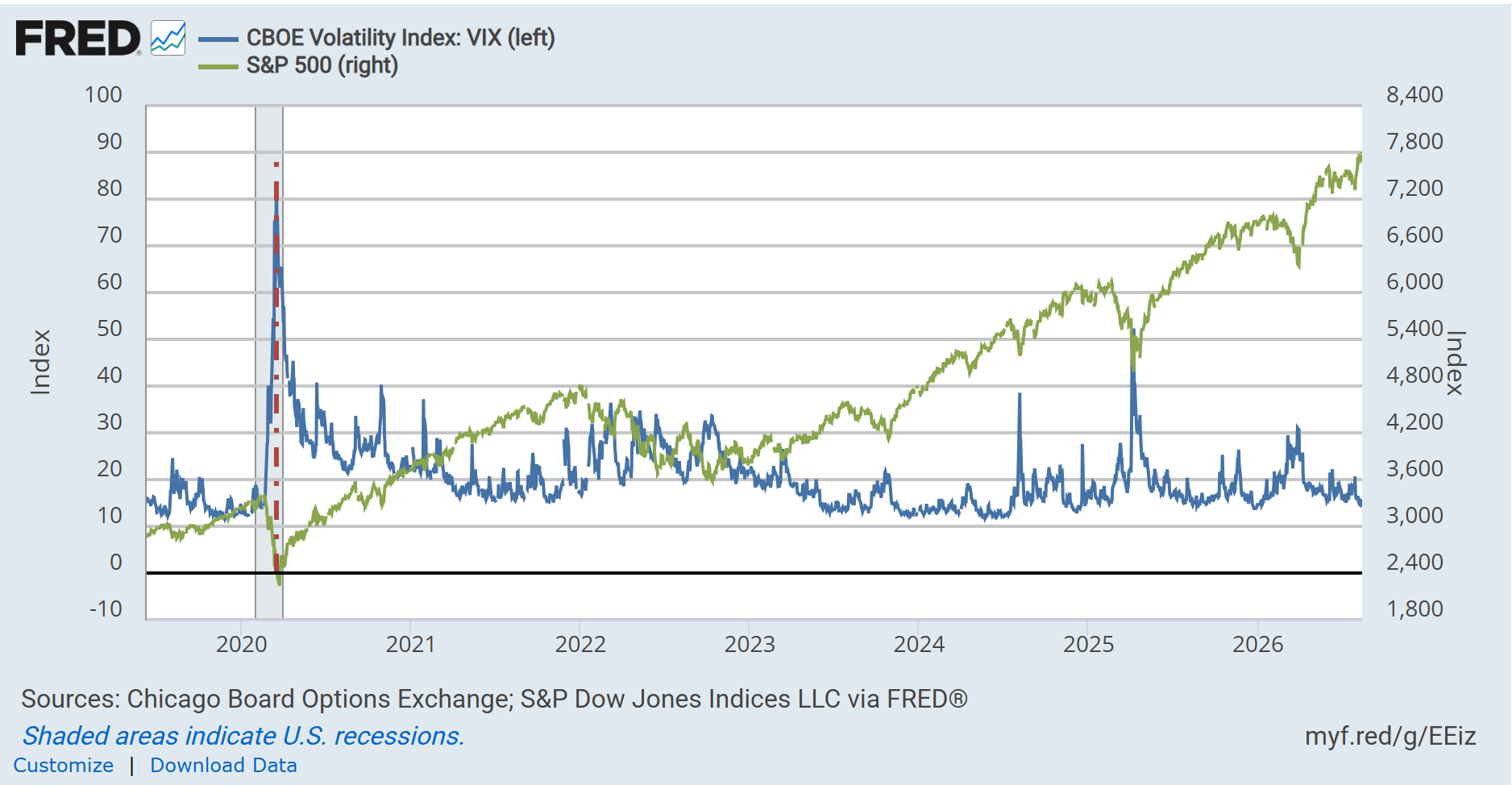
CBOE VIX and S&P 500
Source: Federal Reserve Bank of St. Louis FRED, using CBOE and S&P Dow Jones Indices data.

Figure 1 shows that sharp increases in expected volatility can coincide with steep equity-market declines, most visibly during the 2020 shock. The relationship is not a mechanical buy-or-sell signal, but it illustrates how quickly the market environment can change. My lesson is that patience cannot mean ignoring downside risk: a trader should establish risk limits before uncertainty rises, because calm observation becomes harder once prices move abruptly.

Figure 2. Long-run history of the CBOE Volatility Index, with a high-volatility threshold.
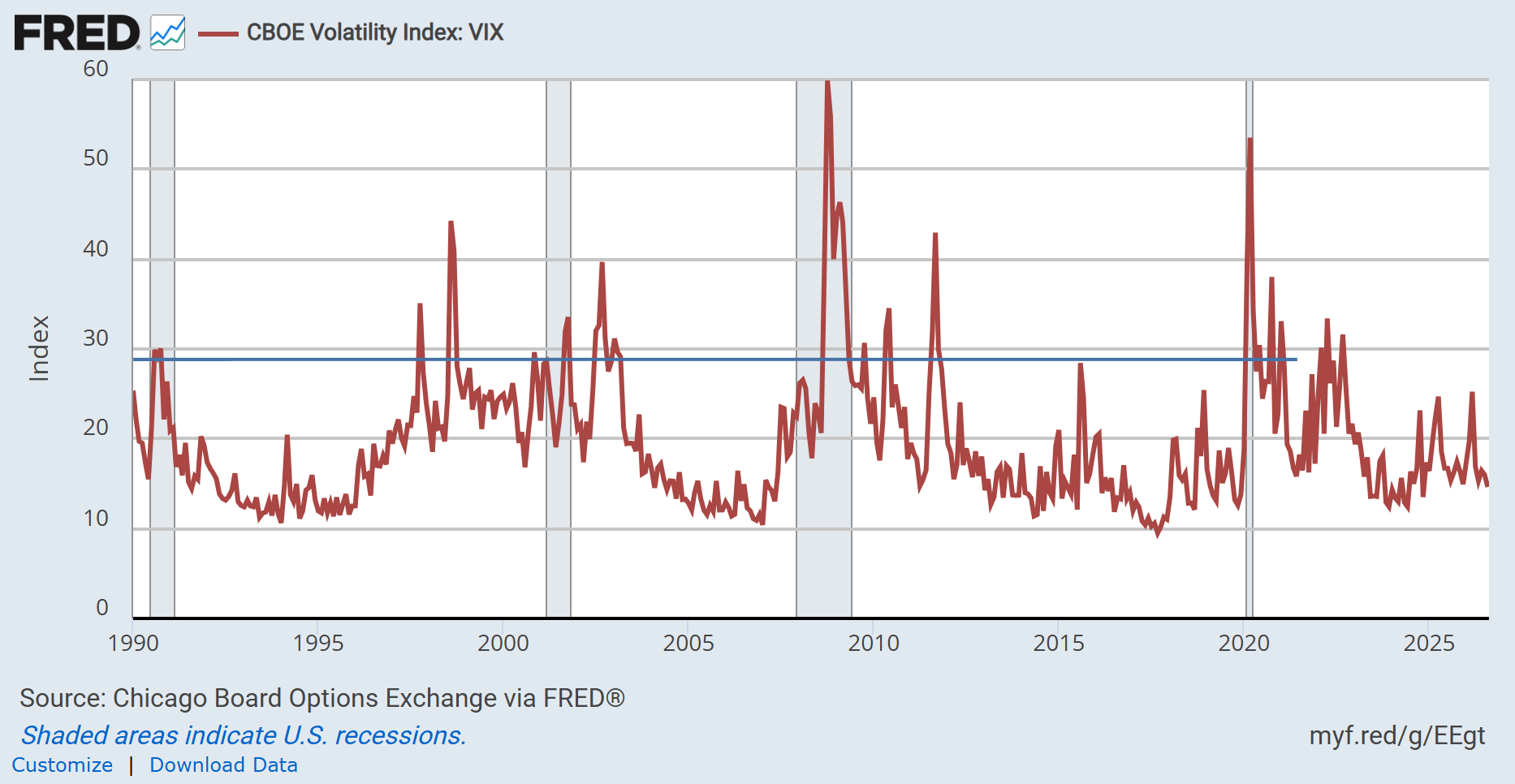
Long-run CBOE VIX with high-volatility threshold
Source: Federal Reserve Bank of St. Louis FRED, using CBOE data.

Figure 2 places volatility spikes in a longer historical context. High-volatility episodes are intermittent, while calmer conditions occupy much of the sample. This helps explain why overreacting to every small movement can be costly, but also why a routine trading rhythm must include contingency plans. We cannot know the exact timing of the next extreme episode; we can only avoid confusing the absence of a shock with the absence of risk.

Figure 3. Absolute daily changes in the S&P 500 and the VIX.

Absolute daily S&P 500 changes and CBOE VIX
Source: Federal Reserve Bank of St. Louis FRED, using CBOE and S&P Dow Jones Indices data.

Figure 3 compares realized daily market movements with the VIX, a forward-looking measure based on options prices. The two tend to rise together in stressed periods, but they do not match exactly because they describe different horizons and information sets. This distinction mirrors SimTrade: observing what has already happened is not the same as forecasting what may happen next. Better judgment requires both evidence from realized outcomes and an explicit view of future uncertainty.

Behavioral finance behind my mistakes

The disposition effect

Selling a winning position too quickly while hesitating over a losing one resembles the disposition effect documented by Shefrin and Statman. Short-term gains feel concrete and easy to secure, whereas realizing a loss feels like admitting that the original judgment was wrong. Recognizing this bias helped me separate emotional comfort from decision quality.

Sunk costs and rational perseverance

Time, money and effort inevitably influence emotions, even though sunk costs should not determine the next decision. Perseverance is rational only when the expected future benefit still justifies the remaining risk. This principle is relevant beyond trading: in analytics projects, I should not defend a model merely because I spent time building it. I should keep, revise or abandon it according to evidence.

From trading discipline to business and data analytics

SimTrade strengthened three qualities that I want to bring to business and data analytics: patient reasoning, reflection and a long-term orientation. Data rarely explains itself. Analysts must distinguish signal from noise, test assumptions, investigate unexpected results and wait for sufficient evidence without becoming passive. The course showed me that a good decision is not defined only by whether one trade makes money. It is defined by whether the process was consistent, explainable and responsive to new information.

Why should I be interested in this post?

For students interested in finance, consulting or analytics, simulations offer a safe environment in which to discover how emotion enters supposedly rational decisions. The most transferable lesson is not a particular order or strategy. It is the habit of slowing down before acting: specify the objective, interpret the evidence, control the downside and review the result. “Haste does not bring success” is therefore not an argument for inactivity; it is a framework for disciplined action.

Related posts on the SimTrade blog

   ▶ Bochen LIU Know yourself and know your opponent, and you will never be defeated – Sun Tzu

   ▶ What I learned during my time in the stock market

   ▶ Posts about behavioral finance

Useful resources

Academic research

Arkes, H. R., & Blumer, C. (1985) The Psychology of Sunk Cost, Organizational Behavior and Human Decision Processes, 35(1), 124–140.

Kahneman, D., & Tversky, A. (1979) Prospect Theory: An Analysis of Decision under Risk, Econometrica, 47(2), 263–291.

Shefrin, H., & Statman, M. (1985) The Disposition to Sell Winners Too Early and Ride Losers Too Long: Theory and Evidence, The Journal of Finance, 40(3), 777–790.

Confucius, The Analects, Book XIII, “Zi Lu”.

Market data

Federal Reserve Bank of St. Louis FRED: Measuring uncertainty and volatility with FRED data

SimTrade

SimTrade course catalogue

SimTrade simulation catalogue

About the author

The article was written in August 2026 by Feitong GUO (The Chinese University of Hong Kong, Shenzhen, Accounting and Data Analytics, 2023–2027; ESSEC Business School, BBA Exchange Program, Spring 2026).

   ▶ Discover all articles by Feitong GUO .

From Verification to Evaluation: How Audit Shaped My Approach to Nonprofit Investment

Feitong GUO

In this article, Feitong GUO (The Chinese University of Hong Kong, Shenzhen, Accounting and Data Analytics, 2023-2027; ESSEC Business School, BBA Exchange Program, Spring 2026) reflects on how her experience as an Audit Assistant at Ernst & Young (EY) and her work as a Project Consultant at A Better Community (ABC) taught her two complementary ways of supporting reliable decisions: verifying evidence against established standards and designing an evaluation framework when the standards themselves must first be defined.

About the organizations

EY and ABC operate in very different environments, but both transform complex information into structured evidence for decision-makers. EY does so through established assurance and review procedures, while ABC provides professional services that help social organizations and funders make more informed decisions.

Ernst & Young (EY) is a global professional-services organization providing assurance, consulting, strategy and transactions, and tax services. I worked as an Audit Assistant in July and August 2025. To respect confidentiality, I do not identify the financial institutions or funds involved.

Logo of EY.
Logo of EY
Source: the company.

A Better Community (ABC), founded in 2008, mobilizes professional volunteers to provide consulting, research, digital, impact-investment and philanthropic-advisory services to social organizations. Since August 2025, I have served as a Volunteer Management Team Member and Project Consultant. I have participated in three volunteer-recruitment seasons and two project seasons, supporting a nonprofit educational research organization and a foundation investment project.

Logo of A Better Community.
Logo of A Better Community
Source: the organization.

From applying standards to designing them

Verification in audit

At EY, my tasks included assisting with audit working papers, reviewing credit files and checking financial information. In credit-file reviews, I examined borrower information such as loan amounts, interest rates, collateral or guarantees, repayment capacity and the bank’s internal loan-risk classification. Completeness meant more than confirming that every required field had been filled in. I also checked whether the information was supported by relevant documents and remained consistent across client reports, audit materials and credible public sources. When the sources did not agree, I recorded the discrepancy and sought clarification rather than selecting the figure that appeared most convenient.

I also supported valuation-related checks for selected investment projects held by funds. The purpose was to verify parts of the existing estimates, not to perform the valuation independently. I organized project information and valuation schedules, traced operational inputs such as annual production volumes, prices and forecasts to annual reports and other supporting materials, and checked formulas and cross-references between different tables. When figures did not match, I followed their sources and calculation paths to locate the problem. If the discrepancy could not be resolved, I documented it and raised a specific question with the client team or my mentor.

These tasks could be repetitive, but they were not trivial. A small inconsistency in a date, amount, formula or supporting document could affect the reliability of the output. Audit taught me to preserve an evidence trail, distinguish a fact from an inference and know when escalation was necessary. I contributed to the process rather than owning the final audit conclusion, yet that role showed me how disciplined verification supports trust.

Evaluation in nonprofit consulting

In ABC’s foundation investment project, the question moved upstream. The client wanted a reusable methodology to screen potential partner organizations and inform future funding decisions. Our team was not merely checking whether information met an existing standard; we first had to decide what a reasonable and usable standard should contain. I was responsible for researching nonprofit-screening methodologies and contributing to the indicator framework and its validation.

Our emerging framework has three sequential layers: compliance, communication and value. Compliance is an entry gate. It may include checks of registration status, annual reports, financial disclosures, penalties and abnormal operating information through credible public sources. If an organization does not pass the required compliance checks, it does not proceed to the communication assessment. This prevents strong publicity from compensating for a fundamental compliance concern.

For organizations that pass the first gate, the communication layer distinguishes current capacity from future potential. Current capacity may be reflected in the volume, frequency, clarity and audience response of existing content. Potential depends less on polished videos or follower counts and more on whether the organization operates a credible project, can provide verifiable stories and evidence, is willing to cooperate in content development, and has a mission that can be meaningfully communicated to the foundation’s target audience. The value layer then asks whether the project addresses a genuine need, has a reasonable intervention logic and is aligned with the funder’s objectives.

The same form, but a different decision problem

At first sight, my work at EY and ABC followed a similar process. In both cases, information had to be collected, entered into a structured table, assessed and transformed into a decision-oriented output. In EY credit-file reviews, the output contributed to an internal loan-risk classification. At ABC, the framework is intended to support the screening of nonprofit organizations and future funding decisions.

The fundamental difference lies in who defines the methodology. At EY, the required fields, supporting documents, assessment standards and classification rules had already been established. My responsibility was to research and verify the information, complete the required fields, check consistency and identify issues that needed clarification. At ABC, our team is helping to design the table itself: its questions, evidence requirements, gates, scoring logic and final decision rules.

The two settings also use different forms of internal consistency. In valuation checks at EY, I examined numerical relationships: for example, how operational assumptions entered one schedule and affected another calculation. In the ABC framework, the relationship is procedural. An organization must pass the compliance gate before its communication potential and project value are assessed. In both cases, a result is credible only when the path from evidence to conclusion can be traced.

Why the evaluation-criteria model appears here

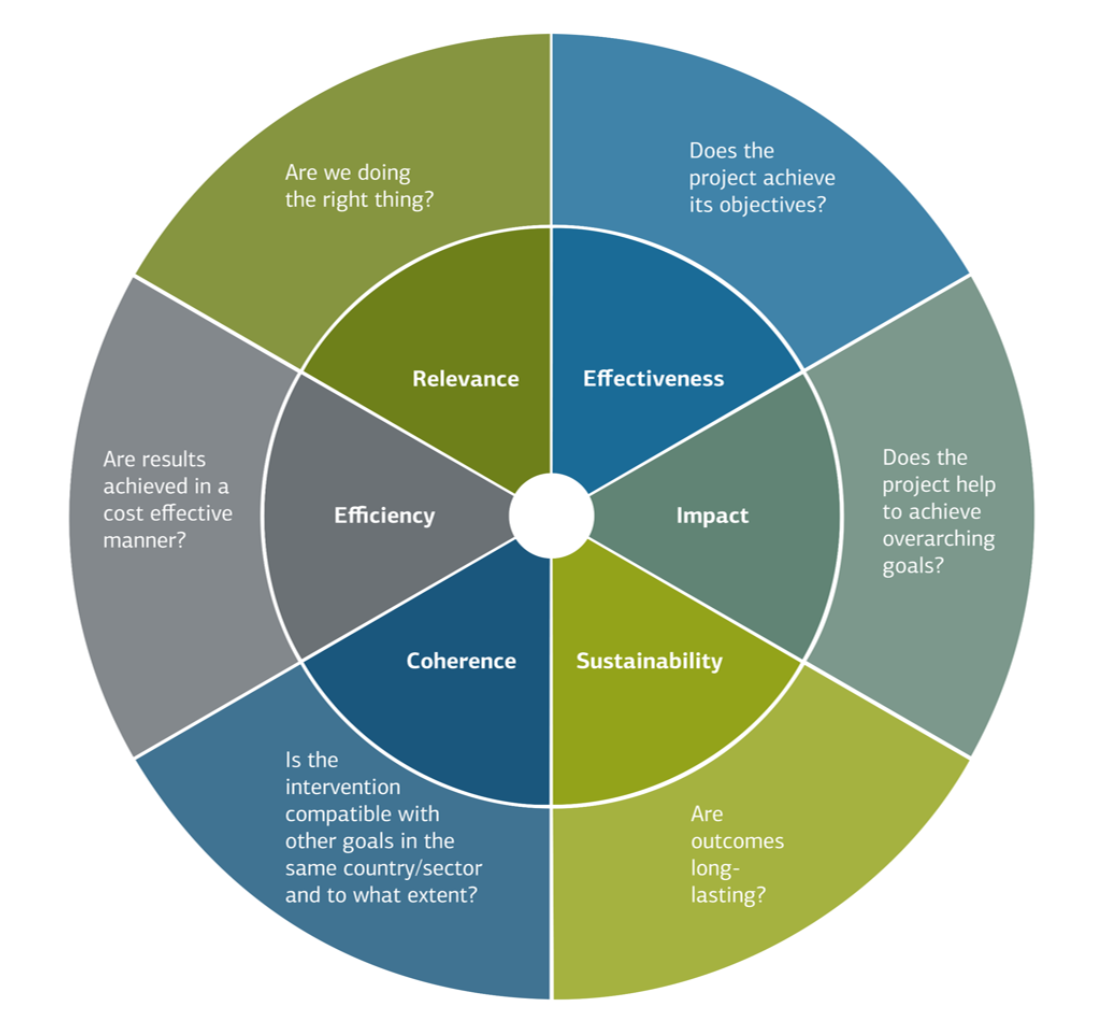
Figure 1. Evaluation criteria developed by the Organisation for Economic Co-operation and Development’s Development Assistance Committee (OECD-DAC).
OECD-DAC evaluation criteria
Source: KfW Development Bank, based on the OECD-DAC evaluation criteria.

The OECD-DAC framework evaluates development interventions through six complementary criteria: relevance, coherence, effectiveness, efficiency, impact and sustainability. It appears here because our team first examined established evaluation methodologies before designing a framework adapted to nonprofit screening and funding decisions. The framework shows that evaluation requires several distinct questions and that each criterion should clarify what evidence an evaluator needs.

However, we did not copy the OECD-DAC model directly. It is primarily designed to evaluate development interventions, whereas our client needs to screen organizations before selecting partners and allocating future funding. We therefore used it as a methodological reference and adapted its multi-dimensional logic to our sequential compliance, communication and value framework. It informed our thinking, but it is not our final framework.

A practical illustration of the framework

Consider a nonprofit organization with a legally registered status, an active social-media account and an education project that appears attractive to potential donors. These characteristics would not immediately produce a positive recommendation. The compliance layer would first verify its registration, annual reports, financial disclosures and relevant risk information. If the organization passed this gate, the communication layer would distinguish current performance, such as publication frequency and audience engagement, from future potential, including the availability of credible project stories, supporting evidence and willingness to cooperate. The value layer would then examine whether the project addresses a genuine need and is aligned with the foundation’s objectives.

This staged process is intended to avoid two common errors: treating polished communication as proof of project value, and treating a lack of current communication resources as proof that an organization has no communication potential. The detailed indicators are still being developed and will need practical testing before the methodology is delivered.

Validation before delivery

A framework may look logical in a presentation and still fail in practice. Another project group will apply the draft indicators to real cases. Their work may reveal unavailable data, overlapping criteria, vague scoring anchors or outputs that do not match the client’s decision needs. We will then revise the definitions, evidence requirements, gates and scoring rules. This process resembles audit in an important way: a conclusion must be traceable to evidence. It also resembles analytics because the model must be tested against observed results rather than defended simply because effort has already been invested in it.

Required skills and knowledge

Both experiences required attention to detail, information organization and professional judgment. Audit placed greater emphasis on accuracy, documentation, reconciliation and escalation. Nonprofit consulting required methodology research, framework design, stakeholder alignment and the ability to translate broad ideas into observable indicators. Across both settings, the most important skill was asking what decision the information was meant to support before deciding how to collect or process it.

What I learned

EY taught me how to use a methodology responsibly, while ABC taught me how difficult it is to design one responsibly. Applying an existing framework requires accuracy, traceability and consistency. Designing a new framework requires the same discipline, but also demands decisions about definitions, evidence, thresholds and trade-offs. Together, the two experiences changed my understanding of evaluation: a reliable result depends not only on the quality of the information entered into a table, but also on the quality of the methodology behind the table.

Economic, financial and business concepts related to my experience

Due diligence and information reliability

Due diligence reduces information asymmetry by checking the reliability, completeness and relevance of evidence before a decision. Credit-file review, valuation checks and nonprofit compliance screening all apply this logic, even though their procedures and stakeholders differ. In each setting, important claims should be traceable to identifiable sources.

Multi-criteria decision analysis

Funding decisions rarely depend on a single metric. Multi-criteria decision analysis makes trade-offs explicit by defining dimensions, evidence and scoring rules. Some conditions may function as gates rather than compensable scores. In our emerging framework, compliance serves this role: communication strength cannot compensate for failure to meet a mandatory compliance requirement.

Model validation and iteration

An evaluation framework is a model of reality. Validation asks whether different reviewers can apply it consistently, whether the necessary evidence is available and whether its outputs are useful for the intended decision. Testing and iteration are therefore part of responsible design, not signs that the first draft failed.

Why should I be interested in this post?

For students interested in audit, consulting, impact investing or business analytics, these experiences show a progression from checking information to structuring judgment. Entry-level work may begin with documents, confirmations and meeting records, but those tasks build the discipline needed for higher-level analysis. The challenge is to connect every task to its decision purpose: what is being verified, what uncertainty remains and what evidence would justify the next step?

Related posts on the SimTrade blog

   ▶ Iris ORHAND My apprenticeship experience as a Junior Financial Auditor at EY

   ▶ Iris ORHAND Risk-based Audit: From Risks to Assertions to Audit Procedures

   ▶ Anant JAIN Impact Investing

Useful resources

Academic research and reports

Gamvros, I., Nidel, M., & Raghavan, N. R. S. (2006) Investment Analysis and Budget Allocation at Catholic Relief Services, Interfaces, 36(5), 400-406.

Salimi, N., & ten Have, W. (2024) Aiding Philanthropic Venture Capitalists in Selecting Nonprofit Organisations, Journal of Philanthropy and Marketing, 29(1), e1834.

Bayarri, M. J., Berger, J. O., Higdon, D., Kennedy, M. C., Kottas, A., Paulo, R., Sacks, J., Cafeo, J. A., Cavendish, J., Lin, C. H., & Tu, J. (2002) A Framework for Validation of Computer Models, NISS Technical Report 128.

OECD: Evaluation criteria

Business and organization resources

EY: About us

A Better Community: About

A Better Community: Consulting services

KfW Development Bank: Evaluation criteria and rating scale

About the author

The article was written in August 2026 by Feitong GUO (The Chinese University of Hong Kong, Shenzhen, Accounting and Data Analytics, 2023-2027; ESSEC Business School, BBA Exchange Program, Spring 2026).

   ▶ Discover all articles by Feitong GUO .

Know yourself and know your opponent, and you will never be defeated – Sun Tzu

Bochen LIU

In this article, Bochen LIU (Queen’s Smith School of Business, BCom 2023–2027; ESSEC BBA Exchange Program, Fall 2025) analyzes how the famous Chinese strategic quote “知己知彼,百战不殆” (know yourself and know your opponent, and you will never be defeated), derived from Sun Tzu’s The Art of War, functions as a foundational principle in modern Business strategy, particularly in positioning, segmentation, and competitive analysis.

Know Yourself, Know Your Opponent: Applying Sun Tzu’s Strategy to Modern Business Competition

The Chinese strategic philosophy “知己知彼,百战不殆” (know yourself and know your opponent, and you will never be defeated), originating from Sun Tzu’s The Art of War, continues to provide valuable insights for modern business strategy and competitive analysis. Although this principle was originally developed in the context of military strategy, its underlying logic remains highly relevant in today’s corporate environment. Companies must understand their own capabilities while continuously analyzing competitors, customers, and external market conditions. Knowledge of both internal resources and external competition enables organizations to develop stronger positioning strategies and maintain competitive advantages.

In the current business environment, companies face uncertainty caused by changing consumer behaviour, technological development, and increasing competition. Having a high-quality product or service alone does not guarantee success. Organizations must understand their own strengths, recognize their weaknesses, and evaluate how competitors influence customer expectations and market conditions. Therefore, the principle of “knowing yourself and knowing your opponent” can be transformed into a practical business framework through Strengths, Weaknesses, Opportunities, and Threats (SWOT) analysis, which allows companies to evaluate internal capabilities and external challenges.

Understanding “Know Yourself”

“Know yourself” refers to the process through which companies understand their internal resources, capabilities, and limitations. From a business perspective, this involves evaluating internal factors such as brand reputation, product quality, pricing strategies, operational efficiency, financial resources, and customer relationships.

Understanding internal strengths allows companies to identify areas where they possess competitive advantages. For example, companies with strong brand recognition may not compete with competitors through lower prices. Instead, they can create value through customer loyalty, premium positioning, and differentiated customer experiences. Similarly, organizations with unique technologies or specialized expertise can use these capabilities to distinguish themselves from competitors.

However, knowing oneself also requires recognizing internal weaknesses. Companies that fail to understand their limitations may develop unrealistic strategies that cannot be effectively implemented. For example, a business may provide high-quality products but lack sufficient distribution channels, marketing resources, or operational capacity to support expansion.

Therefore, “know yourself” does not simply mean identifying positive characteristics. It requires an objective evaluation of both strengths and weaknesses so that companies can develop realistic and effective strategies.

Understanding “Know Your Opponent”

“Know your opponent” refers to understanding competitors, customers, and external market conditions. Businesses operate in environments where competitors continuously adjust their strategies, introduce new products, and influence consumer expectations. Without sufficient knowledge of the external environment, companies may lose their competitive position.

Competitor analysis allows businesses to understand how other organizations attract customers, differentiate their products, and respond to market changes. For example, companies operating in the education industry need to analyze competitors’ pricing strategies, teaching methods, customer acquisition approaches, and brand positioning before developing their own marketing strategies.

Knowing your opponent does not mean copying competitors’ strategies. Instead, it enables businesses to identify opportunities for differentiation and develop unique value propositions. By understanding competitors’ strengths and weaknesses, companies can discover underserved customer segments and create stronger market positions.

Therefore, “know your opponent” represents a continuous process of monitoring external changes and adapting business strategies according to evolving market conditions.

Applying “Know Yourself and Know Your Opponent” Through SWOT Analysis

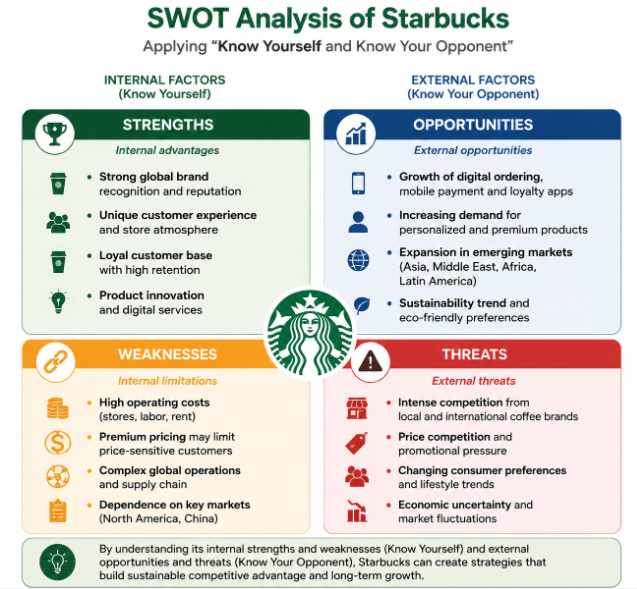
SWOT analysis is one of the most effective frameworks for applying Sun Tzu’s principle to modern business strategy. The framework evaluates four key areas: Strengths, Weaknesses, Opportunities, and Threats. Strengths and weaknesses represent internal factors related to “knowing yourself,” while opportunities and threats represent external factors related to “knowing your opponent.”

 SWOT matrix
Source: the author.

Strengths and Weaknesses: Internal Analysis

Strengths refer to internal advantages that allow companies to compete effectively. These advantages may include strong brand recognition, innovative products, loyal customers, advanced technology, or efficient operations. By identifying strengths, companies can develop strategies that maximize their existing competitive advantages.

Weaknesses refer to internal limitations that may reduce competitiveness. These may include high operating costs, limited resources, weak brand awareness, or inefficient processes. Recognizing weaknesses allows organizations to improve internal capabilities and prevent potential problems from affecting future growth.

Opportunities and Threats: External Analysis

Opportunities refer to external conditions that create potential growth possibilities. These may include emerging customer demands, technological development, new market segments, or changing consumer preferences. Companies that successfully identify opportunities can adapt their strategies and expand their market presence.

Threats refer to external factors that may negatively influence business performance. These include new competitors, changing consumer behaviour, economic uncertainty, and increasing price competition. Understanding threats allows companies to prepare appropriate responses before competitors gain an advantage.

Through SWOT analysis, businesses can transform the abstract principle of “know yourself and know your opponent” into a structured decision-making process. This framework allows organizations to connect internal capabilities with external market conditions and develop more effective strategies.

Real Business Example: Starbucks’ Competitive Strategy

Starbucks Corporation provides a clear example of how “know yourself and know your opponent” can be applied through SWOT analysis. The company demonstrates how understanding internal capabilities and external competition can support long-term competitive success.

From an internal perspective, Starbucks’ major strengths are its global brand recognition and unique customer experience. Starbucks is not simply a company that sells coffee; it creates value through store atmosphere, personalized beverages, customer service, and strong brand identity. These advantages allow Starbucks to build customer loyalty and maintain premium pricing compared with many traditional coffee providers.

However, Starbucks also faces internal weaknesses. Operating thousands of locations worldwide requires significant investment in employees, store management, supply chains, and quality control. These high operating costs create challenges when Starbucks competes with lower-cost coffee providers. Recognizing these weaknesses allows the company to improve efficiency and adapt its operations.

From an external perspective, Starbucks identifies opportunities by analyzing changes in consumer behaviour. The increasing popularity of digital ordering, mobile payment systems, and personalized products provides opportunities for Starbucks to strengthen customer relationships. By understanding customer expectations, Starbucks can develop services that better match market demands.

At the same time, Starbucks must understand competitive threats. In markets such as China, Starbucks faces increasing competition from local coffee brands that compete through lower prices, rapid expansion, and digital platforms. Instead of competing only through price, Starbucks relies on its strengths, including global branding, customer experience, and product innovation, to maintain differentiation.

This example demonstrates that successful businesses need both internal and external analysis. Starbucks maintains competitiveness because it understands its own capabilities while continuously monitoring competitor strategies and market changes.

Conclusion

The principle of “know yourself and know your opponent” remains an important concept in contemporary business strategy. Organizations cannot achieve sustainable success by focusing only on their internal capabilities. They must also understand competitors, customers, and external environmental factors that influence market performance.

SWOT analysis provides a practical method for implementing this principle because it combines internal evaluation with external market analysis. Through SWOT analysis, businesses can create more effective strategies, improve market positioning, and develop sustainable competitive advantages.

Sun Tzu’s strategic thinking therefore continues to provide valuable lessons for modern organizations. Companies that accurately understand themselves and their opponents are better prepared to compete in dynamic markets.

Related posts on the SimTrade blog

   ▶ Mathis HOUROU Client Segmentation and Private Banking: Marketing Strategy or Risk Shield?

   ▶ Camille KELLER My Apprenticeship Experience as Digital Strategy Officer at Gan Assurances

   ▶ Liner SHI My Intern Experience in Tencent Strategy Department

Useful resources

The Art of War (Chinese Text Project)

Encyclopaedia Britannica – The Art of War

American Marketing Association (AMA)

About the author

The article was written in August 2026 by Bochen LIU (Queen’s Smith School of Business, BCom 2023–2027; ESSEC BBA Exchange Program, Fall 2025).

▶ Discover all posts by Bochen LIU