

In this article, Hubert RODARIE (Honorary President of the French Association of Institutional Investors — Af2i) introduces his latest book, Europe Confronting Trump, published by ESKA in May 2026.
This question lies at the heart of the analyses circulating in the media. Should Donald Trump’s election be viewed as an anomaly? Are all his decisions destined to be overturned by a new president, who will then be portrayed as responsible and serious?
Since 2016, the debate regarding Donald Trump has focused primarily on his personality, his provocations, and his excessive behavior. Most of his actions are described as erratic, questionable, and, above all, ineffective. Yet a fundamental question arises: how can we explain the bewilderment currently gripping Democrats in the United States, as well as leaders in the European Union and Washington’s Asian allies? A second question follows: how can we explain that, despite the Supreme Court’s overturning of the tariffs, the agreements reached in exchange for their adjustment or elimination have not been called into question but, on the contrary, have been confirmed (see, in particular, the European Parliament’s recent decision ratifying the July 2025 agreements)?
On May 14, 2026, L’Europe face à Trump (Europe Facing Trump) was published by ESKA. This book aims precisely to move beyond a superficial interpretation of events.
L’Europe face à Trump by Hubert Rodarie.
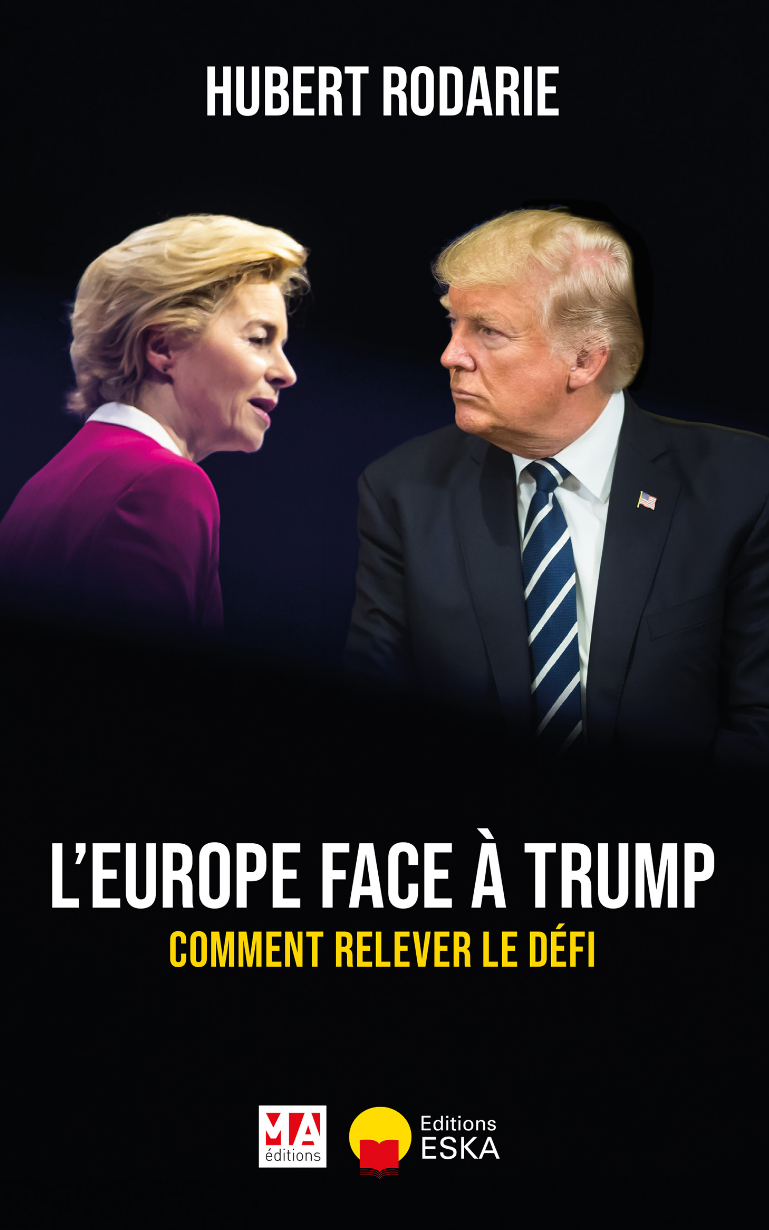
Source : ESKA Editions.
The author first demonstrates that Trump is neither an anomaly nor merely a media phenomenon. He derives his power from his ability to rally a majority of Americans who are currently dissatisfied with their living conditions. This ability is characteristic of demagogues, one of the most famous of whom was Pericles, yet he is considered one of the fathers of democracy. Trump and Pericles, the United States and Athens, do indeed share many similarities. Moreover, Trump relies heavily, in his actions, on a long-standing trend toward the concentration of executive powers at the federal level in the hands of the president. Yet this trend is common to both Democratic and Republican administrations. Trump thus acts by both mobilizing popular support and exploiting the underlying logic of the United States’ political organization.
Next, the author analyzes the foundations of a strategic project driven by a single ambition: to rebuild an autonomous American power. Unlike previous administrations, which continued the policies pursued over several decades, this strategy rests on three pillars that can be described as innovative:
- The rebuilding of strategic power in the face of China, recognized as a systemic competitor. This is the direction set forth by the National Security Strategy of December 2025.
- A trade policy, inspired by the Hamilton doctrine, to rebuild the United States’ capacity to produce goods and services. Presented in Davos in late January 2026, this doctrine signals the United States’ commitment to returning to the principles of the early GATT agreements: the American worker is once again the priority.
- A monetary policy based on reaffirming the role of the dollar, abandoning unconventional monetary policies, returning to Treasury-led industrial policies, and prioritizing support for labor income over asset values. This direction, first outlined in late 2024, was confirmed by the appointment of Kevin Warsh as Chair of the Federal Reserve.
This therefore represents a historic attempt to overturn not only the principles that have governed the U.S. economy and its relations with the rest of the world for the past forty years, but also the balance of power within the U.S. executive branch, by further strengthening federal power relative to that of the states. In short, a radical transformation of American society is underway.
In parallel, this book examines the European Union’s capacity to respond, its vulnerabilities, and the essential transformation it must undertake in the face of this upheaval. Faced with a strategy that is as clear as it is unapologetic, the European Union must assert itself. But is it capable of doing so? Do its leaders truly have the will to do so?
An incisive essay that helps us understand, beyond the turmoil, the logic behind a major transformation.
About the author
This article was written in July 2026 by Hubert RODARIE (Honorary President of the French Association of Institutional Investors — Af2i).
▶ Discover all articles by Hubert RODARIE.