

In this article, Feitong GUO (The Chinese University of Hong Kong, Shenzhen, Accounting and Data Analytics, 2023–2027; ESSEC Business School, BBA Exchange Program, Spring 2026) explains how SimTrade changed her understanding of patience, risk and decision-making under uncertainty.
“欲速则不达”: haste does not bring success
Confucius warned that “欲速则不达,见小利则大事不成”: if we pursue speed or become distracted by small gains, we may fail to achieve the larger objective. Before taking SimTrade, I was often impatient in simulations. A short-term profit could make me close a position too early, while an unexpected loss could make me abandon my reasoning and rush into the next round. The course taught me that good trading is not constant action. It is the discipline to observe, form a view, define acceptable risk and wait until the evidence justifies a decision.
What the simulations revealed
Across market-making exercises in an order-driven market with a limit book, I experienced both premature exits and positions that moved sharply against me. I also learned that quoting a wider spread does not automatically create profit: other participants may offer better prices, execution is uncertain and inventory can become risky when the market changes direction. I therefore stopped treating every price movement as a command to act. Instead, I began to ask what information had changed, whether the movement was ordinary noise or a regime shift, and whether my original assumptions still held.
This distinction also clarified the difference between patience and procrastination. Procrastination means neither acting nor thinking. Patience is active: observing the market, updating expectations, defining price and risk limits, and being ready to act. It is not stubbornly holding a losing position. When evidence invalidates the original thesis, discipline means accepting the loss rather than defending a sunk cost.
Volatility, uncertainty and the need to wait
The following FRED charts connect my simulation experience with real-market evidence. They do not provide a trading rule or predict the next crash. Instead, they show why patience must be combined with preparation for rare but consequential changes.
Figure 1. CBOE Volatility Index (VIX) and the S&P 500.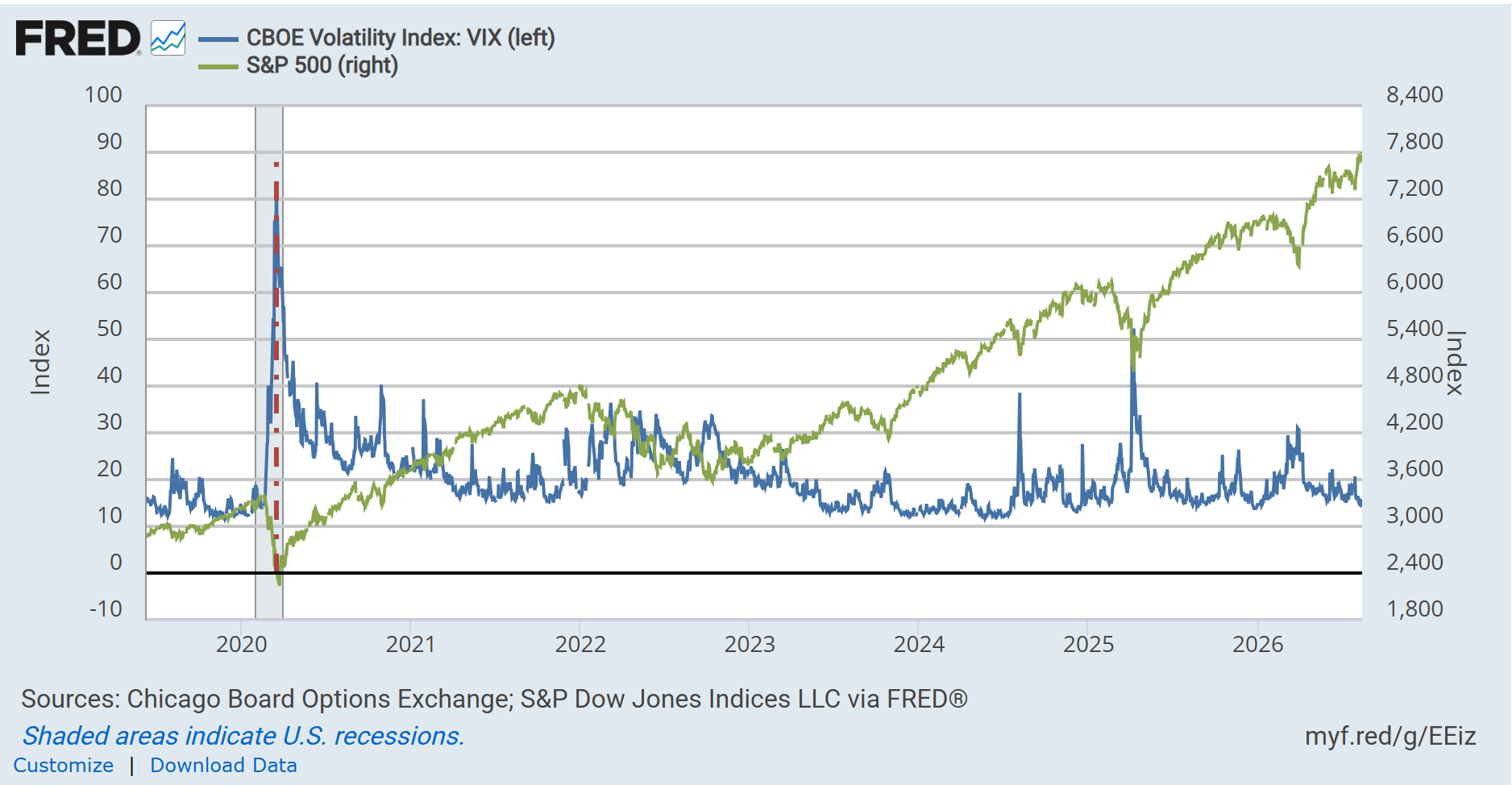
Source: Federal Reserve Bank of St. Louis FRED, using CBOE and S&P Dow Jones Indices data.
Figure 1 shows that sharp increases in expected volatility can coincide with steep equity-market declines, most visibly during the 2020 shock. The relationship is not a mechanical buy-or-sell signal, but it illustrates how quickly the market environment can change. My lesson is that patience cannot mean ignoring downside risk: a trader should establish risk limits before uncertainty rises, because calm observation becomes harder once prices move abruptly.
Figure 2. Long-run history of the CBOE Volatility Index, with a high-volatility threshold.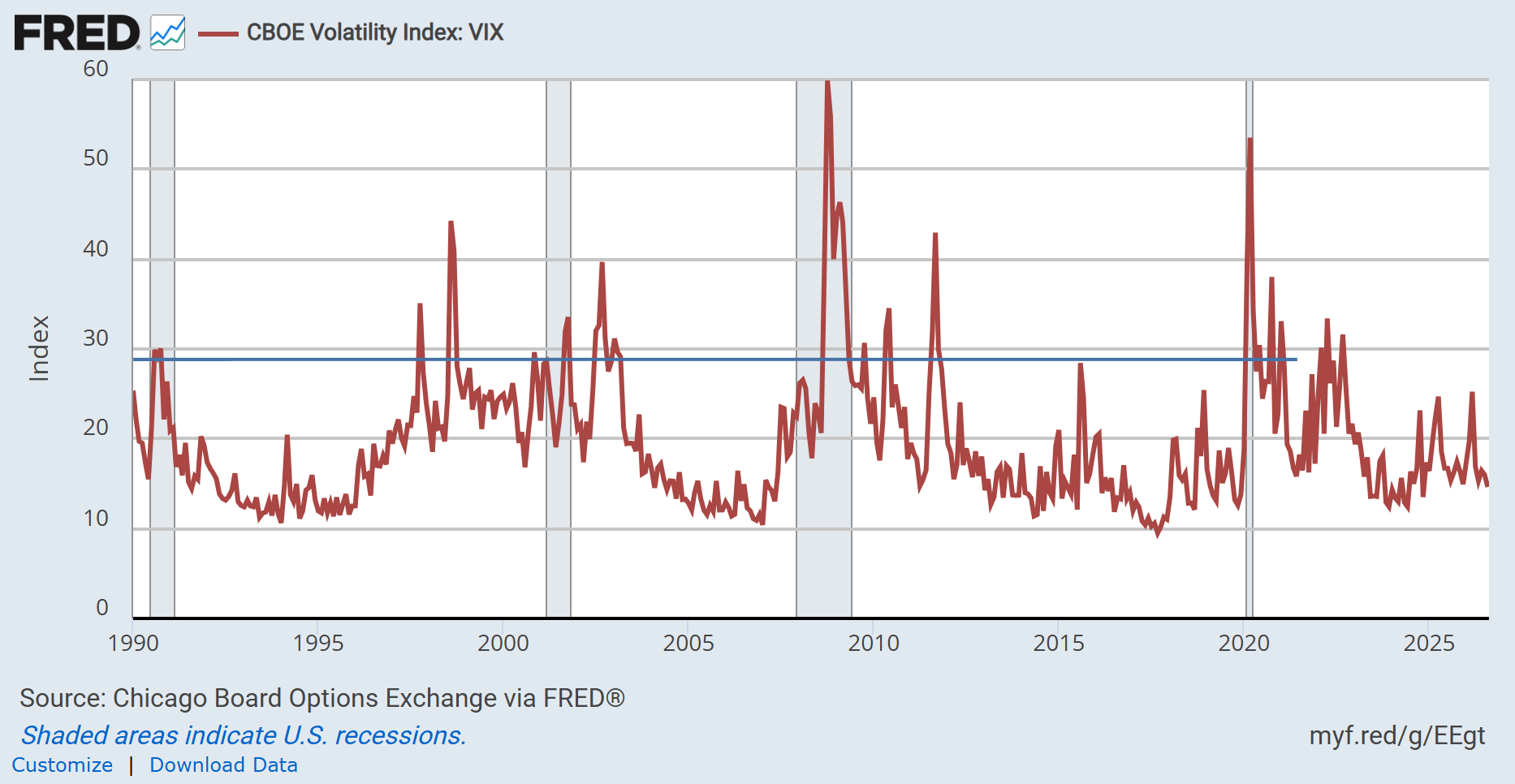
Source: Federal Reserve Bank of St. Louis FRED, using CBOE data.
Figure 2 places volatility spikes in a longer historical context. High-volatility episodes are intermittent, while calmer conditions occupy much of the sample. This helps explain why overreacting to every small movement can be costly, but also why a routine trading rhythm must include contingency plans. We cannot know the exact timing of the next extreme episode; we can only avoid confusing the absence of a shock with the absence of risk.
Figure 3. Absolute daily changes in the S&P 500 and the VIX.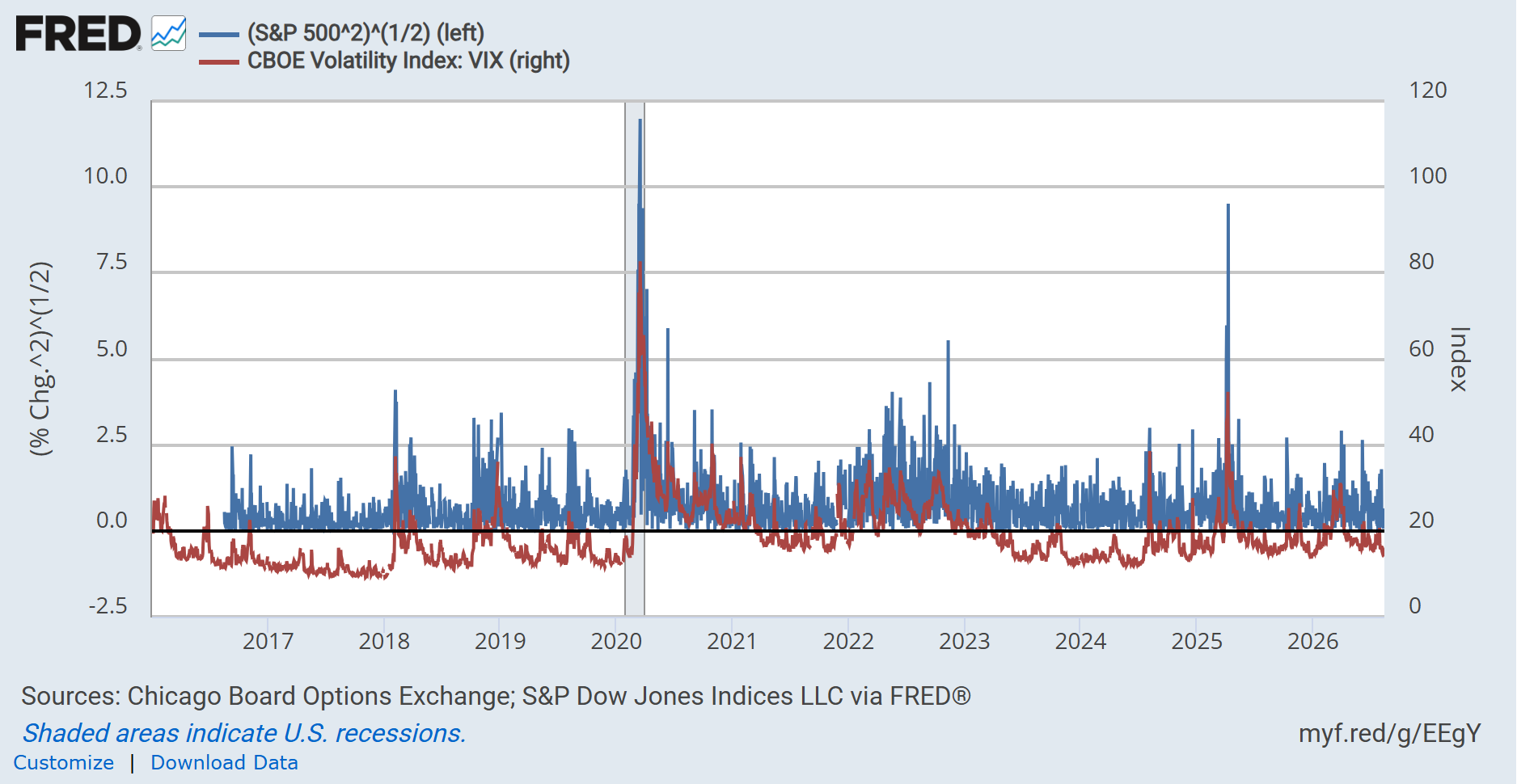
Source: Federal Reserve Bank of St. Louis FRED, using CBOE and S&P Dow Jones Indices data.
Figure 3 compares realized daily market movements with the VIX, a forward-looking measure based on options prices. The two tend to rise together in stressed periods, but they do not match exactly because they describe different horizons and information sets. This distinction mirrors SimTrade: observing what has already happened is not the same as forecasting what may happen next. Better judgment requires both evidence from realized outcomes and an explicit view of future uncertainty.
Behavioral finance behind my mistakes
The disposition effect
Selling a winning position too quickly while hesitating over a losing one resembles the disposition effect documented by Shefrin and Statman. Short-term gains feel concrete and easy to secure, whereas realizing a loss feels like admitting that the original judgment was wrong. Recognizing this bias helped me separate emotional comfort from decision quality.
Sunk costs and rational perseverance
Time, money and effort inevitably influence emotions, even though sunk costs should not determine the next decision. Perseverance is rational only when the expected future benefit still justifies the remaining risk. This principle is relevant beyond trading: in analytics projects, I should not defend a model merely because I spent time building it. I should keep, revise or abandon it according to evidence.
From trading discipline to business and data analytics
SimTrade strengthened three qualities that I want to bring to business and data analytics: patient reasoning, reflection and a long-term orientation. Data rarely explains itself. Analysts must distinguish signal from noise, test assumptions, investigate unexpected results and wait for sufficient evidence without becoming passive. The course showed me that a good decision is not defined only by whether one trade makes money. It is defined by whether the process was consistent, explainable and responsive to new information.
Why should I be interested in this post?
For students interested in finance, consulting or analytics, simulations offer a safe environment in which to discover how emotion enters supposedly rational decisions. The most transferable lesson is not a particular order or strategy. It is the habit of slowing down before acting: specify the objective, interpret the evidence, control the downside and review the result. “Haste does not bring success” is therefore not an argument for inactivity; it is a framework for disciplined action.
Related posts on the SimTrade blog
▶ Bochen LIU Know yourself and know your opponent, and you will never be defeated – Sun Tzu
▶ What I learned during my time in the stock market
▶ Posts about behavioral finance
Useful resources
Academic research
Arkes, H. R., & Blumer, C. (1985) The Psychology of Sunk Cost, Organizational Behavior and Human Decision Processes, 35(1), 124–140.
Kahneman, D., & Tversky, A. (1979) Prospect Theory: An Analysis of Decision under Risk, Econometrica, 47(2), 263–291.
Shefrin, H., & Statman, M. (1985) The Disposition to Sell Winners Too Early and Ride Losers Too Long: Theory and Evidence, The Journal of Finance, 40(3), 777–790.
Confucius, The Analects, Book XIII, “Zi Lu”.
Market data
Federal Reserve Bank of St. Louis FRED: Measuring uncertainty and volatility with FRED data
SimTrade
About the author
The article was written in August 2026 by Feitong GUO (The Chinese University of Hong Kong, Shenzhen, Accounting and Data Analytics, 2023–2027; ESSEC Business School, BBA Exchange Program, Spring 2026).
▶ Discover all articles by Feitong GUO .