


In this article, Feitong GUO (The Chinese University of Hong Kong, Shenzhen, Accounting and Data Analytics, 2023-2027; ESSEC Business School, BBA Exchange Program, Spring 2026) reflects on how her experience as an Audit Assistant at Ernst & Young (EY) and her work as a Project Consultant at A Better Community (ABC) taught her two complementary ways of supporting reliable decisions: verifying evidence against established standards and designing an evaluation framework when the standards themselves must first be defined.
About the organizations
EY and ABC operate in very different environments, but both transform complex information into structured evidence for decision-makers. EY does so through established assurance and review procedures, while ABC provides professional services that help social organizations and funders make more informed decisions.
Ernst & Young (EY) is a global professional-services organization providing assurance, consulting, strategy and transactions, and tax services. I worked as an Audit Assistant in July and August 2025. To respect confidentiality, I do not identify the financial institutions or funds involved.
Logo of EY.
Source: the company.
A Better Community (ABC), founded in 2008, mobilizes professional volunteers to provide consulting, research, digital, impact-investment and philanthropic-advisory services to social organizations. Since August 2025, I have served as a Volunteer Management Team Member and Project Consultant. I have participated in three volunteer-recruitment seasons and two project seasons, supporting a nonprofit educational research organization and a foundation investment project.
Logo of A Better Community.
Source: the organization.
From applying standards to designing them
Verification in audit
At EY, my tasks included assisting with audit working papers, reviewing credit files and checking financial information. In credit-file reviews, I examined borrower information such as loan amounts, interest rates, collateral or guarantees, repayment capacity and the bank’s internal loan-risk classification. Completeness meant more than confirming that every required field had been filled in. I also checked whether the information was supported by relevant documents and remained consistent across client reports, audit materials and credible public sources. When the sources did not agree, I recorded the discrepancy and sought clarification rather than selecting the figure that appeared most convenient.
I also supported valuation-related checks for selected investment projects held by funds. The purpose was to verify parts of the existing estimates, not to perform the valuation independently. I organized project information and valuation schedules, traced operational inputs such as annual production volumes, prices and forecasts to annual reports and other supporting materials, and checked formulas and cross-references between different tables. When figures did not match, I followed their sources and calculation paths to locate the problem. If the discrepancy could not be resolved, I documented it and raised a specific question with the client team or my mentor.
These tasks could be repetitive, but they were not trivial. A small inconsistency in a date, amount, formula or supporting document could affect the reliability of the output. Audit taught me to preserve an evidence trail, distinguish a fact from an inference and know when escalation was necessary. I contributed to the process rather than owning the final audit conclusion, yet that role showed me how disciplined verification supports trust.
Evaluation in nonprofit consulting
In ABC’s foundation investment project, the question moved upstream. The client wanted a reusable methodology to screen potential partner organizations and inform future funding decisions. Our team was not merely checking whether information met an existing standard; we first had to decide what a reasonable and usable standard should contain. I was responsible for researching nonprofit-screening methodologies and contributing to the indicator framework and its validation.
Our emerging framework has three sequential layers: compliance, communication and value. Compliance is an entry gate. It may include checks of registration status, annual reports, financial disclosures, penalties and abnormal operating information through credible public sources. If an organization does not pass the required compliance checks, it does not proceed to the communication assessment. This prevents strong publicity from compensating for a fundamental compliance concern.
For organizations that pass the first gate, the communication layer distinguishes current capacity from future potential. Current capacity may be reflected in the volume, frequency, clarity and audience response of existing content. Potential depends less on polished videos or follower counts and more on whether the organization operates a credible project, can provide verifiable stories and evidence, is willing to cooperate in content development, and has a mission that can be meaningfully communicated to the foundation’s target audience. The value layer then asks whether the project addresses a genuine need, has a reasonable intervention logic and is aligned with the funder’s objectives.
The same form, but a different decision problem
At first sight, my work at EY and ABC followed a similar process. In both cases, information had to be collected, entered into a structured table, assessed and transformed into a decision-oriented output. In EY credit-file reviews, the output contributed to an internal loan-risk classification. At ABC, the framework is intended to support the screening of nonprofit organizations and future funding decisions.
The fundamental difference lies in who defines the methodology. At EY, the required fields, supporting documents, assessment standards and classification rules had already been established. My responsibility was to research and verify the information, complete the required fields, check consistency and identify issues that needed clarification. At ABC, our team is helping to design the table itself: its questions, evidence requirements, gates, scoring logic and final decision rules.
The two settings also use different forms of internal consistency. In valuation checks at EY, I examined numerical relationships: for example, how operational assumptions entered one schedule and affected another calculation. In the ABC framework, the relationship is procedural. An organization must pass the compliance gate before its communication potential and project value are assessed. In both cases, a result is credible only when the path from evidence to conclusion can be traced.
Why the evaluation-criteria model appears here
Figure 1. Evaluation criteria developed by the Organisation for Economic Co-operation and Development’s Development Assistance Committee (OECD-DAC).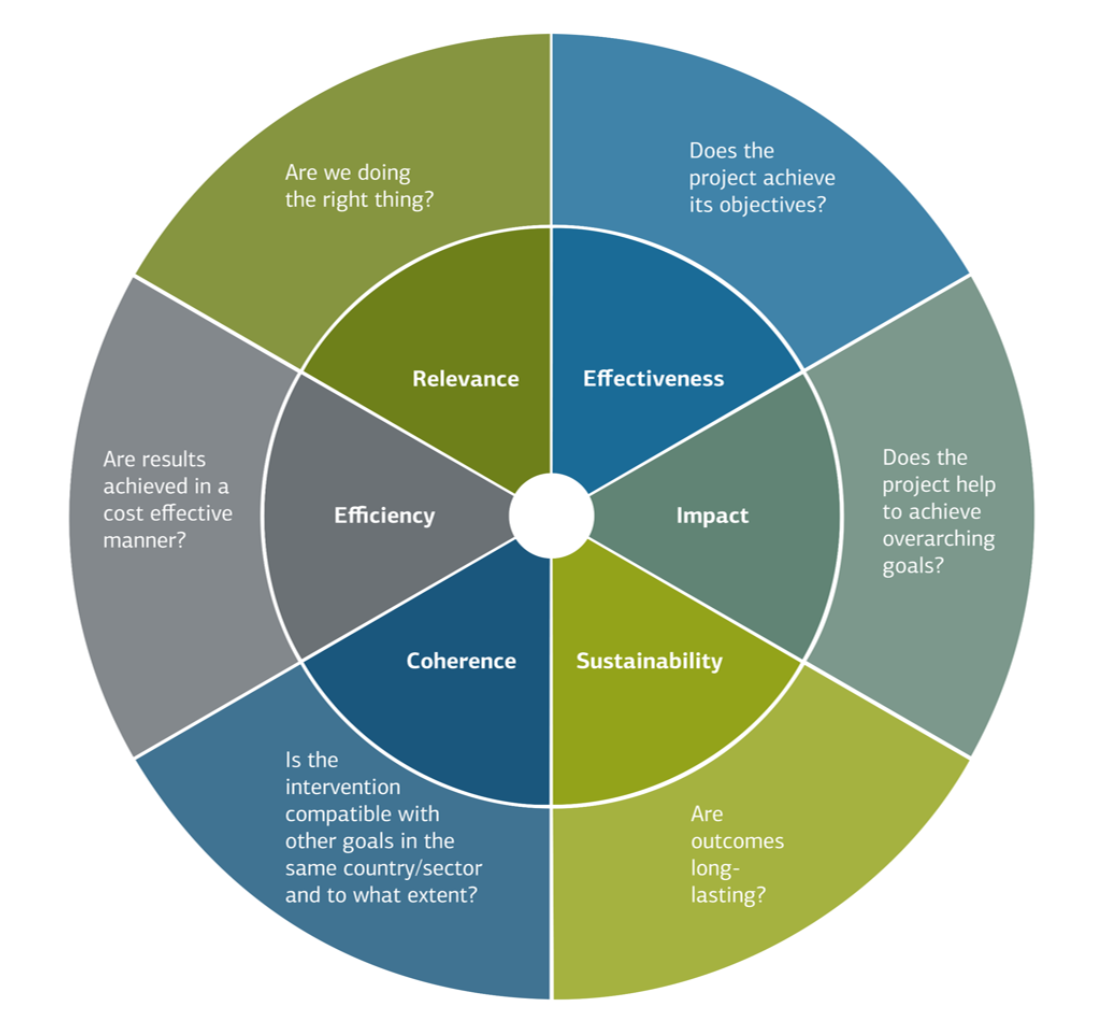
Source: KfW Development Bank, based on the OECD-DAC evaluation criteria.
The OECD-DAC framework evaluates development interventions through six complementary criteria: relevance, coherence, effectiveness, efficiency, impact and sustainability. It appears here because our team first examined established evaluation methodologies before designing a framework adapted to nonprofit screening and funding decisions. The framework shows that evaluation requires several distinct questions and that each criterion should clarify what evidence an evaluator needs.
However, we did not copy the OECD-DAC model directly. It is primarily designed to evaluate development interventions, whereas our client needs to screen organizations before selecting partners and allocating future funding. We therefore used it as a methodological reference and adapted its multi-dimensional logic to our sequential compliance, communication and value framework. It informed our thinking, but it is not our final framework.
A practical illustration of the framework
Consider a nonprofit organization with a legally registered status, an active social-media account and an education project that appears attractive to potential donors. These characteristics would not immediately produce a positive recommendation. The compliance layer would first verify its registration, annual reports, financial disclosures and relevant risk information. If the organization passed this gate, the communication layer would distinguish current performance, such as publication frequency and audience engagement, from future potential, including the availability of credible project stories, supporting evidence and willingness to cooperate. The value layer would then examine whether the project addresses a genuine need and is aligned with the foundation’s objectives.
This staged process is intended to avoid two common errors: treating polished communication as proof of project value, and treating a lack of current communication resources as proof that an organization has no communication potential. The detailed indicators are still being developed and will need practical testing before the methodology is delivered.
Validation before delivery
A framework may look logical in a presentation and still fail in practice. Another project group will apply the draft indicators to real cases. Their work may reveal unavailable data, overlapping criteria, vague scoring anchors or outputs that do not match the client’s decision needs. We will then revise the definitions, evidence requirements, gates and scoring rules. This process resembles audit in an important way: a conclusion must be traceable to evidence. It also resembles analytics because the model must be tested against observed results rather than defended simply because effort has already been invested in it.
Required skills and knowledge
Both experiences required attention to detail, information organization and professional judgment. Audit placed greater emphasis on accuracy, documentation, reconciliation and escalation. Nonprofit consulting required methodology research, framework design, stakeholder alignment and the ability to translate broad ideas into observable indicators. Across both settings, the most important skill was asking what decision the information was meant to support before deciding how to collect or process it.
What I learned
EY taught me how to use a methodology responsibly, while ABC taught me how difficult it is to design one responsibly. Applying an existing framework requires accuracy, traceability and consistency. Designing a new framework requires the same discipline, but also demands decisions about definitions, evidence, thresholds and trade-offs. Together, the two experiences changed my understanding of evaluation: a reliable result depends not only on the quality of the information entered into a table, but also on the quality of the methodology behind the table.
Economic, financial and business concepts related to my experience
Due diligence and information reliability
Due diligence reduces information asymmetry by checking the reliability, completeness and relevance of evidence before a decision. Credit-file review, valuation checks and nonprofit compliance screening all apply this logic, even though their procedures and stakeholders differ. In each setting, important claims should be traceable to identifiable sources.
Multi-criteria decision analysis
Funding decisions rarely depend on a single metric. Multi-criteria decision analysis makes trade-offs explicit by defining dimensions, evidence and scoring rules. Some conditions may function as gates rather than compensable scores. In our emerging framework, compliance serves this role: communication strength cannot compensate for failure to meet a mandatory compliance requirement.
Model validation and iteration
An evaluation framework is a model of reality. Validation asks whether different reviewers can apply it consistently, whether the necessary evidence is available and whether its outputs are useful for the intended decision. Testing and iteration are therefore part of responsible design, not signs that the first draft failed.
Why should I be interested in this post?
For students interested in audit, consulting, impact investing or business analytics, these experiences show a progression from checking information to structuring judgment. Entry-level work may begin with documents, confirmations and meeting records, but those tasks build the discipline needed for higher-level analysis. The challenge is to connect every task to its decision purpose: what is being verified, what uncertainty remains and what evidence would justify the next step?
Related posts on the SimTrade blog
▶ Iris ORHAND My apprenticeship experience as a Junior Financial Auditor at EY
▶ Iris ORHAND Risk-based Audit: From Risks to Assertions to Audit Procedures
▶ Anant JAIN Impact Investing
Useful resources
Academic research and reports
Gamvros, I., Nidel, M., & Raghavan, N. R. S. (2006) Investment Analysis and Budget Allocation at Catholic Relief Services, Interfaces, 36(5), 400-406.
Salimi, N., & ten Have, W. (2024) Aiding Philanthropic Venture Capitalists in Selecting Nonprofit Organisations, Journal of Philanthropy and Marketing, 29(1), e1834.
Bayarri, M. J., Berger, J. O., Higdon, D., Kennedy, M. C., Kottas, A., Paulo, R., Sacks, J., Cafeo, J. A., Cavendish, J., Lin, C. H., & Tu, J. (2002) A Framework for Validation of Computer Models, NISS Technical Report 128.
Business and organization resources
A Better Community: Consulting services
KfW Development Bank: Evaluation criteria and rating scale
About the author
The article was written in August 2026 by Feitong GUO (The Chinese University of Hong Kong, Shenzhen, Accounting and Data Analytics, 2023-2027; ESSEC Business School, BBA Exchange Program, Spring 2026).
▶ Discover all articles by Feitong GUO .