Volkswagen in China: How Localization Strategy Built Success and Created New Challenges

Bochen LIU

In this article, Bochen LIU (Queen’s Smith School of Business, BCom 2023–2027; ESSEC BBA Exchange Program, Fall 2025) explains how Volkswagen’s localization strategy has become a key marketing approach for maintaining competitiveness in the Chinese automobile market. By adapting products, branding, digital communication, and consumer engagement to local preferences, Volkswagen demonstrates how international companies can strengthen their market position through localization rather than standardization.

Volkswagen in China

Volkswagen has been one of the most successful foreign automobile brands in China since entering the market in the 1980s. Through joint ventures with SAIC and FAW, Volkswagen developed a strong business presence by combining its global automotive expertise with local market knowledge. Rather than simply exporting global models, Volkswagen adopted a localization strategy by adapting its products, production processes, and marketing activities to better meet the needs and preferences of Chinese consumers. This approach allowed Volkswagen to establish a strong market position and become one of the leading international automobile brands in China.

The success of Volkswagen in China was highly dependent on its ability to make products that could suit the taste of the Chinese market. For instance, one of the first successful products made by Volkswagen in China was the Santana, which had high reliability and suitability for use by the Chinese consumers. Later, another model known as Lavida was designed specifically for the Chinese market. This model was made taking into consideration the needs of the Chinese consumers for spaciousness and comfort. This shows that the company managed to localize its global brand in the local market by making products that could suit the needs of the Chinese customers.

The Chinese automobile market has been transformed in recent years. In the past, VW could take advantage of its global reputation, engineering skills, and reliability to gain success in the Chinese market. However, today, the customers give more attention to electric cars, intelligent systems, and digital products. The development of Chinese companies producing electric cars, such as BYD and NIO, is posing new challenges for the company. In conclusion, while Volkswagen’s localization strategy has been successful in helping the company enter the Chinese market, it needs to adapt constantly.

From Localization to Competitive Advantage in China

Volkswagen’s localization strategy is important because Chinese consumers increasingly evaluate vehicles based on factors beyond traditional brand reputation. While Volkswagen previously benefited from its global reputation for reliability and engineering quality, the Chinese automotive market has shifted toward digital technology, intelligent driving features, and user experience. Therefore, adapting products and marketing communication to local preferences has become essential for maintaining customer relevance.

For example, Volkswagen has invested in localized technology and product development to better respond to Chinese consumers’ expectations for intelligent vehicles. Features such as intelligent cockpit systems, localized infotainment functions, and digital services allow Volkswagen to compete with domestic brands that have strong technological advantages. Without these adaptations, Volkswagen risks losing younger Chinese consumers who increasingly prioritize innovation and connectivity over traditional brand value.

Consulting: structuring and reducing uncertainty

Market localization requires market analysis procedures. As part of its business strategy, the company constantly gathers consumer data, analyzes competitors, and tracks shifts in consumer demands. Tools like the STP model (segmentation, targeting, and positioning), SWOT analysis, and consumer journey mapping make this easier.

As a result, Volkswagen uses market analysis tools to identify potential customer groups and create more relevant marketing campaigns.

Financial analysis: measuring and pricing risk

The effectiveness of localization can be evaluated through measurable business indicators, including market share, customer acquisition, sales growth, and brand preference. These metrics allow managers to determine whether localized marketing investments generate sustainable returns.

Improved localization often increases customer satisfaction and strengthens long-term brand loyalty, ultimately reducing marketing costs while improving overall business performance.

Challenges in China’s Changing Automotive Market

The Chinese automotive market has experienced significant uncertainty due to the rapid development of electric vehicles, government support for new energy vehicles, and changing consumer expectations. Unlike traditional market risks that can be estimated through historical data, these changes have created new competitive conditions that Volkswagen could not fully predict based on its previous success.

These changes require Volkswagen to continuously adapt its marketing strategy rather than relying only on its previous competitive advantages. For decades, Volkswagen benefited from its strong reputation for quality and reliability in China. However, the rise of domestic EV manufacturers has shifted competition toward technology, connectivity, and user experience. Therefore, Volkswagen’s future competitiveness depends on its ability to localize not only its products but also its digital and innovation strategies.

From managing risk to building resilience

Volkswagen builds long-term resilience by making localization an ongoing strategic capability rather than a temporary marketing campaign. Continuous investment in local research and development, partnerships with Chinese technology companies, and localized communication channels enable the company to respond more quickly to changing market conditions.

This adaptive approach allows Volkswagen to strengthen customer relationships while maintaining competitiveness in an increasingly dynamic automotive industry.

Why should I be interested in this post?

Volkswagen’s experience demonstrates that successful international marketing requires more than global brand recognition. Companies must understand local consumers, adapt their value proposition, and continuously refine their marketing strategy to remain competitive.

For business and marketing students, this case illustrates how localization, consumer insight, and strategic positioning can transform global brands into locally relevant market leaders, providing valuable lessons for international marketing and brand management.

Related posts on the SimTrade blog

   ▶ Mathis HOUROU Client Segmentation and Private Banking: Marketing Strategy or Risk Shield?

   ▶ Guylan ABBOU My Personal Experience in Marketing, and How It Links to Finance

   ▶ Emmanuel CYROT My Internship as a Junior Consultant in Marketing & Finance Studies at Eres Gestion

Useful resources

Volkswagen Newsroom

Volkswagen Group China

American Marketing Association (AMA)

About the author

The article was written in August 2026 by Bochen LIU (Queen’s Smith School of Business, BCom 2023–2027; ESSEC BBA Exchange Program, Fall 2025).

▶ Discover all posts by Bochen LIU

Recent Financial Innovations in China in the 2020s

Recent Financial Innovations in China in the 2020s

Samia DARMELLAH

In this article, Samia DARMELLAH (ESSEC Business School, Global BBA, 2020-2024) present recent financial innovations in China in the 2020s.

Introduction

During my academic exchange at Fudan University in China, I was captivated by the innovation and dynamism of the financial sector. In 2024, China is considerably ahead of other countries in terms of financial progress, reshaping the services landscape with revolutionary technologies. In this article, we will explore some of the most striking developments, including the rise of digital payments, blockchain integration, Intelligence Artificial in China, robo-advisors and the launch of the Digital Yuan.

By diving into these innovations, the aim is to show how they are improving the efficiency of financial services while creating new opportunities for businesses and consumers, providing a glimpse into the trends shaping the future of finance.

Digital Payments via QR Codes

Digital payments have become a revolution in China, especially those made using QR codes. Whether shopping or paying for a cab, scanning a QR code is the most common method. This trend was driven primarily by Covid-19 and has since multiplied across the country. By June 2024, over 969 million users were actively making payments via applications such as WeChat Pay and Alipay, according to Statista’s report on mobile payment users in China, published in 2024. What’s fascinating is the extent to which this practice has become ingrained in everyday life: almost 72% of consumers will regularly use mobile payments by early 2024.

Payment via QR Code.
Payment via QR Code
Source: Google Image.

Although mobile payments in physical stores have fluctuated, reaching almost 84% in the second third quarter of 2024 before dropping and rising again to 72% in the first quarter of 2024 according to Statista. Digital transaction trends remain strong and dominant across China, facilitating billions of transactions seamlessly and securely.

Blockchain for Security and Transparency

Blockchain is a technology that allows a database to be shared in a decentralized manner, that is, between actors who do not necessarily trust each other and without a central controlling entity. In China, blockchain technology has become an essential pillar of financial security and transparency. It has enormous potential, according to a study carried out by Statista between 2017 and 2022, the market size is expected to reach more than 27 billion yuan by 2025 and nearly 69 billion yuan by 2030.

One of the growing sectors that benefits from blockchain in China is logistics. Companies like Alibaba are using this technology to track goods at every stage of their shipment, from manufacturing to delivery. Thanks to blockchain, data on the origin, quality and transport conditions of products are recorded transparently and securely. This not only helps to strengthen consumer confidence, but also to combat counterfeiting, a major challenge for companies operating in China.

AI-Powered Lending

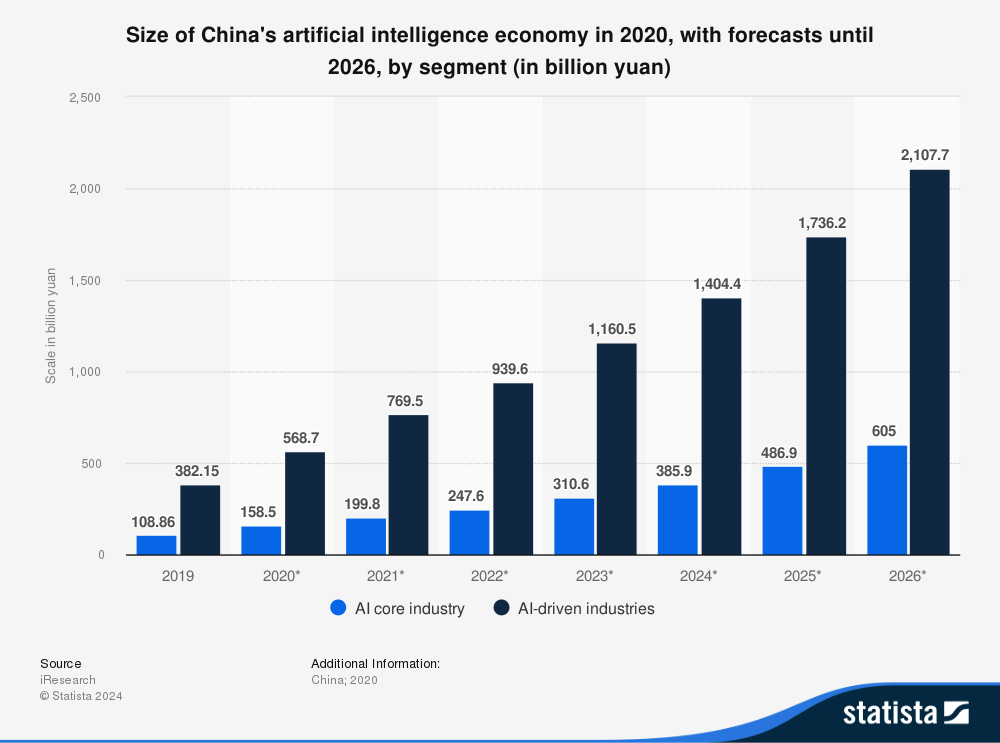
Artificial intelligence (AI) plays a major role in China, with the market reaching around 70 billion yuan in 2020. Forecasts indicate that it could reach nearly 170 billion yuan by 2026. The technology is being integrated into a variety of sectors, including healthcare, financial services, and retail. Companies like Alibaba and Baidu are investing heavily in the development of AI solutions, driving growth, and transforming the way businesses operate. China’s dominance in this field could position it as a global leader in AI in the years to come.

Size of China’s artificial intelligence economy in 2020
 Size of China's artificial intelligence economy in 2020, with forecasts until 2026, by segment (in billion yuan)
Source: Statista.

Size of China’s artificial intelligence economy in 2020, with forecasts until 2026, by segment (in billion yuan)

Robo-Advisors in Wealth Management

In China, innovation in wealth management is booming thanks to robo-advisors. These automated platforms use artificial intelligence to provide personalized investment advice, tailored to each user’s financial goals. The Chinese robo-advisor market is expected to reach $2.67 billion by 2024, with annual growth of 10% to 2027 according to Statista.

According to a BlueWeave Consulting report on artificial intelligence in China in 2024, this expansion is fueled by the growth of the middle class, which will number over 400 million people in 2020. Robo-advisors are making it easier and cheaper to access financial services.

Today, many financial companies are adopting these technologies to attract younger customers. For example, the MyBank platform, a digital bank affiliated to Ant Financial (Alibaba) uses AI algorithms to offer automated, personalized financial services. This model has transformed the way financial services are offered, making wealth management more accessible for the new generation. Robo-advisors are no longer reserved for high-net-worth investors but have also become accessible to ordinary customers. This phenomenon illustrates how China’s innovations are transforming the wealth management landscape.

The Digital Yuan and Cryptocurrencies

The digital yuan, or “e-CNY” as it is also known, is a digital version of China’s currency launched in a test phase in 2020 by the People’s Bank of China. Unlike decentralized crypto-currencies, the digital yuan is fully state-controlled, enabling secure and traceable transactions. It has revolutionized the payments market in China, offering an alternative to platforms such as Alipay and WeChat Pay. By facilitating instant payments, even offline, it has improved financial inclusion, particularly for unbanked populations.

The e-CNY also enables the government to strengthen economic surveillance and stimulate the growth of digital commerce. As the digital yuan develops, it could potentially influence the dynamics of digital currencies worldwide.

Conclusion

In summary, China’s financial sector is evolving rapidly thanks to innovative technologies that are making services more accessible and efficient. The rise of digital payments, the use of blockchain, artificial intelligence, robo-advisors and the launch of the digital yuan show how China is transforming its financial landscape. These changes are opening up new opportunities for consumers and businesses and paving the way for the future of financial services, both in China and internationally.

Related posts on the SimTrade blog

   ▶Nithisha CHALLA Top financial innovations in the 21st century

   ▶Nithisha CHALLA Top 5 companies by market capitalization in China

Useful resources

BlueWeave Consulting (2024) China Artificial Intelligence Market

Fullerton, E. J. (2022) The People’s Republic of China’s Digital Yuan: Its environment, design, and implications. Asian Development Bank

Marin-Dagannaud, G. (2017) Le fonctionnement de la blockchain. Annales Des Mines – Réalités Industrielles

Shen, K., Tong, X., Wu, T., & Zhang, F. (2022) The next frontier for AI in China could add $600 billion to its economy

Statista (2024) Number of mobile payment users in China from 2024 to June 2024

Statista (2018-2024) Mobile payments adoption in POS in China from 2018 to 2024

Statista (2017-2022) Blockchain market size in China from 2017 to 2022

Statista (2019-2026) Scale of AI industry in China by segment from 2019 to 2026

Statista (2017-2027) Robo-advisors market in China from 2017 to 2027

About the author

The article was written in October 2024 by Samia DARMELLAH (ESSEC Business School, Global BBA, 2020-2024).