

In this article, Mathis HOUROU (ESSEC Business School, Global Bachelor in Business Administration (GBBA), 2022-2026) shares his experience as a consolidation intern at Evernex. He explains how a group builds its consolidated accounts, step by step.
About the company
Evernex is a global provider of third-party maintenance (TPM) for data center equipment. It maintains and repairs servers, storage and network devices, but it is not their manufacturer. Clients keep their hardware running for longer and pay less than with the support of the manufacturer. The company is based in Paris.
Logo of Evernex.

Source: Evernex.
Evernex also manages spare parts, recycles equipment, erases data in a secure way and moves data centers. It offers rental and financing of IT hardware as well. In November 2024, 3i described a presence in more than 165 countries and more than 500,000 IT systems maintained.
The group has grown through acquisitions. The investment company 3i entered its capital in October 2019. Since then, Evernex has bought companies such as Storex in South Africa (2020), XSi in the United States (2022) and Ultra Support in the United Kingdom (2024). Ultra Support was the seventh acquisition since the investment of 3i. From an accounting point of view, each new company has its own ledger, its own currency and its own accounting habits. This is why consolidation matters a lot for this group.
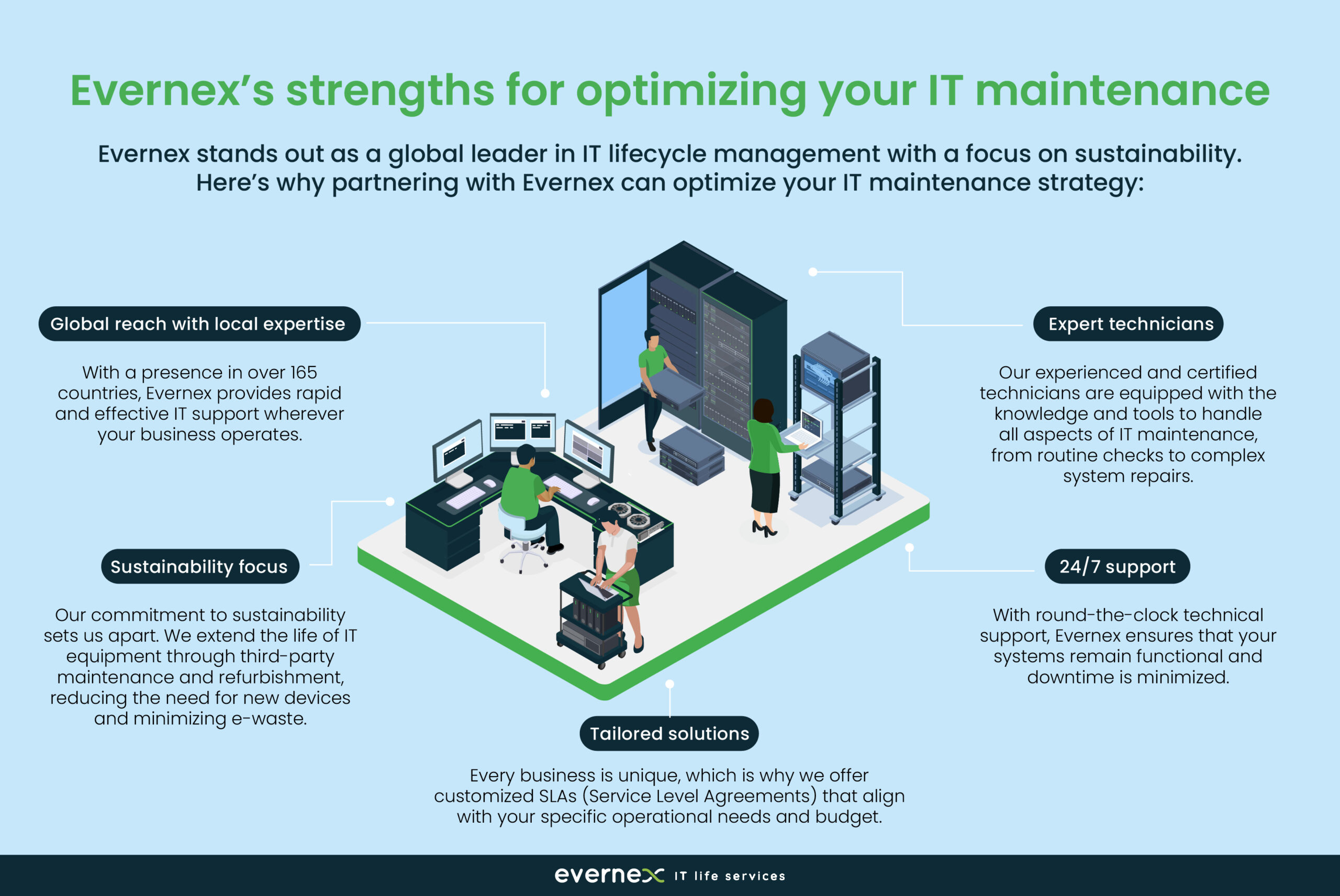
Evernex IT maintenance.
Source: Evernex.
My internship
I work in the consolidation team in Paris. My internship lasts six months and started in September 2026. The team produces the accounts of the group every month. The work starts with the closing of each subsidiary and ends with the figures shown to top management.
I knew consolidation from my courses at ESSEC Business School. In practice, it is different. The numbers do not come from one ledger. They come from many entities. My role is to check that they fit together.
My missions
My main mission is to follow the monthly closing of the subsidiaries. They are in several countries and on several continents. Each month, I check that their accounts are complete and consistent before they enter the group figures. It is the first control of the team.
I also reconcile intercompany balances. This means checking that two entities of the group record the same transaction in the same way. For example, one entity books an invoice in December and the other one books it in January. This creates a difference of a few thousand euros. I look for the cause and ask the local accountant to correct it.
I follow indicators such as DSO (Days Sales Outstanding), DPO (Days Payable Outstanding) and bad debt. Bad debt is the part of the client invoices that may never be paid. I take part in the IFRS restatements used to calculate the EBITDA of the group, and I review the P&L of the entities. I also prepare slides for the CFO and the COO, with a focus on the expenses part of the EBITDA.
Required skills and knowledge
You need solid accounting bases, especially debit and credit, and a good knowledge of IFRS. I use Excel every day to check and compare large amounts of data. Rigor matters, because a small error in one entity can change the group figures.
Communication matters too. I often write to accountants in other countries and time zones. My requests must be clear and polite, so that they can explain or correct a number quickly.
What I learned
The quality of the group accounts starts with the quality of each local closing. I also learned to look at a number from the point of view of the group. A small difference in one entity can become a real issue when you compare it with the other side of the transaction.
Financial concepts related to my internship
The main concept of this post is financial consolidation. It is the core of my daily work. I define it first. Then I follow the process step by step and explain the purpose of each step.
What is financial consolidation?
Financial consolidation combines the financial statements of several legal entities into one set of accounts. The group is treated as if it were a single company. According to the IFRS Foundation, IFRS 10 defines consolidated financial statements as the statements of a parent and its subsidiaries, presented as those of a single economic entity.
Why do we need it? The performance of a group is not the sum of the accounts of its entities. Take an example. Entity A invoices EUR 200,000 of maintenance services to Entity B. Both belong to the same group. A records EUR 200,000 of revenue. B records EUR 200,000 of costs. For the group, nothing happened with the outside world. The group only paid itself. Without correction, the revenue and the costs of the group are both overstated by EUR 200,000.
Two other problems must be solved. The entities can work in different currencies. They can also use different accounting rules. The consolidation process solves these three problems one after the other. It starts with one question: which entities are in the group? This is the consolidation scope. When Evernex acquired Ultra Support in November 2024, a new entity entered the scope with all its accounts.
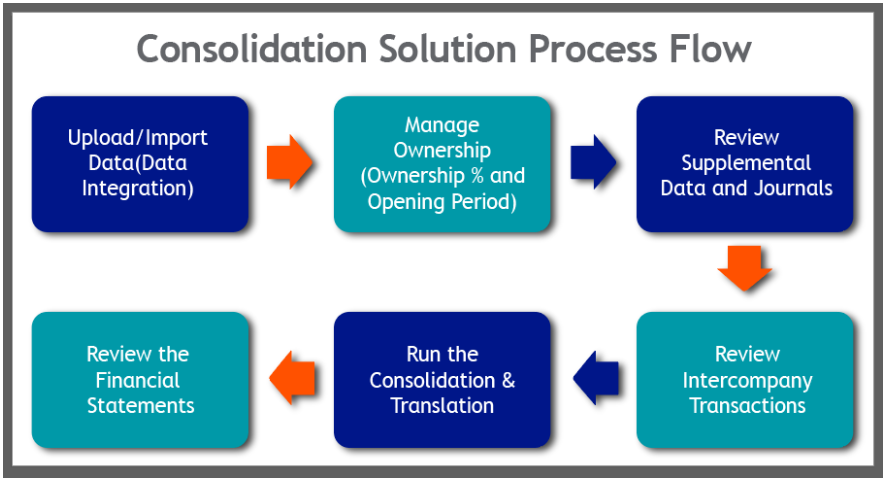
Example of a financial consolidation process flow.
Source: Mastek.
The steps below follow my own experience. They can differ a little from this example, because each group organizes its process in its own way.
Step 1: Local closing in each entity
Each subsidiary closes its own books first. The local team records its last entries, reconciles its bank and client accounts and produces a trial balance.
Purpose: the group accounts can only be as reliable as the local ones. An error that stays in this step will travel through the whole process.
Step 2: Reporting package and validation
Each entity sends its figures to the consolidation team in a standard reporting package. The local accounts are mapped to the chart of accounts of the group, so that a line such as revenue means the same thing everywhere. Checks flag missing data, accounts that do not balance and unusual changes from one month to the next.
Purpose: get comparable data and find the obvious errors early, while the local accountant can still fix them quickly.
Step 3: IFRS restatements
Local accounts often follow local rules. The group reports under IFRS. So the consolidation team adjusts the figures to the same standard. Leases are a good example. Under IFRS 16, a lessee records most leases on its balance sheet, as a right of use asset and a lease liability. Imagine that a subsidiary books a rent of EUR 120,000 per year as a simple expense in its local accounts. In the group accounts, this rent is replaced by a depreciation and an interest expense. The EBITDA of the group is then EUR 120,000 higher, because the rent is no longer in the operating expenses.
Purpose: measure all entities with the same rules, so that they can be added together and compared.
Step 4: Intercompany reconciliation
Before any elimination, the team checks that both sides of each internal transaction match. If entity A shows a receivable of EUR 200,000 on entity B, B must show a payable of EUR 200,000 to A. If B shows only EUR 195,000, the gap of EUR 5,000 has to be explained. The usual causes are an invoice booked in different months, a different exchange rate or a simple booking error.
Purpose: make the next steps possible, because an elimination works only if both sides agree. Handling intercompany activity is described as one of the most time consuming parts of the close (Workday). It is also where I spend a large part of my time as an intern.
Step 5: Currency translation
Subsidiaries report in their local currency. The group reports in one currency. Under IAS 21, assets and liabilities are translated at the closing rate. Income and expenses are translated at the rate of the transaction date, usually approximated by the average rate of the period. Equity items stay at historical rates.
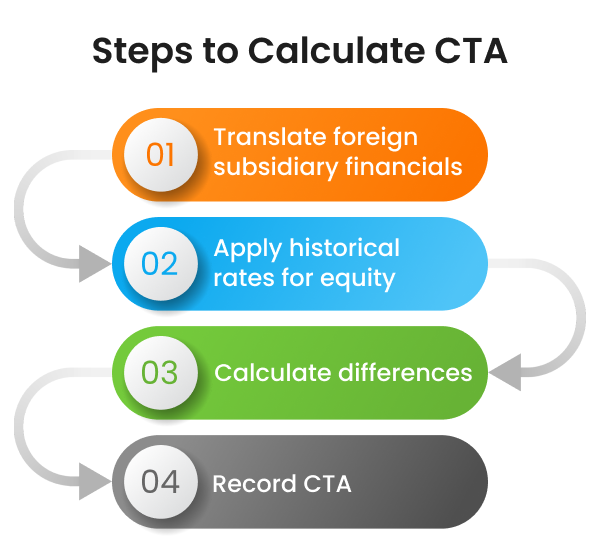
Take an example. A UK subsidiary has assets of GBP 1,000, liabilities of GBP 400 and equity of GBP 600. This equity is made of a share capital of GBP 500 and a profit of GBP 100 for the year. The closing rate is 1.20, the average rate is 1.15 and the historical rate is 1.10 euros per pound. Assets become EUR 1,200 and liabilities EUR 480, so the net assets are EUR 720. On the equity side, the share capital becomes EUR 550 and the profit EUR 115, which makes EUR 665. The balance sheet does not balance by itself. The missing EUR 55 is recorded in equity, in a line called the cumulative translation adjustment (CTA).
Steps to calculate the cumulative translation adjustment (CTA).
Source: HighRadius.
Purpose: express everything in one currency, and keep the effect of exchange rates visible in equity instead of hiding it in the result of the year.
Step 6: Eliminations
Now the group removes everything that exists only inside the group. There are three main eliminations:
- Internal revenue and costs: in our example, once the gap is corrected, the EUR 200,000 of revenue of A is cancelled against the EUR 200,000 of costs of B.
- Internal receivables and payables: the receivable of A and the payable of B are removed from the balance sheet.
- Investments and equity: the investment of the parent in a subsidiary is cancelled against the equity of this subsidiary. If the parent owns less than 100%, the share of the other shareholders is shown separately as non-controlling interests.
Purpose: avoid double counting, so that the group figures show only the transactions with the outside world.
Step 7: Review, analysis and reporting
The last step is the review of the consolidated balance sheet, income statement and cash flow statement. The team compares them with the budget and with the previous month. It explains the main changes and checks key indicators such as EBITDA or DSO. The figures are then presented to the management.
Purpose: make sure that every number can be explained. Consolidated accounts are a legal obligation. They are also the tool that managers use to take decisions.
Why should I be interested in this post?
If you want to work in asset management, equity research, audit or corporate finance, you will read consolidated accounts all the time. Knowing how they are built helps you understand what the numbers say. It explains, for example, why a strong dollar can change the reported results of a group, or why an acquisition makes the revenue jump.
This knowledge also helps if you look for an internship in consolidation, controlling or FP&A. These teams sit at the center of the information of the group and work with all the other departments. My advice to understand consolidation: follow one transaction from the local ledger to the group accounts.
Related posts on the SimTrade blog
Professional experiences
▶ All posts about Professional experiences
▶ Iris ORHAND My apprenticeship experience as a Junior Financial Auditor at EY
▶ Annie YEUNG My Audit Summer Internship experience at KPMG
Financial and accounting techniques
▶ Maxime PIOUX From IAS to IFRS: How International Accounting Standards Shape Financial Reporting
▶ Shruti CHAND Balance sheet
Useful resources
Evernex
Evernex Evernex website
3i 3i-backed Evernex continues its international growth with acquisition of Ultra Support
Evernex IT Maintenance: Complete guide for business IT teams
IFRS
IFRS Foundation IFRS 10 Consolidated Financial Statements
IFRS Foundation IAS 21 The Effects of Changes in Foreign Exchange Rates
IFRS Foundation IFRS 16 Leases
Business resources
Mastek Oracle Financial Consolidation & Close Service (FCCS) Guide
HighRadius A Guide to Cumulative Translation Adjustment (CTA) with Examples
Workday Financial consolidation and close process guide
About the author
The article was written in October 2026 by Mathis HOUROU (ESSEC Business School, Global Bachelor in Business Administration (GBBA), 2022-2026).
▶ Discover all posts by Mathis HOUROU.