At what point does diversification becomes “Diworsification”?

Yann TANGUY

In this article, Yann TANGUY (ESSEC Business School, Global Bachelor in Business Administration (GBBA), 2023-2027) explains the concept of “diworsification” and shows how to avoid falling into its trap.

The Concept of Diworsification

The word “diworsification” was coined by famous portfolio manager Peter Lynch to denote the habit of supplementing a portfolio with investments which, instead of improving risk-adjusted return, add complexity. It demonstrates a common misconception of one of the fundamental pillars of the Modern Portfolio Theory (MPT): diversification.

Whereas the adage “don’t put all your eggs in one basket” exemplifies the foundation of prudent portfolio building, diworsification occurs when an investor adds too many baskets and thus loses sight of the quality and purpose of each one.

This mistake comes from a fundamental misunderstanding of what diversification actually is. Diversification is not a function of the quantity of assets owned by an investor but of the interconnections of assets. If an investor introduces assets highly correlated with assets owned to a portfolio, the diversification effect of risk is greatly reduced, and a portfolio’s possible return can be diluted.

Practical Example

Let’s assume there are two investors.

An investor who is interested in the tech industry may hold shares in 20 different software and hardware companies. This portfolio appears diversified on the surface. However, since all the companies are in the same industry, they are all subject to the same market forces and risks. In a decline of the tech industry, it is likely many of the stocks will decline at the same time due to their high correlation.

A second investor maintains a portfolio of three low-cost index funds: one dedicated to the total US stock market, another for the total international stock market, and a third focusing on the total bond market. Despite the simplicity of holding just these three positions, this investor enjoys a far more effective level of diversification in their portfolio. The assets, US stocks, international stocks, and bonds, have a low correlation with one another. Consequently, poor performance in one asset class is likely to be counterbalanced by stable or positive returns in another, resulting in a smoother return profile and a reduction in overall portfolio risk.

The portfolio of the first investor is a perfect case of diworsification. Increasing the number of technology stocks did not do any sort of risk diversification, but it introduced complexity and diluted the effect of performing stocks.

The point at which diversification began to operate to its own harm can be identified with several factors. Diversification’s initial goal is to improve the risk-adjusted return, a concept often evaluated using the Sharpe ratio. Diworsification begins when adding a new asset does not contribute to an improvement in the portfolio’s Sharpe ratio.

You can download the Excel below with a numerical example of the impact of correlation in diversification.

Download the Excel file for mortgage

Here is a short summary of what is shown in the Excel spreadsheet.

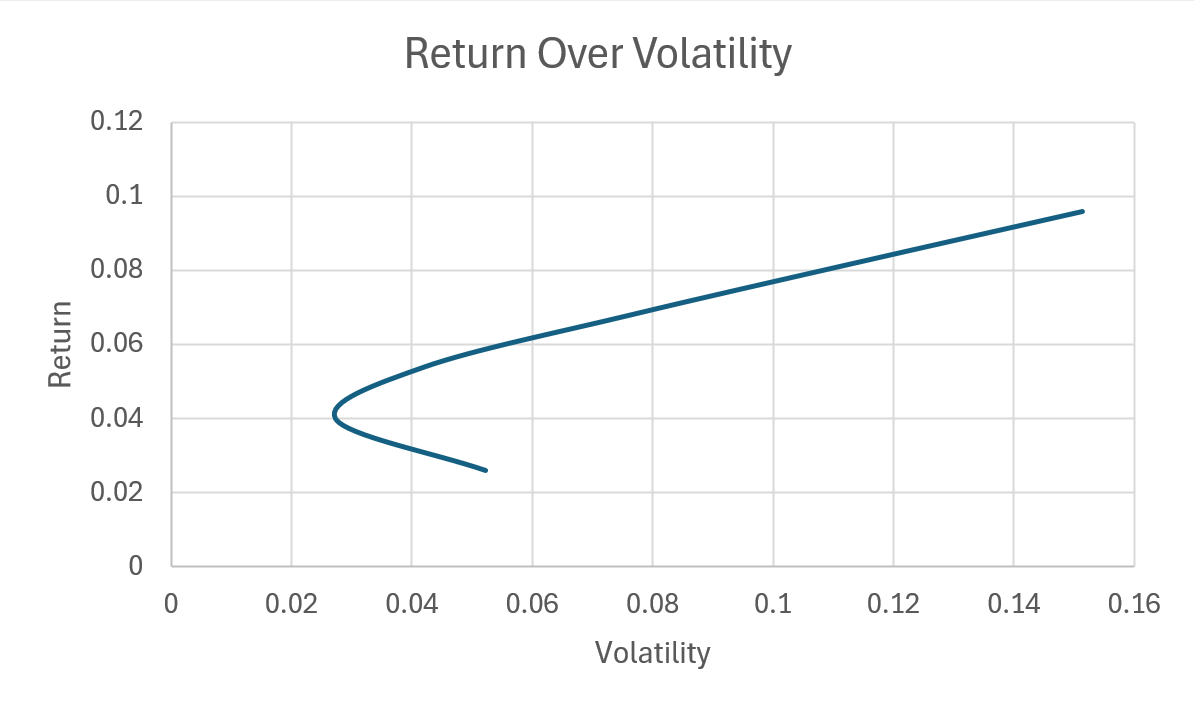
We used two different portfolios, each with 2 assets and both portfolios having a similar expected return and average volatility of assets. The only difference is that the first portfolio has correlated assets, whereas the second portfolio has non-correlated assets.
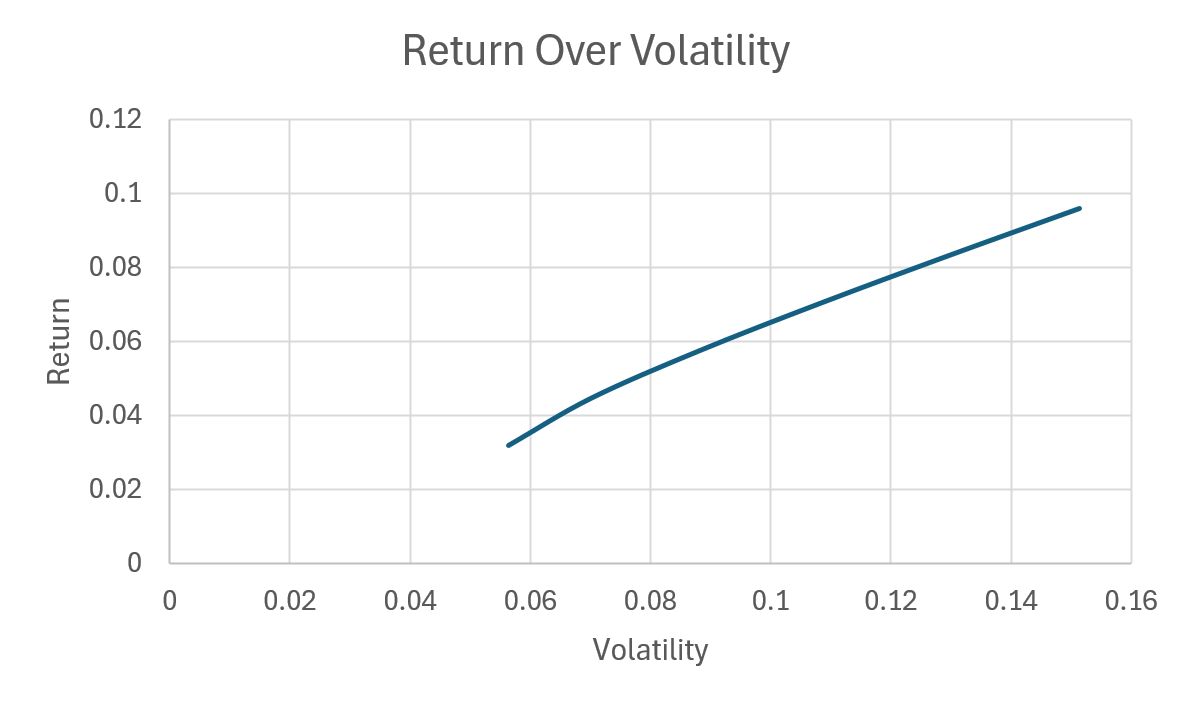
Correlated portfolio returns over volatility

Non-Correlated portfolio returns over volatility

As you can see in these graphs, the diversification effect is much more potent for the non-correlated portfolio, leading to higher returns for a given volatility.

Target number of assets for a diversified portfolio

One of the most important considerations when assembling a portfolio is determining the optimal number of assets relative to which greater diversification can be realized prior to the onset of diworsification. Studies of equity markets had indicated that a portfolio of 20 to 30 stocks could diversify away unsystematic risk.

However, this number varies according to different asset classes and the complexity of the assets. In the world of alternative investments, a landmark study, “Hedge fund diversification: how much is enough?,” was published by authors François-Serge Lhabitant and Michelle Learned in 2002, for the Journal of Alternative Investments. The authors aimed to dispel the myth that ‘more is better’ in the complex world of hedge funds. They analyzed the effect of the size of the portfolio on risk and return, determining that although adding to the portfolio reduces risk, the marginal benefits of diversification diminished rapidly.

Importantly they found that adding too many funds could lead to a convergence toward average market returns, effectively eroding the “alpha” (excess return) that investors seek from active management. Furthermore, even when volatility is reduced, other forms of risks, such as skewness and kurtosis, can get worse. The significance of this research is that it offers empirical evidence for the phenomenon of ‘diworsification’—the idea that, after a certain point, adding assets to a portfolio worsens its efficiency.

Crossover from Diversification to Diworsification

The crossover from diversification to diworsification is normally marked by three main factors.

The first is diluted returns, as the number of assets increases, the performance of the portfolio starts to resemble that of a market index, albeit with elevated costs. The favorable influence of a handful of significant winners is offset by the poor performance of many other investments.

The second is an increase in costs as each asset, and particularly each asset owned through a managed fund, comes with some costs. These can be transaction costs, management fees, or costs of research. The more assets there are, the costs add up and ultimately impose a drag on final performance.

The third is unnecessary complexity as a portfolio with too many holdings becomes hard to keep tabs on, analyze, and rebalance. Which can confuse an investor about his or her asset allocation and expose the portfolio to unnecessary risk.

Causes of Diworsification

The causes for diworsification differ systematically between individual and institutional investors. For individual investors, this fundamental mistake arises from an incorrect understanding of genuine diversification, far too often leading to an emphasis on numbers rather than quality. Behavioral biases, such as familiarity bias, manifested in a preference for investing in well-known names of firms, or fear of missing out, which drives investors toward recently outperforming “hot” stocks, can generate portfolios concentrated in highly correlated securities.

The causes of diworsification for institutional investors are fundamentally different. The asset management business puts on a lot of strain that can lead to diworsification. Fund managers, measured against a comparator index, may prefer to build oversized funds whose portfolios are similar to the index, a process called “closet indexing.” Even if such a strategy reduces the risk of underperforming the comparator and thus losing clients, it also ensures that the fund will not show meaningful outperformance, all the time collecting fees for what is wrongly qualified as active management. In addition, the sale of complex product types like “funds of funds” adds further levels of fees and can mask the fact that the underlying assets are often far from unique.

How to avoid Diworsification

Diworsification doesn’t refer to an abandonment of diversification. Rather, it demands a more intelligent strategy. The emphasis should move from raw number of holdings to the correct asset allocation of the portfolio. The key is to mix asset classes with low or even adverse correlations to each other, for example, stocks, government securities, real estate, and commodities. This method allows for a more solid shelter from price fluctuations than keeping a long list of homogeneous stocks.

A low-cost and efficient means for many investors to achieve this goal is to utilize broad-market index funds and ETFs. These financial products give exposure to thousands of underlying securities representing full asset classes within a single holding, thus eliminating the difficulties and high costs of creating an equivalent portfolio of single assets.

Conclusion

Modern Portfolio Theory provides an intriguing framework for crafting portfolios for investments, and its essential concept of diversification still forms its basis. However, implementing this concept requires thoughtful consideration. Diworsification represents a misinterpretation of the objective, and not an objective to add assets simply in numbers, but to improve the risk-return of the portfolio as a whole.

A successful diversification strategy is built on a foundation of asset allocation to low-correlation assets. By focusing on the quality of diversification rather than the quantity of positions, investors can create portfolios that are closer to what they want, avoiding unnecessary costs and lower returns of a diworsified outcome.

Why should I be interested in this post?

Diworsification is a trap that should be avoided, and is really easy to avoid when you understand the mechanisms at work behind it.

Related posts on the SimTrade blog

   ▶ All posts about Financial techniques

   ▶ Raphael TRAEN Understanding Correlation

   ▶ Youssef LOURAOUI Minimum Volatility Portfolio

Useful resources

Lhabitant, F.-S., M. Learned (2002) Hedge fund diversification: how much is enough? Journal of Alternative Investments, 5(3):23-49.

Lynch P., J. Rothchild (2000) One up on Wall Street. New York: Simon & Schuster.

Markowitz, H. (1952). Portfolio Selection. The Journal of Finance, 7(1), 77–91.

About the author

This article was written in November 2025 by Yann TANGUY (ESSEC Business School, Global Bachelor in Business Administration (GBBA), 2023-2027).

Understanding Correlation in the Financial Landscape: How It Drives Portfolio Diversification

Understanding Correlation in the Financial Landscape: How It Drives Portfolio Diversification

Raphael TRAEN

In this article, Raphael TRAEN (ESSEC Business School, Global BBA, 2023-2024) delves into the fascinating world of correlation and its profound impact on diversification strategies in the financial realm. Understanding correlation is crucial for crafting well-diversified investment portfolios that can effectively mitigate risk and enhance overall performance (the famous trade-off between risk and expected return).

Statistical correlation

Definition

Statistical correlation is a quantitative measure of the strength and direction of the linear relationship between two variables. It describes how two variables are related to each other and how one variable changes in response to the other (but remember that correlation is not causality!).

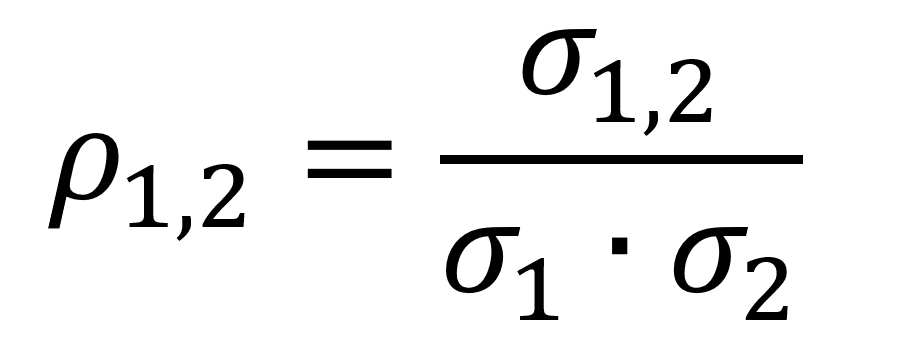
Mathematically (or more precisely statistically), correlation is defined by the following formula:

Correlation formula

where ρ1,2 is the correlation coefficient between the two random variables (say X1 and X2), 𝜎1,2 the covariance between the two random variables, and 𝜎1 and 𝜎2 are the standard deviation of each random variable.

Correlation is measured on a scale from -1 to +1, with -1 representing a perfect negative correlation, +1 representing a perfect positive correlation, and 0 representing no correlation.

Correlation vs Independence

Correlation and independence are two statistical measures that describe the relationship between two variables. As already mentioned, correlation quantifies the strength and direction of the relationship, ranging from perfect negative (one variable decreases as the other increases) to perfect positive (both variables increase or decrease together). Independence on the other hand indicates the absence of any consistent relationship between the variables.

If two random variables are independent, their correlation is equal to zero. But if the correlation between two random variables is equal to zero, it does not necessarily mean that they are independent. This can be illustrated with an example. Let us consider two random variables, X and Y, defined as follows: X is a random variable that takes discrete values from the set {-1, 0, 1} with equal probability (1/3) and Y is defined as Y = X2.

E(X) = 0, as the expected value of X is (1 + 0 + (-1))/3 = 0
E(Y) = E(X2) = (12 + 02 + (-1)2)/3 = 2/3
E(XY) = (-1 * 1 + 0 * 0 + 1 * 1)/3 = 0

Cov(X, Y) = E(XY) – E(X)E(Y) = 0 – 0 * (2/3) = 0

As Corr(X, Y) is equal to Cov(X, Y) / (sqrt(Var(X)) * sqrt(Var(Y))), we find that Corr(X, Y) = 0.

Application in finance

We now consider a financial application : the construction of portfolios. We show that correlation is a key input when building portfolios.

If the concept of portfolios is completely new to you, I recommend first reading through the article by Youssef LOURAOUI about Portfolio.

Portfolio with two assets

In the world of investments, understanding the expected return and variance of a portfolio is crucial for informed decision-making. These two statistical measures provide valuable insights into the potential performance and risk of a collection of assets held together. In what follows, we first focus on a portfolio consisting of two assets.

Return and expected return of a portfolio

The return of a two-asset portfolio P is computed as

Return two assets

where w1 and w2 are the weights of the two assets in the portfolio and R1 and R2 are the returns of the two assets.

The expected return of the two-asset portfolio P is computed as

Expected return two assets

where w1 and w2 are the weights of the two assets in the portfolio and μ1 and μ2 are the expected returns of the two assets.

Risk of a portfolio

The standard deviation (squared root of the variance) of a two-asset portfolio is computed as

Standard deviation of the return of a two-asset portfolio

or

Standard deviation of the return of a two-asset portfolio

where w1 and w2 are the weights of the two assets in the portfolio, 𝜎1 and 𝜎2 are the standard deviations of the returns of the two assets, and 𝜎1,2 and ρ1,2 are the covariance and correlation coefficient between the two assets returns.

The first expression uses the covariance 𝜎1,2 and the second expression the correlation ρ1,2.

Impact of correlation on diversification (the case of two assets)

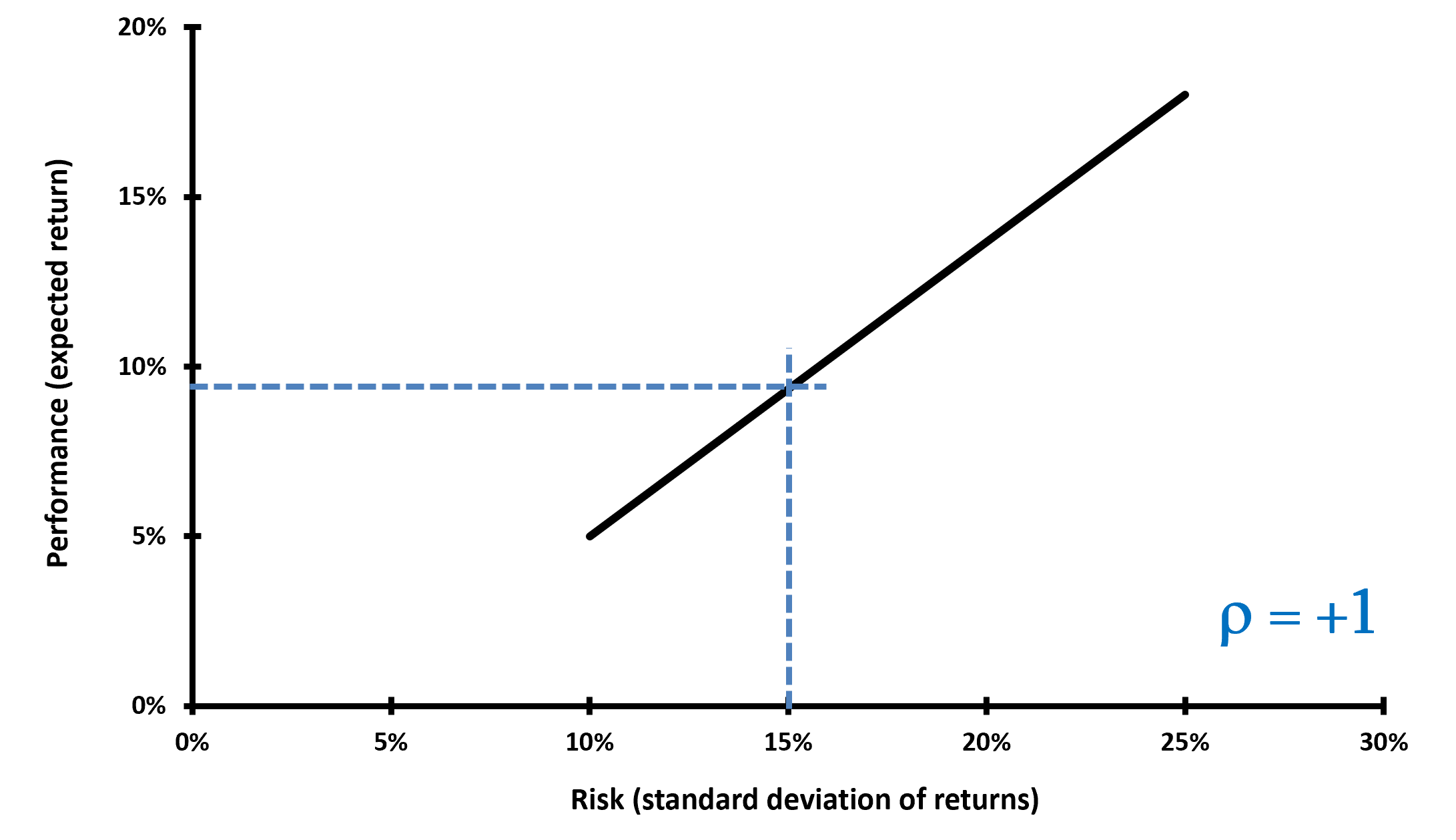
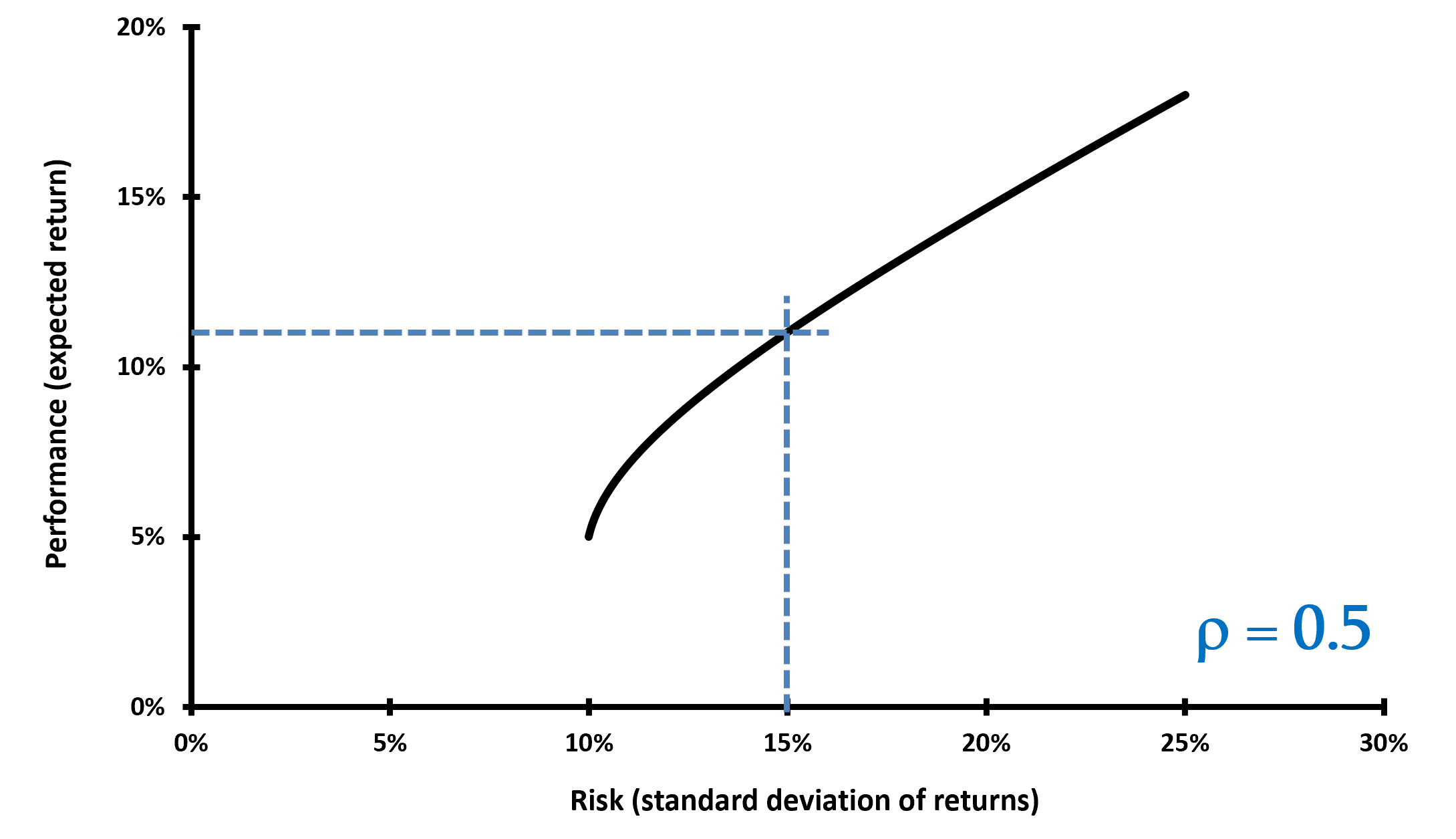
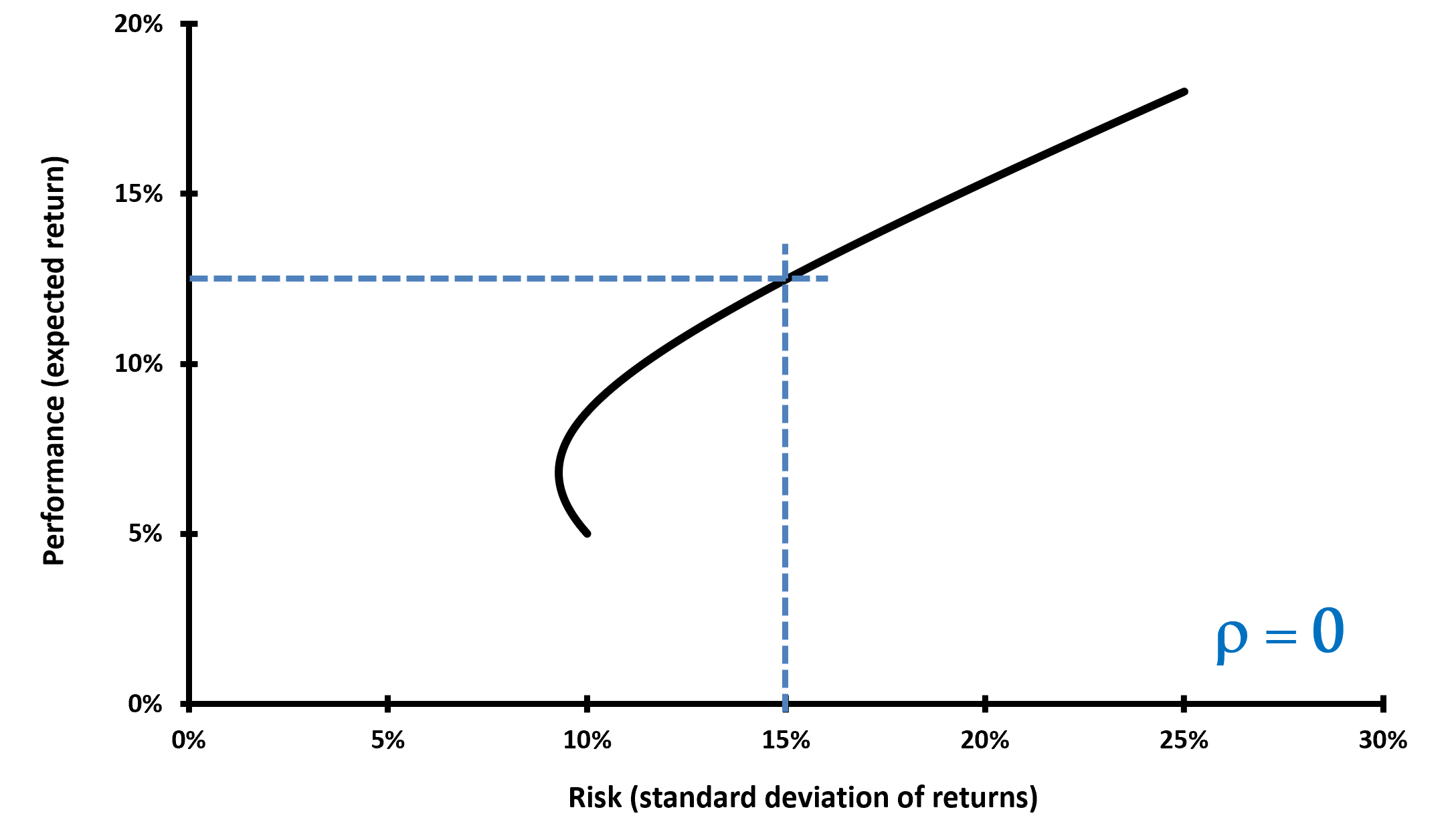
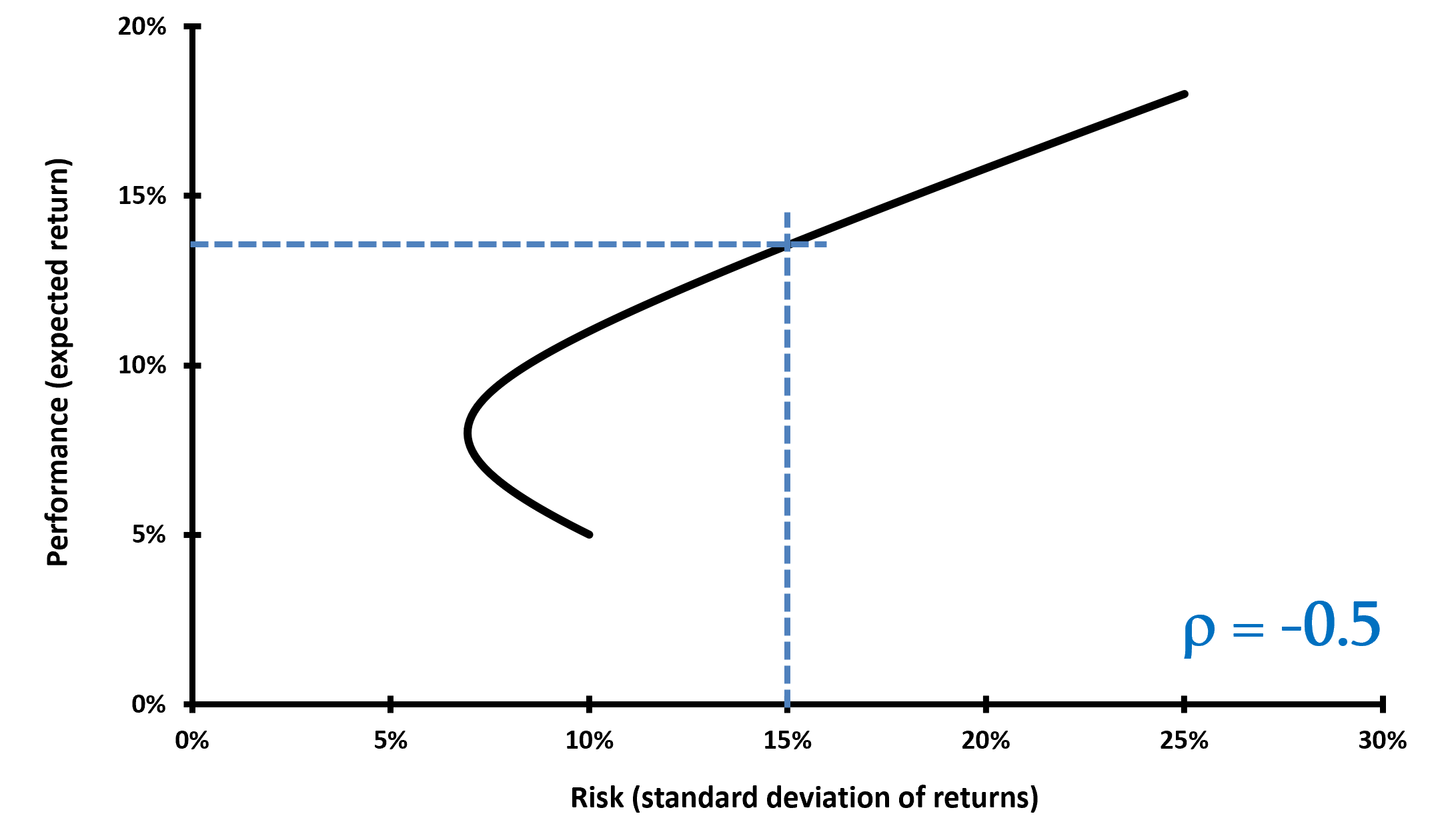
From the above formulas follows a very interesting theorem called the “Diversification effect” which says the following: with two assets, suppose the weights of both securities are positive. As long as the correlation coefficient is less than 1, the standard deviation of a portfolio of two securities is less than the weighted average of the standard deviation deviations of the individual securities. Investors can obtain the same level of expected return with lower risk.

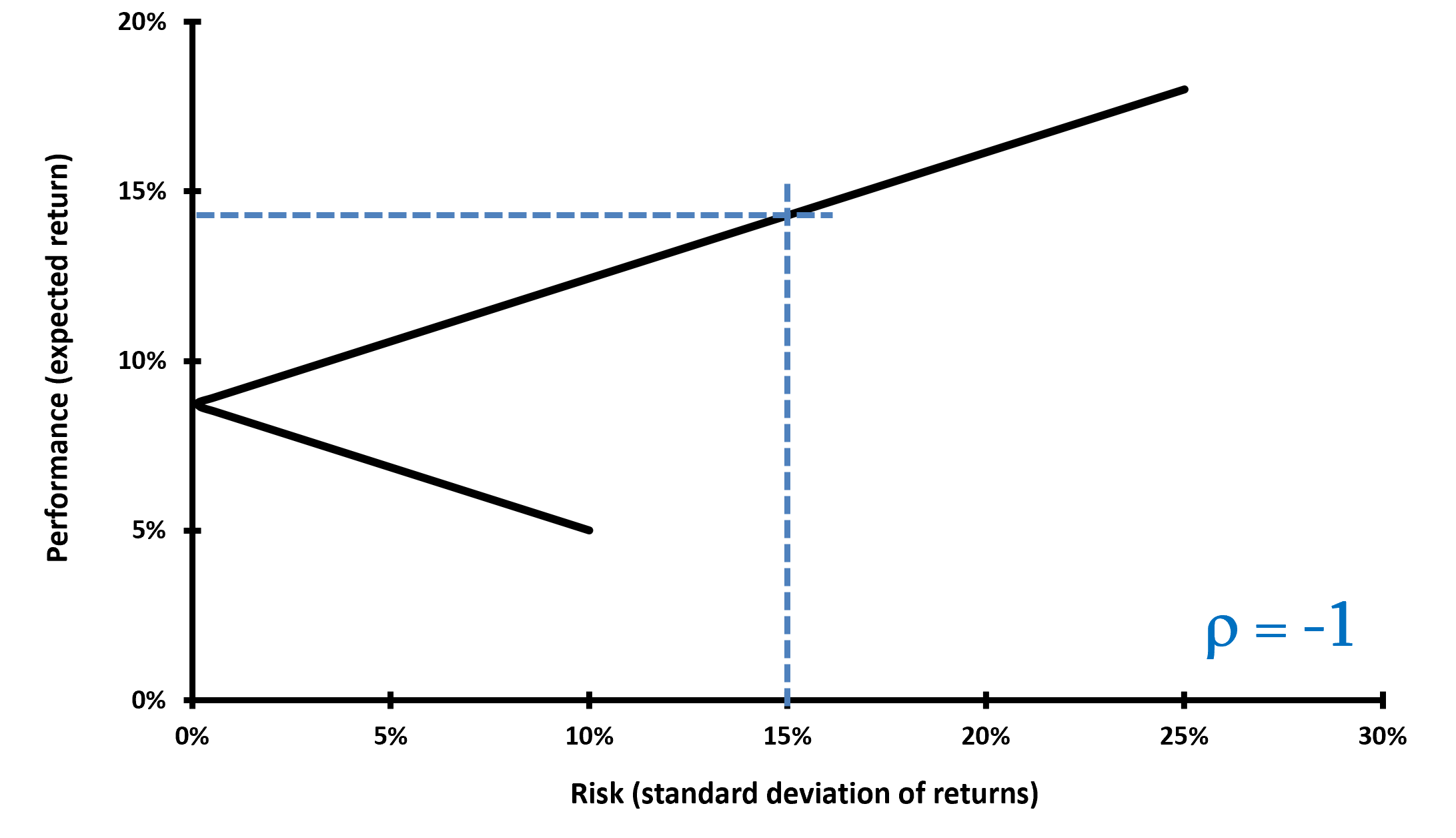
The figures below illustrate the impact of the correlation between the two assets on portfolio diversification and the efficient portfolio frontier. For a given level of portfolio risk, the lower the correlation, the higher the expected return of the portfolio.

Impact of the correlation on portfolio diversification

Impact of the correlation on portfolio diversification

Impact of the correlation on portfolio diversification

Impact of the correlation on portfolio diversification

Impact of the correlation on portfolio diversification

You can download below an Excel file (from Prof. Longin’s course) that illustrates the impact of correlation on portfolio diversification.

Excel file on impact of correlation

Diversification effect (extension to several assets)

With many assets, suppose the weights of all securities are positive. As long as the correlations between pairs of securities are less than 1, the standard deviation of a portfolio of many assets is less than the weighted average of the standard deviations of the individual securities.

Why should I be interested in this post?

Understanding correlation is an essential skill for any investor seeking to build a well-diversified portfolio that can withstand market volatility and achieve long-term growth. By carefully analyzing correlation dynamics and incorporating correlation analysis into their investment strategies, investors can effectively manage risk exposure and build resilient portfolios that can weather market storms and emerge stronger on the other side.

   ▶ Youssef LOURAOUI Portfolio

   ▶ Jayati WALIA Standard deviation

   ▶ Youssef LOURAOUI Hedge fund diversification

   ▶ Lou PERRONE Navigating the Balance Between Risk and Reward in Finance

Useful resources

Prof. Longin’s ESSEC Master in Management “Fundamentals of finance” course.

William Pouder’s ESSEC BBA “Finance” course.

About the author

The article was written in December 2023 by Raphael TRAEN (ESSEC Business School, Global BBA, 2023-2024).

Introduction to Hedge Funds

Youssef_Louraoui

In this article, Youssef LOURAOUI (Bayes Business School, MSc. Energy, Trade & Finance, 2021-2022) elaborates on the concept of Hedge Funds. Hedge funds are a type of asset class that differs from standard fixed-income and equities investments in terms of risk/return profile.

The structure of this article is as follows: First, we will define a hedge fund. Second, we provide a historical perspective on the first known hedge fund. Third, we will discuss hedge fund fees. Fourth, we discuss the conventional long-short strategy and provide an overview of the major hedge fund strategies. And finally, we end by discussing the economic importance of hedge funds.

Introduction

There is no straightforward definition of a hedge fund. Simply said, a hedge fund is an investment vehicle that aims to create performance by employing a variety of complex trading strategies. When the first hedge fund was introduced, the term “hedge” referred to lowering risk by investing in both long and short positions at the same time.

Hedge funds are exempted from the financial regulations that apply to other investment vehicles such as mutual funds. On the one hand, hedge funds have a lot of freedom to implement their investment strategy and face minimal disclosure rules. Hedge funds have the freedom to utilize leverage using derivatives products. On the other hand, hedge funds are restricted in the way they raise money from investors. Hedge fund investors must be “accredited investors,” which means they must have a particular amount of financial wealth and/or financial education to invest. Hedge funds have also been subject to a non-solicitation restriction, which means they are not allowed to advertise or aggressively seek individuals for investment.

According to the Security Exchange Commission (SEC, ), the governmental branch for regulated financial markets in the US, a hedge fund can be defined as follows:

“Hedge fund’ is a general, non-legal term used to describe private, unregistered investment pools that traditionally have been limited to sophisticated, wealthy investors. Hedge funds are not mutual funds and, as such, are not subject to the numerous regulations that apply to mutual funds for the protection of investors – including regulations requiring a certain degree of liquidity, regulations requiring that mutual fund shares be redeemable at any time, regulations protecting against conflicts of interest, regulations to assure fairness in the pricing of fund shares, disclosure regulations, regulations limiting the use of leverage, and more.” (SEC)

The first hedge fund: Jones

In 1949, Alfred Winslow Jones is said to have founded the first professional hedge fund and is regarded as the “father of the hedge fund industry”. He set up the fund as a limited partnership, with the hedge fund manager providing significant initial capital and a few significant investors. The fund’s principal strategy was to use a long/short method, the fund being long on undervalued securities and short on overvalued securities. Jones based his investment approach on stock picking (he believed he lacked market timing skills). Hedge funds’ main idea is that they can use leverage to boost returns in both directions.

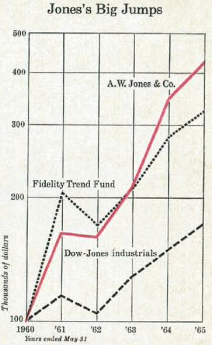
From 1955 to 1965, Jones is reported to have achieved a 670% return on his hedge fund by taking both long and short positions. Before Jones, short selling had been popular for a long time, but he realized that by balancing long and short positions, he could be relatively immune to overall market changes while benefiting from the relative outperformance of his long positions against his short positions. The performance of Jones’s fund is shown in Figure 1 about the Dow Jones Industrials index used as a benchmark and Fidelity’s highest performing mutual fund. Over the 1960-65 period, the fund managed to multiply its return by a factor of four, which is higher than the best performing mutual fund (Fidelity Trend Fund) and the Dow-Jones industrials.

Figure 1. Alfred Winslow Jones’s hedge fund performance between 1960-65.
img_SimTrade_jones_performance
Source: “The Jones Nobody Keeps Up With” (Fortune, 1966).

Development of hedge funds

Interest in hedge funds grew after Fortune magazine published Jones’s results in 1966, and the Securities and Exchange Commission (SEC) listed 140 hedge funds in 1968. As institutional investors began to embrace hedge funds in the 1990s, the hedge fund industry saw a huge spike in interest. Hedge funds with billions of dollars under management were typical in the 2000s, with total hedge fund assets reaching a peak of nearly $2 trillion before the global financial crisis of 2008, dropping during the crisis, and recently reached a new peak.

Hedge funds’ aggregate positions are much larger than their assets under management due to their leverage, and their trading volume is a much larger part of the aggregate trading volume than their relative position sizes due to their high turnover, so hedge fund trading now accounts for a significant portion of all trading. Given a limited demand for liquidity, there is a limited amount of profit to be made and a limited requirement for active investment in an optimally inefficient market, the quantity of capital committed to hedge funds cannot keep expanding.

Hedge funds fees

Among the most frequent fees in the hedge fund industry, we can name the following:

Management fee

Management fee represents the fees that the hedge funds collect to run their operations (salaries, infrastructure, etc.). The management fee is usually about 3%

Performance fee

The performance fee is a compensation when the hedge fund achieves a certain level of performance. This threshold, called the hurdle rate, represents the minimum performance that a hedge fund has to achieve to charge an incentive fee. This motivates the hedge fund manager to perform and to align its interest with its clients’ interests. Beyond the hurdle rate, the outperformance is shared between the hedge fund manager (20%) and the clients (80%).

The high water mark (HWM) provision is a mechanism where the hedge fund will only charge performance fees if it manages to deliver returns above the returns of the previous period. If the hedge fund is down 50%, the performance achieved to recover the losses (100% won’t be subject to performance fees). Only after recovering entirely from the drawdown, the hedge fund can be entitled to earn the performance fee.

A classic hedge fund strategy: the long-short strategy

The long-short strategy is the strategy implemented by the first hedge fund (Alfred Winslow Jones fund). According to Credit Suisse, long-short equity funds engage in both the long and short sides of the equity markets, to diversify or hedge across sectors, regions, and market capitalizations. Managers can switch from value to growth, from small to medium to large capitalization equities, and from net long to net short positions. Managers can also trade stock futures and options, as well as equity-related instruments and debt, and form more concentrated portfolios than classic long-only equity funds.

To illustrate a long-short strategy, we create a hedge fund portfolio based on two stocks from the US equity market. We pick one overvalued stock and one undervalued stock based on their price-to-earnings (P/E) ratio. We chose for this purpose Twitter (overvalued) and Pfizer (undervalued). We download a time series of three-month worth of data for two stocks (Twitter and Pfizer) and the S&P500 index.

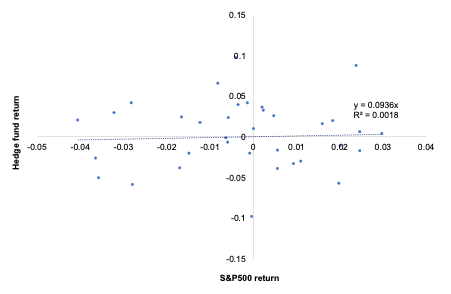
Figure 2 represents the regression of the returns of the simulated hedge fund portfolio on the S&P500 index. We can appreciate a null slope (0.0936) of the regression indicating the low correlation of the hedge fund with the market represented by the S&P500 index. This strategy is market-neutral, meaning that the portfolio is not correlated directly with the market fluctuations. The performance of a zero-beta portfolio would be derived from the alpha, a key metric in the portfolio management industry.

Figure 2. Regression of the hedge fund return on the S&P500 market index.
Hedge fund portfolio regression
Source: computation by the author (data: Bloomberg).

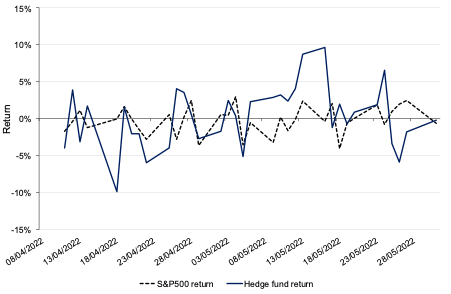
We compute the return and volatility of each security and the market index as a starting point. We also determine the correlation of the stocks to the market index. For the short position (Twitter), the sign of the correlation inverts of the sign. We compute an equally-weighted portfolio composed of two stocks: a long position on Pfizer and a short position on Twitter. This portfolio delivered a return of 0.27%, which is better than the broader stock index return over the same period (-0.22%).

Figure 3 depicts the return of the hedge fund portfolio relative to the market index return. From the analysis, the long-short strategy managed to outperform the S&P500 market index by 49 basis points. Even if the market is in a bearish setting, the strategy managed to deliver positive returns as the short position helps to be uncorrelated the return of the hedge fund from the market return.

Figure 3. Return of the hedge fund relative to the S&P500 market index.
Long short strategy performance
Source: computation by the author (data: Bloomberg).

You can download below the Excel file below which gives the details of the computation of the long-short strategy example.

Excel file for the long-short startegy example

Hedge fund role in economy

Hedge funds, for example, are frequently criticized in the media. Companies, for example, dislike seeing their shares shorted because it indicates a belief that the company’s share price will fall. Short sellers, including hedge funds, are sometimes blamed for a company’s problems, even though the stock price is usually falling due to the company’s poor financial condition, not because of any other source.

Hedge funds, in general, serve several important functions in the economy. First, they improve market efficiency by gathering information about businesses and incorporating it into prices through their trades. Because the capital market is the tool used to allocate resources in the economy, increased efficiency can improve real economic outcomes. Companies with good growth prospects see their share prices rise when markets are efficient, allowing them to raise capital and fund new projects. Companies that produce goods and services that are no longer required to see their share prices fall and the factories may be repurposed for more productive purposes, possibly leading to a merger. Furthermore, when share prices reflect more information and are more efficient, CEO decisions may improve, and they may be more prudent if active investors are monitoring them. Hedge funds also serve as a source of liquidity for other investors who need to buy or sell (e.g., to smooth out their consumption), hedge or buy insurance, or simply enjoy certain types of securities. Finally, hedge funds offer investors another source to diversify their returns.

Why should I be interested in this post?

As an investor, hedge funds may provide an opportunity to diversify its global portfolios. Including hedge funds in a portfolio can help investors obtain absolute returns that are uncorrelated with typical bond/equity returns.

For practitioners, learning how to incorporate hedge funds into a standard portfolio and understanding the risks associated with hedge fund investing can be beneficial.

Understanding if hedge funds are truly providing “excess returns” and deconstructing the sources of return can be beneficial to academics. Another challenge is determining whether there is any “performance persistence” in hedge fund returns.

Getting a job at a hedge fund might be a profitable career path for students. Understanding the market, the players, the strategies, and the industry’s current trends can help you gain a job as a hedge fund analyst or simply enhance your knowledge of another asset class.

Useful resources

Academic research

Pedersen, L. H., 2015. Efficiently Inefficient: How Smart Money Invests and Market Prices Are Determined. Princeton University Press.

Business Analysis

Wikipedia Alfred Winslow Jones

Fortune (2015) The Jones Nobody Keeps Up With (Fortune, 1966).

SEC Mutual Funds and Exchange-Traded Funds (ETFs) – A Guide for Investors.

SEC Selected Definitions of “Hedge Fund”

Credit Suisse Hedge fund strategy

Credit Suisse Hedge fund performance

Credit Suisse Long-short strategy

Credit Suisse Long-short performance benchmark

Related posts on the SimTrade blog

   ▶ Shruti CHAND Financial leverage

   ▶ Akshit GUPTA Initial and maintenance margins in futures contracts

   ▶ Akshit GUPTA Hedge funds

About the author

The article was written in June 2022 by Youssef LOURAOUI (Bayes Business School, MSc. Energy, Trade & Finance, 2021-2022).