

In this article, Jules HERNANDEZ (ESSEC Business School, Global Bachelor in Business Administration (GBBA), 2021-2025) shares his professional experience as Cross-Asset Structurer in a structured products brokerage firm.
What is this article about?
In this article, I will explore the role of a structured products brokerage firm and the four key services it provides: structuring, best execution, financial analysis and investment ideas, and product monitoring and lifecycle management. I will then share my experience as an intern, describe my main responsibilities, from product pricing and marketing presentations to client and issuer relationships, and explain the knowledge and skills required to succeed in this field, including how to prepare for an interview.
However, having knowledge about these investment solutions will help you to fully understand this article and the description of an internship in a structured product broker. Therefore, if you have limited knowledge about structured products, I highly recommend reading this article first where you’ll find an explanation of this financial instrument and many details related to it: Structured products: what’s behind them?
What is a structured product broker?
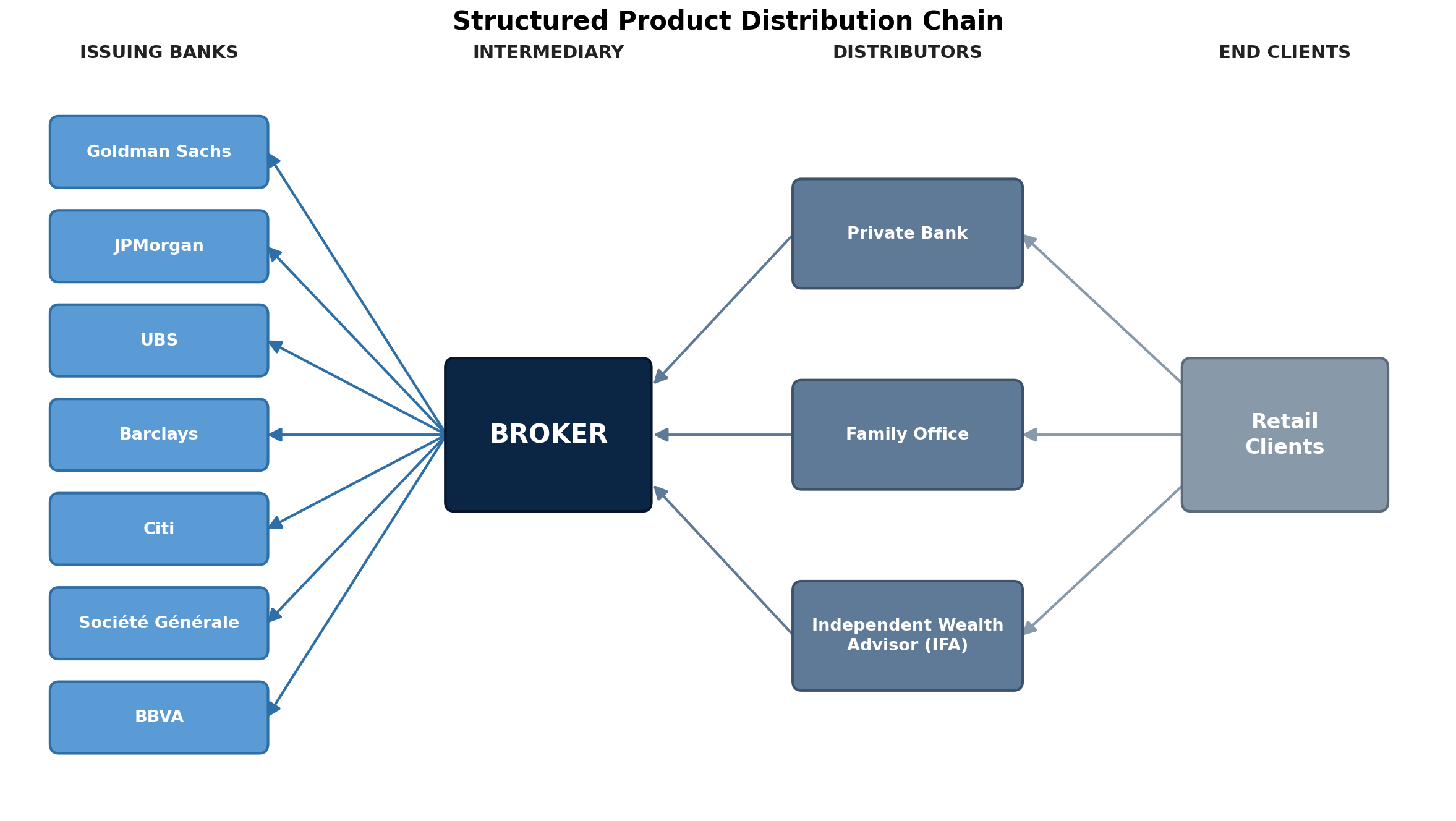
A structured product broker acts as an intermediary between professional investors and issuing banks such as JPMorgan, Goldman Sachs, UBS, BBVA, Citi, Barclays, and many others. Its clients include wealth management advisers, known in France as Conseillers en Gestion de Patrimoine (CGPs), single-family offices and multi-family offices, as well as private banks. Although these clients may have different business models and customer bases, they share the same objective when approaching a broker: finding a structured product that reflects their market views and investment objectives, while obtaining the most competitive pricing possible. To achieve this, brokers leverage their network of banking partners to source and compare proposals, helping clients identify the most attractive investment opportunities available on the market.
You will find below a chart clarifying the structured products actor and the distribution chain :
Structured products actors and the distribution chain
How is a Structured Products Brokerage Firm Organized?
From my experience, a structured products brokerage firm can be divided into two main teams: Sales and Structuring. Both teams must work closely together to ensure that each transaction runs smoothly, from the initial client discussion to the final execution of the order.
The Sales Team
The Sales team is responsible for developing the firm’s client base and maintaining long-term relationships with existing clients. This involves prospecting new clients, contacting wealth management advisers, family offices and private banks, and demonstrating the value a broker can bring to their investment activities.
Beyond acquiring new clients, Sales professionals act as the main point of contact throughout the investment process. They identify clients’ needs, understand their market views, advise their clients about the market, present investment opportunities, and communicate proposals prepared with the Structuring team. For example, a client may have a positive outlook on equity markets but may not want broad exposure to the entire market or to every sector. In this case, the broker can help refine the client’s investment view by identifying sectors with strong growth potential, such as electrification, and highlighting companies that could benefit from this trend. Examples include Schneider Electric, Bloom Energy or Prysmian, which could be suitable underlyings for a structured product. The objective is to help clients translate their market views into more targeted investment opportunities.
They also explain product mechanics, discuss potential risks and returns, and can even teach client about structured products. Maintaining strong relationships is essential, as clients rely on their Sales contacts not only to access investment products but also to receive relevant market insights and timely investment ideas.
The Structuring Team
The Structuring team provides the technical and operational support required to turn client requests into executable investment solutions. Working closely with Sales, its responsibilities include designing and pricing structured products, obtaining quotes from issuing banks, comparing available structures, and preparing marketing presentations for clients. Its role also extends beyond the initial design and pricing stages. The team monitors product events, coordinates with issuers, and helps ensure that financial orders are processed correctly. Depending on the firm’s organization, these responsibilities can cover activities associated with both the front office, such as structuring and pricing, and the back office, such as transaction processing and operational follow-up.
The two teams are complementary: Sales’ objectives are to understand the client’s needs and communicate the investment opportunity, while the Structuring Team aims to provide the technical expertise and operational support needed to deliver it.
The Four Key Services of a Structured Products Broker
Structuring Services: Turning Market Views into Investment Solutions
One of the broker’s core responsibilities is to translate a client’s market expectations into a structured investment product. Clients may have a specific view on an underlying asset, an expectation about future market volatility, or a target return subject to defined risk constraints. The broker’s role is to convert these expectations into a product with clearly defined payoff conditions. For example, imagine a wealth manager who expects the Euro Stoxx 50 to remain relatively stable or rise moderately over the next three years. Rather than investing directly in the index, the wealth manager may want to offer clients a product that generates periodic coupons as long as the index remains above a predefined barrier, with the possibility of early redemption if certain conditions are met. The broker works with the Sales team to understand the client’s objectives, including the desired maturity, coupon level, capital protection conditions, and acceptable risk. The Structuring team then uses pricing tools provided by different issuing banks to model and compare possible structures. By adjusting parameters such as coupon barriers, capital barriers, observation dates, and maturity, it can assess different combinations and identify solutions that best match the client’s requirements.
This process requires a solid understanding of financial instruments, derivatives, market parameters, and the mechanics of structured products. It also involves balancing several constraints: a more attractive coupon may require the client to accept a higher level of risk, while stronger capital protection may reduce the potential return. The objective is not simply to design a product with an attractive headline yield, but to find a structure whose payoff, risk profile, and pricing are consistent with the client’s investment objectives.
Best Execution: Finding the Most Competitive Offer
Best execution is another fundamental service provided by structured products brokers. Because multiple banks can issue similar structured products, the broker can request competing proposals and compare the terms offered by different issuers. The comparison goes beyond the headline coupon. Depending on the product, relevant parameters may include the issue price, coupon, observation schedule, barriers, maturity, capital protection features, and the issuer’s credit quality. The broker also considers the consistency of each proposal with the client’s investment objectives and the practical conditions required to execute the transaction. For example, suppose a client wants to invest €1 million in a three-year autocallable product linked to a basket of European equities. The broker may approach several issuers with the same product specifications. One bank might offer a 7.5% annual coupon, another 7.8%, and a third 8.0%. The broker would then give the best price to its customer. The diagram below illustrates how our best execution service works.
Best Execution service
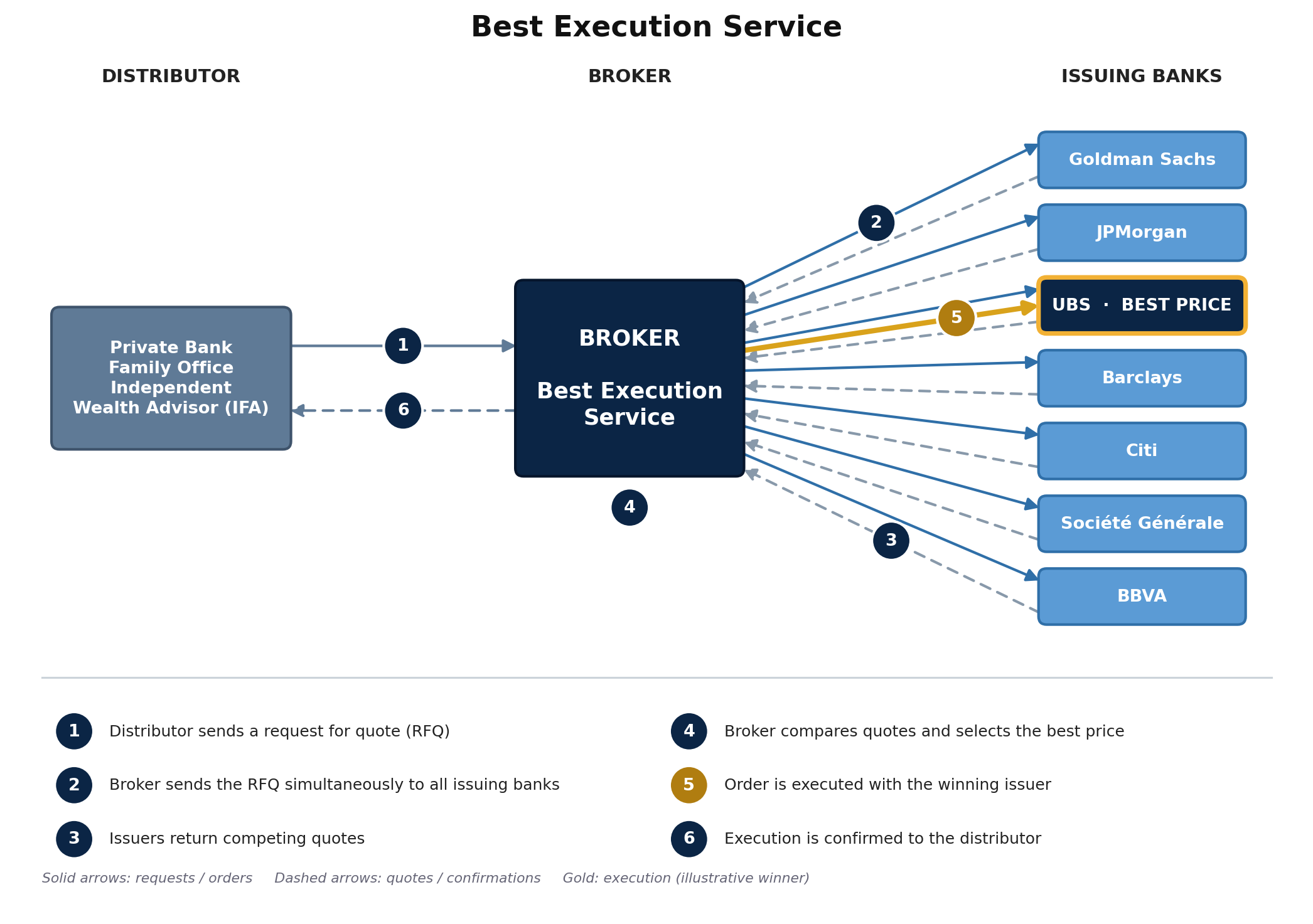
This ability to compare multiple issuers is a key source of value. An individual wealth manager may have access to only a limited number of banking partners, whereas a broker can leverage a broader network of issuers and centralise the comparison process. The objective is to obtain the best available terms for the client, while ensuring that the product remains appropriate for their needs. However, this should not be confused with simply choosing the highest coupon: the overall terms, risks, issuer quality, and execution conditions all matter.
Financial Analysis and Investment Ideas
A structured products broker also provides financial analysis to help clients and Sales teams identify investment opportunities. This research can cover macroeconomic developments, equity markets, interest rates, currencies, commodities, corporate fundamentals, volatility, and relative-value opportunities.
The purpose is to connect market developments with actionable investment ideas. For example, if a broker’s analysis suggests that a particular equity index offers an attractive risk-return profile, the team may investigate whether a structured product linked to that index could be relevant. Similarly, changes in implied volatility or interest-rate expectations may create opportunities to design products with different coupon levels or payoff profiles. Research therefore supports both the development of investment ideas and the structuring process. The analysis team helps identify potential underlying assets and market themes, while Sales professionals use these insights to discuss opportunities with clients and explain the rationale behind a proposed investment. This service is particularly valuable for wealth managers and private banks that may not have dedicated research teams covering every asset class. By providing accessible market commentary, investment scenarios, and product ideas, a broker helps clients make more informed decisions and gives Sales teams relevant material for their client discussions. Importantly, financial analysis should also consider the downside scenario. An investment idea must be assessed in terms of its potential return, the risks that could undermine the underlying market view, and the conditions under which the product could incur losses.
Product Monitoring and Lifecycle Management
A structured product is not static once it has been issued. Its market value fluctuates throughout its life in response to several factors, including the performance of its underlying assets, interest rates, dividends, volatility, and the issuer’s credit spread. Depending on its structure, changes in these parameters can materially affect the product’s valuation and potential redemption value.
A broker helps clients access this information easily by providing valuations and facilitating communication with issuers. This allows wealth managers and other professional investors to monitor their positions and better understand how market developments affect their investments. In addition to valuation, structured products can generate several contractual events during their lifetime. These may include coupon payments, the observation of coupon or capital barriers, early redemption through autocall features, and maturity. Monitoring these events is essential to ensure that clients understand what has happened to their investments and what may happen next.
Many brokers therefore use dedicated digital platforms that allow clients to view their portfolios, monitor product valuations, and track upcoming or completed events. Some platforms also include integrated pricing tools, enabling users to simulate different product structures, adjust parameters, and explore potential payoffs before submitting a request to the broker. These tools improve transparency and simplify portfolio monitoring. They also allow clients to become more autonomous when exploring investment opportunities, while retaining access to the broker’s expertise for product design, pricing comparisons, and execution. Overall, product monitoring extends the broker’s role beyond the initial transaction. It helps maintain the relationship with clients throughout the product’s lifecycle and provides them with the information needed to follow their investments over time.
My internship
I spent six months working alongside the Structuring team, informally referred to in French as “La Structu”. Interns are entrusted with real responsibilities and quickly exposed to both sides of the business: clients and banking partners (issuers). This level of exposure requires rigor, attention to detail, and a strong sense of responsibility, since the intern’s tasks can have a significant impact on transactions, client relationships, and ultimately, the firm’s business.
My missions
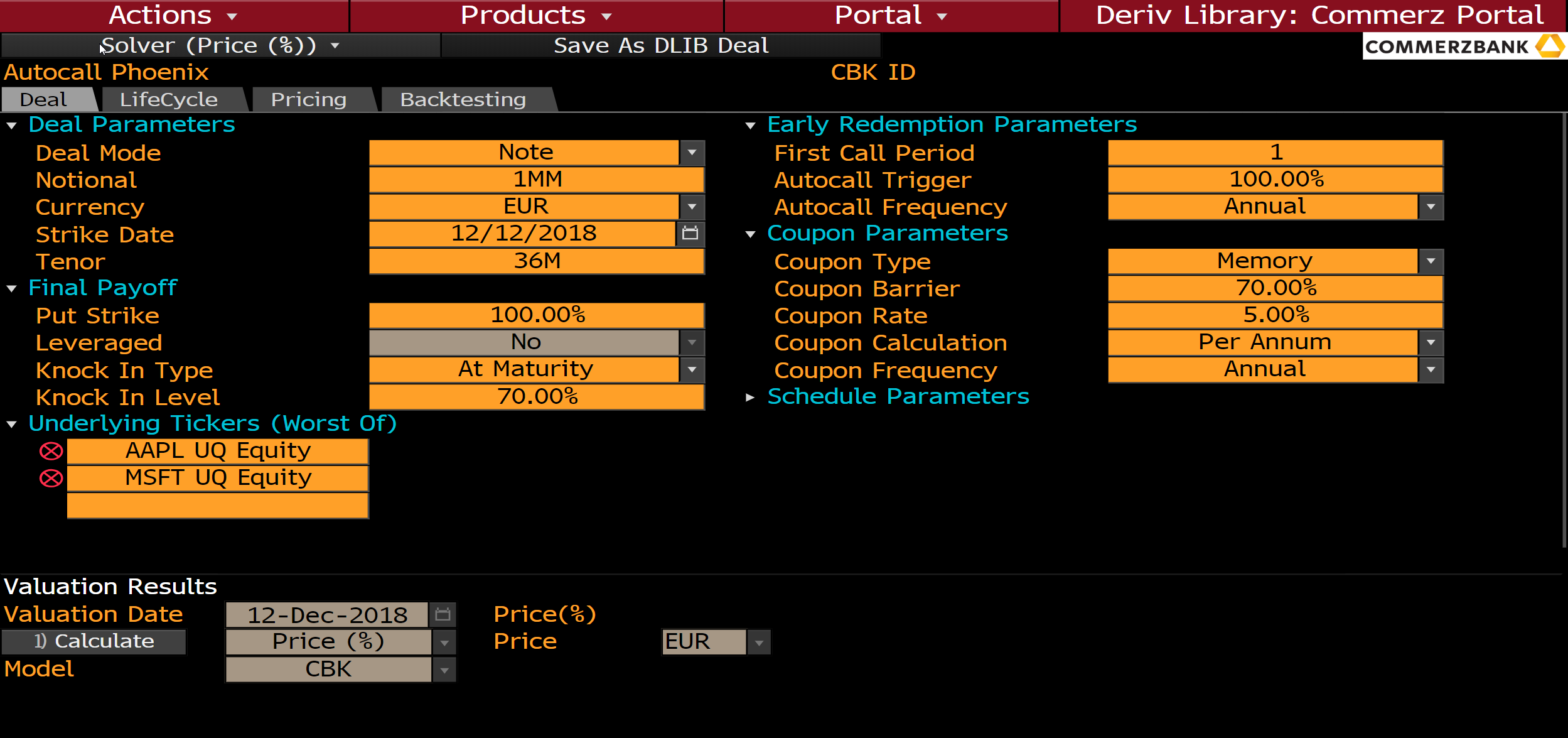
One of the most interesting aspects of my internship was the variety of responsibilities I had. Working within the Structuring team gave me exposure to almost every stage of a structured product transaction, from its initial pricing to its execution and monitoring. Pricing was one of my main responsibilities. Using the dedicated platforms provided by our banking partners like Goldman Sachs, BNP Paribas and Société Générale, I could simulate different structured products and obtain indicative pricing. For instance, I could enter the parameters of an autocallable product, such as its coupon barrier, capital protection barrier and maturity, to determine the coupon each bank was prepared to offer. I would then compare the quotes received from different issuers to identify the most competitive proposal and share the results with the Sales team. The aim was to provide clients with the best available terms for their desired structure. This task demanded precision and a good understanding of product mechanics, as even small differences in pricing could influence the final terms offered to a client.
Below, you’ll find an exemple of a pricing platform. The following pricer is provided by Bloomberg. On this pricer, we can find all the relevant paramters used to price a structured product :
Bloomberg structured product pricer
My responsibilities did not end once a client decided to invest. I also took part in the operational follow-up of transactions, helping ensure that orders were processed and settled correctly. This involved coordinating with issuing banks, their back-office teams and custodians, checking transaction details and following up whenever an issue arose. Although less visible than pricing, this work was essential to ensure that transactions were completed smoothly and that all parties had the correct information.
Another part of my role involved document verification and product monitoring. Before products could be properly recorded and monitored, I had to check the documentation supplied by issuers, including term sheets, Key Information Documents (KIDs), target market documents and brochures used for life insurance contracts. I also entered newly issued products into a dedicated monitoring platform, enabling the firm and its clients to follow their valuations and key lifecycle events. This required particular attention to detail, since the information recorded needed to remain consistent with the product’s official documentation.
Finally, I contributed to the preparation of marketing materials used by the Sales team. These included presentations for client seminars and webinars, as well as product-specific presentations and one-pagers outlining a structure’s main features, payoff mechanics and investment rationale. The challenge was to turn technical financial information into clear, accessible material that Sales professionals could use when presenting investment opportunities to clients.
Alongside these core responsibilities, I also worked on various projects, particularly the automation of operational tasks using Excel and Bloomberg. The aim was to reduce manual work and improve efficiency in the team’s day-to-day activities. I also carried out regular market monitoring. Every week, I prepared and presented a short market update covering the macroeconomic environment and the main developments in economic news. This required keeping track of key indicators, central bank decisions, major market events and companies’ financial announcements that could boost implied volatility and offer investment opportunities to our clients.
Required skills and knowledge
Working in a structured products brokerage firm requires a combination of personal qualities and technical knowledge. While financial expertise can be developed over time, certain qualities are essential to work effectively in such a fast-paced environment.
First of all, teamwork and collaboration are arguably the most important qualities. As explained earlier, the business relies on close cooperation between the Sales and Structuring teams, as well as regular communication with issuing banks and clients. Information must flow smoothly between everyone involved, and the success of a transaction often depends on how well these different parties work together. Being approachable, responsive and willing to help colleagues is therefore just as important as individual performance. No matter how strong your technical skills are, you cannot succeed in this environment by working in isolation.
From my experience, I would then say that curiosity and a genuine interest in financial markets are equally important. Markets evolve constantly, driven by economic data, central bank decisions, geopolitical developments and corporate news. Understanding these movements helps identify investment opportunities, anticipate clients’ needs and assess how changing market conditions affect structured products. Reading financial news regularly, following market trends and developing your own investment views are all good ways to build this curiosity. You do not need to know everything from day one, but you must be willing to learn every day.
Rigour and attention to detail are also essential qualities. Structured products involve complex payoff mechanisms, precise contractual terms and multiple operational steps. An incorrect pricing parameter, an error in a term sheet or a mistake in an order can have financial consequences for both the client and the firm. Being organized, checking your work carefully and remaining focused under pressure are therefore fundamental to the job.
Beyond these personal qualities, working in this field requires a solid technical understanding of financial markets and financial engineering. You need to understand how different asset classes behave, including equities, interest rates, foreign exchange and commodities, as well as the main factors influencing their prices. Knowledge of derivatives, particularly options, is also valuable, since their pricing and risk characteristics underpin many structured products. It is equally important to understand the mechanics of structured products themselves: how coupons are generated, how barriers work, what triggers an early redemption, and under which conditions an investor may incur losses. A basic understanding of volatility, dividends, interest rates and correlation can also help explain why a product’s pricing changes depending on market conditions and its underlying assets.
And finally, it goes without saying, proficiency in Excel is particularly useful. It is used every day for analysing data and automating recurring tasks. Familiarity with Bloomberg can also be an advantage, as it allows you to access market data, monitor financial news and analyse market movements more efficiently.
What I learned during this internship
Of course, this internship allowed me to develop my technical knowledge, particularly in pricing structured products and understanding their mechanics. It also gave me a much clearer picture of how structured products are distributed, from the relationship between brokers and issuing banks to the role of wealth managers, Family Offices and private banks. I discovered an ecosystem involving a wide range of actors, each with their own objectives and constraints, and learned how they work together to bring investment solutions to clients.
But beyond the technical skills, the most important lesson I took away from this experience was the importance of curiosity. Financial markets are constantly evolving, and there is always something new to understand. An economic announcement, a central bank decision, a geopolitical event or a sudden change in volatility can create new opportunities or completely change the way an investment should be approached. Following the markets is therefore not simply about knowing what happened, but about understanding why it happened, how different asset classes interact and what the implications might be for investors. Why does a rise in interest rates affect equity valuations? How can a geopolitical event influence currency markets? Why does implied volatility change the pricing of an option? These are the kinds of questions that make financial markets so interesting to me. During my internship, I realised that curiosity also means going beyond the tasks you are assigned. Whenever I came across an underlying asset or an investment theme I did not know well, I wanted to understand it better, explore the factors that could influence its performance and consider whether it could offer an interesting investment opportunity. This approach helped me gradually move beyond the technical aspects of structuring and develop a broader understanding of the investment rationale behind each product. It also encouraged me to share my market views and ideas with the Sales team, sometimes on topics that were not initially part of my responsibilities.
I believe that curiosity is what allows you to keep learning, improve your judgement and become more relevant in this industry. Technical knowledge can be acquired, and tools can be mastered, but the willingness to ask questions, challenge your assumptions and continuously deepen your understanding is what drives long-term progress. This is what I enjoyed most during my internship, and it is the mindset I want to carry forward throughout my career in financial markets.
What to know for your interview?
The purpose of this section is not to provide an exhaustive explanation of every concept you may encounter during an interview. Instead, it is intended as a checklist of the main topics you should be familiar with before applying for an internship or a position in structured products. For more detailed explanations, I recommend consulting other articles on the SimTrade Blog, particularly Structured Products: What’s Behind Them?, which provides a deeper look at several of the concepts mentioned below.
First, you should have a solid understanding of how financial markets work and be familiar with the main asset classes. In structured products, four asset classes are particularly important: Equity, Rates, Credit and FX.
You should be able to explain the main characteristics of each asset class and understand how they react to main economic events such as central bank decisions and inflation announcements.
The Main Types of Structured Products
You should know the mechanics of the most common structured products, understand how they generate returns and identify the risks faced by investors. In particular, you should be familiar with:
- Phoenix Products with Memory: structured products offering conditional coupons when the underlying asset meets a predefined coupon barrier condition on an observation date, with unpaid coupons potentially accumulated and paid later if the condition is subsequently satisfied.
- Reverse Convertibles: structured products offering a fixed coupon, generally independent of the underlying asset’s performance, in exchange for exposure to its downside risk, subject to the issuer’s credit risk.
- Capital-Protected Interest Rate Products: products designed to provide exposure to interest rate markets while protecting the invested capital at maturity, subject to the terms of the product and the issuer’s credit risk.
- Credit-Linked Notes (CLNs): products whose returns and repayment depend on the credit performance of one or more reference entities or credit events.
- Participation Products: products designed to provide exposure to the performance of an underlying asset, sometimes with a participation rate greater than or less than 100%.
Derivatives and Options
Options are at the heart of many structured products, so understanding them is essential. You should know the difference between calls and puts, European and American options, and vanilla and exotic options. You should also understand the main factors affecting option prices, including the underlying asset price, volatility, time to maturity, interest rates and dividends.
You should be particularly comfortable with the following option payoffs and strategies:
- Upside participation mechanisms: call options, digital options and up-and-out calls.
- Downside protection mechanisms: down-and-in puts, put spreads and leveraged puts.
You should be able to sketch their payoff profiles, explain how they behave under different market scenarios and understand how they can be combined to create a structured product.
Another useful concept to master is the replication of a digital option using a tight call spread. By combining a long call (lower strike) and a short call (higher strike) with nearby strike prices, it is possible to approximate the payoff of a digital option, with the accuracy of the approximation depending on the distance between the strikes. This question is almost always asked during an interview. The objective is to assess whether the candidate understands basic trading concepts and replication mechanics.
The Greeks and Risk Sensitivities
Finally, you should understand the main option Greeks, which measure how an option’s value responds to changes in different market parameters:
- Delta: sensitivity to changes in the underlying asset price.
- Gamma: sensitivity of delta to changes in the underlying asset price.
- Vega: sensitivity to changes in implied volatility.
- Theta: sensitivity to the passage of time.
- Rho: sensitivity to changes in interest rates.
For structured products, it is particularly useful to understand how these sensitivities evolve over the product’s lifetime and how they are affected by barriers, early redemption features and market conditions. You do not necessarily need to derive every formula from memory, but you should be able to explain what each Greek measures and why it matters for pricing and risk management.
Why should you be interested in this post?
If you are interested in financial markets and considering a career in structured products, this article offers an overview of the role of a structured products broker, the main services provided and the responsibilities of a structuring intern. You will also find practical advice on the skills and knowledge required to prepare for an interview, based on my own six-month internship experience in a structured products brokerage firm.
Related posts on the SimTrade blog
Professional experiences
▶ All posts about Professional experiences
▶ Mathis HOUROU Client Segmentation and Private Banking: Marketing Strategy or Risk Shield?
▶ Wenxuan HU My experience as an intern of the Wealth Management Department in Hwabao Securities
▶ Lang Chin SHIU My internship experience at HSBC
▶ Louis DETALLE A quick review of Wealth Management’s job…
Financial techniques
▶ Jules HERNANDEZ Structured products: what’s behind them?
▶ Slah BOUGHATTAS Book by Slah Boughattas: State of the Art in Structured Products
▶ Mahé FERRET Selling Structured Products in France
▶ Akshit GUPTA Equity structured products
▶ Shengyu ZHENG Reverse Convertibles
▶ Nithisha CHALLA Index fund manager: Unveiling the Dynamics of Passive Investing
▶ Tianyi WANG Understanding Snowball Products: Payoff Structure, Risks, and Market Behavior
Useful resources
SRP Website – Industry insights This website is very useful to learn about the structured products industry. SRP conducts a lot of research on this matter
Yaël Eljarrat-Ouakni What is a Structured Product? Société Générale Private Banking France.
Pôle commun AMF-ACPR (06/2026) Distribution, frais et performance des produits structurés – Rapport final – Juin 2026
Autorité des Marchés Financiers (AMF) (24/05/2025) 2025 Markets and Risk Outlook
SRP (18/03/2025) Global Market review 2024, Europe Market review 2024
About the author
The article was written in November 2026 by Jules HERNANDEZ (ESSEC Business School, Global Bachelor in Business Administration (GBBA), 2021-2025).
▶ Discover all posts by Jules HERNANDEZ.