

In this article, Arjun KODAPPULLY (ESSEC Business School, Global Bachelor in Business Administration (GBBA), 2024-2028) shares his professional experience as an operations and business development intern at Tea Ideas, a Singapore social enterprise that runs the Sippy Mug cafés. He explains what he did during the internship and uses it to present three business concepts: unit economics, break-even analysis and the financing of mission-driven organizations.
About the company
Tea Ideas Pte Ltd is a social enterprise based in Singapore and founded in 2012. It sells tea-based food and beverage products and creates jobs for people who face barriers to work, such as seniors, caregivers, people with disabilities (PWDs) and people living with debilitating health conditions. Its mission statement says that “for some, it’s a first job, for others, a step toward entrepreneurship”. The company has been a member of raiSE, the Singapore Centre for Social Enterprise, since 2017.
The product range includes teas, cookies, cold brew coffee and customized corporate gifting. Tea Ideas also operates the Sippy Mug cafés and presents its model as Singapore’s first food and beverage social franchising model, in which trainees receive hands-on training and a pathway towards co-ownership. raiSE classifies the company as an “Emerging Social Enterprise”, a category for businesses that have tracked at least three months of social impact and generated market revenue. It received the Brands of Good Award in 2019 and 2020 and was a Steward Leadership 25 Honouree in 2023. The supporters listed in its profile include the National Kidney Foundation, the Ministry of Home Affairs, Prudential Corporation Asia and the TungLok Group.
According to the impact summary published in its raiSE directory profile, seven beneficiaries are employed and 52% of the manpower is dedicated to social impact creation. These figures are self-disclosed by the company, so they should be read as its own report and not as audited data. Tea Ideas is a small private company: it has no market capitalization or stock chart.
The company operates in a dense ecosystem. raiSE alone supports more than 350 social enterprise members. In food and beverages, Tea Ideas shares the market with other inclusive businesses such as Dignity Kitchen and with social enterprise cafés listed in the raiSE directory, such as Foreword Coffee.
Logo of Tea Ideas.

Source: the company.
I worked at a Sippy Mug café located inside the Ministry of Home Affairs. The café is small, with one counter and a compact kitchen area. Its team combines colleagues on the autism spectrum, who take orders and prepare drinks, with older mentors who coach them, and the founders are closely involved in the daily running of the business. Our group of three interns joined this team for one month.
My professional experience
The internship lasted one month in 2026. Looking back, it had four phases: learning the system, fixing it, rethinking the business model and testing it in public.
My missions
Learning the system. During the first week we served customers and prepared drinks while documenting how everything was done. We created visual guides for every item on the menu, to be displayed at each workstation. Each guide gives the sequence of steps, the quantities, the timings and a photo of each step, so that a team member can follow a recipe without guessing. We then expanded this work into a guidebook covering the opening routine, mise en place, taking orders on the point-of-sale system, and the closing and cleaning procedure.
Fixing the system. After the first week, simultaneous orders made the small work area chaotic. I proposed a station-based workflow: every person owns a station, every order is written on a ticket placed on a slider, the person taking the order reads it aloud, and the kitchen starts with the items that take the longest so that everything reaches the plate warm at the same time. By the end of the second week, I was coordinating the kitchen. In parallel, a guest mixologist ran a session with the team, and we added new drinks to the menu, such as an Oreo frappe, a Biscoff frappe and a cold brew tea.
Rethinking the model. In the second half of the internship we helped prepare the application for a S$50,000 social enterprise grant offered through raiSE. This meant presenting the business model, building financial projections and explaining how the money would be used. We spent several days on it, including a full day of strategy discussions with the founders in Johor Bahru, Malaysia. The central idea was to use the café as a training ground for a workplace integration model: older mentors train PWDs in the café, and the trainees are then placed in regular corporate workplaces where they can earn a living.
Testing in public. At the end of the internship we ran a roadshow in a corporate office, with a stall to sell Tea Ideas tea products, hand out samples and talk to prospective customers.
Required skills and knowledge
The hard skills were process mapping and the writing of operating procedures, building a simple financial model in a spreadsheet with revenue lines, cost lines and scenarios, using a point-of-sale system and applying food hygiene standards. The soft skills mattered at least as much: patience and clear communication with colleagues who need precise and unambiguous instructions, leading without formal authority, adapting quickly when a plan fails in the middle of service, and presenting a business case to the founders and, indirectly, to a grant reviewer.
What I learned
The most important lesson came from a colleague on the autism spectrum. He followed every instruction with more precision than most people would, but when something went wrong, for example when too much salt went into a dish, the only recovery he knew was to start again. I would simply add water. It showed me that the limit was in the design of the instructions and not in the person. A good operating procedure needs recovery steps, not only the normal path. This is also the logic of the workplace integration model: train people not only to execute but to adapt.
On the business side, I learned how a funding proposal is read. A reviewer wants to see a story of pilot, validation, scale and sustainability, supported by explicit assumptions. I also learned how much operations drive financial results: a ticket system or a clearer recipe card looks like a small change, but it changes how many orders a small team can serve in an hour.
Economic, financial and business concepts related to my professional experience
I present below three concepts related to my professional experience: unit economics, break-even analysis and blended financing. The numbers in the first two sections are stylized illustrations that I built for this article. They are not Tea Ideas’ figures.
Unit economics and contribution margin
Unit economics measures what one unit of a business earns after the costs that vary with that unit. In this example, the unit of analysis is a billable session. The contribution margin (CM) is the price (P) minus the variable cost per unit (VC), and the contribution margin ratio is this amount divided by the price. The contribution margin measures the amount available to cover fixed costs and, once these costs are covered, to generate operating profit.
CM = P − VC and CM ratio = (P − VC) / P
Suppose a four-hour support session is billed S$200. Delivering it costs S$90 for the person who delivers it, S$30 for supervision and S$20 for administration. All costs in this example are assumed to vary with the number of sessions delivered. The contribution is S$60, or 30% of the price (Figure 1).
Figure 1: Stylized unit economics of a four-hour support session.
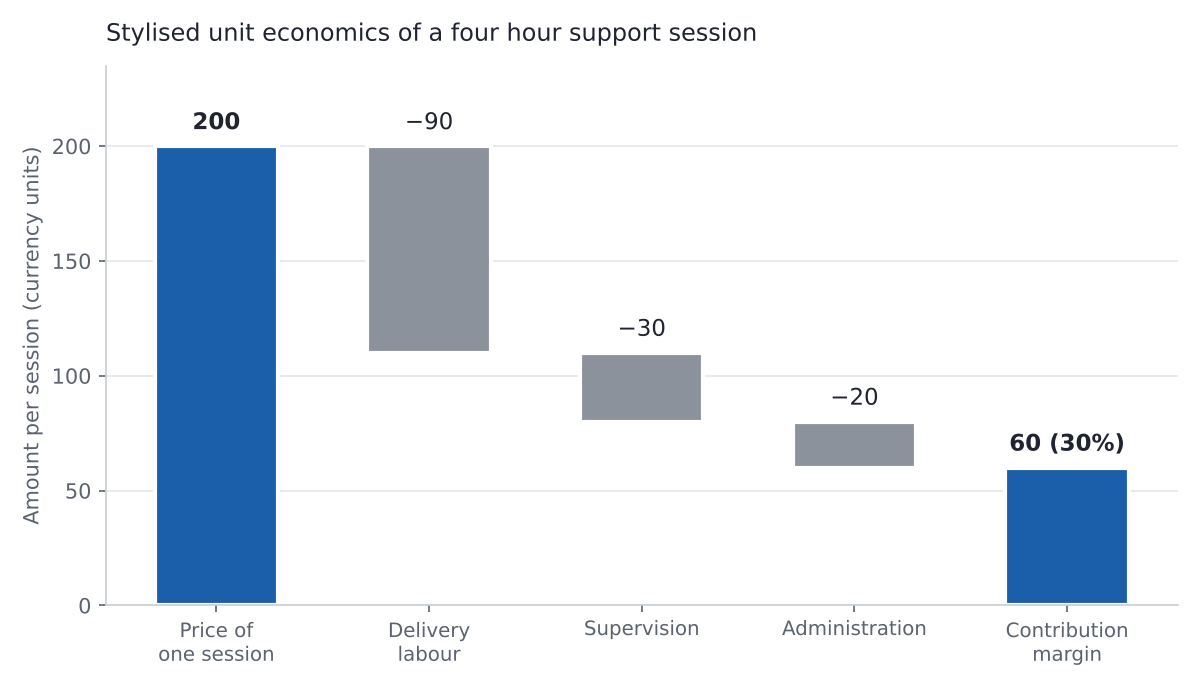
Source: author’s own illustration, stylized numbers.
This was the starting point of the financial projections we prepared. Before forecasting a single year, we had to ask what one unit of service earns after the people who deliver it are paid. The framework also shows where management attention matters most. With these numbers, a 10% price increase (from S$200 to S$220) lifts the contribution from S$60 to S$80, an increase of 33.33%, while a 10% reduction in all variable costs (S$14 out of S$140) increases the contribution margin by 23.33%. In this example, increasing the price has a greater impact on the contribution margin than reducing variable costs by the same percentage. However, the effectiveness of a pricing strategy also depends on how customers respond to price changes.
Break-even analysis and operating leverage
Fixed costs, such as rent, core salaries, and insurance, remain constant within a relevant range of activity and over a given time horizon. The break-even volume is the number of units at which total contribution equals fixed costs. The operating profit (EBIT) is equal to the total contribution margin minus fixed costs (FC). The break-even volume is reached when EBIT equals zero.
EBIT = Q × CM – FC
Q* = FC / CM
where Q is the number of sessions sold, CM is the contribution margin per session, and FC represents fixed costs.
With stylized fixed costs (FC) of S$120,000 per year and a contribution of S$60 per session, break even is reached at 2,000 sessions (Figure 2). A pilot year has few clients and sits to the left of this point, so it makes a loss. A grant can help finance the operating costs of the pilot phase, provided these expenditures are eligible under the grant conditions. Initial losses may be economically justified if the business plan demonstrates a credible path toward financial sustainability.
Figure 2: Stylized break-even analysis.
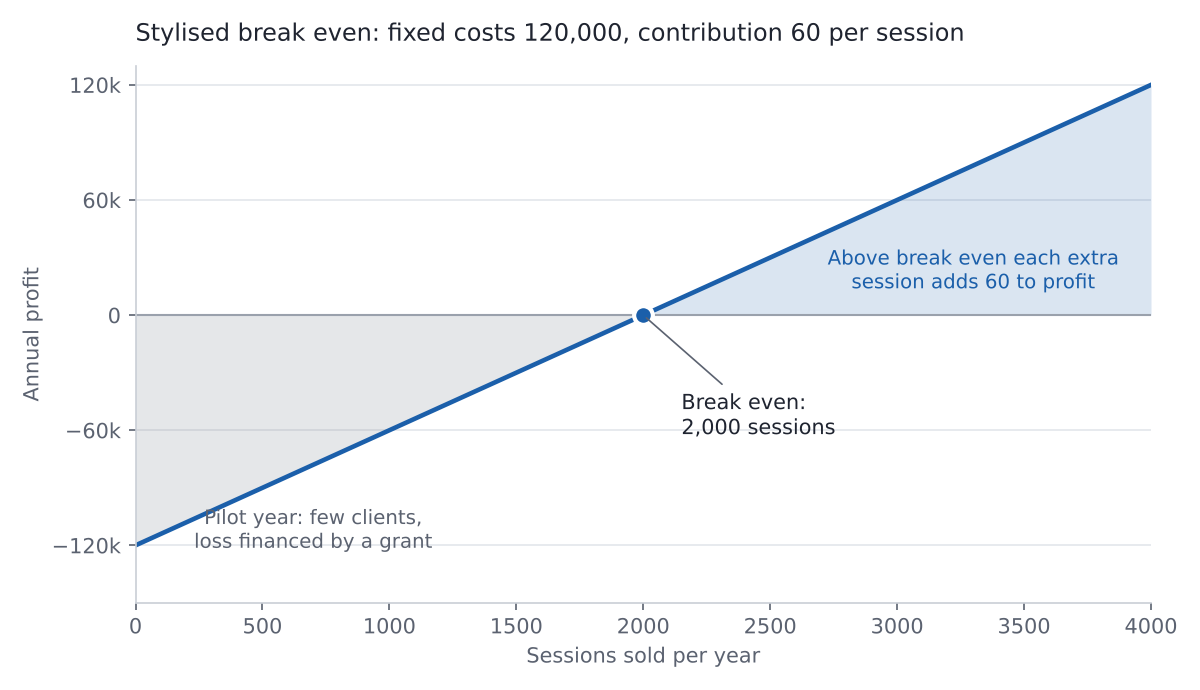
Source: author’s own illustration, stylized numbers.
Beyond the break-even point, each additional session adds its full contribution of S$60 to operating profit. Operating leverage measures the sensitivity of operating profit to changes in sales volume. For a given contribution margin per unit and sales volume, higher fixed costs increase the relative sensitivity of operating profit to changes in sales volume, provided operating profit remains positive. It explains why scaling a service business is attractive, but also why a pilot must prove demand before fixed costs are committed.
Blended financing and mission drift
A social enterprise sells products or services like a business, but its goal is a social outcome. It therefore often combines earned revenue with grants and donations. A grant does not dilute ownership and is usually tied to a purpose, but it is temporary. Earned revenue is renewable, but it creates a risk that researchers call mission drift: the organization moves toward the customers who pay best and away from the people it wants to serve (Battilana and Lee, 2014). Yunus, Moingeon and Lehmann-Ortega (2010) argue that a social business must be designed so that its economic engine covers its costs while serving the social objective.
In our case, the objective was to use the grant to finance the pilot phase while developing a sustainable revenue stream from companies paying for workplace integration programs. These revenues could eventually cover the program’s operating costs. Funders also look at what is measured. Ebrahim and Rangan (2014) distinguish outputs (for example, the number of people trained), outcomes (for example, the number who keep a job) and impact, defined as lasting change in the lives of people. A proposal that is explicit about this ladder is easier to evaluate and harder to criticize.
Why should I be interested in this post?
If you are a business or finance student, this post shows how finance tools apply outside a bank. Unit economics, break-even analysis, and financing decisions are also central to the financial analysis of startups and investment projects. A grant application is also close to an investment memo: it requires assumptions, scenarios and a clear use of proceeds. Impact investing and sustainability reporting are areas where understanding how a mission-driven organization balances revenue and impact is directly useful. Finally, an operations role in a very small organization gives responsibility early, and it teaches you what drives margins in a way that a valuation model captures only indirectly.
Related posts on the SimTrade blog
▶ All posts about Professional experiences
▶ Anant JAIN My internship experience at Deloitte
▶ Bochen LIU My Internship Experience as a Marketing Intern at XING QI Educational Institution
Useful resources
Academic research
Battilana, J., Lee, M., (2014) Advancing Research on Hybrid Organizing: Insights from the Study of Social Enterprises, Academy of Management Annals, 8(1), 397–441.
Ebrahim, A., Rangan, V. K., (2014) What Impact? A Framework for Measuring the Scale and Scope of Social Performance, California Management Review, 56(3), 118–141.
Yunus, M., Moingeon, B., Lehmann-Ortega, L., (2010) Building Social Business Models: Lessons from the Grameen Experience, Long Range Planning, 43(2–3), 308–325.
Business resources
Tea Ideas profile in the raiSE member directory
raiSE, Singapore Centre for Social Enterprise
About the author
The article was written in November 2026 by Arjun KODAPPULLY (ESSEC Business School, Global Bachelor in Business Administration (GBBA), 2024-2028).
▶ Discover all posts by Arjun KODAPPULLY.