

In this article, Bochen LIU (Queen’s Smith School of Business, BCom 2023–2027; ESSEC BBA Exchange Program, Fall 2025) analyzes how the famous Chinese strategic quote “知己知彼,百战不殆” (know yourself and know your opponent, and you will never be defeated), derived from Sun Tzu’s The Art of War, functions as a foundational principle in modern Business strategy, particularly in positioning, segmentation, and competitive analysis.
Know Yourself, Know Your Opponent: Applying Sun Tzu’s Strategy to Modern Business Competition
The Chinese strategic philosophy “知己知彼,百战不殆” (know yourself and know your opponent, and you will never be defeated), originating from Sun Tzu’s The Art of War, continues to provide valuable insights for modern business strategy and competitive analysis. Although this principle was originally developed in the context of military strategy, its underlying logic remains highly relevant in today’s corporate environment. Companies must understand their own capabilities while continuously analyzing competitors, customers, and external market conditions. Knowledge of both internal resources and external competition enables organizations to develop stronger positioning strategies and maintain competitive advantages.
In the current business environment, companies face uncertainty caused by changing consumer behaviour, technological development, and increasing competition. Having a high-quality product or service alone does not guarantee success. Organizations must understand their own strengths, recognize their weaknesses, and evaluate how competitors influence customer expectations and market conditions. Therefore, the principle of “knowing yourself and knowing your opponent” can be transformed into a practical business framework through Strengths, Weaknesses, Opportunities, and Threats (SWOT) analysis, which allows companies to evaluate internal capabilities and external challenges.
Understanding “Know Yourself”
“Know yourself” refers to the process through which companies understand their internal resources, capabilities, and limitations. From a business perspective, this involves evaluating internal factors such as brand reputation, product quality, pricing strategies, operational efficiency, financial resources, and customer relationships.
Understanding internal strengths allows companies to identify areas where they possess competitive advantages. For example, companies with strong brand recognition may not compete with competitors through lower prices. Instead, they can create value through customer loyalty, premium positioning, and differentiated customer experiences. Similarly, organizations with unique technologies or specialized expertise can use these capabilities to distinguish themselves from competitors.
However, knowing oneself also requires recognizing internal weaknesses. Companies that fail to understand their limitations may develop unrealistic strategies that cannot be effectively implemented. For example, a business may provide high-quality products but lack sufficient distribution channels, marketing resources, or operational capacity to support expansion.
Therefore, “know yourself” does not simply mean identifying positive characteristics. It requires an objective evaluation of both strengths and weaknesses so that companies can develop realistic and effective strategies.
Understanding “Know Your Opponent”
“Know your opponent” refers to understanding competitors, customers, and external market conditions. Businesses operate in environments where competitors continuously adjust their strategies, introduce new products, and influence consumer expectations. Without sufficient knowledge of the external environment, companies may lose their competitive position.
Competitor analysis allows businesses to understand how other organizations attract customers, differentiate their products, and respond to market changes. For example, companies operating in the education industry need to analyze competitors’ pricing strategies, teaching methods, customer acquisition approaches, and brand positioning before developing their own marketing strategies.
Knowing your opponent does not mean copying competitors’ strategies. Instead, it enables businesses to identify opportunities for differentiation and develop unique value propositions. By understanding competitors’ strengths and weaknesses, companies can discover underserved customer segments and create stronger market positions.
Therefore, “know your opponent” represents a continuous process of monitoring external changes and adapting business strategies according to evolving market conditions.
Applying “Know Yourself and Know Your Opponent” Through SWOT Analysis
SWOT analysis is one of the most effective frameworks for applying Sun Tzu’s principle to modern business strategy. The framework evaluates four key areas: Strengths, Weaknesses, Opportunities, and Threats. Strengths and weaknesses represent internal factors related to “knowing yourself,” while opportunities and threats represent external factors related to “knowing your opponent.”
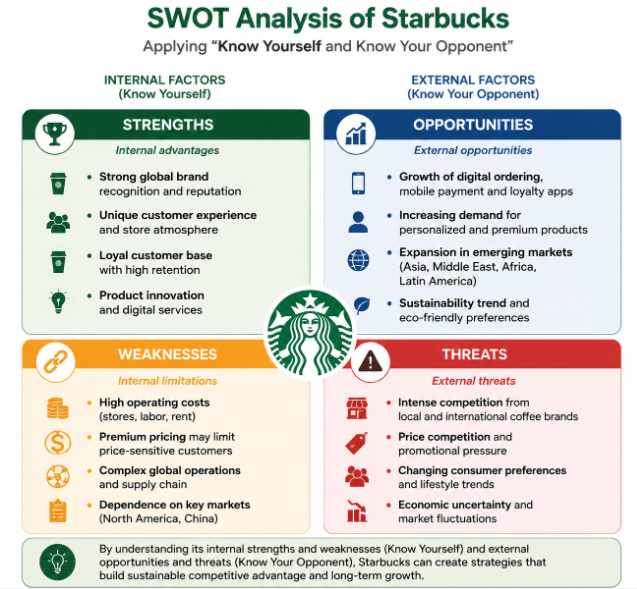
Source: the author.
Strengths and Weaknesses: Internal Analysis
Strengths refer to internal advantages that allow companies to compete effectively. These advantages may include strong brand recognition, innovative products, loyal customers, advanced technology, or efficient operations. By identifying strengths, companies can develop strategies that maximize their existing competitive advantages.
Weaknesses refer to internal limitations that may reduce competitiveness. These may include high operating costs, limited resources, weak brand awareness, or inefficient processes. Recognizing weaknesses allows organizations to improve internal capabilities and prevent potential problems from affecting future growth.
Opportunities and Threats: External Analysis
Opportunities refer to external conditions that create potential growth possibilities. These may include emerging customer demands, technological development, new market segments, or changing consumer preferences. Companies that successfully identify opportunities can adapt their strategies and expand their market presence.
Threats refer to external factors that may negatively influence business performance. These include new competitors, changing consumer behaviour, economic uncertainty, and increasing price competition. Understanding threats allows companies to prepare appropriate responses before competitors gain an advantage.
Through SWOT analysis, businesses can transform the abstract principle of “know yourself and know your opponent” into a structured decision-making process. This framework allows organizations to connect internal capabilities with external market conditions and develop more effective strategies.
Real Business Example: Starbucks’ Competitive Strategy
Starbucks Corporation provides a clear example of how “know yourself and know your opponent” can be applied through SWOT analysis. The company demonstrates how understanding internal capabilities and external competition can support long-term competitive success.
From an internal perspective, Starbucks’ major strengths are its global brand recognition and unique customer experience. Starbucks is not simply a company that sells coffee; it creates value through store atmosphere, personalized beverages, customer service, and strong brand identity. These advantages allow Starbucks to build customer loyalty and maintain premium pricing compared with many traditional coffee providers.
However, Starbucks also faces internal weaknesses. Operating thousands of locations worldwide requires significant investment in employees, store management, supply chains, and quality control. These high operating costs create challenges when Starbucks competes with lower-cost coffee providers. Recognizing these weaknesses allows the company to improve efficiency and adapt its operations.
From an external perspective, Starbucks identifies opportunities by analyzing changes in consumer behaviour. The increasing popularity of digital ordering, mobile payment systems, and personalized products provides opportunities for Starbucks to strengthen customer relationships. By understanding customer expectations, Starbucks can develop services that better match market demands.
At the same time, Starbucks must understand competitive threats. In markets such as China, Starbucks faces increasing competition from local coffee brands that compete through lower prices, rapid expansion, and digital platforms. Instead of competing only through price, Starbucks relies on its strengths, including global branding, customer experience, and product innovation, to maintain differentiation.
This example demonstrates that successful businesses need both internal and external analysis. Starbucks maintains competitiveness because it understands its own capabilities while continuously monitoring competitor strategies and market changes.
Conclusion
The principle of “know yourself and know your opponent” remains an important concept in contemporary business strategy. Organizations cannot achieve sustainable success by focusing only on their internal capabilities. They must also understand competitors, customers, and external environmental factors that influence market performance.
SWOT analysis provides a practical method for implementing this principle because it combines internal evaluation with external market analysis. Through SWOT analysis, businesses can create more effective strategies, improve market positioning, and develop sustainable competitive advantages.
Sun Tzu’s strategic thinking therefore continues to provide valuable lessons for modern organizations. Companies that accurately understand themselves and their opponents are better prepared to compete in dynamic markets.
Related posts on the SimTrade blog
▶ Mathis HOUROU Client Segmentation and Private Banking: Marketing Strategy or Risk Shield?
▶ Camille KELLER My Apprenticeship Experience as Digital Strategy Officer at Gan Assurances
▶ Liner SHI My Intern Experience in Tencent Strategy Department
Useful resources
The Art of War (Chinese Text Project)
Encyclopaedia Britannica – The Art of War
American Marketing Association (AMA)
About the author
The article was written in August 2026 by Bochen LIU (Queen’s Smith School of Business, BCom 2023–2027; ESSEC BBA Exchange Program, Fall 2025).
▶ Discover all posts by Bochen LIU
1 thought on “Know yourself and know your opponent, and you will never be defeated – Sun Tzu”
Comments are closed.