Reinventing Wellness: How il Puro Brings Personalization to Nutrition

Emanuele GHIDONI

In this article, Emanuele GHIDONI ESSEC Business School, European Management Track (EMT), 2025-2026) shares his entrepreneurial experience of founding il Puro a startup born from the vision of transforming daily nutrition into a personalized and emotional experience. By combining data-driven personalization with sensory design, il Puro aims to make functional food both effective and enjoyable.

Turning an Idea into a Mission

The idea behind il Puro was born from a simple yet powerful question: how can we help people feel better every day through what they consume? During my studies and professional experiences, I observed a gap between the science of nutrition and the reality of human habits. Many people struggle to meet their daily nutritional needs not because of a lack of awareness, but because healthy choices often feel inconvenient or uninspiring. I wanted to bridge this gap by creating a brand that combined personalization, science, and pleasure, transforming nutrition from a routine task into a daily ritual. That vision became il Puro, a functional food venture built around personalization, emotion, and Italian values.

Logo of il PURO.
Logo of il Puro
Source: The company.

From Concept to Market: Testing and Learning

After shaping the initial concept, the next crucial step was to validate it in the real world. Rather than jumping straight into full production, we focused on building a minimum viable product (MVP) to test the market and understand how potential customers would truly respond. Through this phase, we explored key dimensions such as product–market fit, price sensitivity, and willingness to pay, combining qualitative feedback with quantitative data.

A central part of this process was the use of A/B testing a method where two or more variations of a single element are presented to different groups of users to measure which performs better. For instance, we tested different product formulations, packaging visuals, and website layouts to observe how each influenced user engagement and purchase intent. We also ran price point experiments to identify the threshold at which conversion began to decline, allowing us to estimate optimal pricing and margin trade-offs. Each test generated measurable data, click-through rates, conversion percentages, time-on-page, and cart completion, which we used to make data-driven adjustments.

This structured experimentation reduced uncertainty and transformed creative intuition into quantifiable learning. By systematically measuring what worked and what didn’t, we refined both the product and the brand narrative, ensuring that il Puro evolved through validated consumer insight and real behavioral evidence rather than assumptions alone.

Business concepts related to my project

I present below three financial and business concepts related to my project il Puro, which guided my decision-making during the early development phase of the brand.

Be simple

I build il Puro on simplicity because simplicity compounds financially. A focused hero lineup (2–3 SKUs) keeps COGS tight, inventory turns high, and the cash conversion cycle short. A clean price architecture (starter, core, subscription) reduces choice friction and lifts conversion while protecting margin. I sell where unit economics are strongest DTC via Shopify plus a selective B2B channel with clear MOQs and prepayment terms to de-risk working capital. Operationally, fewer suppliers, standardized Italian actives, and repeatable fulfillment flows mean lower variability, fewer stockouts, and healthier gross margins from day one.

Be scientific

I treat decisions as experiments with a P&L. Personalization isn’t a story; it’s a retention engine that increases LTV: onboarding quizzes → segmentation → tailored formulations → higher reorder rates. I quantify everything and elasticity tests for pricing; split tests on bundles, claims, and creatives; cohort and payback tracking by acquisition channel. My targets are explicit: LTV:CAC ≥ 3:1, first-order contribution margin positive by order #2, subscription retention ≥ 70% at month 3. Clinical substantiation and transparent labeling aren’t just ethical they reduce returns, build trust, and lower CAC over time.

Be detail-oriented

I run il Puro with a unit-economics dashboard, not vibes. COGS broken down to the gram (actives, flavoring, sachet, carton), freight per parcel, pick-pack, payment fees, and support cost per ticket. I design packaging to ship small and light, negotiate lead times to avoid safety-stock bloat, and lock FX/commodity exposure where sensible. My working metrics: DTC gross margin, B2B contribution margin after CAC, paid payback, monthly churn, inventory turns, NPS. Contract manufacturing keeps CAPEX light; disciplined reorders and rolling forecasts keep cash free for growth.

Why should I be interested in this post?

For someone with an entrepreneurial mindset, the journey of il Puro represents the essence of turning vision into execution. Building a startup in the functional food space was not just about creating a product, it was about identifying a real problem, testing assumptions, and translating insights into a viable business model. Every step, from market validation and financial modeling to branding and investor pitching, demanded both strategic thinking and adaptability. It was a hands-on lesson in how innovation happens: through curiosity, experimentation, and resilience. Above all, il Puro reflects a new kind of entrepreneurship, one that merges health, technology, and purpose to create businesses that are not only profitable, but also meaningful in the lives of people.

Related posts on the SimTrade blog

   ▶ All posts about Professional experiences

   ▶ Alexandre VERLET Classic brain teasers from real-life interviews

Useful resources

il Puro – Official website

World Health Organization Healthy Diet Guidelines

Mintel Functional Food and Beverage Trends

NutraIngredients News on Functional Foods and Supplements

McKinsey The Future of Wellness

About the author

The article was written in October 2025 by Emanuele GHIDONI (ESSEC Business School, European Management Track (EMT), 2025-2026).

The importance of data in finance to support small business managers

 Sylvain GILIBERT  Yann FONTAINE

In this article, Yann FONTAINE (head of Marketing of atometrics) and Sylvain GILIBERT (co-founder of atometrics) explain about the importance of data in finance to support small business managers. They discuss how their platform, atometrics, helps transform complex market data into actionable insights for small businesses and their stakeholders (like accountants, banks, brokers, and consultants) throughout different stages of the business lifecycle – from creation to development, through difficult phases, and during transmission/acquisition processes.

Today economic context

Did you know that 29% of local businesses in France fail within their first three years , often due to a lack of market understanding?

In today’s fast-moving economy, access to relevant and actionable data is critical for businesses—whether they are launching, growing, or overcoming challenges. Yet, small business managers and their advisors often struggle to find and interpret the right information —strategic insights about their market, including prospects, customers, competitors, and the business environment—, particularly at a local level. By local level, we mean the geographic scope tailored to the company’s market: from the catchment area of a neighbourhood for a local retail store to the entire country for national markets.

The power of local data

For businesses operating in local markets, understanding the economic environment, consumer behavior, competition and market transactions is essential. In France, open data sources provide valuable insights, but the sheer volume and complexity of this information can be overwhelming without the right tools.

atometrics: turning data into decisions

At atometrics, we simplify this process. Our platform automates the collection, analysis, and visualization of market data across all sectors and locations of the economy. By combining financial and non-financial information, we provide clear, actionable insights to support small business managers and their trusted partners, such as certified accountants, bankers, and consulting firms.

Logo of atometrics.
Logo of atometrics
Source: the company.

Description of the product: atometrics platform

Atometrics is a cutting-edge platform that connects in real-time to numerous public and private databases via APIs, such as SIRENE (the national directory of businesses in France), BODACC (official bulletins for company announcements, including bankruptcies and mergers), public financial records from Infogreffe, INSEE census data (socio-economic and demographic statistics), DVF property transaction data (detailing real estate sales), Damodaran’s valuation datasets (global financial benchmarks), and more. By leveraging this vast data network, the platform enables users to generate comprehensive market studies instantly.

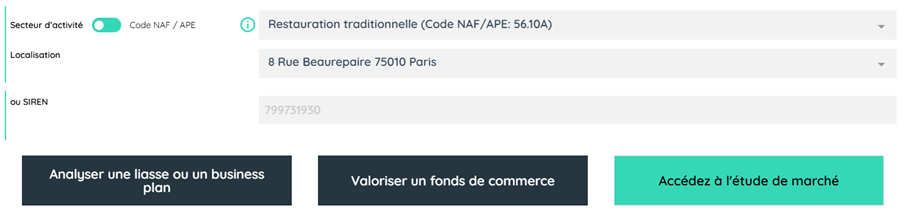
Searching for a company.
 Searching for a company
Source: atometrics.

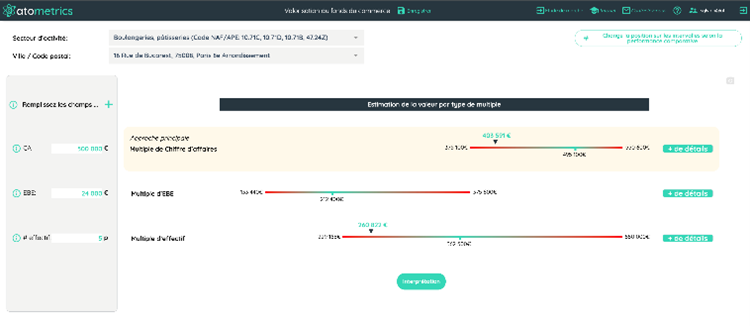
Users simply select an industry (e.g., bakery, hairdressing) and a location, and Atometrics delivers a detailed report. This includes financial insights on competitors, transaction prices for nearby properties or businesses, valuation tools for businesses or shares, competitor mapping, and local demographic and economic data. Additionally, qualitative market insights are provided. The platform also features customizable email alerts to notify users of critical events, such as new tenders or competitors.

Report on a company.
Report on a company
Source: atometrics.

The platform allows users to either work with specific datasets (e.g., Excel exports, map visuals) or generate complete reports in PDF or PPT format.

Supporting small businesses at every stage

atometrics empowers small businesses through their stakeholders — accountants, banks, brokers, consultants — to access key information at the different stages of the business life cycle:

  • Creation: assess market feasibility, validate business plans, and identify the best locations for new businesses.
  • Development: monitor trends, spot opportunities, and manage risks. For example, our platform can alert managers to new competitors or relevant public tenders in real time.
  • Difficulty phases: respond quickly to economic shifts with up-to-date market intelligence, ensuring resilience during challenging times.
  • Transmission and acquisition: conduct reliable valuations of businesses, assets, or securities based on accurate market multiples.

A concrete example: how atometrics enhances banking efficiency and risk assessment

Banks leveraging atometrics gain a significant advantage by accessing a uniform and structured source of information. When client managers and risk analysts evaluate a funding request or a business plan, they need to determine whether the entrepreneur is likely to achieve their revenue targets. This requires reliable market data: have similar projects succeeded or failed? Does the targeted catchment area show strong potential?

Atometrics simplifies this process by providing objective, data-driven insights that streamline the assessment of funding requests and accelerate the time to market of loan drawdowns. Instead of spending hours collecting and interpreting scattered information, bank advisors can access clear, actionable insights in real time.

Furthermore, the shared use of atometrics across commercial and risk departments fosters a common source of information among them, hence improving communication and collaboration between teams.

Conclusion

In today’s data-driven world, success belongs to those who can transform information into action. atometrics equips small business stakeholders with the tools and insights they need to unlock opportunities, navigate challenges, and drive sustainable growth—at every stage of the journey.

Why should I be interested in this post?

In today’s era of open finance and open data, financial professionals need cutting-edge tools to better serve their clients. This article reveals how atometrics, an innovative French fintech, is transforming the way banks, brokers, accountants, and business advisors support companies through data analytics. Whether you’re an ESSEC student preparing for a career in finance, a banker looking to streamline credit processes, or a consultant aiming to provide better market insights, you’ll want to know how the latest data-driven tools are reshaping financial decision-making and improving client service.

Related posts on the SimTrade blog

   ▶ Nithisha CHALLA Job description – Financial analysts

   ▶ Louis DETALLE The importance of data in finance

   ▶ Nithisha CHALLA Market Consensus Based on Financial Analysts’ Forecasts

Useful resources

atometrics

About the authors

The article was written in January 2025 by Yann FONTAINE (head of Marketing of atometrics) and Sylvain GILIBERT (co-founder of atometrics).

Exploring the SARR Fund: A New Approach to Innovative Corporate Financing

Gilles de MALBOSC

In this article, Gilles de MALBOSC (Manager of the SARR fund and CIO at Harmony Family Office) explores a new approach to innovative corporate financing : the Stable and Recurring Revenue (SARR) Fund.

Exploring the SARR Fund: A New Approach to Innovative Financing

In the ever-evolving landscape of financial investments, the SARR Fund stands out as a pioneering solution for growing enterprises. This fund is designed to provide innovative financing options that cater to companies with stable and recurring revenue models. Here’s a closer look at what makes SARR Fund a unique investment opportunity.

Introduction to SARR Fund

SARR stands for Stable and Recurring Revenue. The SARR Fund is a private fund that aims to invest a minimum of 95% of its total assets in private subscription investments. Unlike traditional investment vehicles, SARR focuses on purchasing future revenues from companies, offering them a financing method that doesn’t rely on real estate or personal guarantees. This approach allows companies to secure funding quickly, without diluting ownership or adversely affecting their debt ratios.

Why SARR Fund?

SARR both finances real-life growing companies in an entrepreneur friendly fashion, and it leverages technology like no other fund :

Innovative Financing Solutions

SARR helps entrepreneurs.

  • Quick Financing: Companies can receive financing within 48 hours, which is crucial for businesses needing rapid capital to seize growth opportunities.
  • Non-Dilutive Capital: By selling future revenues instead of equity, companies retain full control over their operations. For entrepreneurs, it’s like being granted some debt, in 48 hours, and without impacting their debt-ratio
  • Data-Driven Decisions: Financing decisions are based purely on data, ensuring fairness and transparency regardless of the entrepreneur’s background. Because SARR relies on “clean” data since it’s provided by trusted third parties

Timing and Technology

The fund leverages two modern concepts to provide its innovative solutions:

  • Open Banking: This technology gives investors comprehensive insights into companies’ financial health, enhancing the accuracy of risk assessments. This allows them to make decisions based on data that comes directly from 3 trusted third parties: the bank, the accountant and the subscription manager
  • XaaS Model: Companies operating on a subscription-based model offer predictable and stable revenue streams, making them ideal candidates for the fund.

How Does SARR Fund Work?

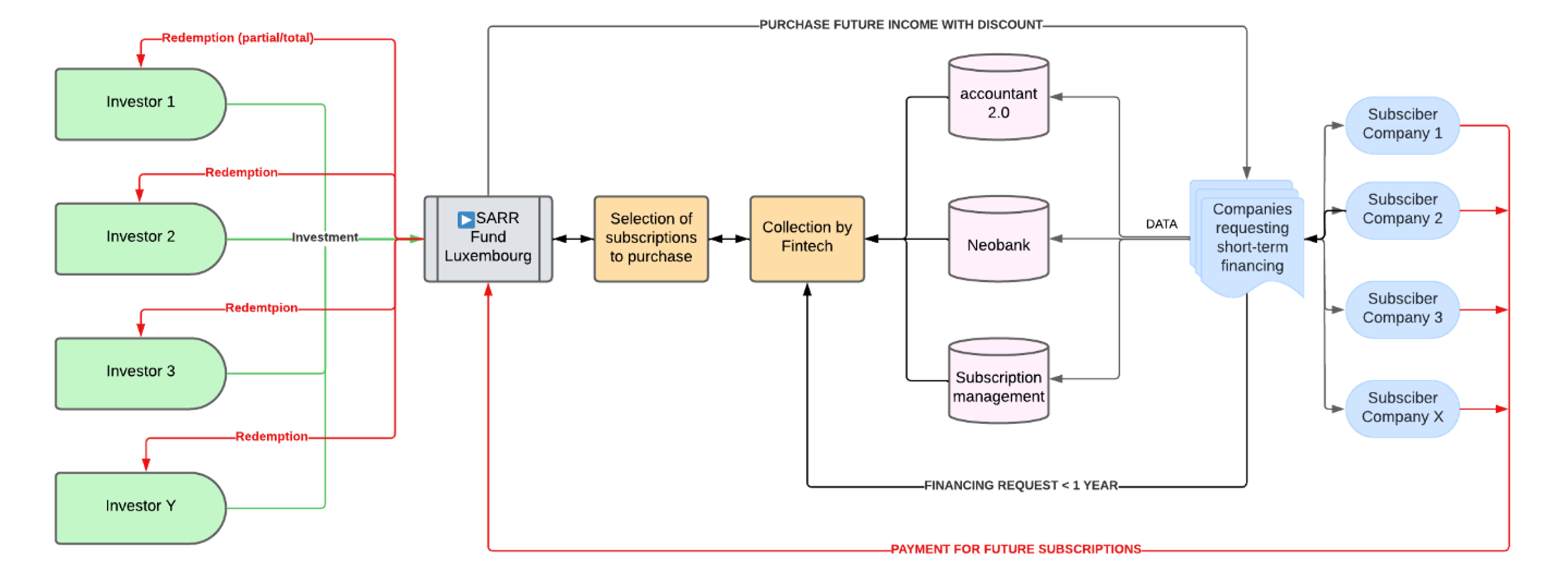
A typical transaction involves a company, such as a growing CRM software provider, seeking additional funding to expand its product offerings. The step-by-step process is described below:

  1. Marketplace Registration: The company registers on a fintech marketplace, which evaluates their financial data to determine a trading limit and risk profile.
  2. Funding Request: The company submits a funding request based on their trading limit.
  3. Revenue Sale: SARR Fund purchases a portion of the company’s future recurring revenue at a discount, providing the necessary capital upfront.
  4. Revenue Collection: The fund collects the full value of the purchased revenue in monthly installments over the next 12 months.

Process of a transaction.
 Process of a transaction
Source: The company.

Benefits for Investors

Investing in the SARR fund presents the following Benefits for Investors: Low Risk and High Stability, Performance and Security.

Low Risk and High Stability

  • Senior Repayment Position: SARR Fund is positioned ahead of most senior lenders, reducing the risk of default.
  • Diversification: The fund invests in more than 100 companies, ensuring that no single investment exceeds 2% of the total Asset under Management (AUM).
  • Monthly Liquidity: Investors have access to 7.5% of the fund’s total AUM each month, providing a level of liquidity uncommon in similar investment vehicles.

Performance and Security

  • Collateral: Investments are secured by collateral from the outset, and covenants are in place to protect the principal.
  • Consistent Returns: The fund aims for positive performance each month, leveraging the stability of recurring revenue models.

Target Audience

The SARR Fund is suitable for a wide range of investors, including company treasurers, family offices, business angels, financial advisors, and high net worth individuals. Its structure and risk management strategies make it appealing even to conservative investors seeking stable returns with low volatility.

Conclusion

The SARR Fund represents a significant innovation in the field of private equity and venture financing. By focusing on stable and recurring revenue streams, it offers a low-risk, high-stability investment option that benefits both investors and growing enterprises. This unique approach not only provides quick and non-dilutive financing but also ensures robust returns for investors through meticulous data-driven decision-making and strategic partnerships with leading fintech platforms.

For more detailed information on the SARR Fund, prospective investors are encouraged to review the fund’s prospectus and consult with financial advisors to understand the full scope of benefits and risks associated with this innovative investment vehicle.

Useful resources

The Future of Data-Driven Finance and RegTech: Lessons from EU Big Bang II European Banking Institute Working Paper Series 2019/35

From FinTech to TechFin: The Regulatory Challenges of Data-Driven Finance

New York University Journal of Law and Business, Forthcoming European Banking Institute Working Paper Series 2017 – No. 6

Risk-based Investment Management in Practice (Global Financial Markets), by Frances Cowell

Banks and the real economy: An assessment of the research, Allen N. Berger, Phil Molyneux, John O.S. Wilson

About the author

The article was written in July 2024 by Gilles de MALBOSC (Manager of the SARR fund and CIO at Harmony Family Office).

Why Berlin could be the new Silicon Valley for startups?

Why Berlin could be the new Silicon Valley for startups?

Jessica BAOUNON

In this article, Jessica BAOUNON (ESSEC Business School, Executive Master in Direction Financière et Contrôle de Gestion, 2020-2022) explores the latest trends which is transforming the the startups world and the venture capital in Berlin, the capital of Germany.

These last decades, with the rise of internet and new technologies, startups rapidly boomed. Some of them became very famous. You may be familiar with AirBnb, Instagram or Uber; they all started from scratch in a grungy basement before flourishing at a global scale. BytheDance, with 2 billion users in 150 countries recorded 58 billion of dollars in revenues for 2021, an example of success story that creates a high interest of curiosity for tech-investors everywhere in the world. However, only a few cities are among the most attractive for entrepreneurs. Berlin is on the path to become the most popular city for startups. But first of all, let’s go back to the basics by defining what a startup is.

What is a startup ?

Startups are companies that are in the first stages of its business operations. They are often founded by young people. They work in a collaborative way to scale up quickly their innovative products or services. They are looking for disruption opportunities to change the world and industries. They want to bring new ideas. As a result, the startup ecosystem is known to be a very fast-paced environment but also valuable for investors that expect a high return on their investment. On the other side, corporate operate with a different approach. They are most of the time, well-established. They work with a pyramidal organization and focus on the productivity rather than taking risks to grow fast.

Startups costs are usually very high with a low revenue at the start. They need funds to finance innovation and their entry in the markets. This is the reason why they turn to venture capitalist, but it can also come from various sources. The venture capitalist is a private investor. He provides capital in exchange for equity stake when they don’t have access to equity markets. Startup can then graduate by going public with an initial public offering (IPO), making them purchasable on the stock exchange.

How is the Berlin Startup Ecosystem?

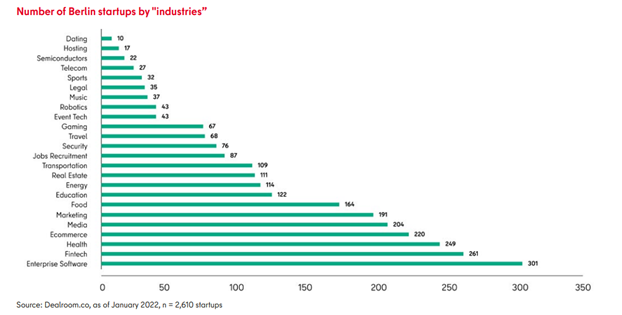
Berlin counts 4 500 startups among well-known organizations such as SoundCloud, Tier Mobility or Babbel and employ over 80 000 people. Software as a Service (Saas), FinTechs and healthcare startups represent most of the business models. For the next coming years, the forecast expects a shift towards the green industry with the new climate neutrality challenges.

Figure 1. Number of Berlin startups by “industries”.
Number of Berlin startups by industries
Source: Dealroom.co

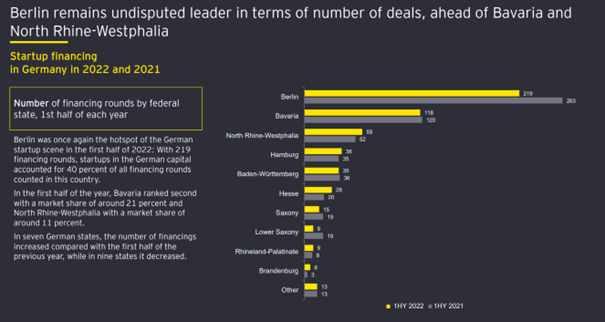
With over 10 billion euros invested in total in startups in 2021, the city is also among the top 10 locations for startup investment worldwide (1). Berlin is leading the investments in Germany “Three out of five euros invested in start-ups in Germany (60%) were invested in Berlin startups in 2021” (2) and Berlin records the most financing rounds” (3) in 2021 and 2022. The funding is diverse coming from public, private and institutional actors. Startups are the engine of Berlin’s economy. The new government state has detailed the plan for the next four years. They want to pursue the development of Berlin’s startup ecosystem into one of the first technology location.

Figure 2. Berlin: leader for startups in Germany.
Berlin startups
Source: Ernst & Young Startup Barometer (2022)

Why Berlin is attractive for startups

Berlin offers a lot of favorable conditions. The startup ecosystem benefits from an important aspect of the capital: the diversity. The city offers a wide network of high-quality professional talents coming from all over the world. 44% of entrepreneurs are not German (4). Indeed, Berlin has a strong historical with several countries such as France, Great Britain, The United States. The geographical location, almost in the middle of the European Union, facilitates the connections between the north, south, east, and west side but also for people outside of the region.

Indeed, the diverse sources of financing from private to public actors enable a positive investment climate for entrepreneurs. They are business incubators, universities, technology centers, regular meetups, and the greatest number of coworking spaces in Germany to ensure an outstanding infrastructure. Most of the entrepreneurs don’t want to follow the classic corporate path. Berlin as a creative and dynamic city offers the opportunity to express their ideas and freedom. The city is constantly in transformation in all areas: technology, art, music, architecture which attract people who aspire to change and innovation. Although rental prices rise in Berlin, it keeps one of the most affordable in term of living cost. Berlin’s startups and the venture capital scene promises to grow at a high dynamic for the next coming years.

Why should I be interested in this post

If you are considering working abroad and interested to work for a startup or a capital venture, this article is for you. This article presents the Berlin startup scene and explains why Berlin is considered as one of the most attractive cities for entrepreneurs and venture capital.

Related posts on the SimTrade blog

   ▶ Louis DETALLE A quick presentation of the Private Equity field…

Ressources utiles

Startup Map Berlin

Startup Capital Berlin

Startup Barometer Germany E&Y

Startup Ecosystem

About the author

The article was written in October 2022 by Jessica BAOUNON (ESSEC Business School, Executive Master in Direction Financière et Contrôle de Gestion 2020-2022).