“In investing, what is comfortable is rarely profitable.” – Robert Arnott

Hadrien PUCHE

In this article, Hadrien PUCHE (ESSEC Business School, Grande École Program, Master in Management, 2023-2027) comments on Robert Arnott’s famous quote, exploring how it relates to risk-taking, behavioral biases, and the mindset required to achieve consistent, long-term performance.

About Robert Arnott

Robert Arnott

 Robert Arnott

Source: Research Affiliates

Robert D. Arnott (born 1954) is an American investor, researcher, and entrepreneur. He is the founder and chairman of Research Affiliates, a firm known for its pioneering work on smart beta and alternative indexing strategies. Arnott has written extensively on asset allocation, portfolio construction, and factor investing, often challenging traditional assumptions about market efficiency.

Throughout his career, Arnott has emphasized that the best investment opportunities emerge when investors are willing to leave their comfort zone, particularly when markets are volatile, sentiment is negative, and uncertainty dominates.

Analysis of the quote

When Arnott says, “In investing, what is comfortable is rarely profitable,” he highlights a fundamental paradox of financial markets: comfort and profit rarely coexist.

Comfort comes from stability, familiarity, and consensus. Yet, markets reward those who act rationally in uncomfortable moments; those who buy when others sell and remain calm when others panic. Profitable investing often requires doing what feels counterintuitive.

However, this quote does not promote reckless risk-taking. Instead, it reminds us that genuine investment opportunities often arise in periods of uncertainty and fear, when prices deviate from intrinsic value. Success lies in maintaining discipline and conviction when others lose theirs.

Moreover, this insight resonates with Frank Knight’s distinction between risk and uncertainty. While risk can be measured and priced, true uncertainty is unknowable and unpredictable. Investing in moments of discomfort often means confronting this unmeasurable uncertainty, and taking opportunities when most investors hesitate.

Case study: March 2020 – Investing during the Covid crisis

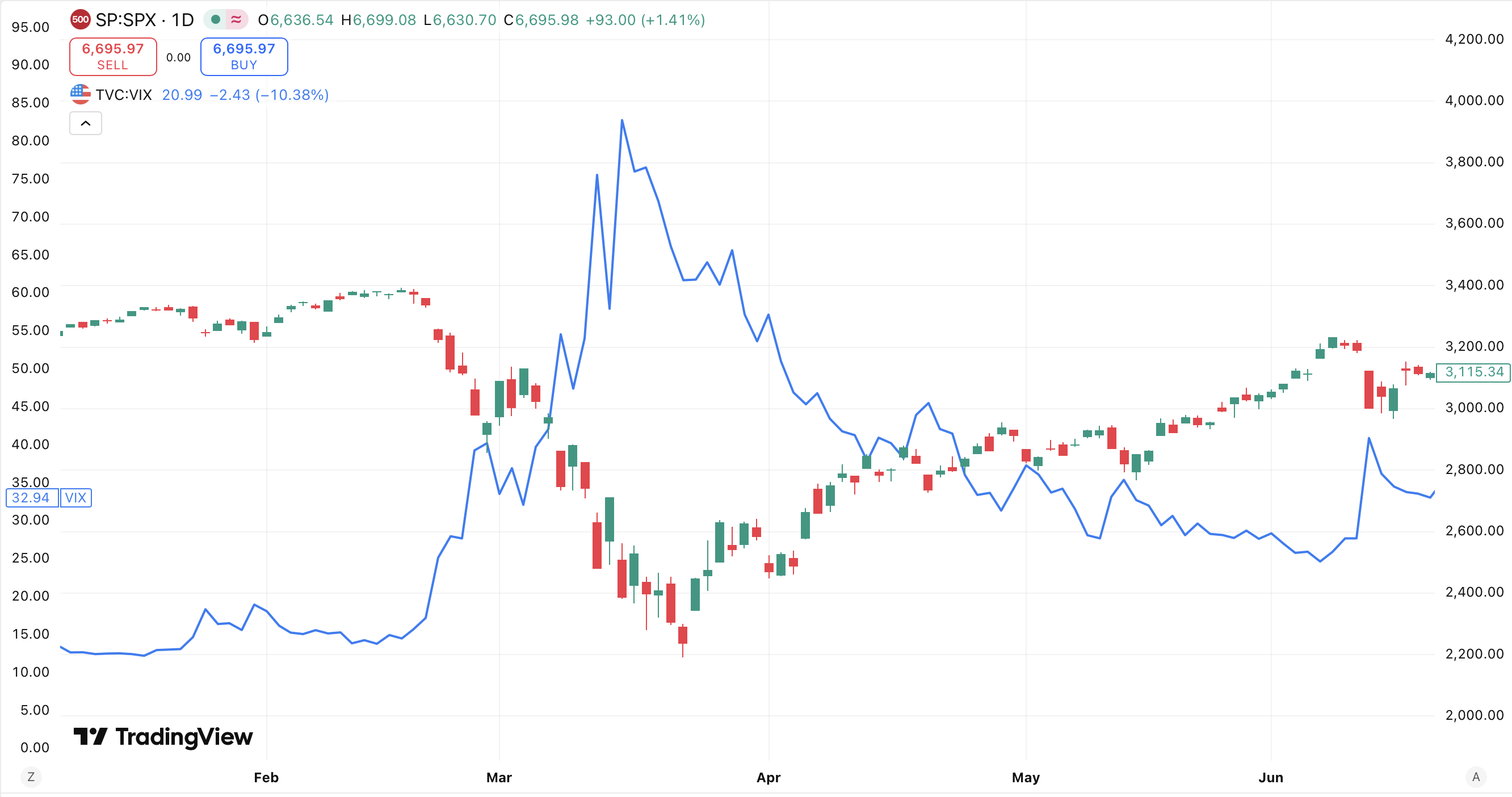
Between February and March 2020, the S&P 500 index fell by more than 30% as investors panicked and rushed to sell their holdings. However, those who bought stocks during the downturn (or even simply stayed invested) saw the market recover to new highs within just a few months. The real losses came not from the crash itself, but from panic selling at the worst possible moment.

To better understand why the market reaction was so violent during this period, it is useful to look at the VIX index, often referred to as the “fear gauge” of financial markets. The VIX measures expected volatility based on S&P 500 option pricing, and it tends to spike when uncertainty and investor anxiety rise.

In the graph below, which compares the performance of the S&P 500 and the VIX over the 2020 Covid market crash, we can clearly see how moments of market stress correspond to sharp increases in the VIX.

S&P500 and VIX index in 2020

The S&P 500 declines at the same time the VIX surges, illustrating the sharp rise in market fear and uncertainty.
Source: TradingView
Financial concepts related to the quote

I present below three financial concepts: the risk–return tradeoff, the psychology behind discomfort, and contrarian investing and market cycles.

The risk–return tradeoff

Arnott’s quote connects directly to the risk–return tradeoff, a cornerstone of modern portfolio theory (Harry Markowitz, 1952). The principle is simple but powerful: higher expected returns are only possible when investors accept higher levels of risk.

In quantitative terms, risk is often measured by metrics such as volatility (the standard deviation of returns) or the Value at Risk (the expected maximum loss that could occur on a given period). Assets with higher volatility tend to offer higher average returns to compensate investors for the uncertainty they bear.

This relationship is evident across asset classes: equities have historically outperformed bonds, and small-cap or emerging market stocks have outperformed large, stable firms, precisely because they are riskier and therefore less “comfortable” to hold.

Money Markets Bonds (20Y TB) Equities (S&P 500)
Historical returns 3.3% 5.7% 10.3%
Historical volatility 0.1 to 1% 10% 15 to 20%

These are the average historical returns and volatility of the main asset classes over the past century.
Source: “Long-Term Performance”, Martin Capital, and CFA Institute.

Those who prioritize comfort, by investing in stable, low-volatility assets such as government bonds or blue-chip stocks, may achieve safety but at the cost of limited upside. In contrast, investors willing to face volatility intelligently, through diversification, disciplined portfolio construction, and long-term perspective, can capture higher returns over time.

Ultimately, discomfort is not a flaw of investing, but rather the price of better returns. As every investor learns sooner or later, there is no reward without risk, and no performance without volatility.

This relationship between risk and return is often illustrated by the efficient frontier: as investors take on more risk (measured by the volatility of returns), the expected long-term return increases. The graph below shows this fundamental tradeoff, highlighting how low-risk assets typically offer modest returns, while higher-risk assets provide the potential for superior performance.
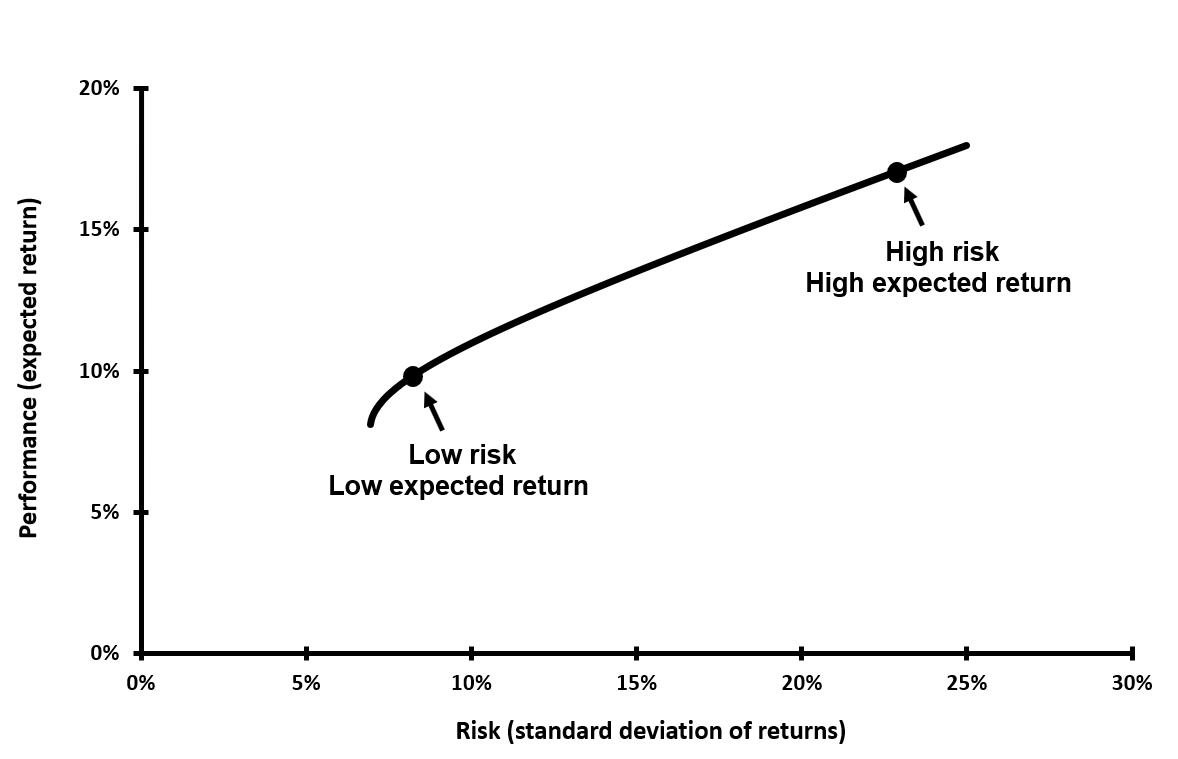
Graph of performance against risk

The psychology behind discomfort

Arnott’s insight aligns closely with behavioral finance, particularly Daniel Kahneman and Amos Tversky’s concept of loss aversion. The idea is that the pain of losing is psychologically about twice as powerful as the pleasure of gaining.

The chart below illustrates this asymmetry: while gains produce only a moderate rise in satisfaction, losses trigger a disproportionately strong emotional reaction, shaping many irrational investment decisions.
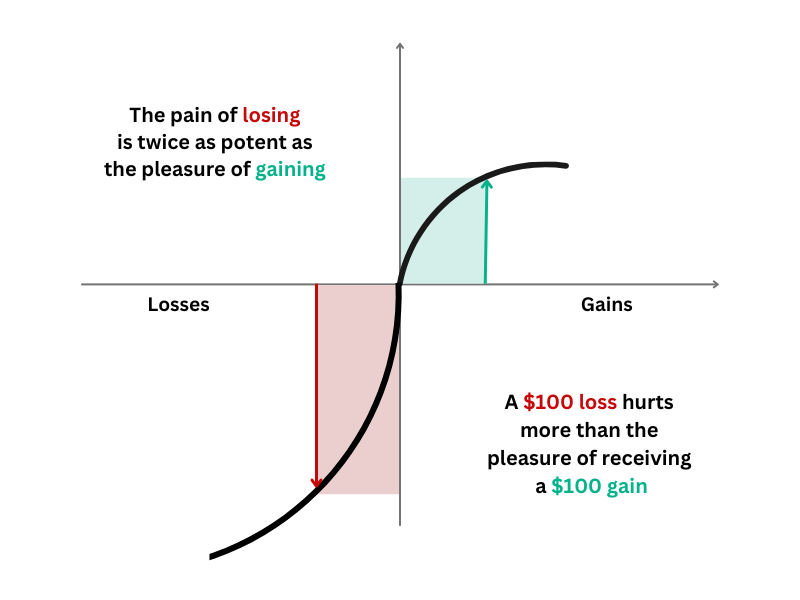
Losses hurt people more than gains make them feel good

This bias makes investors instinctively avoid risk, even when it offers potential rewards.

In financial markets, this aversion to loss often translates into herd behavior: investors seek comfort in doing what others do, buying overvalued assets during booms and selling undervalued ones during downturns. While this may feel safe in the short term, it systematically destroys value over time.

Legendary investors such as Warren Buffett and Howard Marks have long warned against this mindset: “Be fearful when others are greedy, and greedy when others are fearful.” True comfort in markets is often a sign of danger, not safety.

A good example is the dot-com bubble of 2000. At the time, investing in fast-growing tech stocks felt like the comfortable and obvious choice, as prices seemed to rise endlessly. Yet when the bubble burst, it became clear that this comfort had been an illusion, and that discomfort, not consensus, is where opportunity truly lies.

Contrarian investing and market cycles

Arnott’s quote also resonates with the philosophy of contrarian investing: the art of going against prevailing market sentiment. It means buying when fear dominates and selling when euphoria prevails.

As Minsky explains in his Financial Instability Hypothesis, periods of stability paradoxically encourage increasing risk-taking, as market participants move from hedge finance to speculative and then Ponzi finance. This endogenous dynamic inevitably leads to points of fragility where confidence collapses. Kindleberger, in Manias, Panics, and Crashes, provides empirical illustration: markets swing from euphoria to distress, from boom to bust, before stability gradually returns and the cycle begins anew.

The chart below visually maps this emotional cycle, highlighting how investor psychology typically evolves from euphoria to panic and back to optimism.
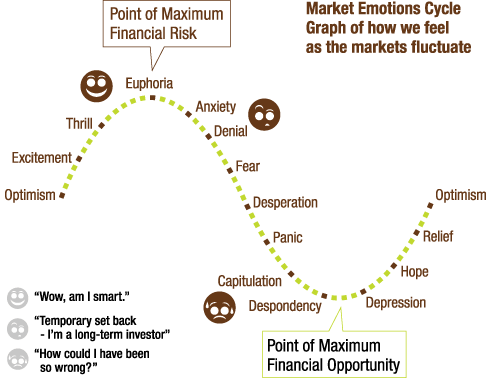
Market emotions cycles graph

The most profitable opportunities often emerge during moments of maximum discomfort: recessions, crises, or market panics, when prices are depressed but fundamentals remain sound. As Sir John Templeton famously said, “The time of maximum pessimism is the best time to buy.”

However, acting against the crowd is far from easy. It requires not only analytical conviction but also emotional discipline, the ability to stay rational when everyone else reacts emotionally. This mental resilience is what separates long-term investors from speculators driven by short-term noise.

My opinion about this quote

I find Arnott’s statement particularly relevant, at a time when social media and short-term performance metrics dominate investor psychology. Platforms such as X (Twitter), Reddit, or TikTok amplify herd behavior by rewarding consensual views rather than conviction. True investment success requires patience, analytical thinking, and the ability to tolerate discomfort.

To me, this quote extends beyond finance: it reflects a mindset of resilience and independence, valuable in career decisions, entrepreneurship, and life in general, because growth rarely happens in comfort zones.

Why should you be interested in this post?

This quote provides a timeless reminder for students and young professionals: comfort is the enemy of progress.

The rise of AI-driven trading, quantitative strategies, and passive investing has made markets appear more predictable and automated. This can create new forms of comfort, a belief that algorithms or index funds can replace human judgment. However, Arnott’s message reminds us that critical thinking, curiosity are still needed to outperform others.

As Arnott’s principle suggests, growth rarely happens in comfort zones. Whether in markets, careers, or personal development, long-term success comes from embracing uncertainty intelligently, and finding opportunity where others see discomfort.

Related posts on the SimTrade blog

   ▶ All posts about Quotes

   ▶ Youssef LOURAOUI Asset allocation techniques

   ▶ Youssef LOURAOUI Smart Beta strategies: between active and passive allocation

   ▶ Youssef LOURAOUI Markowitz Modern Portfolio Theory

Useful Resources

Business Books

Graham, B. (1949). The Intelligent Investor: A Book of Practical Counsel (Rev. ed.). Harper & Brothers.

Academic Articles

Arnott, R. D. (2003). The Fundamental Index: A Better Way to Invest. Financial Analysts Journal, 59.

Arnott, R. D. (2005). The Most Dangerous Equation. Financial Analysts Journal, 61.

Kahneman, D., & Tversky, A. (1979). Prospect Theory: An Analysis of Decision under Risk. Econometrica, 47(2), 263–291.

Markowitz, H. (1952). Portfolio Selection. The Journal of Finance(1), 7:77–91.

Classic Economic & Finance Works

Kindleberger, C. P. (1978). Manias, Panics, and Crashes: A History of Financial Crises. New York: Basic Books.

Minsky, H. P. (1992). The Financial Instability Hypothesis. Working Paper No. 74, Jerome Levy Economics Institute.

About the Author

This article was written in November 2025 by Hadrien PUCHE (ESSEC, Grande École Program, Master in Management – 2023–2027).

“Most people overestimate what they can do in a year and underestimate what they can do in ten.” – Bill Gates

Hadrien Puche

In a world that often focuses on immediate results and instant gratification, it can be easy to overlook how regular effort accumulates into long-term impact.

This quote by Bill Gates reminds us that human ambition and effort are most effectively realized over extended periods of time. Planning ahead, embracing patience, and committing to consistent action are the keys to achieving extraordinary outcomes.

In this article, Hadrien Puche (ESSEC, Grande École, Master in Management, 2023 to 2027) reflects on this quote, exploring how it applies not only to personal growth but also to finance, and especially investing.

About Bill Gates

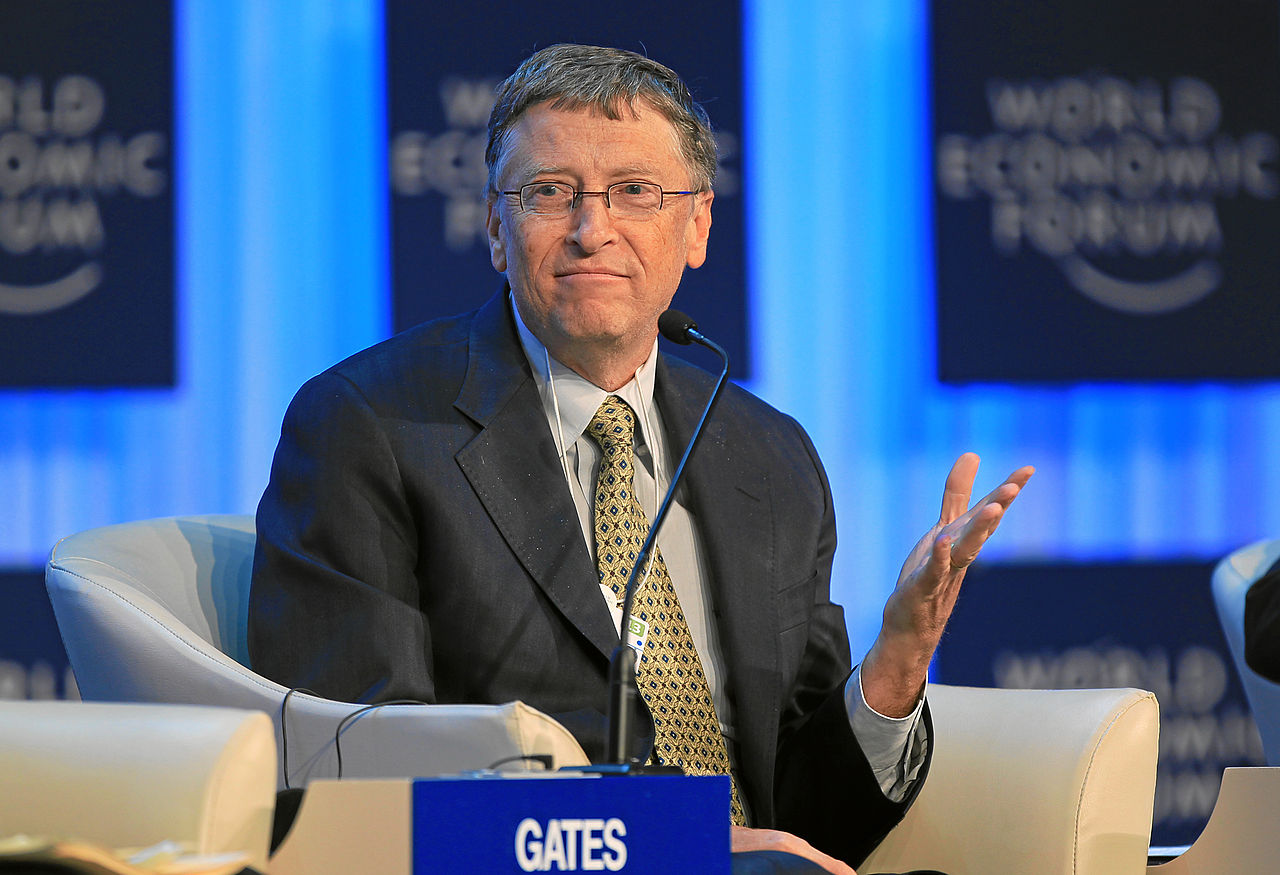
Bill Gates
Bill Gates

Source: Wikimedia Commons

Bill Gates is a co-founder of Microsoft and one of the most influential entrepreneurs of the late twentieth and early twenty-first century. Beyond his contributions to technology, he is widely recognized for his philanthropy through the Bill and Melinda Gates Foundation, which focuses on global health, education, and poverty reduction. Gates has often spoken about vision, long-term planning, and the accumulation of effort over time.

The quote, “Most people overestimate what they can do in a year and underestimate what they can do in ten,” is widely attributed to Bill Gates, although its true authorship is uncertain. What matters, however, is that Gates has consistently demonstrated through his work in technology and philanthropy how sustained effort and strategic planning can produce results that far exceed initial expectations.

Analysis of the quote

The central insight of this quote is that time magnifies effort. People often approach challenges with a short-term mindset, setting goals that are ambitious for a short period but fail to consider the compounding effect of consistent action. This makes them unable to reach these goals, leading to potential failure, whereas small steps over ten years can accumulate to produce extraordinary results.

This bias toward short-term thinking is prevalent in many areas of life, from career planning to investing. Individuals overestimate what they can accomplish quickly, which can lead to frustration when immediate goals are not met. Simultaneously, they underestimate what can be achieved over a decade, missing opportunities for growth, learning, and accumulation of value.

In finance, this mindset manifests in impatience with investments or ventures that require time to mature. In personal development, it is reflected in the failure to adopt habits that pay dividends over the long term. Gates’ quote is a reminder that extraordinary achievements are rarely the product of sudden effort. They are the result of consistent, incremental progress compounded over years.

This idea of long-term, incremental effort resonates closely with Malcolm Gladwell’s The Tipping Point: How Little Things Can Make a Big Difference. Gladwell explains how small, consistent actions or seemingly minor events can accumulate over time until they trigger a dramatic, outsized effect: the “tipping point.”

Economic and financial concepts related to the quote

I present below three financial concepts: compound interest, investment horizons, strategic planning and time diversification.

Compound interest

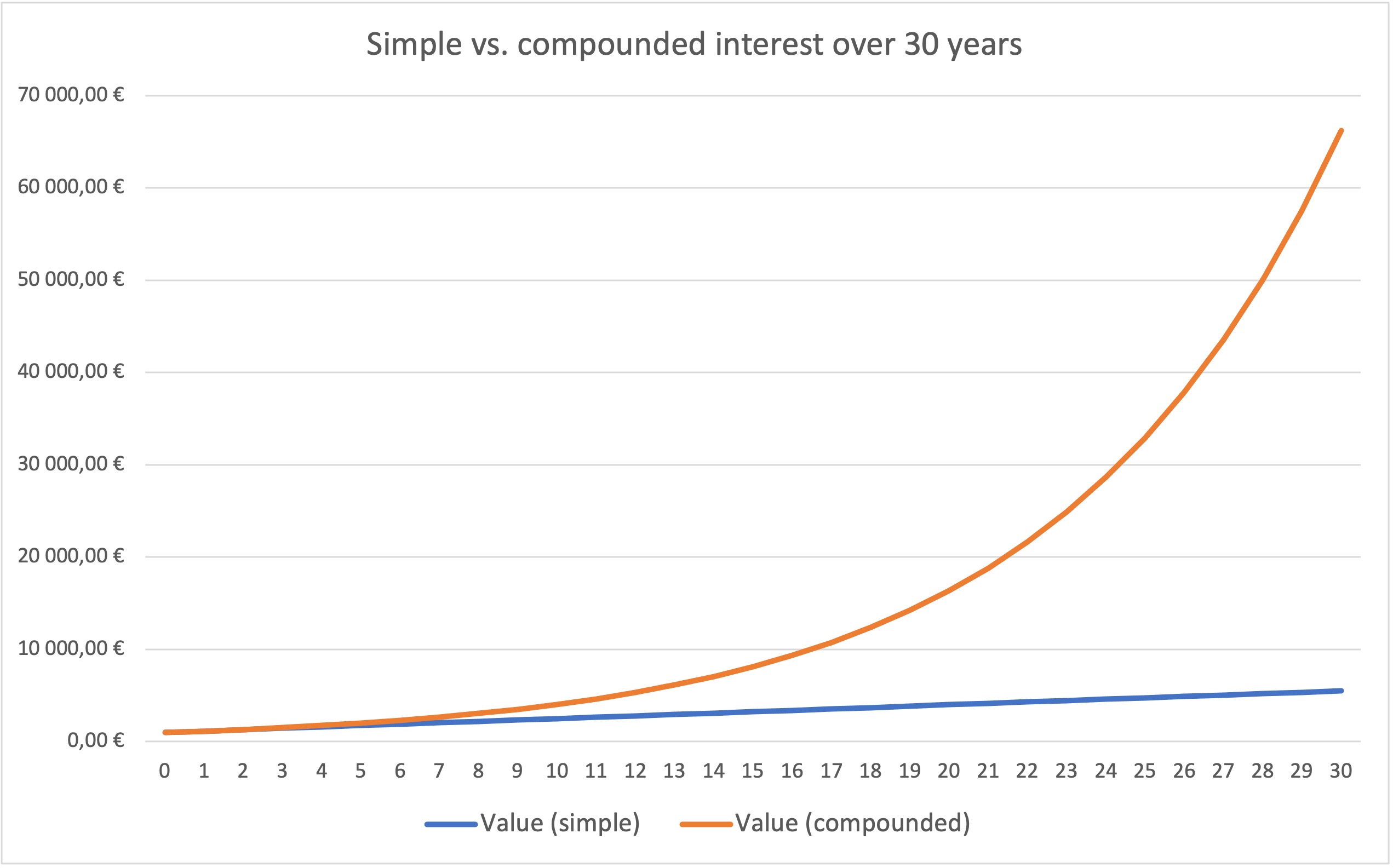
The concept of compound interest is perhaps the most direct financial parallel to Gates’ insight. In investing, the growth of wealth is not linear: returns earned on investments generate additional returns over time, producing an exponential effect. Individuals who understand and leverage compound interest can turn modest contributions into significant wealth over decades, whereas those who focus on immediate gains often miss the cumulative benefits. Gates’ quote captures this principle in human effort and strategic planning, emphasizing that patience and consistency are more powerful than short bursts of activity.

This is why Einstein famously called compound interest the “eighth wonder of the world.”

A graph showing the difference between simple and compounded interest

This graph shows how investing €1,000 over 30 years leads to exponential growth through compounding.

To better understand compounding, download this excel file and try to play around with the interest rate.

Download the Excel file to learn more about how compounding works

Investment horizons

Successful investing often relies on a long-term perspective. Markets can be volatile in the short term, but sustained investment in fundamentally sound assets typically produces growth over extended periods. Investors who overreact to short-term fluctuations may underperform by frequently buying and selling, while those who commit to a long-term strategy benefit from the power of time. Gates’ insight mirrors this approach.

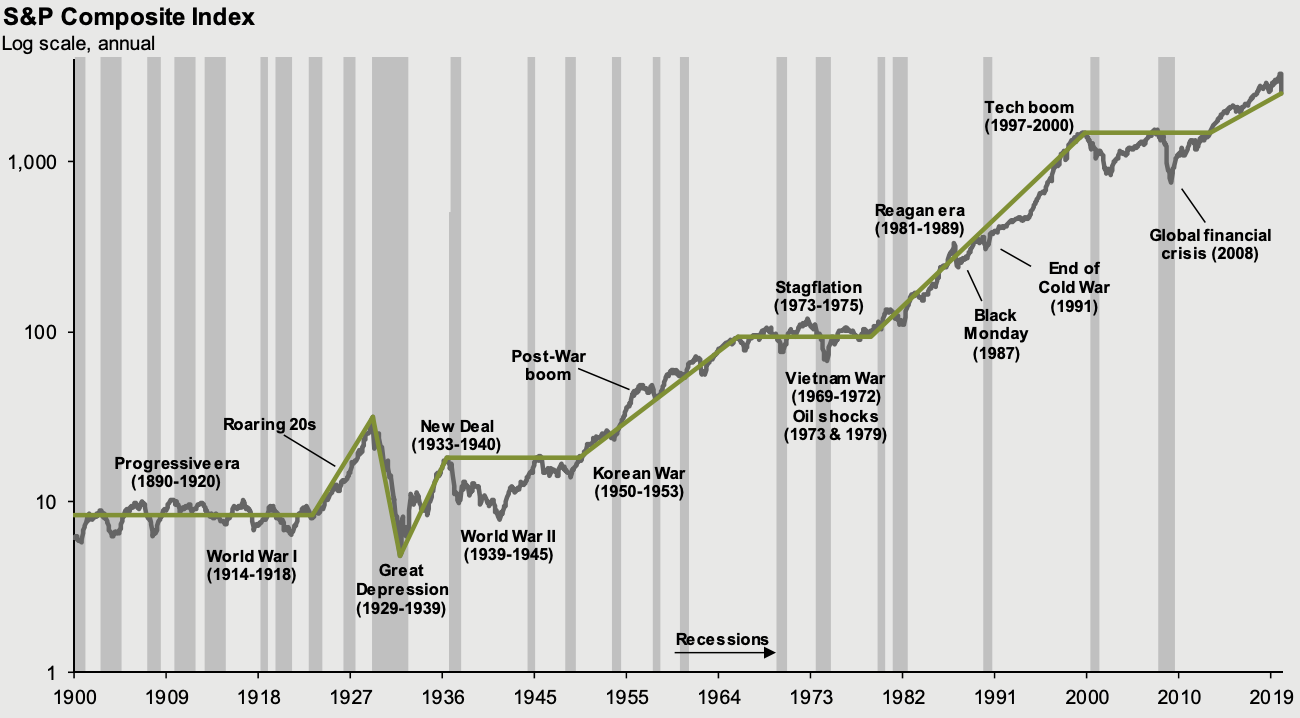
From a financial standpoint, this is also a question of μ vs σ: in the short run, market movements are dominated by σ (sigma; volatility), which makes returns unpredictable and often discouraging. But over longer horizons, μ (mu; the average expected return) becomes more visible, and the noise of volatility fades relative to the trend. In other words, the longer you stay invested, the more likely the underlying growth of the market (and not short-term fluctuations) will determine your outcome.

A graph of the S&P 500 index since 1900

As you can see on this graph, the S&P 500 index tends to perform well on the long run and always recover from times of crisis.

Just as how small investments compound over many years, consistent effort in personal or professional life produces results far greater than what is visible in a single year.

Strategic planning and time diversification

In economics and business, strategic planning means looking beyond immediate gains and considering how decisions will play out over multiple years or even decades. Investments in areas such as research and development, employee training, or infrastructure rarely pay off right away. Yet, as these efforts accumulate, they can create lasting competitive advantages, foster innovation, and drive long-term profitability.

A similar logic applies in finance through time diversification. Short-term market fluctuations can be unpredictable, but the longer an investor stays committed to a well-constructed portfolio, the greater the chance that temporary volatility smooths out and long-term growth prevails.

Gates’ quote captures the essence of both ideas: meaningful results (in business, investing, or personal development) come not from quick wins but from sustained effort and the willingness to think further ahead than the next quarter or the next year.

My opinion about this quote

This quote feels especially relevant today, as the pace of technological change accelerates with the rise of artificial intelligence and other innovations. Society is not accustomed to this level of speed, which can distort our perception of what is achievable. While there is a temptation to believe that technological advances will produce massive change within just a few years, Gates’ quote reminds us to temper optimism with realistic expectations. In reality, it often takes considerable time for firms to integrate new technologies and realize meaningful productivity gains, as seen with the adoption of the internet and, more recently, with AI.

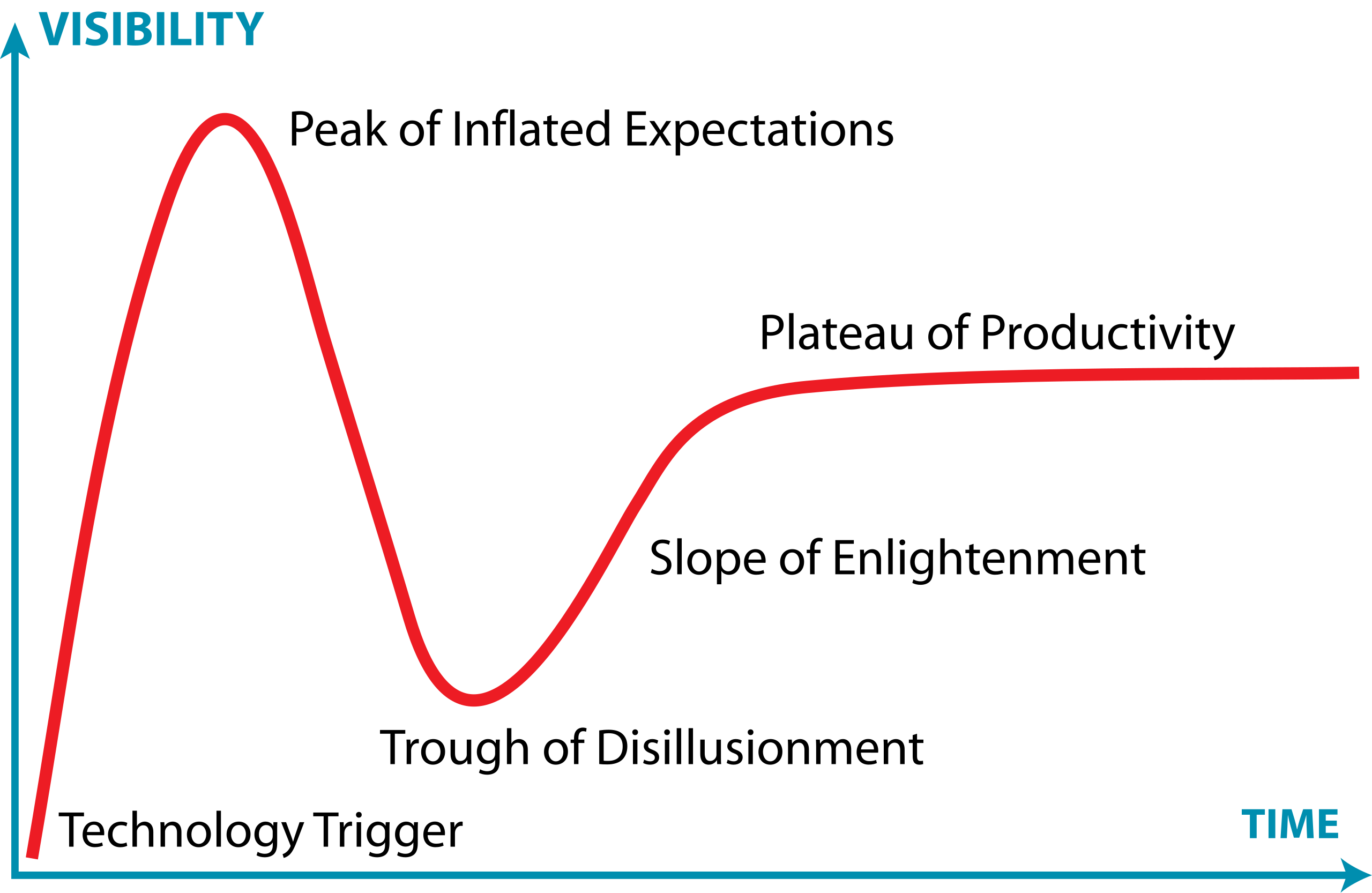
This dynamic is clearly illustrated in the graph below, known as the Gartner Hype Cycle. This framework describes the typical pattern of expectations surrounding new technologies. When a breakthrough such as generative AI emerges, public enthusiasm and media attention often inflate expectations far beyond what is achievable in the short term. As a result, we tend to overestimate the immediate impact of the innovation.

However, as the technology progresses through the different phases of the cycle (from initial excitement to disillusionment, and eventually to maturity), its long-term transformative potential becomes clearer. The Gartner Hype Cycle helps explain why we so often underestimate what a technology can achieve over a decade, even while exaggerating what it can achieve in its first year.

A graph of the Gartner Curve

The Gartner Hype Cycle, illustrating the typical progression of expectations around new technologies (Source: Gartner).

At the same time, the quote encourages reflection on long-term potential. Even if technologies develop more slowly than expected, incremental improvements over a decade can still lead to transformative outcomes. The lesson is to maintain both patience and vigilance, avoiding the extremes of overconfidence or neglect.

This principle also applies to personal finance and life planning. Many people set short-term goals and become frustrated when progress seems slow. Yet, the cumulative effect of consistent action, thoughtful saving, learning, or skill development often surpasses what we anticipate in the first year. By recognizing the value of long-term effort, individuals can better allocate resources, set meaningful goals, and make decisions that pay off over time.

In professional contexts, such as career progression or entrepreneurship, the quote is equally valuable. Building a company, developing expertise, or pursuing innovation rarely produces instant results. Sustained effort, compounded knowledge, and consistent decision-making are what lead to exceptional achievements over the long term.

Why should you be interested in this post?

Bill Gates’ quote is a reminder to plan thoughtfully, embrace patience, and recognize the exponential power of effort. While no one can predict the future with certainty, adopting a long-term perspective allows individuals to maximize the impact of their actions and investments.

This insight is particularly relevant for students and young professionals. You do not need a detailed plan for the next ten years, but considering the direction of your efforts and making incremental progress can dramatically improve outcomes over time. Recognizing the gap between short-term overestimation and long-term underestimation fosters discipline, focus, and resilience in both personal and financial decisions.

Whether applied to investing, professional development, or personal goals, this quote encourages a mindset that values consistency, foresight, and the compounding power of effort. Understanding this principle allows individuals to avoid the pitfalls of impatience while harnessing the opportunities presented by sustained dedication.

Related posts

   ▶ All posts about Quotes

Useful resources

– The Tipping Point: How Little Things Can Make a Big Difference by Malcolm Gladwell

About the Author

This article was written in 2025 by Hadrien Puche (ESSEC, Grande École, Master in Management 2023 to 2027)

“The market is never wrong, only opinions are“ – Jesse Livermore

Hadrien PUCHE

In this article, Hadrien PUCHE (ESSEC Business School, Grande École Program, Master in Management, 2023-2027) comments on Jesse Livermore’s timeless quote and explores its relevance for modern investors and students seeking to understand market psychology.

About Jesse Livermore

Jesse Livermore (1877–1940) was one of Wall Street’s first great speculators, a man who understood the rhythm of markets long before data screens and algorithms existed. He made and lost several fortunes, most famously by shorting stocks ahead of the Panic of 1907 and the Great Depression of 1929.

Livermore’s life was both brilliant and tragic, but his insights into crowd behavior and emotional discipline remain essential reading for anyone who wishes to understand how markets truly work.

Jesse Livermore
Jesse Livermore

Analysis of the quote

“The market is never wrong, only opinions are.” – Jesse Livermore

When Livermore says, “The market is never wrong, only opinions are,” he reminds us that prices are not moral judgments or forecasts of truth — they are the product of human behavior under uncertainty.

Markets do not care about fairness or logic. They reflect the collective sum of all opinions, weighted by money. To claim that “the market is wrong” is to claim that your personal view outweighs the collective intelligence and capital of millions of other participants.

That rarely ends well. The market may sometimes overreact, but it is almost always the individual who misunderstands its message.

This quote, in the end, is a lesson in humility. Investors lose not because they lack intelligence, but because they refuse to admit when the market has proven them wrong.

Economic and financial concepts related to the quote

1 – Market efficiency

Livermore’s idea anticipates the theory of market efficiency introduced many decades later by Eugene Fama in 1970. This theory suggests that prices incorporate all available information, which means it is almost impossible to consistently beat the market.

Even if markets are not perfectly efficient, they are highly competitive ecosystems. Information spreads very quickly, and any mispricing is soon corrected by professionals equipped with technology and capital.

So when you decide that the market is wrong, you are effectively betting that your insight is sharper than everyone else’s, from hedge funds to central banks. Occasionally, some investors do have that edge, but they are the exception, not the rule.

2 – The Wisdom and the Madness of Crowds

In The Wisdom of Crowds (2004), James Surowiecki argues that large groups can make remarkably accurate collective judgments, even when individual members are biased or imperfectly informed. Financial markets often exemplify this phenomenon: while single investors are prone to emotion and error, the aggregation of their independent views can produce a consensus that efficiently reflects available information.

Yet, Surowiecki also cautions that collective intelligence breaks down when independence disappears. In markets, this occurs when participants are driven by shared emotions: panic during crashes or euphoria during bubbles. At such moments, the “wisdom” of the crowd can turn to madness.

3 – Risk management and flexibility

Livermore’s warning remains as relevant as ever: never fight the market. Every investor is wrong sometimes, but what matters is how quickly you realize it and act. The real danger isn’t being wrong, it’s refusing to admit it. Livermore’s rule captures this perfectly: “Cut your losses short and let your winners run.”

Good risk management starts there. It means knowing how much you can afford to lose, setting a stop-loss before entering a trade, and sticking to it. A stop-loss isn’t a sign of weakness, it’s a protection. It prevents small mistakes from turning into big ones and keeps you in the game for the long run.

As Keynes famously said, “Markets can stay irrational longer than you can stay solvent.” Managing risk isn’t about predicting the market, it’s about surviving it.

My opinion about this quote

Livermore’s insight feels even more relevant in today’s world of instant information and algorithmic trading. Social media multiplies opinions at unprecedented speed, creating noise that can easily obscure reality.

Recent market episodes illustrate this perfectly. In 2021, for example, the GameStop saga showed how collective emotion on Reddit briefly overwhelmed fundamental analysis, sending the stock to irrational highs before gravity reasserted itself.

Similarly, during the cryptocurrency boom of 2021 and 2022, investors often claimed that “this time is different,” only to face sharp corrections when enthusiasm faded.

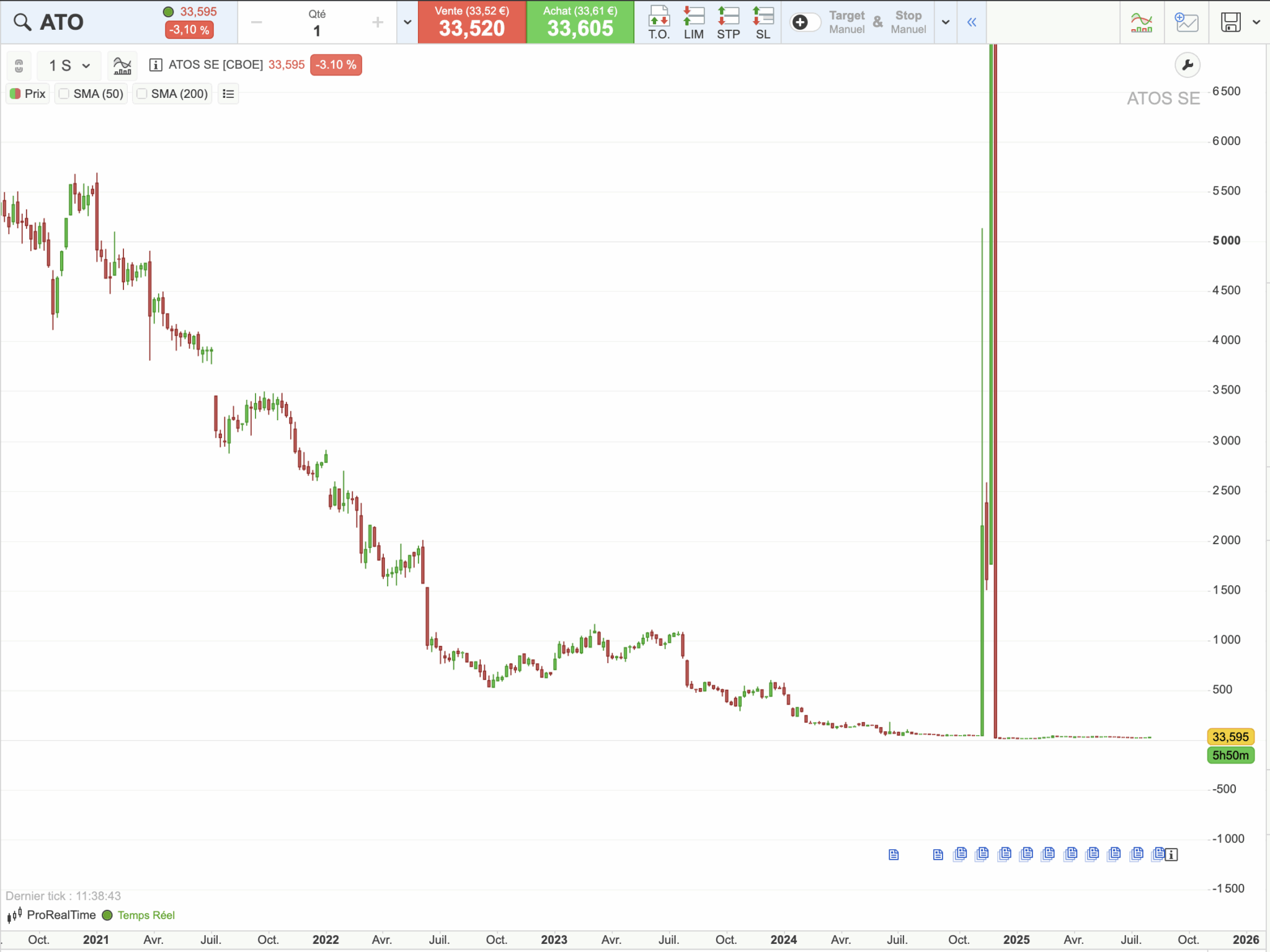
Closer to home, the Atos case in 2024 reflected the same dynamic. Despite the company’s severe financial distress and an announced dilution that effectively made the stock almost worthless, waves of speculative buying pushed its valuation to absurd levels for a few days. When reality returned, the correction was brutal.

Atos stock price chart

These examples confirm Livermore’s message: opinions can be wrong for a long time, but the market always has the final word.

Why should you be interested in this post?

For students and young professionals, Livermore’s lesson is a call for intellectual humility. Markets are complex and adaptive systems, impossible to predict with precision but possible to understand with patience.

Learning to separate your opinions from what the market is telling you will make you a better analyst, investor, and decision-maker. It will also help you develop emotional intelligence, a skill far rarer than technical knowledge.

In finance, as in life, the goal is not to be right, it is to adapt faster when you are wrong.

Related posts on the SimTrade blog

   ▶ All posts about Quotes

Useful resources

Reminiscences of a Stock Operator – Edwin Lefèvre (1923)

The Efficient Market Hypothesis and Its Critics – Burton Malkiel (2003)

Thinking, Fast and Slow – Daniel Kahneman (2011)

SimTrade course Market information

Academic research

Fama E. (1970) Efficient Capital Markets: A Review of Theory and Empirical Work, Journal of Finance, 25, 383–417.

Fama E. (1991) Efficient Capital Markets: II, Journal of Finance, 46, 1575–617.

Grossman S.J. and J.E. Stiglitz (1980) On the Impossibility of Informationally Efficient Markets, The American Economic Review, 70, 393–408.

Chicago Booth Review (30/06/2016) Are markets efficient? Debate between Eugene Fama and Richard Thaler (YouTube video)

About the author

This article was written in November 2025 by Hadrien PUCHE (ESSEC, Grande École Program, Master in Management – 2023–2027).

“Don’t look for the needle in the haystack. Just buy the haystack.“ – John Bogle

Hadrien PUCHEOver the past decade, investing has become more accessible than ever. Anyone with a smartphone can now buy or sell shares, cryptocurrencies, or ETFs within seconds. While this democratization of finance has clear benefits, it has also led many to lose money by chasing “the next big stock.” Retail investors often believe they can find the next Tesla or Nvidia: the famous “needle in the haystack.” Yet, as history repeatedly shows, only a small fraction succeed.

That is precisely what John C. Bogle, the founder of Vanguard and the father of index investing, warned against. His advice was simple yet profound: stop trying to find the needle, just buy the entire haystack.

In this article, Hadrien PUCHE (ESSEC Business School, Grande École Program, Master in Management, 2023-2027) comments on Bogle’s timeless quote, exploring how it captures one of the most important principles in modern investing: diversification.

About John C. Bogle

John Clifton Bogle (1929 – 2019) was an American investor and philanthropist best known as the founder of The Vanguard Group, one of the world’s largest asset management firms. In 1976, Bogle created the first index fund available to individual investors, the Vanguard 500 Index Fund, designed to replicate the performance of the S&P 500 index rather than beat it.

At the time, his idea was revolutionary. The prevailing belief was that skilled managers could consistently outperform the market through superior stock selection and market timing. Bogle argued the opposite: after accounting for management fees, transaction costs, and human error, most active managers fail to beat the market over the long term. His philosophy emphasized simplicity, discipline, and cost-efficiency, principles that now underpin the $12 trillion global index fund industry.

John C. Bogle
John Bogle

Analysis of the quote

Bogle’s quote encapsulates a powerful truth: successful investing does not require finding hidden gems, but rather owning the market as a whole. The “needle in the haystack” represents the elusive high-performing stock every investor dreams of. Yet statistically, most attempts to find it fail. By buying the entire “haystack” (that is, the full market) investors automatically own all the winners and minimize the risk of missing them.

Empirical research overwhelmingly supports this idea. Over time, a small number of stocks account for the majority of total market gains. A study by Hendrik Bessembinder (2018) found that, since 1926, just 4% of U.S. stocks generated the entire net wealth created by the stock market. Most others either underperformed or disappeared entirely. Thus, identifying the few long-term winners ex ante is nearly impossible. The rational solution is to own the entire market, a strategy that index funds make accessible and affordable.

Bogle’s insight also reflects humility: acknowledging that even professionals struggle to outperform broad market indexes. By accepting this, investors shift their focus from beating the market to participating in its long-term growth.

Financial concepts related to the quote

I present below three fiancial concepts: diversification, index funds, and the efficient portfolio frontier.

Diversification

Diversification is the cornerstone of modern portfolio theory. It refers to spreading investments across different assets or sectors to reduce risk. By owning a broad range of companies, an investor limits the impact of any single firm’s poor performance.

Bogle’s philosophy embodies this principle. Buying the entire market, through an index fund tracking, for example, the S&P 500 or the CAC 40, ensures exposure to hundreds of firms across multiple sectors. The failure of one or two is offset by the success of others.

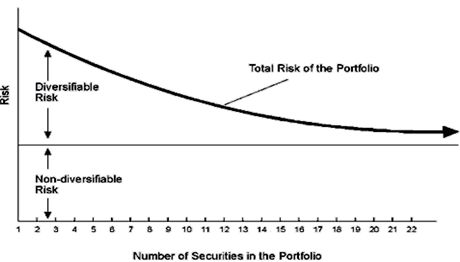
In practice, diversification improves a portfolio’s risk-adjusted return. It does not eliminate risk entirely but reduces idiosyncratic risk (the risk specific to individual companies). What remains is systematic risk, which affects the entire market and cannot be diversified away. This relationship is evident when observing how portfolio risk declines as the number of securities increases.

 Risk of a portfolio as a function of the number of assets

Index funds

Index funds are collective investment vehicles that aim to replicate the performance of a specific market index, such as the S&P 500 (U.S.), the MSCI World (Global), or the CAC 40 (France). They hold the same securities as the index, in the same proportions, ensuring the fund’s return closely matches that of the benchmark. Because they are passively managed, index funds have very low management fees (often 10 to 20 times cheaper than traditional mutual funds). They also provide instant diversification: by buying one share of an S&P 500 ETF, you effectively invest in 500 companies.

This simplicity explains their rapid growth. According to Morningstar, index funds and ETFs now represent more than 50% of all U.S. equity fund assets. Their accessibility and transparency have fundamentally reshaped global investing.

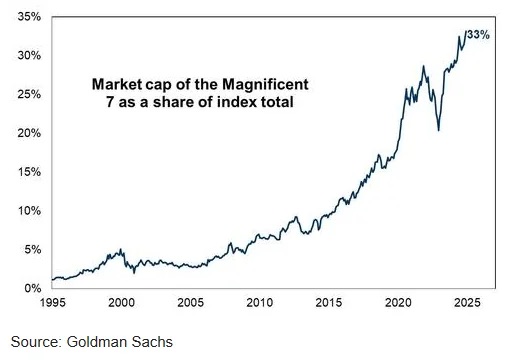
However, one subtle limitation is that most major indexes are market-cap weighted, meaning the largest companies exert the greatest influence. As of 2025, the “Magnificent 7” (Tesla, Nvidia, Apple, Microsoft, Alphabet, Meta, and Amazon) represent nearly 35% of the index’s total value. The chart below illustrates their growing share of total market capitalization over time, highlighting how even “diversified” investors are increasingly concentrated in a handful of mega-cap technology firms.

 Market capitalization of the Magnificent 7 as a share of index total

The efficient portfolio frontier

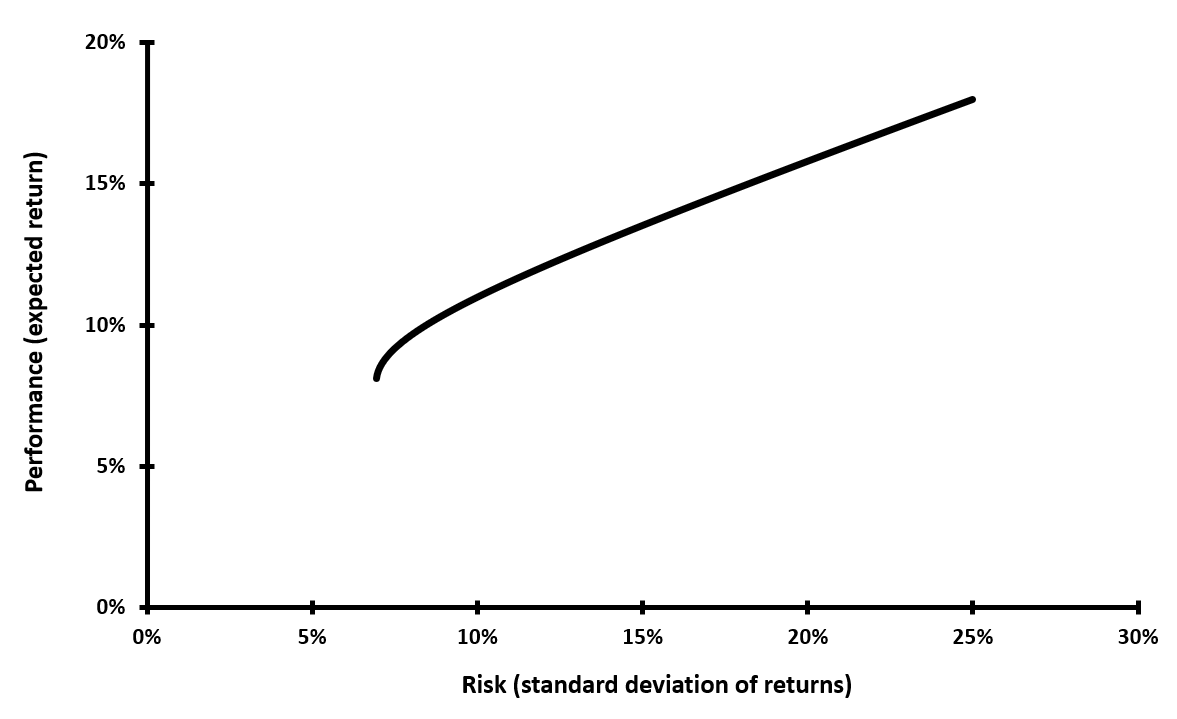
Introduced by Harry Markowitz in 1952, the efficient frontier illustrates the optimal trade-off between risk and (expected) return for a diversified portfolio. Each point on the curve represents the best possible expected return for a given level of risk.

Efficient frontier graph

Index investing often lies near this efficient frontier. Because broad indexes like the S&P 500 already aggregate thousands of investors’ information and preferences, they effectively represent a “market portfolio” close to the optimal mix. Passive investors benefit from this efficiency without needing to forecast which assets will outperform.

Understanding the efficient frontier also reveals why chasing high returns through concentrated bets is dangerous. While such strategies may yield spectacular results occasionally, they almost always involve disproportionate risk.

My opinion about this quote

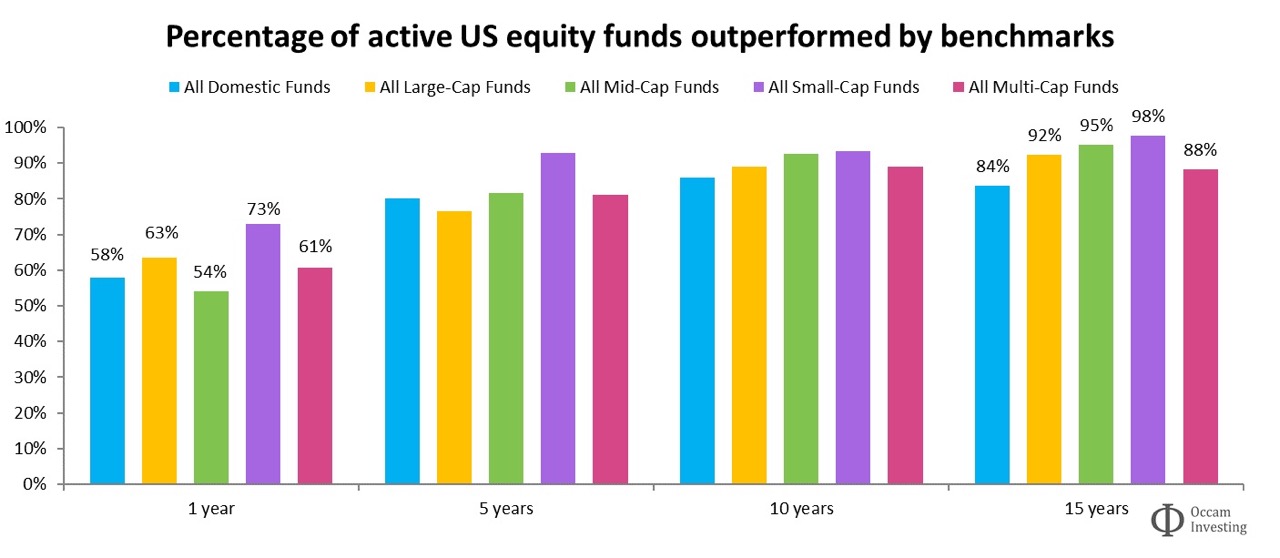
I believe this quote perfectly captures the essence of modern investing: simplicity often outperforms sophistication. Many individuals (and professionals) spend enormous time and money trying to beat the market, often with limited success. The SPIVA (S&P Indices Versus Active) report consistently shows that the majority of actively managed funds underperform their benchmark indexes over the long term. As of 2024, for instance, more than 85% of U.S. equity funds lagged the S&P 500 over a 10-year period.

The chart below illustrates this trend across different investment horizons, showing that the longer the time frame, the harder it becomes for active managers to outperform their benchmarks.

Most US equities fund managers fail at outperforming the S&P500 index

The reasons are clear: high management fees, excessive trading, and the psychological pressure to deliver short-term results. Fund managers often prioritize annual bonuses over long-term compounding, leading to decisions driven by incentives rather than rational analysis.

At the same time, Bogle’s approach is not entirely without nuance. Index funds may appear perfectly diversified, but as noted earlier, their concentration risk has increased with the rise of mega-cap tech firms. Buying “the market” today means owning a portfolio dominated by a handful of giants. That, too, is an investment choice, one that has worked well recently but may not always hold true.

Therefore, the essence of Bogle’s wisdom is not that index investing is flawless, but that it is rational. It reflects humility, an understanding that long-term success comes not from prediction, but from participation, discipline, and patience.

Why should you be interested in this post?

For students and young professionals, this quote offers two critical lessons.

First, from a personal investing perspective, it highlights the power of simplicity. Investing through low-cost index funds allows anyone, regardless of expertise, to participate in long-term market growth without the stress of constant stock-picking. It is a proven strategy for building wealth steadily over time.

Second, from a professional standpoint, understanding how and why index funds dominate modern markets is essential. Whether you aim to work in asset management, corporate finance, or risk consulting, you must grasp how passive investing shapes market dynamics, liquidity, and valuation.

Ultimately, Bogle’s message goes beyond finance. It teaches intellectual humility: the recognition that long-term discipline often triumphs over short-term brilliance.

Related posts on the SimTrade blog

   ▶ All posts about Quotes

Useful resources

Vanguard official website

Bessembinder, H. (2018). Do Stocks Outperform Treasury Bills? Journal of Financial Economics.

SPIVA U.S. Scorecard (2024)

Markowitz, H. (1952). Portfolio Selection. Journal of Finance.

Bogle, J. C. (2017). The Little Book of Common Sense Investing.

About the Author

The article was written in November 2025 by Hadrien PUCHE (ESSEC Business School, Grande École Program, Master in Management, 2023-2027).

How to choose an online broker to invest in the stock market

How to choose an online broker to invest in the stock market

In reality, individuals cannot directly access the market to buy or sell financial assets such as stocks or currencies. They must go through intermediaries responsible for transmitting their clients’ orders to the market. It may be a bank, but since the early 2000s, specialized institutions have developed on the internet: online brokers.

What criteria should be used to choose an online broker to invest in the stock market?

Brokerage fees

For any order placed on the stock exchange, a broker charges you fees called brokerage fees. The amount of brokerage fees is deducted at the time of the transaction from your cash account. The amount and structure of brokerage fees vary greatly from one broker to another. Brokers also offer different formulas depending on your trading profile (average amount of orders and number of orders placed per month), which does not really facilitate comparisons between brokers.

The fee structure is often both fixed (for small amounts) and variable (for large amounts). For example, €2 if the amount of the order is less than €1,000, and €5 for any order of an amount between €1,000 and €5,000, and 0.10% for orders of a higher amount at €10,000. Note that the fees on orders placed on foreign markets (from a broker located in France) are often much higher.

Among the different fee formulas offered by brokers, your choice will be guided by your trading profile defined by the estimated number of orders placed per month. An “Active Trader” profile corresponds to more than 10 orders placed per month.

The amount of the fees is not to be neglected because it can significantly impact the performance of your stock market investment. For an inactive trader placing 2 orders per month for around €500 on Euronext, the total amount of fees should remain below €100. For a very active trader placing 20 orders per month for around €1,000 on Euronext and abroad, the total amount of fees could easily exceed €2,000.

You will also be aware of the account transfer or closing costs.

Markets and products available

In France, online brokers all offer access to the Euronext market, which is the main stock exchange in the euro zone (Amsterdam, Brussels, Lisbon and Paris). Depending on your needs, it may be interesting to have access to other markets: London, Milan, Zurich, US markets, Asian markets….

Likewise, online brokers offer all the standard products like stocks, currencies and commodities. Depending on your needs, it may be interesting to have access to other products: UCITS, trackers, options and futures, warrants… Some brokers (but not all) also offer to carry out leveraged transactions – purchases and sales on credit – with the Deferred Settlement Service (Service de Règlement Différé or SRD).

The ease of use of the platform

The trading platform must be easy to use to both place orders on the markets and follow the evolution of your position (the cash in your cash account and the lines of your portfolio in your securities account).

We will also see if the broker offers a mobile phone application in addition to classic internet access.

Technical support

From my experience, I have seen that the operation of an account with an online broker (or a traditional bank) is never perfect. We can cite, for example, the difficulty or impossibility of recovering access codes. It is therefore essential to be able to contact the technical support to solve the problems that will arise. We will pay attention to the time slot of the support, the online waiting time and the quality of the answers.

What to do before opening an account

Before opening an account, I advise you to open a fictitious account to test the trading platform and see if it suits you in terms of use: placing orders, speed of execution of orders, associated services (such as SMS alerts), presentation of orders and transactions, and organization of the account. It is also important to check the availability of accessible products and markets. Testing the technical support – the hotline – is also an eye-opening experience.

Some online brokerage sites

In France: boursorama.com and Boursedirect.com

In Europe: internaxx.com swissquote.com and keytrade.com

In the United States: etrade.com schwab.com tdameritrade.com interactivebrokers.com or even speedtrader.com and suretrader.com.

Thank you and last advice from a friend

Finally, a big thank you to Prof. Jean-Marie Choffray who shared with me his advice on choosing an online broker. It reminds me of reading two books that need to be studied very carefully: Malkiel (A random walk down Wall Street), and, ESPECIALLY, Clews (“Twenty-Eight Years in Wall Street” updated in “Fifty years in Wall Street”) – the “bible” as far as he is concerned! Its summary could whet your appetite Henry Clews: Twenty-Eight Years in Wall Street

Before entering the markets, it is also necessary to train yourself. The SimTrade certificate allows you to discover the markets in an educational and fun way.

May The Market Be With You!