

BCapital Fund at Bocconi: building a student-run investment fund

Roberto Restelli

In this article, Roberto RESTELLI (ESSEC Business School, Master in Finance (MiF), 2025–2026) explains how he founded BCapital Fund at Bocconi University—a student‑run, global‑equity investment student association—and what it taught him about markets, leadership, and teamwork.

Founding BCapital Fund (2022)

During my final semester at Bocconi University in Milan in 2022, driven by passion for financial markets and curiosity, I founded a student society called BCapital Fund. The aim was to bring together friends with the same enthusiasm and replicate— as closely as possible— the functions of an investment fund focused exclusively on global equities, rather than a typical university club centered on articles. It became the first student‑run investment fund in Italy and among the first in Europe.

BCapital Fund – Student Investment Society at Bocconi University.

Logo of BCapital Fund
Source: BCapital Fund.

Concept & investment approach

Using various online brokers, we simulated investments with US$1,000,000 in demo capital. Each month, we published a detailed report explaining our investment theses—supported by deep company research and macro analysis—modeled on the style of hedge‑fund letters. Report after report, we improved visuals, explanations, and content to make our publications as professional as possible.

We began with eight members (first‑year BSc students in Management, Finance, and Law). At the university society fair in September, the idea resonated immediately: we received 120+ applications and grew to 25 members by October, representing countries such as Russia, India, China, Italy, and the UK.

How we structured the fund

  • Portfolio Department: junior analysts, senior analysts, and portfolio managers responsible for investment decisions.
  • Macroeconomic Department: focused on inflation, central‑bank policy (e.g., Fed rate moves), and broader trends.
  • Data & Reporting: charts, report layout, and document production using Word and Excel.
  • Legal & Communications: documentation plus LinkedIn and Instagram pages.

For six months, a crypto sleeve—run by several passionate members—delivered a +33% return, contributing positively to the main equity portfolio’s performance over the period. Over time, our approach narrowed into a global‑equity and macro strategy. We also hosted campus events to share insights and engaged the broader student body, while steadily building a simulated‑portfolio track record.

Personal reflection

Now that I’m no longer a Bocconi student, I’m not involved operationally. I handed the society over to younger bachelor students who continue to add value and deliver performance, carrying the project forward as most of the original eight members have moved on.

This was the highlight of my bachelor’s degree: pursuing a passion with friends, learning continuously, and being recognized as one of the most innovative student initiatives in Italy. Most gratifying is seeing the project thrive beyond my tenure.

What I learned

I learned a great deal from a diverse team with complementary skills. Exposure to different departments let me explore portfolio construction and valuation, macro analysis and central‑bank actions, and the technical side of modeling and reporting.

Personally, I learned the importance of organisation and clarity. To execute and lead effectively, you need rigorous structure and precision—from sequencing investment ideas and valuation frameworks to standardising report templates and social‑media posts.

Teamwork was another key skill. Working in larger groups helped me collaborate, deliver projects in teams of five or more, recognise when others’ ideas are better, adapt the final outcome, and stay open to different viewpoints—well‑suited to my extroverted personality. Finally, mutual help matters: with the right people, everything becomes easier than going solo.

Concepts related to my society

  1. Follow your passion: the project began organically with friends who shared a genuine interest—learning more and preparing beyond what university offers.
  2. Just do it: step outside your comfort zone, take initiative, and build—without overthinking everything that could go wrong.
  3. Keep learning: learning never stops; hands‑on practice is often more engaging than lectures, because you work directly with the topics.

Why should I be interested in this post?

If you are an ESSEC student curious about launching student initiatives or pursuing public‑markets roles, this post offers a practical blueprint: how to design a student investment fund, structure departments, recruit and scale, and publish professional‑grade research—skills that translate directly to internships and entry‑level roles.

Conclusion

BCapital Fund was more than a student initiative—it was a proving ground for disciplined investing, collaborative leadership, and continuous learning. Building a multi‑department team, publishing research, and iterating our process taught me how to set a clear vision, structure execution, and raise the bar. Handing the project to the next cohort—and seeing it grow—confirmed the value of creating something that endures. I carry forward stronger analytical judgment, sharper communication, and a practical sense of how strategy, macro context, and rigorous reporting come together in public markets.

Related posts on the SimTrade blog

   ▶ Alexandre VERLET Classic brain teasers from real-life interviews

Useful resources

Bocconi University

Bocconi Student Finance Society LinkedIn page

SEC EDGAR company filings

European Securities and Markets Authority (ESMA)

Bloomberg Markets

About the author

The article was written in November 2025 by Roberto RESTELLI (ESSEC Business School, Master in Finance (MiF), 2025–2026).

The role of DCF in valuation

Roberto Restelli

In this article, Roberto RESTELLI (ESSEC Business School, Master in Finance (MiF), 2025–2026) explains the role of discounted cash flow (DCF) within the broader toolkit of company valuation—when to use it, how to build it, and where its limits lie.

Introduction to company valuation

Valuation is the process of determining the value of any asset, whether financial (for example, shares, bonds or options) or real (for example, factories, office buildings or land). It is fundamental in many economic and financial contexts and provides a crucial input for decision-making. In particular, the importance of proper company valuation emerges in the preparation of corporate strategic plans, during restructuring or liquidation phases, and in extraordinary transactions such as mergers and acquisitions (M&As). Company valuations are also useful in regulatory and tax contexts (for example, transfers of ownership stakes or determining value for tax purposes). Entrepreneurs and investors can evaluate the economic attractiveness of strategic options, including selling or acquiring corporate assets.

The need for a company valuation typically arises to answer three questions: Who needs a valuation? When is it necessary? Why is it useful?

Users and uses of company valuation

Different categories rely on valuation. In investment banks, Equity Capital Markets use it for IPO research and coverage (including fairness opinions), while M&A teams analyze transactions and prepare fairness opinions to inform deal decisions. In Private Equity and Venture Capital, valuation supports majority/minority acquisitions, startup assessments, and LBOs. Strategic investors use it for acquisitions or divestitures, stock‑option plans, and financial reporting. Accountants and appraisal experts (CPAs) prepare fairness opinions, tax valuations, technical appraisals in legal disputes, and arbitration advisory.

Beyond these, regulators and supervisory bodies (e.g., the SEC in the U.S., CONSOB in Italy) require precise valuations to ensure market transparency and investor protection. Corporate directors and managers need valuations to define growth strategies, allocate capital, and monitor performance. Courts and arbitrators request valuations in disputes involving contract breaches, expropriations, asset divisions, or shareholder conflicts. Owners of SMEs—backbone of the Italian economy—use valuations to set sale prices, manage generational transfers, or attract investors.

Examples of valuation

Valuations appear in equity research (e.g., a UBS report on Netflix indicating a short‑ to medium‑term target price based on public information), in M&A deal analyses (including subsidiary valuations and group structure changes), and in fairness opinions (e.g., Volkswagen’s acquisition of Scania). They are central in IPOs to set offer prices and expectations. Banks also rely on valuations in lending decisions to assess enterprise value and credit risk, clarifying the allocation of requested capital.

Core competencies in valuation

High‑quality valuation requires business and strategy foundations (industry analysis, competitive context, business‑model strength), theoretical and technical finance (NPV, pricing models, corporate cash‑flow modeling), and economic theory (uncertainty vs. value and limits of standard models). Valuation is not just technique: it balances modeling choices with empirical evidence and fit‑for‑purpose estimates.

A fundamental principle is that a firm’s value is driven by its ability to generate future cash flows, which must be estimated realistically and paired with an appropriate risk assessment. Higher uncertainty in cash‑flow estimates implies a higher discount rate and a lower present value. Discount‑rate choice depends on the model (e.g., CAPM for systematic risk via beta). Sustainability also matters: modern practice increasingly integrates environmental, social, and governance (ESG) factors—climate risk, regulation, and reputation—into valuation.

General approaches and specific methods

Income Approach. Present value of future benefits, risk‑adjusted and long‑term (e.g., discounted cash flows).
Market Approach. Value estimated by comparing to similar, already‑traded assets.
Cost (Asset‑Based) Approach. Value derived by remeasuring assets/liabilities to current condition.

Within these, DCF is among the most studied and used. It can be computed from the asset perspective via free cash flow to the firm (FCFF) or from the equity perspective via free cash flow to equity (FCFE). Under the asset‑based approach, other methods include net asset value and liquidation value. Additional families include economic profit (e.g., EVA, residual income) and market‑based analyses: trading multiples (e.g., P/E, EV/EBITDA), deal multiples, and premium analysis (control premia). Four further techniques often considered are current market value (market capitalisation), real options (valuing flexible investment opportunities), broker/analyst consensus, and LBO analysis (value supported by leveraged acquisition capacity).

Critical aspects and limits of valuation models

Each method has strengths and limits. In DCF, accuracy depends on projection quality; macro cycles can render forecasts unreliable. In market‑multiple analysis, industry/geography differences and poor comparables can distort results. Real options are powerful for uncertainty but require subjective parameters (e.g., volatility), introducing error bands.

Practical applications of company valuation

Firms use valuation to plan growth, allocate capital, and budget projects. In disputes and restructurings, it informs liquidation values and creditor negotiations. It also supports governance and incentives (e.g., option plans) that align managers with shareholders. In short, valuation enables both day‑to‑day management and extraordinary decisions.

Discounted Cash Flow (DCF)

What is a DCF?

The discounted cash flow (DCF) method values a company by forecasting and discounting future cash flows. Originating with John Burr Williams (The Theory of Investment Value), DCF seeks intrinsic value by projecting cash flows and applying the time value of money: one euro today is worth more than one euro tomorrow because it can be invested.

Advantages include accuracy (when inputs are sound) and flexibility (applicable across firms/projects). Risks include reliance on uncertain projections and difficulty estimating both discount rates and cash flows; hence outputs are estimates and should be complemented with other methods.

Uses of DCF

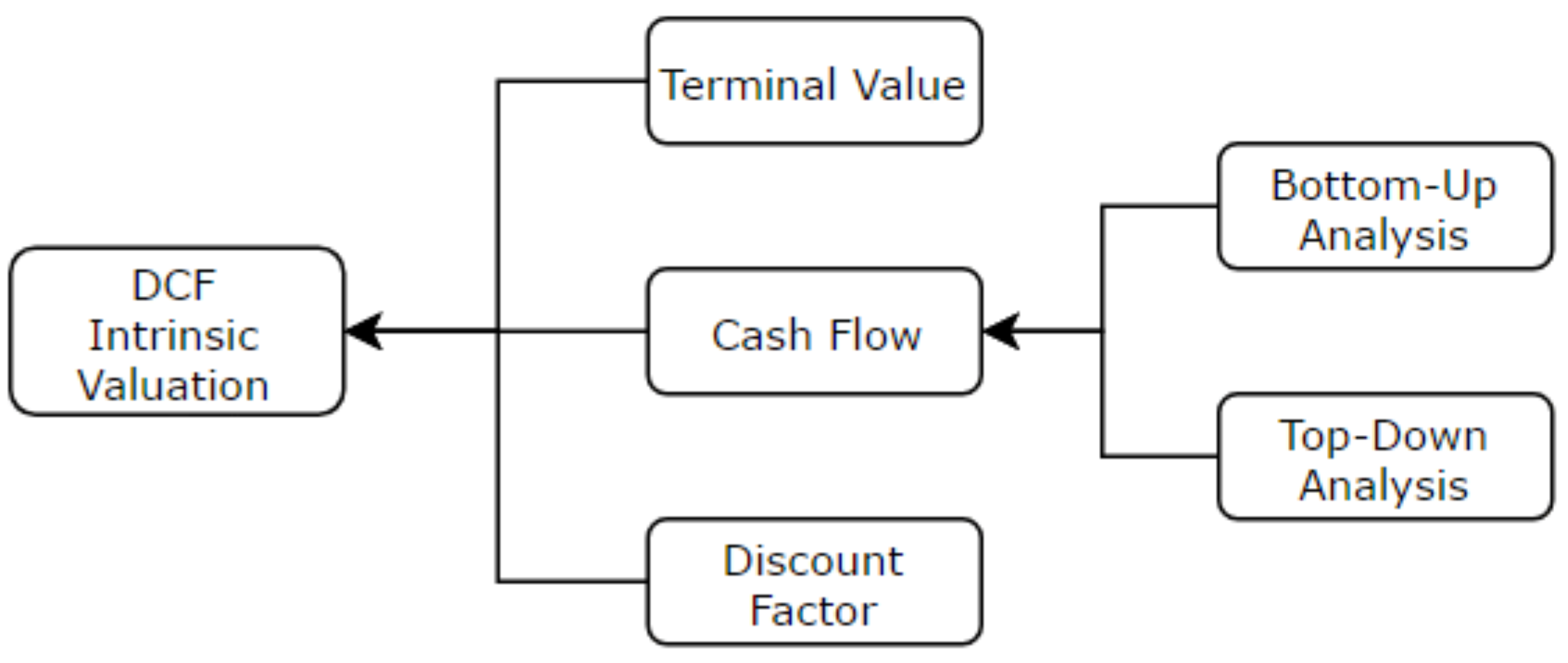
DCF is widely applied to value companies, analyse investments in public firms, and support financial planning. The five fundamental steps are:

  1. Estimate expected future cash flows.
  2. Determine the growth rate of those cash flows.
  3. Calculate the terminal value.
  4. Define the discount rate.
  5. Discount future cash flows and the terminal value to the present.

DCF components.
 DCF components
Source: author.

Discounted cash flow formula (with a perpetuity‑growth terminal value):

DCF = CF1 / (1 + r)1 + CF2 / (1 + r)2 + … + CFT / (1 + r)T + (CFT+1 / (r – g)) · 1 / (1 + r)T

Where CFt are cash flows in year t, r is the discount rate, and g is the long‑term growth rate.

Building a DCF

Start from operating cash flow (cash‑flow statement) and typically move to free cash flow (FCF) by subtracting capital expenditures. Example: if operating cash flow is €30m and capex is €5m, FCF = €25m. Project future FCF using growth assumptions (e.g., if 2020 FCF was €22.5m and 2021 FCF €25m, growth is ~11.1%). Use near‑term high‑growth and longer‑term fade assumptions to reflect maturation.

Determining the terminal value

The terminal value represents long‑term growth beyond the explicit forecast. A common formula is:

Terminal Value = CFT+1 / (r – g)

Ensure g is consistent with long‑run economic growth and the firm’s reinvestment needs.

Defining the discount rate

The discount rate reflects risk. Common choices include the risk‑free government yield, the opportunity cost of capital, and the WACC (weighted average cost of capital). In equity‑side models, CAPM is often used to estimate the cost of equity via beta (systematic risk).

Discounting the cash flows

Finally, discount projected cash flows and terminal value at the chosen rate to obtain present value. Sensitivity analysis (varying r, g, margins, capex) and scenario analysis (bull/base/bear) are essential to understand valuation drivers.

Example

You can download below an Excel file with an example of DCF. It deals with Maire Tecnimont, which is an Italian engineering and consulting company specializing in the fields of chemistry and petrochemicals, oil and gas, energy and civil engineering.

Download the Excel file for an example of DCF applied to  Maire Tecnimont

Why should I be interested in this post?

If you are an ESSEC student aiming for roles in investment banking, private equity, or equity research, mastering DCF is table‑stakes. This post distills how DCF fits among valuation approaches, the exact steps to build one, and the pitfalls you must stress‑test before using your number in IPOs, M&A, or buy‑side models.

Related posts on the SimTrade blog

   ▶ Jayati WALIA Capital Asset Pricing Model (CAPM)

   ▶ William LONGIN How to compute the present value of an asset?

   ▶ Maite CARNICERO MARTINEZ How to compute the net present value of an investment in Excel

   ▶ Andrea ALOSCARI Valuation methods

Useful resources

Damodaran online New York University (NYU).

SEC EDGAR company filings

European Central Bank (ECB) statistics

Maire Tecnimont

About the author

The article was written in November 2025 by Roberto RESTELLI (ESSEC Business School, Master in Finance (MiF), 2025–2026).

My internship at Valori Asset Management

Roberto Restelli

In this article, Roberto RESTELLI (ESSEC Business School, Master in Finance (MiF), 2025–2026) shares key takeaways from a four‑month off‑cycle internship as an Investment Analyst Intern at Valori Asset Management, focusing on subordinated debt within the Fixed Income team.

Introduction

Before starting my Master in Finance at ESSEC Business School, I completed a four‑month off‑cycle internship at a €2.5bn asset management firm. The role developed my skills in credit risk assessment and gave me hands‑on exposure to macroeconomic analysis, performance‑measurement methodologies, the Bloomberg Terminal, and problem‑solving under time pressure. Within the Fixed Income team, I supported a subordinated debt fund through top‑down macro work and bottom‑up credit analysis on AT1 (CoCo), Tier 2, and RT1 bonds: subordinated bank and insurance capital instruments designed to absorb losses and meet regulatory capital requirements, sitting below senior debt in the capital structure and therefore offering higher yields in exchange for higher risk. AT1 (CoCo) and RT1 can be perpetual with discretionary coupons and loss-absorption features (write-down or equity conversion), while Tier 2 is typically dated, less deeply subordinated and only absorbs losses in gone-concern situations (resolution or insolvency). This post summarizes what I did at Valori Asset Management and what I learned—professionally and personally.

This was my first deep dive into fixed income after prior experience in private banking and equities. I learned that fixed income is not only about valuations and ratings; it also requires a macro view, policy awareness, trading considerations, and clear, critical thinking on portfolio positions.

About Valori Asset Management

Valori AM is an investment boutique founded 11 years ago, initially in Luxembourg and later expanding to Milan (Italy) and Chiasso, near Lugano (Switzerland). The SICAV (investment company with variable capital) are managed out of Luxembourg; advisory and family‑office services are in Milan; and the investment team in Chiasso manages nine funds. As of July 2025, assets under management and advisory (AUMA) were €2.5bn, with a target of €3bn by January 2026.

Logo of Valori AM.
Logo of Valori AM
Source: the company.

What I did during my internship

My work focused on three areas: ESG (Environmental, Social, and Governance) macro research and reporting; sovereign credit‑risk analysis across EMEA (Europe, the Middle East, and Africa), LATAM (Latin America), and the US; and two macro‑quantitative models.

ESG macro research and reporting

I conducted 30+ ESG country studies across EMEA and LATAM, using the Bloomberg Terminal to gather data and charts, and building Excel models to compare composite ESG scores and rankings. I complemented this with Morningstar Sustainalytics to benchmark carbon footprints and relative positioning. Bloomberg and Morningstar are two essential tools for working in asset management and hedge funds. Through the Bloomberg terminal, you can track real-time news on equities, fixed income, interest rates and all major financial markets, as well as access key economic and macro data for fixed income analysis, financial statements for equity positions, and even route securities orders via brokers. Morningstar is likewise crucial, not only for financial and economic news but also for ESG metrics and fund analytics. I produced concise reports highlighting the strongest ESG profiles—both in absolute terms and relative to the fund’s existing bond exposures. These outputs fed directly into portfolio discussions, ensuring ESG considerations were integrated alongside risk and return.

Sovereign credit‑risk valuation (EMEA, LATAM, US)

I performed 20+ sovereign credit assessments using indicators such as GDP growth, PMI, retail sales, current‑account balance (% of GDP), and unemployment. Sourcing data from Bloomberg and IMF (International Monetary Fund) forecasts, I translated the metrics into comparable Excel scorecards to surface relative value across regions. I then presented actionable ideas—such as Romanian government bonds, U.S. Treasuries, and Spanish bonds—to initiate new positions or reaffirm existing ones, linking macro fundamentals to valuation, liquidity, and timing.

Two macro‑quantitative models

  • BTP–Bund spread positioning model: an Excel‑based quant‑positioning model using ETF (exchange traded funds) flow data, Z‑scores (statistical measure that indicates how many standard deviations a value is away from the mean of a data set, allowing comparisons across different scales), regression analysis, CDS (credit default swaps), and macro‑financial indicators to generate daily signals and stay updated on the BTP (italian government bond)–Bund spread.
  • EU (europe) macroeconomic VAR (Vector Autoregression) model: a model for EU countries using key economic indicators and yield curves (GDP, PMI, retail sales, and 2‑ to 30‑year yields). I applied VAR analysis in EViews to forecast future movements of indicators and prices, with outputs aggregated in Excel; This macroeconomic VAR model is used to analyze how shocks to one variable (for example GDP or long-term yields) propagate over time to the other macro and yield-curve variables, and to generate consistent scenario analyses for EU economies. Using EViews, I estimated the VAR and produced multi-period forecasts for all the variables jointly, building different future scenarios and updating these forecasts as new data became available. EViews is a widely used econometrics and time-series analysis software, designed for estimating models, running statistical tests, and generating forecasts in a user-friendly interface.

Required skills and knowledge

The internship demanded both technical and soft skills. Technically, I worked extensively in Excel (modeling and forecasting), Bloomberg (market data and news), EViews (econometrics), and PowerPoint (investment pitches). On the soft‑skills side, I learned to prioritize under tight deadlines, double‑check deliverables, and solve problems independently to deliver high‑quality work.

What I learned

This internship provided practical experience in investment management within a professional, multicultural environment. I learned the importance of active listening: carefully understanding the initial brief and following colleagues’ discussions improves the quality and speed of the work. In a fast‑paced desk environment, acting like a sponge accelerates learning and connects day‑to‑day tasks with the bigger investment picture.

I deepened my fixed‑income knowledge beyond coursework: how rates, the broader debt market, and derivative hedges interact; how to think and debate credit; and how to combine top‑down macro views with bottom‑up analysis to form clear, defensible portfolio decisions. I also gained practical command of execution tools—building and stress‑testing Excel models, using Bloomberg for data and news, preparing pitches in PowerPoint, and applying econometrics in EViews. Altogether, the experience strengthened my analytical discipline and confirmed my long‑term interest in financial markets.

Financial concepts related to my internship

The role of AT1

AT1s typically offer equity‑like yields with bond‑like structures; frequent call features can create pull‑to‑par upside when issuers refinance at the first call. Post‑crisis capital buffers and resilient profitability support coupon sustainability and a steady call culture, improving carry reliability. Dislocations and regulatory risk premia often leave AT1 spreads wide vs. senior/RT1—creating room for outperformance if sentiment, capital ratios, or rates volatility improve.

The importance of balancing an ESG portfolio

Building a well‑diversified portfolio with a robust ESG process can improve long‑term resilience and broaden the investor base, especially among institutional allocators with sustainability mandates.

The key role of financial news

Investors need both analytical depth and speed in reacting to market‑moving news and policy announcements. Consistently reading high‑quality reports and newsflow helps anticipate paths for markets and frame timely responses.

Why should I be interested in this post?

If you are a student interested in business and finance—especially fixed income—this post offers practical, desk‑level insights: how the work is structured, the skills required, and how to grow in a markets‑focused role, based on months on the desk alongside a 15+ person team.

Conclusion

My internship at Valori AM sharpened my analytical abilities and helped me grow personally. Learning from colleagues taught me how to contribute from day one and confirmed my interest in investment management and fixed income. Looking ahead, I aim to pursue a buy‑side role at a fund or bank, focusing on portfolio strategy in financial markets.

Related posts on the SimTrade blog

   ▶ All posts about Professional experiences

   ▶ Matthieu MENAGER My professional experience as a credit analyst at Targobank

   ▶ Praduman AGRAWAL My Professional Experience as a Quantitative Analyst Intern at Findoc Financial Services

   ▶ Alexandre VERLET Classic brain teasers from real-life interviews

Useful resources

Bloomberg

International Monetary Fund (IMF)

Morningstar Sustainalytics

Valori Asset Management

About the author

The article was written in November 2025 by Roberto RESTELLI (ESSEC Business School, Master in Finance (MiF), 2025–2026).