

The Private Equity Secondary Market: from liquidity mechanism to structural pillar

Adam MERALLI BALLOU

In this article, Adam MERALLI BALLOU (ESSEC Business School, Global Bachelor in Business Administration (GBBA), 2021-2026) introduces the Secondary Market in Private Equity.

Introduction

Over the past decade, the private equity secondary market has undergone a profound transformation. Originally conceived as a marginal liquidity outlet for constrained investors, it has progressively become a central component of private markets architecture, as it increasingly shapes how capital circulates within the private equity ecosystem rather than merely how it exits it. The secondary market now acts as a mechanism through which investors actively manage portfolio duration, smooth cash-flow profiles, and adjust exposure across vintages and strategies, while allowing General Partners to optimize asset holding periods in response to market conditions. This evolution reflects a broader shift away from a rigid, linear fund lifecycle toward a more dynamic and continuous model of capital allocation.

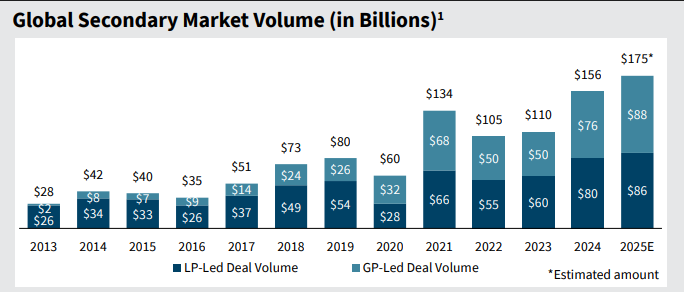
This transformation has accelerated in the recent cycle, as exit activity slowed materially and fund durations extended beyond initial expectations, amplifying the need for alternative liquidity and capital recycling solutions. According to the Preqin Secondaries in 2025 report and the William Blair Private Capital Advisory Secondary Market Report (2025), year 2025 is expected to mark a historical milestone, with global secondary transaction volumes reaching approximately $175bn, the highest level ever recorded. This surge reflects not only cyclical pressures on liquidity, but also a deeper structural shift in how private equity portfolios are managed, financed, and recycled across market cycles.

Global Secondary Market Volume
Source: Willliam Blair.

This figure illustrates the rapid expansion of the global private equity secondary market. According to the William Blair Private Capital Advisory Secondary Market Report (2025), transaction volumes grew from $28bn in 2013 to $156bn in 2024, with $175bn projected for 2025. The increasing share of GP-led transactions highlights the growing role of secondary markets in addressing liquidity needs and exit constraints.

LP-led vs GP-led secondaries: complementary functions within the ecosystem

The secondary market is fundamentally organized around two distinct transaction types: LP-led and GP-led, each fulfilling a different economic function within the private equity ecosystem. LP-led transactions represent the original backbone of the market. In these deals, Limited Partners sell existing fund interests to obtain liquidity, rebalance their portfolios, or reduce exposure following overallocation to private equity. Data from the 2025 Preqin report shows that LP-led transactions tend to dominate in number, particularly during periods of market stress, as institutional investors respond to denominator effects, regulatory constraints, or liability-matching requirements. However, while LP-led transactions account for a high share of deal count, their relative weight in value terms has become more balanced. In 2024, LP-led secondaries represented roughly $80bn, or close to half of total market volume. GP-led by contrast, are initiated by the General Partner rather than by investors. In a GP-led secondary, the GP transfers one or several assets from an existing fund into a new vehicle. In 2024, GP-led transactions represented approximately $76bn in value, accounting for a share comparable to LP-led transactions despite being fewer in number, which reflects their significantly larger average deal sizes.

The explosion of continuation funds and the normalization of GP-led structures

Within the GP-led universe, the rapid rise of continuation funds stands out as the most consequential development of the past few years. Once viewed as exceptional restructuring tools for underperforming or illiquid assets, continuation funds have become mainstream instruments used to extend the ownership of high-quality portfolio companies. The Preqin report identifies 401 continuation funds launched between 2006 and 2025, with a striking acceleration after 2020. Of these, 340 funds are already closed, representing an aggregate capital base of approximately $182.7bn. In value terms, continuation funds now account for around 45–50% of total secondary market volume and nearly 80% of GP-led transactions. This expansion has been driven by a combination of prolonged exit timelines, improved governance standards, systematic use of third-party valuations, and stronger alignment mechanisms such as GP carry rollovers. The data confirms that continuation funds are no longer marginal or opportunistic structures, but rather standardized tools for managing asset life cycles and sustaining value creation beyond the constraints of traditional closed-end fund structures.

Capital concentration, pricing normalization, and the strategic role of secondaries

Beyond transaction structures, the scale of capital committed to the secondary market underscores its growing strategic importance. The William Blair report highlights that secondary-focused investors held more than $200bn of dry powder in 2024, equivalent to approximately 43% of total secondary AUM (Asset under Management), a proportion materially higher than that observed in private equity primaries. This accumulation of capital has enabled the execution of increasingly large and complex transactions and has supported a notable improvement in pricing conditions. In 2024, 91% of single-asset continuation fund transactions were priced at or above 90% of NAV (Net Asset Value, i.e. the estimated fair value of a fund’s underlying), while multi-asset continuation funds also saw a significant normalization in discounts. At the same time, performance data from Preqin indicates that secondaries continue to offer a differentiated risk-return profile, characterized by lower dispersion of outcomes and faster cash-flow generation relative to primary funds. In an environment marked by distribution scarcity and heightened uncertainty, these characteristics help explain why the secondary market has moved from a peripheral liquidity solution to a structural stabilizer of the private equity ecosystem .

Why should I be interested in this post?

As the private equity secondary market reached record transaction volumes of around $156bn in 2024 and could grow to nearly $300bn by 2030, understanding its mechanics has become essential for anyone interested in private markets. This post provides a data-driven explanation of LP-led and GP-led transactions and highlights why continuation funds now account for a large share of secondary activity. These structures are central to liquidity management, portfolio rebalancing, and capital recycling in a constrained exit environment. The different industry reports used in this analysis can be found in the “Useful information” section below.

Related posts on the SimTrade blog

   ▶ All posts about Private Equity

   ▶ Emmanuel CYROT Deep Dive into evergreen funds

   ▶ Lilian BALLOIS Discovering Private Equity: Behind the Scenes of Fund Strategies

   ▶ Adam MERALLI BALLOU My internship experience in Investor Relation at Eurazeo

Useful resources

William Blair (March 2025) William Blair Private Capital Advisory: 2025 Secondary Market Report

Preqin (June 2025) Secondaries in 2025

About the author

The article was written in December 2025 by < https://www.linkedin.com/in/adam-meralli-ballou/" target="_blank">Adam Meralli Ballou (ESSEC Business School, Global Bachelor in Business Administration (GBBA), 2021-2026).

   ▶ Read all articles by Adam MERALLI BALLOU.

My internship experience in Investor Relation at Eurazeo

Adam MERALLI BALLOU

In this article, Adam MERALLI BALLOU (ESSEC Business School, Global Bachelor in Business Administration (GBBA), 2021-2026) shares his professional experience as Investor Relations at Eurazeo.

About the company

Eurazeo is one of the leading European investment groups specialized in private markets. Listed on Euronext Paris, the group has a market capitalization of approximately €3.62 billion. As of 2024–2025, Eurazeo manages around €37 billion in assets under management, investing on behalf of institutional investors, sovereign wealth funds, pension funds, insurers, family offices and high-net-worth individuals. Eurazeo supports a portfolio of more than 600 companies and relies on a team of over 400 investment professionals across Europe, North America and Asia.

The group operates a highly diversified private markets platform, covering a broad range of non-listed strategies. These include buyout funds, growth equity, venture capital, secondary funds, as well as private debt, infrastructure debt and real estate. Through these strategies, Eurazeo supports a wide range of companies, for example Aroma-Zone, Ozone and Eres in buyout; Vestiaire Collective and Doctolib in growth equity; and Deezer, Swile and JobTeaser in venture capital. This diversification allows Eurazeo to address different investor objectives, risk-return profiles and investment horizons across the private markets universe.

Logo of Eurazeo
Logo of Eurazeo
Source: Eurazeo

My internship

I worked within the Investor Relations / Product Specialist team. This team plays a central role between the sales teams, whose responsibility is to maintain relationships with Limited Partners (LPs) and lead fundraising discussions, and the investment teams, which focus on sourcing, executing and managing investments.

The Product Specialist team acts as a bridge between these two functions. Its role is to translate investment strategies, portfolio construction, performance and market insights into clear, accurate and investor-ready materials. This positioning requires constant coordination with multiple internal teams to ensure consistency between what is communicated to investors and what is implemented by investment teams.

My missions

My missions were primarily centered on fundraising support and investor due diligence processes. I collaborated closely with all internal teams to respond as quickly and efficiently as possible to LPs’ Requests for Proposals (RFPs) and due diligence questionnaires. This involved collecting information from investment teams, coordinating with legal and compliance teams, and consolidating responses to meet institutional investors’ requirements. I was also responsible for managing and updating several fundraising data rooms using Intralinks. This included organizing documentation, ensuring version control, maintaining up-to-date information and supporting transparency throughout the fundraising process, which is essential for investor confidence.

In parallel, I contributed to the production of high-quality marketing materials such as fund presentations, teasers and fundraising documents. Producing these materials required a deep understanding of each fund’s investment thesis, portfolio composition, value creation strategy and track record, as well as the ability to present complex information in a clear and compelling way for institutional investors.

Finally, I conducted a competitive analysis of the European Private Equity, Private Debt and Real Assets markets. This analysis focused on peer fund strategies, fundraising trends, market positioning and competitive dynamics, and was used to support the sales and product teams in positioning Eurazeo’s funds relative to other major European players.

Required skills and knowledge

This internship required a strong combination of technical, analytical and interpersonal skills. From a technical perspective, a solid understanding of financial markets was essential, particularly across equities and fixed income. Beyond theoretical knowledge, closely following financial markets on a day-to-day basis was a key part of the role, in order to understand market movements, macroeconomic developments and their impact on asset prices.

I needed to be comfortable with portfolio management principles such as asset allocation, diversification, benchmarking and active management in order to contribute effectively to investment proposals and portfolio monitoring.

Proficiency in financial tools was also critical. I regularly used Bloomberg and FactSet to access market data, analyze securities, monitor portfolios and support performance and benchmark analysis. These platforms were essential for understanding market dynamics, tracking asset allocation and assessing portfolio positioning across different asset classes. Advanced Excel skills were used to consolidate data, build allocation summaries, perform basic performance calculations and prepare clear and accurate reports for internal use and client-facing deliverables, ensuring consistency and reliability across analyses.

Beyond technical skills, soft skills played a central role in my day-to-day work. Given the level of autonomy involved in preparing investment proposals for new clients, rigor, attention to detail and strong organizational skills were essential. Clear communication was also key, as I interacted frequently with private bankers, portfolio managers, middle office and management teams. This required the ability to translate complex financial analysis into clear and actionable insights adapted to different stakeholders. This internship required a solid understanding of private markets and institutional fundraising mechanisms. Knowledge of private equity, private debt, infrastructure and real assets was essential to accurately understand investment strategies and respond to investor inquiries.

Strong analytical skills were necessary to conduct competitive market analyses and synthesize complex information into concise and relevant messaging. Writing and presentation skills were also critical, given the importance of producing investor-facing materials that meet high professional standards.

In addition, the role required strong organizational skills, attention to detail and the ability to work under time pressure, particularly during active fundraising phases. Soft skills such as communication, responsiveness and adaptability were essential, as the role involved constant interaction with sales, investment, legal and management teams.

What I learned

This experience provided me with a deep understanding of how private market fundraising operates within a large European investment platform. I learned how institutional investors evaluate funds, what they expect during due diligence processes and how investment strategies are assessed beyond pure financial performance.

Working at the interface between sales and investment teams highlighted the importance of internal coordination and message consistency in fundraising success. I gained insight into how investment strategies and track records are translated into investor-ready narratives, and how responsiveness and data quality play a critical role in building long-term LP relationships.

Overall, this internship strengthened my interest in private markets, investor relations and investment products, and complemented my previous experience in portfolio management by providing a broader perspective on the asset management value chain.

Financial and business concepts related to my internship

I present below three financial and business concepts related to my internship: private market fundraising and LP relations, product positioning and information asymmetry in private markets, and competitive dynamics in European private markets.

Private market fundraising and LP relations

Fundraising in private markets relies on long-term relationships between General Partners (GPs) and Limited Partners (LPs). Institutional investors conduct extensive due diligence before committing capital, assessing governance, risk management, team stability, operational infrastructure and alignment of interests.

My involvement in RFPs and due diligence processes illustrated how transparency, consistency and responsiveness are essential to maintaining investor trust. The Investor Relations and Product Specialist function plays a key role in reducing information gaps and ensuring that investors receive accurate and timely information throughout the fundraising process.

Product positioning and information asymmetry in private markets

Private market funds are characterized by a high degree of information asymmetry, as investment strategies, portfolio composition and value creation processes are not publicly observable. Effective product positioning is therefore crucial to help investors understand how a fund fits within their broader portfolio.

Through the preparation of fund presentations and marketing materials, I learned how complex investment strategies are translated into structured narratives supported by data and track records. Clear positioning helps differentiate funds in a competitive environment and facilitates investor decision-making.

Competitive dynamics in European private markets

European private markets have become increasingly competitive, with a growing number of fund managers competing for institutional capital. Differences in fund size, sector focus, geographic exposure and investment style play a major role in investor allocation decisions. The competitive analyses I conducted highlighted how Eurazeo positions its strategies relative to peers across private equity, private debt and real assets. Understanding these dynamics is essential for adapting fundraising strategies and maintaining competitiveness in evolving market conditions.

Why should I be interested in this post?

This experience offers valuable insight into the fundraising and investor relations side of private markets, which is often less visible than the investment process itself. For students interested in private equity, private debt or alternative investments, this role provides a unique perspective on how funds are raised, how investors evaluate strategies and how investment products are positioned in competitive institutional markets.

Related posts on the SimTrade blog

   ▶ All posts about Professional experiences

   ▶ Dante MARRAMIERO My Experience as an Investment Intern at Eurazeo

   ▶ Margaux DEVERGNE Top 5 Private Equity firms in Germany

   ▶ Lilian BALLOIS Discovering Private Equity: Behind the Scenes of Fund Strategies

Useful resources

Eurazeo Official website

Eurazeo (2025) White Paper on why Investing in Europe

Invest Europe

About the author

The article was written in December 2025 by Adam MERALLI BALLOU (ESSEC Business School, Global Bachelor in Business Administration (GBBA), 2021-2026).

   ▶ Read all articles by Adam MERALLI BALLOU.

My internship experience in Portfolio Management at Mirabaud

Adam MERALLI BALLOU

In this article, Adam MERALLI BALLOU (ESSEC Business School, Global Bachelor in Business Administration (GBBA), 2021-2026) shares his professional experience as Portfolio Management at Mirabaud.

About the company

Founded in 1819, Mirabaud is an independent international banking group with strong Swiss roots and a long-standing presence in Europe. The group operates across private banking, asset management and investment services, serving private clients, families, entrepreneurs and institutional investors, and manages CHF 32.4 billion in assets under management. Mirabaud is recognized for its long-term investment philosophy, disciplined risk management and strong focus on capital preservation.

With offices in major financial centers such as Geneva, Zurich, Paris, London, Luxembourg and Madrid and more than 700 employees worldwide, Mirabaud combines local expertise with a global investment perspective. The group offers a wide range of investment solutions, including discretionary and advisory portfolio management, structured products, alternative investments and private market solutions, enabling clients to access diversified sources of return across market cycles.

Logo of Mirabaud
Logo of Mirabaud
Source: Mirabaud

My internship

I joined Mirabaud in July 2024 as a Portfolio Management Analyst and remained in the team until January 2025. My role consisted in supporting portfolio managers in the construction, monitoring and analysis of client portfolios within a multi-asset framework. This included traditional asset classes such as equities and bonds, as well as exposure to alternative assets, including private equity through dedicated investment vehicles and funds. Working at the interface between portfolio management and private banking provided a comprehensive view of how investment decisions are translated into concrete client portfolios. I was exposed both to strategic asset allocation decisions and to more tactical adjustments driven by market dynamics, interest rate environments and client-specific constraints.

My missions

My missions covered a broad range of responsibilities within a multi-asset portfolio management framework. I was in charge to draft investment proposals for all new clients. These proposals were designed to reflect each client’s financial objectives, risk tolerance and specific investment preferences. The construction of these portfolios required the careful selection of appropriate underlying instruments, including investment funds and direct securities across equities, fixed income and alternative assets. In this process, I had to simultaneously integrate client-specific requirements, the portfolio managers’ convictions on asset classes and sectors, and the group-level strategic recommendations. This experience highlighted the importance of aligning top-down asset allocation with bottom-up security selection.

In parallel, I was involved in the execution of orders for discretionary and managed mandates, using both internal tools and external platforms such as Bloomberg. This allowed me to gain practical exposure to trade execution processes, market liquidity considerations and operational constraints.

I also contributed to the monitoring of portfolio managers’ strategies, focusing on portfolio performance analysis and deviations from benchmarks. This work helped assess the impact of allocation decisions and active management choices over time.

Finally, my role required close interaction with multiple internal stakeholders. I worked regularly with private bankers, middle office, marketing and management teams to ensure the smooth implementation of investment decisions and to provide both administrative and commercial support. This cross-functional exposure gave me a comprehensive view of how investment solutions are delivered within a private banking organization.

Required skills and knowledge

This internship required a strong combination of technical, analytical and interpersonal skills. From a technical perspective, a solid understanding of financial markets was essential, particularly across equities and fixed income. Beyond theoretical knowledge, closely following financial markets on a day-to-day basis was a key part of the role, in order to understand market movements, macroeconomic developments and their impact on asset prices.

I needed to be comfortable with portfolio management principles such as asset allocation, diversification, benchmarking and active management in order to contribute effectively to investment proposals and portfolio monitoring.

Proficiency in financial tools was also critical. I regularly used Bloomberg and FactSet to access market data, analyze securities, monitor portfolios and support performance and benchmark analysis. These platforms were essential for understanding market dynamics, tracking asset allocation and assessing portfolio positioning across different asset classes. Advanced Excel skills were used to consolidate data, build allocation summaries, perform basic performance calculations and prepare clear and accurate reports for internal use and client-facing deliverables, ensuring consistency and reliability across analyses.

Beyond technical skills, soft skills played a central role in my day-to-day work. Given the level of autonomy involved in preparing investment proposals for new clients, rigor, attention to detail and strong organizational skills were essential. Clear communication was also key, as I interacted frequently with private bankers, portfolio managers, middle office and management teams. This required the ability to translate complex financial analysis into clear and actionable insights adapted to different stakeholders.

What I learned

This internship provided me with a comprehensive understanding of how multi-asset portfolio management operates within a private banking environment. I learned how investment strategies are built from both a top-down and bottom-up perspective, combining group-level strategic views, portfolio managers’ convictions and client-specific requirements.

One of the most valuable lessons was understanding how theory translates into real investment decisions. Concepts such as diversification, asset allocation and benchmarking became concrete through the construction and monitoring of client portfolios. I also gained practical exposure to trade execution and operational processes, which highlighted the importance of liquidity, timing and coordination between front and middle office teams.

In addition, working on structured products deepened my understanding of how customized investment solutions can be designed to respond to specific market conditions and client objectives. Overall, this experience strengthened my analytical skills, increased my autonomy and confirmed my interest in asset management, private banking and investment solutions.

Financial concepts related to my internship

I present below three financial concepts related to my internship: asset allocation and diversification in a multi-asset framework, benchmarking and active portfolio management, and structured products in wealth management.

Asset allocation and diversification in a multi-asset framework

Asset allocation refers to the distribution of investments across different asset classes such as equities, bonds and alternative assets, including private equity. In a multi-asset framework, this allocation is the primary driver of portfolio risk and long-term performance. Diversification aims to reduce portfolio volatility by combining assets with different risk, return and correlation characteristics.

During my internship, I observed how strategic asset allocation provides a long-term investment framework, while tactical adjustments allow portfolio managers to adapt to changing market conditions. The construction of investment proposals for new clients clearly illustrated how allocation choices are aligned with investment horizons, risk profiles and return objectives.

Benchmarking and active portfolio management

Benchmarking plays a central role in portfolio management, as it provides a reference framework to assess portfolio performance and risk. By comparing portfolios to appropriate benchmarks, portfolio managers can evaluate the impact of asset allocation and security selection decisions and determine whether performance deviations are driven by active management choices or market movements.

During my internship, I contributed to the monitoring of portfolio managers’ portfolios, focusing in particular on deviations from benchmarks. This analysis helped identify sources of over- or under-performance and assess the consistency of investment strategies over time. It also illustrated the trade-offs involved in active portfolio management, where deviations from benchmarks are necessary to generate alpha but must remain controlled to stay aligned with clients’ risk profiles and investment mandates.

Structured products in wealth management

Structured products are investment instruments that combine traditional securities, such as bonds, with derivatives to create customized risk-return profiles. In wealth management, products such as autocallables and capital-protected notes are used to offer conditional returns, yield enhancement or capital protection depending on market scenarios.

My exposure to these products helped me understand how structured solutions can complement traditional assets within diversified portfolios. Analyzing their payoff structures and underlying assets highlighted both their potential benefits and their risks, emphasizing the importance of suitability analysis and clear communication when integrating them into client portfolios.

Why should I be interested in this post?

This experience illustrates how multi-asset portfolio management operates within a private banking environment and how investment strategies are translated into tailored solutions for clients. For students interested in asset management, private banking or investment solutions, this experience provides valuable exposure to real-world portfolio construction, market analysis and cross-team coordination within a financial institution.

Related posts on the SimTrade blog

Profesional experiences

   ▶ All posts about Professional experiences

   ▶ Roberto RESTELLI My internship at Valori Asset Management

   ▶ Chloé ANIFRANI Creating a portfolio of Conviction

   ▶ Zineb ARAQI My internship Experience at Bloomberg

Financial techniques

   ▶ Youssef LOURAOUI Asset allocation techniques

   ▶ Akshit GUPTA Equity structured products

Financial data

   ▶ Akshit GUPTA Bloomberg

   ▶ Nithisha CHALLA FactSet

Useful resources

Business

Mirabaud

Bloomberg

Factset

Others

Kahlich, M. and co-authors (2025) Global Wealth Report 2025 BCG.

About the author

The article was written in December 2025 by Adam MERALLI BALLOU (ESSEC Business School, Global Bachelor in Business Administration (GBBA), 2021-2026).

   ▶ Read all articles by Adam MERALLI BALLOU.