Managing Corporate Risk: How Consulting and Export Finance Complement Each Other

Julien MAUROY

In this article, Julien MAUROY (ESSEC Business School, Global Bachelor in Business Administration (GBBA), 2021-2025) shares technical knowledge on risk management in the business world based on his experiences. The concepts of financial risk in business, risk management, and risk analysis will be presented. All of this information is drawn from my experiences and supported by literature on the subject.

Risk as a strategic lever

This topic aims to explore how companies manage risk and transform it into a lever for decision-making and value creation. It ties in with my academic background at ESSEC Business School and my professional experience in two complementary environments: finance and risk consulting at BearingPoint and export financing at Bpifrance. Today, risk-related issues are omnipresent in business. Whether it is competitiveness, investment decisions or international expansion, every strategy involves a degree of uncertainty.

Risk is no longer just a threat, it is anticipated, studied, calculated and has a market price: the cost of seeking advice, the cost of insurance, etc. It therefore becomes a key management factor for companies that can identify, measure and integrate it into their strategic thinking. This is why understanding risk management means understanding how organisations balance growth, stability and performance. It is this dual approach : consulting (risk reduction) and insurance and export financing (risk assessment and pricing), that I would like to share with you.

Reducing and structuring risk with consulting

During my internship at BearingPoint, I discovered how consulting could help companies reduce and structure their strategic, financial and operational risks. Consultants bring an external perspective to a company’s activities. They use an analytical, neutral approach to identify organisational weaknesses and make more informed decisions.

Within the Finance & Risk department, my assignments consisted of improving the financial performance and financial management of the company’s activities. The main topics were data reliability, reporting automation, and optimisation of budgeting and forecasting processes.

By improving the quality of financial information and its analysis, we helped companies become more agile and better able to manage their business. Companies gained visibility and the ability to anticipate future developments. Consulting is therefore the ideal way to transform uncertainty into a structured and effective methodology for addressing the challenges facing these sectors.

It helps companies adopt rigorous governance, allocate resources and budgets more effectively to each activity, and avoid costly strategic errors.

Finally, consulting helps reduce companies’ exposure to risk by providing support at all levels. It makes decision-making more rational, measurable and aligned with long-term strategy in light of competition and industry challenges.

Measuring and pricing risk with export insurance and financing

My experience in Bpifrance’s Export Insurance department gave me a different perspective on risk, this time more quantitative and institutional.

In this organisation, risk is not borne solely by the customer seeking insurance, but also by Bpifrance, which insures French exporters against risk arising from foreign buyers. The risk is therefore shared between the lending bank, the insurer and the French exporter.

In export insurance, risk is not abstract: it is analysed, measured and valued. The accuracy of the analysis is paramount, involving financial, extra-financial and geopolitical analysis. An in-depth study of exporting companies and their international counterparties makes it possible to assess their solidity and their ability to honour their financial commitments.

Each project is subject to a detailed risk assessment: counterparty risk, country risk, sectoral or political risk. These factors have an immediate impact on the premium rate applied to the export guarantee. In other words, the higher the risk of loss, the higher the cost of coverage. This approach, based on collaboration with the French Treasury and the OECD, has enabled me to understand how institutions can price risk on a global scale.

In comparison, consulting helps to anticipate, explore solutions and reduce risk, while insurance seeks to assess and price risk. At that point, risk is not avoidable, but is an integral part of the economic model.

Understanding risk in order to leverage it

These two experiences taught me that risk management is not just about protecting yourself from risk, but understanding it so you can use it as a lever for growth.

In consulting, risk is controlled through better organisation, reliable information and a clear strategy. In finance, risk becomes a measurable parameter, integrated into decision-making models and valued according to its potential impact.

These two approaches are therefore complementary: one aims to make the company more resilient, the other enables it to grow despite uncertainty.

These two perspectives show that risk, far from being a constraint, can become a strategic management tool, a driver of adaptation and a source of sustainable competitiveness.

Conclusion: the strategic value of risk management

Through these experiences, I have understood that risk management is at the heart of finance and strategy.

At BearingPoint, I acquired analytical rigour and the ability to structure my thinking, at Bpifrance I gained a macroeconomic vision and a concrete understanding of the link between risk and financial performance.

This dual perspective on qualitative and quantitative risk convinced me that knowing how to assess, integrate and explain risk is a key skill for the future of business.

In an uncertain world, managing risk means managing the relevance of decisions: this is what distinguishes companies that are able to anticipate the future from those that simply react to it.

Opening the topic with the vision of Frank Knight and Nassim Taleb

The study of risk in business has been the subject of earlier studies and research, notably initiated by Frank Knight in 1921 in Risk, Uncertainty and Profit. Knight distinguishes between two essential realities: risk, which can be quantified and insured against, and uncertainty, which cannot be quantified.

This distinction is further developed by Nassim Taleb in The Black Swan (2007), where he shows that certain extreme disruptions, known as ‘black swans’, cannot be predicted or incorporated into traditional models. Examples include pandemics, political shocks and sectoral collapses. For Taleb, the issue is not only one of prediction, but of building resilient organisations capable of absorbing unexpected shocks.

These two perspectives are directly reflected in corporate risk management. I have observed how consulting helps organisations reduce their exposure to ‘measurable’ risk, and conversely, my experience at Bpifrance immersed me in an approach where risk is quantified and priced. But neither consulting nor finance can eliminate uncertainty in Knight’s sense or Taleb’s ‘black swans’. Their role is to help the company better prepare for them by strengthening strategic robustness and adaptability.

That is why risk is no longer just a threat: it becomes a management tool and a lever for structuring action, in order to build organisations that are resilient in the face of the unexpected.

Related posts on the SimTrade blog

   ▶ Rishika YADAV Understanding Risk-Adjusted Return: Sharpe Ratio & Beyond

   ▶ Mathias DUMONT Pricing Weather Risk: How to Value Agricultural Derivatives with Climate-Based Volatility Inputs

   ▶ Vardaan CHAWLA Real-Time Risk Management in the Trading Arena

   ▶ Snehasish CHINARA My Apprenticeship Experience as Customer Finance & Credit Risk Analyst at Airbus

   ▶ Marine SELLI Political Risk: An Example in France in 2024

   ▶ Julien MAUROY My internship experience at BearingPoint – Finance & Risk Analyst

   ▶ Julien MAUROY My internship experience at Bpifrance – Finance Export Analyst

Useful resources

BearingPoint

Didier Louro (25/09/2024) Le risk management au service de la croissance Bearing Point x Sellia (podcast).

Bpifrance

OECD

Treasury department

Academic articles and books

Cohen E. (1991) Gestion financière de l’entreprise et développement financier, AUF / EDICEF.

Hassid O. (2011) Le management des risques et des crises Dunod.

Knight, F. H. (1921) Risk, Uncertainty and Profit Houghton Mifflin Company.

Mefteh S. (2005) Les déterminants de la gestion des risques financiers des entreprises non financières : une synthèse de la littérature, CEREG Université Paris Dauphine, Cahier de recherche n°2005-03.

Taleb N.N. (2008) The Black Swan Penguin Group.

About the author

The article was written in November 2025 by Julien MAUROY (ESSEC Business School, Global Bachelor in Business Administration (GBBA), 2021-2025).

My internship experience at BearingPoint – Finance & Risk Analyst

Julien MAUROY shares his professional experience as a Finance & Risk Analyst at Bearingpoint.

Overview of BearingPoint

BearingPoint is a management and technology consulting firm founded in 1997, with European origins and international reach. The firm operates in more than 20 countries and has over 6,000 employees. It supports large companies, financial institutions and public organizations in their strategic, financial and digital transformation projects.

The firm’s unique selling point is its ability to combine strategic thinking with operational implementation. Its consultants are involved throughout the entire process, from defining the strategy to its concrete implementation. BearingPoint also stands out for its strong entrepreneurial culture, based on collaboration, knowledge sharing and continuous skills development.

Logo of BearingPoint.
Logo of BearingPoint
Source: the company.

My experience and service

I joined BearingPoint France as an intern analyst in the Finance & Risk department. I completed this internship during the first part of my gap year for a period of six months, from September 2024 to February 2025.

The Finance & Risk department supports the finance departments of large international groups (both private and public) in their transformation projects: optimizing management processes, performance management, digitization of financial tools and risk control. I had the opportunity to participate in a variety of assignments, combining financial analysis and strategic analysis. I worked for a company in the energy sector and had the opportunity to participate in the drafting of two commercial proposals.

As part of my client assignment, I worked in collaboration with a junior consultant, a consultant and a senior manager. I participated in all meetings with the client, contributed to the drafting of various deliverables, mainly in PowerPoint and Excel, produced reports and acted as PMO for effective project management. More specifically, I had the opportunity to gain detailed insight into the organization of a large group’s finance department and to understand the economic challenges and structure involved in the financial management of such an organization.

This assignment had a real impact on the company’s financial management in terms of both the budget and projections and actual results. I was able to interact directly with the finance departments and sometimes with members of executive committees, in a stimulating environment.

Explanation of the hierarchy

At BearingPoint, positions are organized around a clear hierarchy:

  • Analyst/Junior Consultant: participates in analyses, preparing deliverables and structuring data.
  • Consultant: manages part of the project, sometimes supervises a junior consultant and contributes to client relations.
  • Senior Consultant: provides technical or sector-specific expertise and leads certain assignments
  • Manager: coordinates the team, ensures the quality of deliverables and client satisfaction, and begins to work on several assignments at the same time
  • Senior Manager: a position between operations and assignment management, supporting consultants on assignments and with clients, leading project and steering committees, and structuring the deliverables plan
  • Director: strategic vision, supports senior managers in client relations and specialises in a sub-sector of the service (e.g. in public institutions in the Finance and Risk department)
  • Partner: designs the development strategy, supports and manages a portfolio of clients and contacts, defines the firm’s vision and sectors/areas of development

This hierarchical model provides a highly educational learning environment. Each level of responsibility represents a step forward in one’s career progression.

As a trainee analyst, I was able to learn directly from experienced consultants, understand the logic and structure of a project, and observe how managers structure strategic thinking. Consulting thus offers an environment where learning is continuous and skills develop rapidly.

Required skills and knowledge

On a technical level, the assignments I carried out strengthened my advanced mastery of tools such as PowerPoint and Excel for structuring models and analysing complex data. In addition, understanding budgetary processes, forecasting cycles and key financial indicators (KPIs, margins, cash flow) was essential for me to be able to work collaboratively with my teams on assignments. On a personal level, the consulting environment requires a high degree of adaptability, whether in client meetings, when encountering difficulties, or in keeping up with the fast pace of work. Rigour and attention to detail were also essential, as they are integral to the quality of the deliverables expected and the accuracy of the analyses performed. Finally, teamwork is central to BearingPoint. I strengthened my communication skills and my ability to be proactive and solution-oriented. These constant exchanges with my team members were a driving force for learning and progress.

What I learnt from this experience

This internship was particularly educational. I learned how to:

  • Structure my thinking and present analyses in a clear and concise manner (analysis of complex financial and quantitative models),
  • Work as part of a team in a demanding and intense environment where collaboration is essential,
  • Develop the analytical rigor needed to understand a company’s financial performance,
  • Finally, translate complex issues into concrete, quantifiable solutions tailored to the client.

Beyond the technical skills I developed, this experience confirmed my interest in financial strategy and consulting. It is a field that I found fascinating, where reflection, adaptation and a deep understanding of business issues are complementary.

Financial and Business concepts related to my internship

Here are three financial and business concepts related to my internship experience at Bearingpoint: financial analysis, writing commercial proposals and pricing assignments, and the strategic and analytical approach to barriers to financial performance for a company.

Detailed financial analysis by cost category

During my internship, I worked on a project that required me to examine in detail the cost structure of the company we were supporting. The analysis was based not only on its financial statements but also on those of its SPVs and the distribution of costs throughout the entire structure. It was necessary to distinguish between support and operational items by linking them to the appropriate cost centre to ensure that the allocation of costs was fair. This work required a deep understanding of the employees’ roles, as well as the financial challenges of each financial structure. One of the challenges was therefore to restructure the allocation of the company’s costs to ensure the right balance within the structures and enable them to grow without running out of resources.

Commercial proposals and pricing for assignments

I have had the opportunity to participate in the drafting of commercial proposals. This is a demanding task that is carried out in collaboration with the departments involved in the tender process. It is often an intense exercise, given the tight deadlines and the complexity of creating a convincing response that is tailored to the company. It is also through responses to calls for tenders that we can see the financial structure of a consulting assignment. Depending on the duration and the people who will be assigned to work on the assignment, there will be a price (number of people per grade x the FTE price per grade x the duration of the assignment). An FTE is a full-time equivalent, i.e. the price of one person working for one day.

Strategic approach and barriers to financial performance

During an assignment, I had the opportunity to work on analysing a company’s financial performance. The task was to identify cost items but also to find ways to optimise certain costs, facilitate access to information and improve understanding of revenues within the company. This involved both internal and external work with a strategic vision. Financial management is therefore a key factor in preparing a solid budget and setting targets that reflect the current situation. I had the opportunity to work on these elements and support the teams in implementing a financial management tool.

Why should I be interested in this post?

This position is a great opportunity to discover several sectors of activity while specialising in corporate finance. Consulting assignments allow you to work with a company and learn about its sector, strengths and weaknesses. This position is also challenging in a dynamic environment. You will be very exposed, working directly with the client, which is very educational but also demanding. It is a great way to learn from extremely competent and motivated teams.

Related posts on the SimTrade blog

   ▶ All posts about Professional experiences

   ▶ Annie YEUNG My internship experience at FTI Consulting

   ▶ Olivia BRÜN Working as a Strategy Intern at ANXO Management Consulting

   ▶ Mickael RUFFIN Strategy Consultant at Devlhon Consulting

   ▶ Snehasish CHINARA External Junior Consultant at Eurogroup Consulting

Useful resources

BearingPoint

About the author

The article was written in November 2025 by Julien MAUROY (ESSEC Business School, Global Bachelor in Business Administration (GBBA), 2021-2025).

My internship experience at Bpifrance – Finance Export Analyst

Julien MAUROY

In this article, Julien MAUROY (ESSEC Business School, Global Bachelor in Business Administration (GBBA), 2021-2025) shares his professional experience as a Finance Export Analyst at Bpifrance.

Overview of Bpifrance and Bpifrance Assurance Export

Bpifrance is France’s public investment bank. Created in 2012 to support businesses at every stage of their development, from start-up to international expansion, through financing, investment, innovation and guarantees.

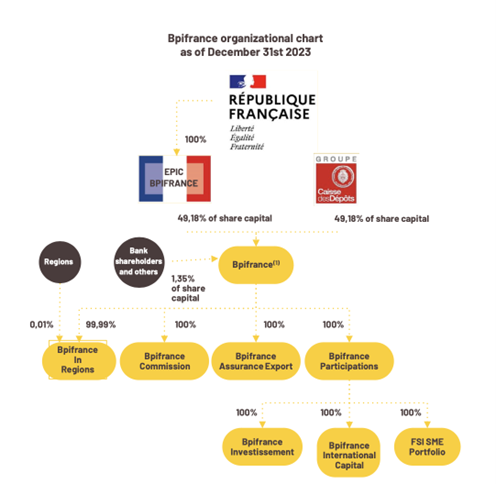
Here is a chart showing the organization of Bpifrance and its entities in 2023.

Bpifrance organizational chart as of December 31st 2023.
Bpifrance organizational chart 2023
Source: the company.

Today, Bpifrance plays a major role in the French economy. In 2023, the institution supported more than 84,000 companies, mobilizing over €69 billion in financing, guarantees, investment and export support.

Bpifrance currently employs approximately 3 700 people across France, making it one of the largest public financial institutions in Europe.

Since 2017, Bpifrance Assurance Export has been managing public export guarantees on behalf of and under the control of the State (more specifically, the Treasury Department). These guarantees secure and facilitate the international operations of French companies by covering the economic and political risks associated with their export contracts.

Before 2017, the management of public export guarantees was carried out by Coface. The transfer of this activity to Bpifrance aimed at strengthening the alignment between France’s industrial policy, export strategy, and financing tools.

My experience and service

I joined this department as an Export Finance Analyst intern, working at the intersection of three departments: ASR (Administration and Risk Monitoring), ESC (Social Environment and Governance) and NTI (Internal Rating and Pricing). I had the opportunity to work with teams responsible for portfolio monitoring (€69 billion in outstanding loans and nearly 1,500 companies) and teams responsible for analysing and reviewing export insurance applications. This internship had a strong economic, strategic and geopolitical aspect, and working in collaboration with the treasury was very enriching.

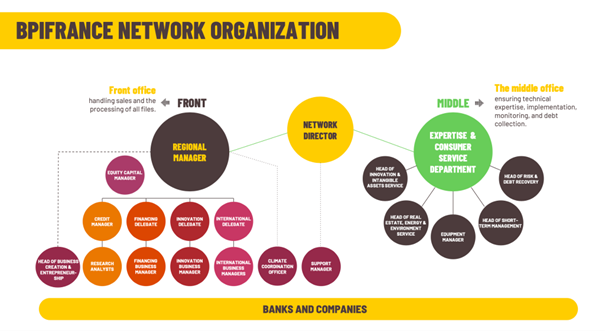
Here is a chart showing the distribution of services and the managerial structure of Bpifrance.

Organization of Bpifrance.
Bpifrance network organization
Source: the company.

During this internship, my tasks were varied and demanding:

  • Participating in the analysis of the financial and non-financial situation of exporting companies and their foreign counterparts,
  • Carrying out an assignment on the credit insurance portfolio in order to better manage reporting on behalf of the Treasury Department,
  • Producing benchmarks and memos for the Treasury, participating in various committees (rating, pricing, guarantees commission).

These tasks enabled me to understand the importance of export financing and guarantees in the French economy and in supporting exporters who wish to carry out projects abroad.

Macroeconomic vision, economic diplomacy and geopolitics

Working in this context allowed me to broaden my macroeconomic vision and better understand the interactions between finance, politics and geopolitics. Analysing transactions that sometimes involved governments directly and institutional players made me aware of the challenges of sovereign risk management. I was able to observe how financial decisions are part of a foreign economic policy approach: supporting a strategic project in an emerging country or strengthening a French industrial sector.

I understood that risk analysis is not limited to reading a company’s financial statements, but requires a detailed understanding of the economic, social and political environment of the buyer or the purchasing country.

What I learnt from this experience

This internship was a rich and decisive experience in my career. It taught me to think on a macroeconomic scale and analyze risks from a strategic perspective.

I worked on sometimes complex economic issues between exporting companies and foreign buyers. I developed rigorous analytical skills and a more comprehensive understanding of the challenges of export financing and insurance in the French economy.

Finally, this immersion at the crossroads of finance, strategy and macroeconomics was fascinating. I gained a lot from it and am certain that I want to continue my career in multidimensional roles like this one.

Related posts on the SimTrade blog

   ▶ All posts about Professional experiences

   ▶ Frédéric ADAM Senior banker (coverage)

   ▶ Dawn DENG Assessing a Company’s Creditworthiness: Understanding the 5C Framework and Its Practical Applications

   ▶ AnnieY EUNG Understanding the Economics of Tariffs

Useful resources

Business

bpifrance

OECD

Direction générale du Trésor

Academic articles

Hayez S. and F. Savel (2018) Bpifrance : entreprises et territoires, Revue d’économie financière, 132(4):179-189.

Gervais F., Guillermain E., Parker D., Venin E., Wagenhausen F., Mayrhofer U., Soathan G.A., Aymard T., Meurier M. B., Varet S., Arzumanyan L. and Ph. Blesbois (2020) Module 22. La gestion du risque de crédit, Exporter – Pratique du commerce international Foucher (27th edition), 22: 332-347.

Alferdo P. (2019) Fiche 15. L’assurance-crédit export, Fiches de droit du commerce international, 215-223.

About the author

The article was written in November 2025 by Julien MAUROY (ESSEC Business School, Global Bachelor in Business Administration (GBBA), 2021-2025).