

Deep Dive into evergreen funds

Emmanuel CYROT

In this article, Emmanuel CYROT (ESSEC Business School, Global Bachelor in Business Administration (GBBA), 2021-2026) introduces the ELTIF 2.0 Evergreen Fund.

Introduction

The asset management industry is pivoting to democratize private market access for the wealth segment. We are moving from the rigid Capital Commitment Model (the classic “blind pool” private equity structure) to the flexible NAV-Based Model, an open-ended structure where subscriptions and redemptions are executed at periodic asset valuations rather than through irregular capital calls. For technical product specialists, the ELTIF 2.0 regulation isn’t just a compliance update, it’s the architectural blueprint for the democratization of private markets. Here is the deep dive into how these “Semi-Liquid” or “Evergreen” structures actually work, the European landscape, and the engineering behind them.

The Liquidity Continuum: Solving the “J-Curve” Problem

To understand the evergreen structure, you have to understand what it fixes. In a traditional Closed-End Fund (the “Old Guard”):

  • The Cash Drag: You commit €100k, but the manager only calls 20% in Year 1. Your money sits idle.
  • The J-Curve: You pay fees on committed capital immediately, but the portfolio value drops initially due to costs before rising (the “J” shape).
  • The Lock: Your capital is trapped for 10-12 years. Secondary markets are your only (expensive) exit.

The Evergreen / Semi-Liquid Solution represents the structural convergence of private market asset exposure with an open-ended fund’s periodic subscription and redemption framework.

  • Fully Invested Day 1: Unlike the Capital Commitment model, your capital is put to work almost immediately upon subscription.
  • Perpetual Life: There is no “end date.” The fund can run for 99 years, recycling capital from exited deals into new ones.
  • NAV-Based: You buy in at the current Net Asset Value (NAV), similar to a mutual fund, rather than making a commitment.

The difference in investment processes between evergreen funds and closed ended funds
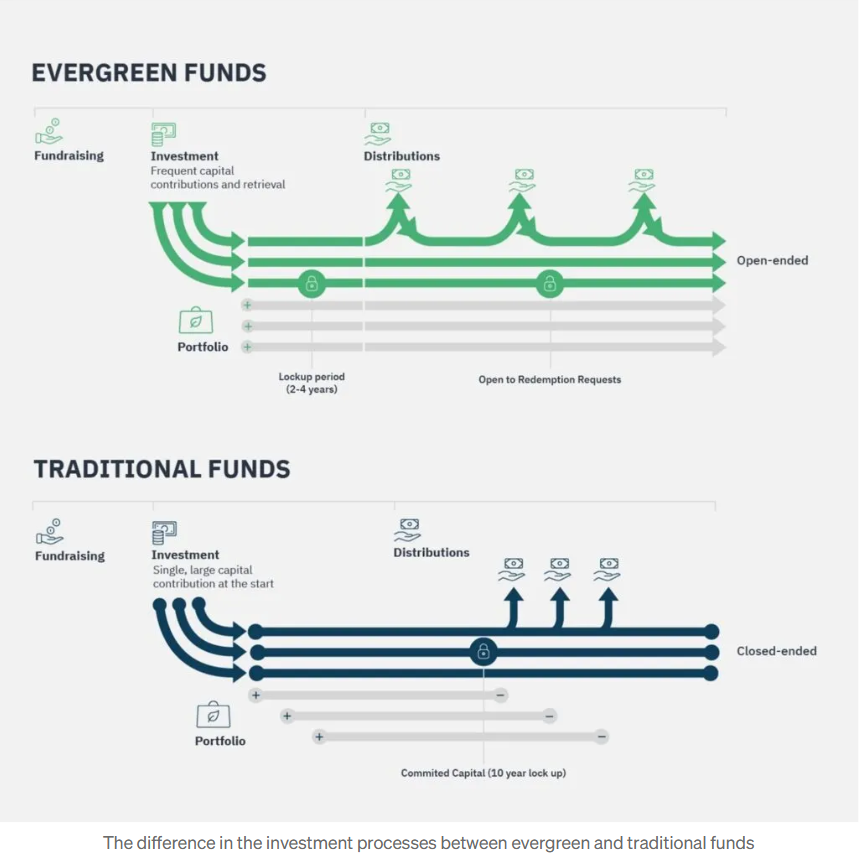
 The difference in investment processes between evergreen funds and closed ended funds
Source: Medium.

The European Landscape: The Rise of ELTIF 2.0

The “ELTIF 2.0” regulation (Regulation (EU) 2023/606) is the game-changer. It removed the extra local rules that held the market back in Europe. These rules included high national minimum investment thresholds for retail investors and overly restrictive limits on portfolio composition and liquidity features imposed by national regulators.

Market Data as of 2025 (Morgan Lewis)

  • Volume: The market is rapidly expanding, with over 160+ registered ELTIFs now active across Europe as of 2025.
  • The Hubs: Luxembourg is the dominant factory (approx. 60% of funds), followed by France (strong on the Fonds Professionnel Spécialisé or FPS wrapper) and Ireland.
  • The Arbitrage: The killer feature is the EU Marketing Passport. A French ELTIF can be sold to a retail investor in Germany or Italy without needing a local license. This allows managers to aggregate retail capital on a massive scale.

Structural Engineering: Liquidity

This section delves into the precise engineering required to reconcile the illiquidity of the underlying assets with the promise of periodic investor liquidity in Evergreen/Semi-Liquid funds. This is achieved through a combination of Asset Allocation Constraints and robust Liquidity Management Tools (LMTs).

The primary allocation constraint is the “Pocket” Strategy, or the 55/45 Rule. The fund is structurally divided into two distinct components. First, the Illiquid Core, which must represent greater than 55% of the portfolio, is the alpha engine holding long-term, illiquid assets such as Private Equity, Private Debt, or Infrastructure. Notably, ELTIF 2.0 has broadened the scope of this core to include newer asset classes like Fintechs and smaller listed companies. Second, the Liquid Pocket, which can be up to 45%, serves as the fund’s buffer, holding easily redeemable, UCITS-eligible assets like money market funds or government bonds. While the regulation permits a high 45% pocket, efficient fund operation typically keeps this buffer closer to 15%–20% to mitigate performance-killing “cash drag”.

Crucial to managing liquidity risk is the Gate Mechanism. Although the fund offers conditional liquidity (often quarterly), the Gate prevents a systemic crisis if many investors attempt to exit simultaneously. This mechanism works by capping redemptions at a specific percentage of the Net Asset Value (NAV) per period, commonly set at 5%. If aggregate redemption requests exceed this threshold (e.g., requests total 10%), all withdrawing investors receive a pro-rata share of the allowable 5% and the remainder of their request is deferred to the next liquidity window.

Finally, managers utilize Anti-Dilution Tools like Swing Pricing to protect the financial interests of the long-term investors remaining in the fund. In a scenario involving heavy redemptions, where the fund manager is forced to sell assets quickly and incur high transaction costs, Swing Pricing adjusts the NAV downwards only for the exiting investors. This critical mechanism ensures that those demanding liquidity—the “leavers”—bear the transactional “cost of liquidity,” thereby insulating the NAV of the “stayers” from dilution.

Why should I be interested in this post?

Mastering ELTIF 2.0 architecture offers a definitive edge over the standard curriculum. With the industry pivoting toward the “retailization” of private markets, understanding the engineering behind evergreen funds and liquidity gates demonstrates a level of practical sophistication that moves beyond theory—exactly what recruiters at top-tier firms like BlackRock or Amundi are seeking for their next analyst class.

Related posts on the SimTrade blog

   ▶ David-Alexandre BLUM The selling process of funds

Useful resources

Société Générale Fonds Evergreen et ELTIF 2 : Débloquer les Marchés Privés pour les Investisseurs Particuliers

About the author

The article was written in December 2025 by Emmanuel CYROT (ESSEC Business School, Global Bachelor in Business Administration (GBBA), 2021-2026).

   ▶ Read all articles by Emmanuel CYROT.

My Internship as a Junior Consultant in Marketing & Finance Studies at Eres Gestion

Emmanuel CYROT

In this article, Emmanuel CYROT (ESSEC Business School, Global Bachelor in Business Administration (GBBA), 2021-2026) shares his professional experience as Junior Consultant in Marketing & Finance Studies at Eres Gestion.

About the company

Eres Gestion is a leading independent player in the French employee savings (épargne salariale) and retirement savings (épargne retraite) markets. The company is part of the Eres Group, which offers a unique open-architecture approach, allowing them to select and combine the best investment funds from various management companies. With over €7 billion in assets under management (as of 12/31/2024), Eres is known for its expertise in designing and implementing profit-sharing schemes, employee share ownership plans, and individual retirement solutions (Plan Epargne Retraite or PER). Eres Gestion places a strong emphasis on socially responsible investing (SRI) and solidarity funds.

Logo of Eres Gestion
Source: the company.

My internship

I worked as a Junior Consultant in charge of Marketing & Finance Studies at Eres Gestion from September 2024 to February 2025 in Paris. I was within the company’s dual-focused research team, bridging the gap between deep financial analysis and market strategy. My role involved quantitative modeling, competitive benchmarking, and the creation of strategic content aimed at supporting sales and marketing efforts. I was reporting to Mirela Stoeva, Head of Studies and Offer at Eres Gestion.

My missions

My primary technical mission involved comprehensive Regulatory Intelligence and Data Analysis, specifically leading the update of the L’Observatoire Européen des Retraites study. This required consolidating data to quantify the evolution of retirement savings assets focusing on the post-Loi Pacte growth of the PER (Plan d’Épargne Retraite). I also conducted crucial Competitive Benchmarking by analyzing various third-party funds based on their retrocession rates to optimize Eres’s offerings. Finally, I supported the firm’s thought leadership on Employee Share Ownership (SBF 120 companies) by drafting expert articles and maintaining all key analytical supports, including the Le panorama de l’actionnariat salarié. I was tasked by the Marketing Director to conduct an internal study on the Retail’s Structured Product Environment in France.

Required skills and knowledge

My experience as a Junior Consultant in Marketing & Finance Studies at Eres Gestion was characterized by a high degree of autonomy and a constant curiosity, which were essential for navigating the complex sector of employee savings (épargne salariale) and employee share ownership. The role required me to conduct in-depth studies on the Pacte Law (Loi Pacte), fund performance analysis, and the valuation of unlisted companies. The intensive work on Excel to model these assets and flows cultivated methodical rigor and discipline, enabling me to become perfectly fluid with numbers and ensure the accuracy of strategic deliverables for the teams.

What I learned

This experience provided me with a comprehensive understanding of the French employee savings and retirement ecosystem, particularly the strategic implications of the Loi Pacte and the development of value-sharing initiatives. I significantly enhanced my skills in quantitative market analysis, competitive benchmarking, and translating complex financial information into accessible, strategic content for both internal and external stakeholders. Working closely with both the finance and marketing teams offered invaluable insight into the product life cycle, from regulatory impact assessment to market positioning.

Business and financial concepts related to my internship

I present below three business and financial concepts related to my internship: The French Retirement Savings Reform (Loi Pacte), Employee Share Ownership Plans (ESOPs), and Structured Products.

The French Retirement Savings Reform (Loi Pacte)

The 2019 Pacte Law (Plan d’Action pour la Croissance et la Transformation des Entreprises) is a major French reform aimed at simplifying the country’s complex retirement savings landscape. Its main component is the creation of the Retirement Savings Plan (Plan d’Épargne Retraite or PER), a unified and portable product replacing previous schemes. The law aimed to channel more of the French population’s savings into long-term investments, including unlisted assets like private equity, to support corporate financing and economic growth.

Employee Share Ownership Plans (ESOPs)

Employee Share Ownership Plans (ESOPs) are incentive programs that allow employees to acquire shares in their company. In France, this is a key component of the employee savings system (épargne salariale). The benefits include aligning the interests of employees and shareholders, increasing organizational commitment, and strengthening the company’s capital structure. Recent French legislation also focuses on developing and simplifying various value-sharing and profit-sharing schemes.

Structured Products

Structured products are complex financial instruments whose performance is linked to an underlying asset, index, or basket of assets. They are typically issued by banks and are essentially a combination of a “riskless” bond (to provide capital protection) and one or more derivative instruments (like options) (to provide market exposure and enhance return). They are customized to offer a specific risk/return profile, but their complexity necessitates thorough internal analysis, which was a core part of my mission.

Why should I be interested in this post?

The experience provides unique Business Intelligence training: you won’t just be supporting one study but rather working on at least two of the four major annual publications, such as the L’observatoire Européen des Retraites or the Le panorama de l’actionnariat salarié. This direct involvement gives you a unique, 360-degree insight into the strategic data, market trends, and competitive landscape of French employee savings and share ownership that few junior roles offer. Furthermore, the requirement for high autonomy and rigorous Excel work on fund benchmarking and asset modeling forces the development of methodical discipline and fluency with numbers necessary for demanding quantitative roles after graduation.

Related posts on the SimTrade blog

Professional experiences

   ▶ All posts about Professional experiences

   ▶ Alexandre VERLET Classic brain teasers from real-life interviews

Financial techniques

   ▶ David-Alexandre BLUM The selling process of funds

   ▶ Shruti CHAND Pension Funds

   ▶ Mahé FERRET Selling Structured Products in France

Useful resources

Blog Eres Gestion

H24 Finance

About the author

The article was written in December 2025 by Emmanuel CYROT (ESSEC Business School, Global Bachelor in Business Administration (GBBA), 2021-2026).

   ▶ Read all articles by Emmanuel CYROT.
My Internship as a Product Development Specialist at Amundi ARA

Emmanuel CYROT

In this article, Emmanuel CYROT (ESSEC Business School, Global Bachelor in Business Administration (GBBA), 2021-2026) shares his professional experience as a Product Development Specialist within the marketing team at Amundi ARA under the Senior Product Development Specialist and the Director of Marketing and Communication.

About the company

Amundi Alternative & Real Assets (ARA) is a specialized business line within the Amundi Group dedicated to private market investment solutions, managing approximately €66.1 billion in assets as of late 2025. Formally established in 2016 to consolidate the group’s capabilities, ARA employs a team of roughly 330 professionals operating across eight European investment hubs (including Paris, London, Milan, and Zurich). The division provides institutional and retail investors with access to the real economy through a diverse range of products, including real estate (its largest segment), private debt, private equity, and infrastructure, as well as fund of funds strategies and Hedge Funds UCITS (Undertakings for Collective Investment in Transferable Securities) which are a liquid versions of hedge fund strategies to a broad base of retail investors in Europe.

Logo of Amundi Investment Solutions.
Logo of Amundi Investment Solutions
Source: the company.

The Marketing team at Amundi ARA, comprising approximately 15 members (including a robust cohort of interns and apprentices), acts as a specialized bridge connecting Clients with the Sales team. Their primary mandate is to translate complex private market strategies into commercially viable investment solutions tailored for both institutional and retail investors. The team utilizes a highly structured support model where every specific area of expertise is represented by a dedicated “Investment Specialist,” each of whom is directly supported by an assigned intern.

My internship

The internship lasted 6 months between March and August 2025 and was reporting directly mostly reporting to the Senior Product Development Specialist in the team and monitoring new fund launches across to all teams within ARA: Sales, structuring, Investments Teams, Business Development, etc.

My missions

My primary mission was to participate in the conception, structuring, and launch of two new funds within the ARA range. To support this, I conducted detailed market analyses and competitive studies, specifically benchmarking French and Luxembourgish evergreen funds using professional terminals like Preqin, Pitchbook, and Bloomberg, which provided access to crucial data on performance, management fees, Assets under management, redemption gates, lock-up periods, etc.

I was also responsible for the collection, analysis, and dissemination of sectoral Business Intelligence data. I produced reports designed for the Sales, Marketing, Management teams to aid in decision-making for meetings internally and externally.

Another major part of my mission was the creation and updating of marketing materials, including pitchbooks, brochures, and product sheets. This ensured that the sales teams had accurate and compelling documentation to promote the funds to investors.

Required skills and knowledge

This role required strong communication and organizational skills to coordinate effectively across diverse teams and manage product launch deadlines. Intellectual curiosity and discipline were essential for synthesizing complex market studies without external AI assistance, alongside the ability to filter relevant business intelligence from general noise. Finally, technical proficiency in Excel and data providers (Bloomberg, Preqin, Pitchbook) was critical, coupled with a rapid understanding of the specificities of Private Assets vehicles.

What I learned

Through the benchmarking and product launch support, I gained a systematic understanding of how private asset funds are structured and positioned in a competitive market. I developed the ability to assess market needs and translate them into product features.

My contribution helped streamline the flow of Business Intelligence between the structuring and sales teams. I also deepened my understanding of the regulatory and commercial requirements for launching funds in the European market. Overall, this internship strengthened my skills in market analysis, product marketing, and strategic communication.

Financial concepts related to my internship

I present below three financial concepts related to my internship: Evergreen funds, UCITS hedge funds, and Private Equity funds.

Evergreen Funds

Unlike traditional closed-ended Private Equity or Private Debt funds with finite terms and J-curve effects, evergreen funds function as semi-liquid open-ended vehicles allowing for continuous capital recycling. My work focused on benchmarking the liquidity management mechanisms of French and Luxembourgish vehicles such as ELTIF 2.0, which is the European Long-Term Investment Fund regulation designed to increase retail and institutional investor participation in long-term, illiquid assets. I analyzed key technical features including NAV (Net asset Value) calculation frequency, the calibration of redemption gates, notice periods, and the implementation of liquidity sleeves to mitigate the asset-liability mismatch inherent in offering liquidity on illiquid underlying assets.

UCITS Hedge Funds

Alternative UCITS (often referred to as “Liquid Alts”) democratize access to hedge fund strategies (e.g., Long/Short Equity, Global Macro) by wrapping them in a regulated UCITS framework. My benchmarking work involved analyzing how these funds offer weekly or daily liquidity and high transparency to investors, unlike their offshore Cayman or BVI counterparts which often impose lock-up periods and gates.

Private Equity Funds

A central part of this role involved the strategic overhaul and tailoring of investor pitchbooks and marketing materials. This required translating complex fund structures and performance data into clear, compelling narratives for both institutional and retail investors. In that context, I learned the key concepts of Private Equity Funds alongside helpful formations that were provided by Amundi. This allowed me to familiarize well with metrics used to analyze PE funds (DPI, TVPI, J-Curve…) and different strategies (Mid-market, Impact).

Why should I be interested in this post?

This post is for you if you want to be at the forefront of asset management, specializing in the growing world of Private Markets (Private Equity, Infrastructure, Impact). It’s an excellent chance to learn deeply about product structuring and the commercial lifecycle of funds, all within a honestly great, supportive environment that ensures you gain hands-on experience and valuable strategic insight.

Related posts on the SimTrade blog

   ▶ All posts about Professional experiences

   ▶ Alexandre VERLET Classic brain teasers from real-life interviews

   ▶ Lilian BALLOIS Discovering Private Equity: Behind the Scenes of Fund Strategies

   ▶ Matisse FOY Key participants in the Private Equity ecosystem

Useful resources

Opalesque Alternative Market Briefing

Citywire

France Invest

About the author

The article was written in December 2025 by Emmanuel CYROT (ESSEC Business School, Global Bachelor in Business Administration (GBBA), 2021-2026).

   ▶ Read all articles by Emmanuel CYROT.