The “lemming effect” in finance

Langchin SHIU

In this article, SHIU Lang Chin (ESSEC Business School, Global Bachelor in Business Administration (GBBA), 2024-2026) explains the “lemming effect” in financial markets, inspired by the animated movie Zootopia.

About the concept

The “lemming effect” refers to situations where individuals follow the crowd unthinkingly, just as lemmings are believed to follow one another off a cliff. In finance, this idea is linked to herd behaviour: investors imitate the actions of others instead of relying on their own information or analysis.

The image above is a cartoon showing a line of lemmings running off a cliff, with several already falling through the air. The caption “The Lemming Effect: Stop! There is another way” warns that blindly following others can lead to disaster, even if “everyone is doing it.” The message is to think independently, question group behaviour, and choose an alternative path instead of copying the crowd.

In Zootopia, there is a scene where lemmings dressed as bankers leave their office and are supposed to walk straight home after work. However, after one lemming notices Nick selling popsicles and suddenly changes direction to buy one, the rest of the lemmings automatically follow and queue up too, even though this is completely different from their original route and plan. This illustrates how individuals can abandon their own path and intentions simply because they see someone else acting first, much like investors may follow others into a trade or trend without conducting independent analysis.

Watch the video!


Source: Zootopia (Disney, 2016).

The first image shows Nick Wilde (the fox) holding a red paw-shaped popsicle. In the film, Nick uses this eye‑catching pawpsicle as a marketing tool to attract the lemmings and earn a profit.

zootopia lemmings
Source: Zootopia (Disney, 2016).

The second image shows a group of identical lemmings in suits walking in and out of a building labelled “Lemming Brothers Bank.” This is a parody of the real investment bank “Lehman Brothers,” which collapsed during the 2008 financial crisis. When one lemming notices the pawpsicle, it immediately changes direction from going home and heads toward Nick to buy the product, illustrating how one individual’s choice triggers the rest to follow.

zootopia lemmings
Source: Zootopia (Disney, 2016).

The third image shows Nick successfully selling pawpsicles to a whole line of lemmings. Nick is exploiting the lemmings’ herd‑like behaviour: once a few begin buying, the others automatically copy them and all purchase the same pawpsicle. The humour lies in how Nick profits from their conformity, using their predictable group behaviour—the “lemming effect”—to make easy money.

zootopia lemmings
Source: Zootopia (Disney, 2016).

Behavioural finance uses the lemming effect to describe deviations from perfectly rational decision-making. Rather than analysing fundamentals calmly, investors may be influenced by social proof, fear of missing out (FOMO) or the comfort of doing what “everyone else” seems to be doing.

Understanding the lemming effect is important both for professional investors and students of finance. It helps to explain why markets sometimes move far away from fundamental values and reminds decision-makers to be cautious when “the whole market” points in the same direction.

How the lemming effect appears in markets

In practice, the lemming effect can be seen when large numbers of investors buy the same “hot” stocks simply because prices are rising, they assume that so many others doing the same thing cannot be wrong.

It applies in reverse during market downturns. Bad news, rumours, or sharp price declines can trigger a wave of selling. The fear of being the last one can push them to copy others’ behaviour rather than stick to their original plan.

Such herd-driven moves can amplify volatility, push prices far above or below intrinsic value, and create opportunities or risks that would not exist in a purely rational market. Recognising these dynamics helps investors to step back and question whether they are thinking independently.

Related financial concepts

The lemming effect connects naturally with several basic financial ideas: diversification, risk-return trade-off, market efficiency, Keynes’ beauty contest and gamestop story. It shows how human behaviour can distort these textbook concepts in real markets.

Diversification

Diversification means not putting all your money in the same blanket (asset or sector), so that the poor performance of one investment does not destroy the whole. When the lemming effect is strong, investors often forget diversification and concentrate on a few “popular” stocks. From a diversification perspective, following the crowd can increase risk without necessarily increasing expected returns.

Risk and return

Finance said that higher expected returns usually come with higher risk. However, when many investors behave like lemmings, they may underestimate the true risk of crowded trades. Rising prices can create an illusion of safety, even if fundamentals do not justify the move. Understanding the lemming effect reminds investors to ask whether a sustainable increase in expected return really compensates the extra risk taken by following the crowd.

Market efficiency

In an efficient market, prices should reflect all available information. Herd behaviour and the lemming effect demonstrate that markets can deviate from this ideal when many investors react based on emotions or social cues rather than information. Short-term mispricing created by herding can eventually be corrected when new information becomes available or when rational investors intervene. For students, this illustrates why theoretical models of perfect efficiency are useful benchmarks but do not fully capture real-world behaviour.

Keynes’ beauty contest

Keynes’ “beauty contest” analogy describes investors who do not choose stocks based on their own view of fundamental value, but instead try to guess what everyone else will think is beautiful.Instead of asking “Which company is truly best?”, they ask “Which company does the average investor think others will like?” and buy that, hoping to sell to the next person at a higher price. This links directly to the lemming effect: investors watch each other and pile into the same trades, just like the lemmings all changing direction to follow the first one who goes for the pawpsicle.

GameStop story

The GameStop short squeeze in 2021 is a modern real‑world illustration of herd behaviour. A large crowd of retail investors on Reddit and other forums started buying GameStop shares together, partly for profit and partly as a social movement against hedge funds, driving the price far above what traditional valuation models would suggest. Once the price started to rise sharply, more and more people jumped in because they saw others making money and feared missing out, reinforcing the crowd dynamic in a very “lemming‑like” way.

Why should I be interested in this post?

For business and finance students, the lemming effect is a bridge between psychology and technical finance. It helps explain why prices sometimes move in surprising ways, and why sticking mindlessly to the crowd can be dangerous for long-term wealth.

Whether you plan to work in banking, asset management, consulting or corporate finance, understanding herd behaviour can improve your judgment. It encourages you to combine quantitative tools with a critical view of market sentiment, so that you do not become the next “lemming” in a crowded trade.

Related posts on the SimTrade blog

   ▶ All posts about Financial techniques

   ▶ Hadrien PUCHE “The market is never wrong, only opinions are“ – Jesse Livermore

   ▶ Hadrien PUCHE “It’s not whether you’re right or wrong that’s important, but how much money you make when you’re right and how much you lose when you’re wrong.”– George Soros

   ▶ Daksh GARG Social Trading

   ▶ Raphaël ROERO DE CORTANZE Gamestop: how a group of nostalgic nerds overturned a short-selling strategy

Useful resources

BBC Five animals to spot in a post-Covid financial jungle

Tversky, A., & Kahneman, D. (1973). Availability: A heuristic for judging frequency and probability. Cognitive psychology, 5(2), 207-232.

Gupta, S., & Shrivastava, M. (2022). Herding and loss aversion in stock markets: mediating role of fear of missing out (FOMO) in retail investors. International Journal of Emerging Markets, 17(7), 1720-1737.

Gupta, S., & Shrivastava, M. (2022). Argan, M., Altundal, V., & Tokay Argan, M. (2023). What is the role of FoMO in individual investment behavior? The relationship among FoMO, involvement, engagement, and satisfaction. Journal of East-West Business, 29(1), 69-96.

About the author

The article was written in December 2025 by SHIU Lang Chin (ESSEC Business School, Global Bachelor in Business Administration (GBBA), 2024-2026).

   ▶ Read all articles by SHIU Lang Chin.
Time value of money

Langchin SHIU

In this article, SHIU Lang Chin (ESSEC Business School, Global Bachelor in Business Administration (GBBA), 2024-2026) explains the time value of money, a simple but fundamental concept used in all areas of finance.

Overview of the time value of money

The time value of money (TVM) is the idea that one euro today is worth more than one euro in the future because today’s money can be invested to earn interest. In other words, receiving cash earlier gives more opportunities to save, invest, and grow wealth over time. This principle serves as the foundation for valuing loans, bonds, investment projects, and many everyday financial decisions.

To work with TVM, finance uses a few key tools: present value (the value today of future cash flows), future value (the value in the future of money invested today),etc. With these elements, it becomes possible to compare different cash-flow patterns that occur at various dates consistently.

Future value

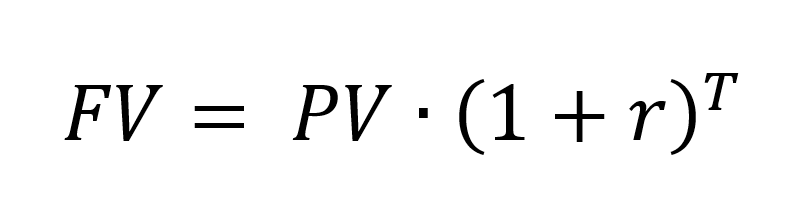
The future value (FV) of money answers the question: if I invest a certain amount today at a given interest rate, how much will I have after some time? Future value uses the principle of compounding, which means that interest earns interest when it is reinvested.

For a simple case with annual compounding, the formula is:

Future Value (FV)

where PV is the amount invested today, r is the annual interest rate, and T is the number of years.

For example, if 1,000 euros are invested at 5% per year for 3 years, the future value is FV = 1,000 × (1.05)^3 = 1,157.63 euros. This shows how even a modest interest rate can increase the value of an investment over time.

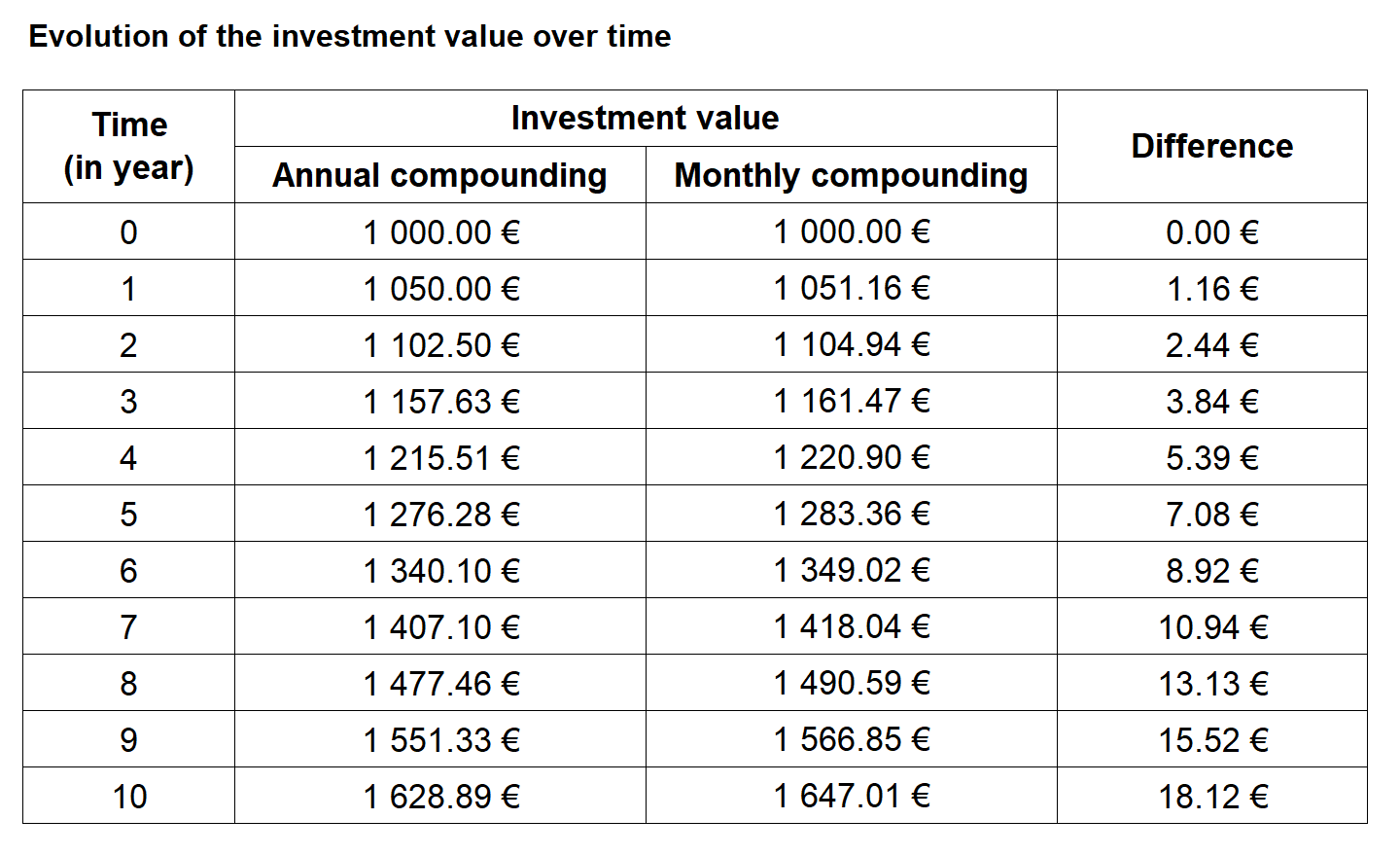
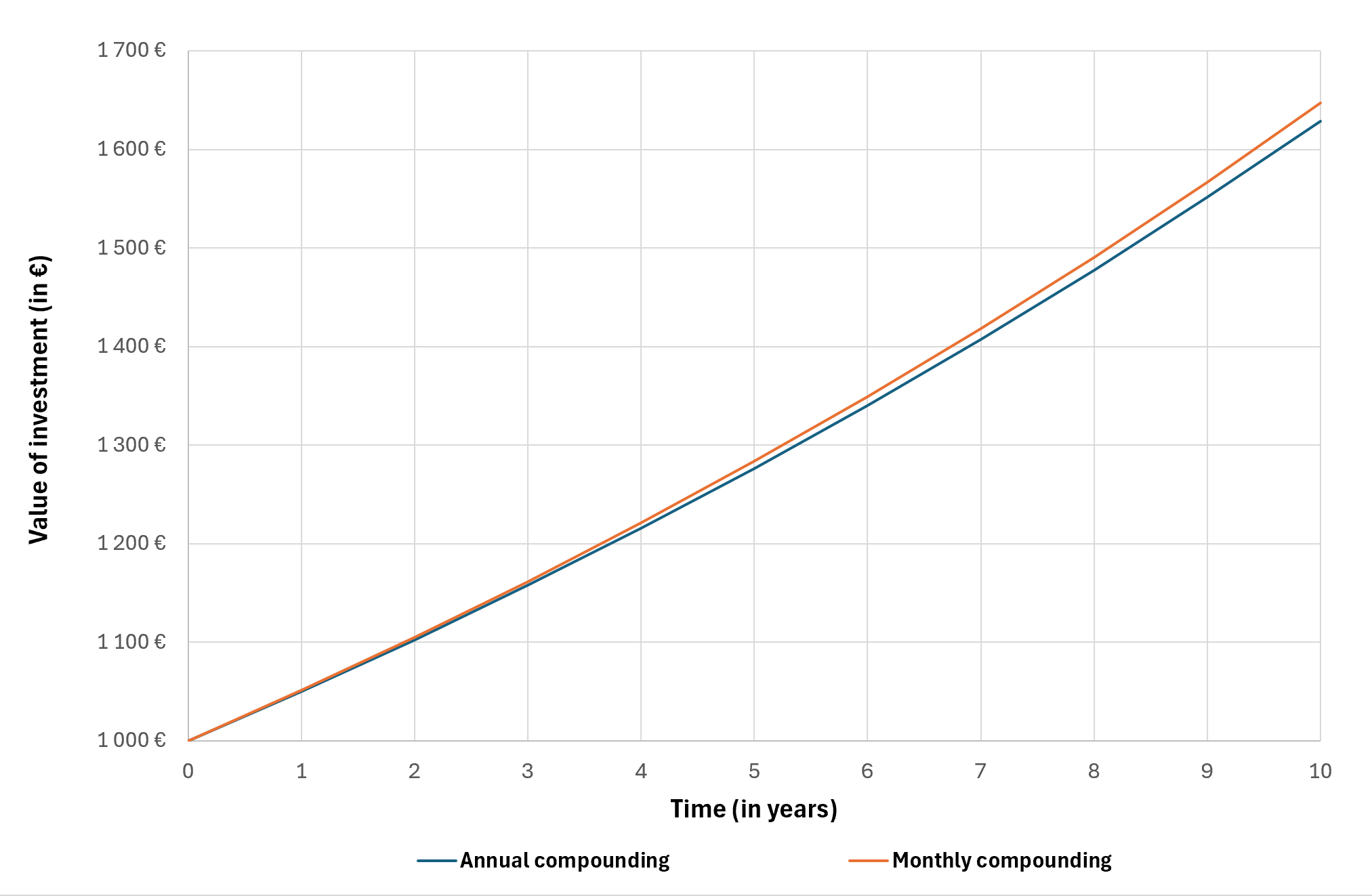
Compounding frequency can also change the result. If interest is compounded monthly instead of annually, the formula is adjusted to use a periodic rate and the total number of periods. The more frequently interest is added, the higher the future value for the same nominal annual rate, illustrating why compounding is such a powerful mechanism in long-term investing.

Compounding mechanism with monthy and annual compounding.
Compounding mechanism

Compounding mechanism with monthy and annual compounding.
Compounding mechanism

You can download the Excel file provided below, which contains the computation of an investment to illustrate the impact of the frequency on the compounding mechanism.

Download the Excel file for computation of an investment to illustrate the impact of the frequency on the compounding mechanism

Present value

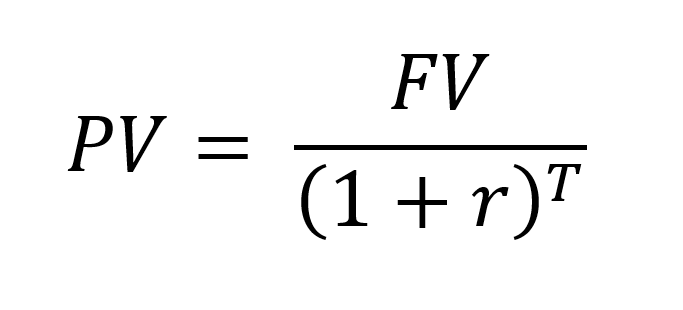
Present value (PV) is the reverse operation of future value and answers the question: how much is a future cash flow worth today? To find PV, the future cash flow is “discounted” back to today using an appropriate discount rate that reflects opportunity cost, risk and inflation.

For a single future cash flow, the present value formula is:

Present Value (PV)

Where FV is the future amount, r is the discount rate per period, and T is the number of periods.

For example, if an investor expects to receive 1,000 euros in 2 years and the discount rate is 5% per year, the present value is PV = 1,000 / (1.05)^2 = 907.03 euros. This means the investor would be indifferent between receiving 907.03 euros today or 1,000 euros in two years at that discount rate.

Choosing the discount rate is a key step: for a safe cash flow, a risk-free rate such as a government bond yield might be used, while for a risky project, a higher rate reflecting the required return of investors would be more appropriate. A higher discount rate reduces present values, making future cash flows less attractive compared to money today.

Applications of the time value of money

The time value of money is used in almost every area of finance. In corporate finance, it forms the basis of discounted cash-flow (DCF) analysis, where the expected future cash flows of a project or company are discounted to estimate the net present value. Investment decisions are typically made by comparing the present value to the initial cost.

DCF

In banking and personal finance, TVM is essential to design and understand loans, deposits and retirement plans. Customers who understand how interest rates and compounding work can better compare offers, negotiate terms and plan their savings. In capital markets, bond pricing, yield calculations and valuation of many other instruments depend directly on discounting streams of cash flows.

Even outside professional finance, TVM helps individuals answer simple but important questions: is it better to take a lump sum now or a stream of payments later, how much should be saved each month to reach a future target, or what is the true cost of borrowing at a given interest rate? A good intuition for TVM improves financial decision-making in everyday life.

Why should I be interested in this post?

As a university student, understanding TVM is essential because it underlies more advanced techniques such as discounted cash-flow (DCF) valuation, bond pricing and project evaluation. It is usually one of the first technical topics taught in introductory corporate finance and quantitative methods courses.

Related posts on the SimTrade blog

   ▶ All posts about Financial techniques

   ▶ Hadrien PUCHE The four most dangerous words in investing are, it’s different this time

   ▶ Hadrien PUCHE Remember that time is money

Useful resources

Harvard Business School Online Time value of money

Investing.com Time value of money: formula and examples

About the author

The article was written in December 2025 by SHIU Lang Chin (ESSEC Business School, Global Bachelor in Business Administration (GBBA), 2024-2026).

   ▶ Read all articles by SHIU Lang Chin.
My internship experience at HSBC

Langchin SHIU

In this article, SHIU Lang Chin (ESSEC Business School, Global Bachelor in Business Administration (GBBA), 2024-2026) shares her professional experience at HSBC in Hong Kong.

About the company

HSBC (The Hongkong and Shanghai Banking Corporation) is one of the world’s largest banking and financial services organisations, serving millions of customers through Retail Banking, Wealth Management, Commercial Banking, Global Banking and Markets, and other specialised businesses.

In Hong Kong, HSBC plays a key role as a leading provider of corporate and investment banking, trade finance, and wealth management products, making it a central player in the regional and global financial system.

Logo of HSBC.
Logo of HSBC
Source: the company.

My internship

During my internship in the Wealth and Personal Banking team in Hong Kong, I assisted with daily operations supporting client relationship managers and investment advisors. My work involved preparing client onboarding documents, updating records in the bank’s management system, and ensuring compliance with Know Your Customer (KYC) and internal policy requirements. I also helped compile client portfolio summaries, draft investment proposals, and conduct market research to support financial planning and investment recommendations.

Beyond these tasks, I gained exposure to a wide range of wealth management products including mutual funds, equity and bonds, structured products, and insurance solutions. I participated in internal meetings to observe how product specialists, compliance officers, and relationship managers collaborate to deliver integrated services for clients. Additionally, I contributed to the preparation of client presentations and market updates, which strengthened my understanding of how macroeconomic trends influence individual investment strategies.

My missions

My missions included supporting relationship managers and product managers with the preparation of client materials, such as simple financial summaries and presentation slides for internal and external meetings. I also assisted with internal reports, helped update client information in our internal systems, and observed calls and meetings to understand client needs and identify follow-up actions.

Required skills and knowledge

This internship required strong analytical skills, attention to detail and a solid foundation in finance and banking concepts, such as understanding financial statements, basic risk metrics and common banking products. At the same time, soft skills such as communication, time management, and professionalism were crucial, as I had to collaborate with different team members, handle confidential information carefully, and deliver work under tight deadlines.

What I learned

Through this experience, I learned how front-office and support teams interact to serve clients and manage risks within a large universal bank. I developed a more concrete understanding of how theoretical concepts from corporate finance and financial markets are applied in real transactions and client discussions, and I improved my ability to structure quantitative information clearly in reports.

Financial concepts related to my internship

Three financial concepts related to my internship: relationship banking, risk-return and capital allocation, and regulation and compliance. These concepts help explain how my daily tasks fit into the broader functioning of the bank.

Relationship banking

Relationship banking refers to building long-term relationships with clients rather than focusing only on individual transactions. In practice, this means understanding clients’ businesses, industries and strategic priorities to provide tailored solutions over time. By helping prepare client materials and following up on information requests, I contributed to the relationship-building process that supports client retention and opportunities.

Risk-return and capital allocation

Banks constantly balance risk and return when they grant loans, underwrite deals or hold assets on their balance sheet, subject to capital and liquidity constraints. Internal analyses, credit information, and financial ratios are used to assess whether the expected return of a client or transaction justifies the associated risk and capital consumption. My exposure to simple financial analysis and internal reporting showed how data and models support these risk-return decisions.

Regulation and compliance

Banking is a highly regulated industry, with strict rules on capital, liquidity, anti-money laundering (AML), know-your-customer (KYC) and conduct. Many processes in the bank, from onboarding to reporting and product approval, are shaped by these regulatory requirements. During my internship, I observed how documentation, data accuracy, and internal controls are integrated into daily workflows to ensure that business growth aligns with regulatory expectations and internal risk appetite.

Why should I be interested in this post?

An internship at HSBC offers exposure to a global banking environment, sophisticated financial products and real client situations. It also provides a strong platform to develop quantitative skills, professional communication and an understanding of how large financial institutions create value while managing complex risks—skills that are highly transferable to careers in banking, consulting, corporate finance and risk management.

Related posts on the SimTrade blog

All posts about Professional experiences

Useful resources

HSBC – Official website

HSBC Internships for students and graduates

HSBC Financial Regulation

About the author

The article was written in December 2025 by SHIU Lang Chin (ESSEC Business School, Global Bachelor in Business Administration (GBBA), 2024-2026).

   ▶ Read all articles by SHIU Lang Chin.
My internship experience at HKTDC

Langchin SHIU

In this article, SHIU Lang Chin (ESSEC Business School, Global Bachelor in Business Administration (GBBA), 2024-2026) shares her professional experience as a summer intern in the Exhibition and Digital Business Department at the Hong Kong Trade Development Council (HKTDC) in Hong Kong, China.

About the company

The Hong Kong Trade Development Council (HKTDC) is a statutory body established in 1966 to promote, assist and develop Hong Kong’s trade. It serves as the international marketing arm for Hong Kong-based traders, manufacturers and service providers, with a strong focus on supporting small and medium-sized enterprises.

HKTDC operates a global network of around 50 offices, including multiple offices in Mainland China, to position Hong Kong as a two-way global investment and business hub. Through international exhibitions, conferences and business missions, it creates business opportunities for companies by connecting them with partners and buyers worldwide.

Logo of HKTDC.
Logo of HKTDC
Source: the company.

My internship

I joined HKTDC as a summer intern in the Exhibition and Digital Business Department in Hong Kong, which is responsible for organising large-scale trade fairs and public exhibitions. During my internship at the Hong Kong Trade Development Council (HKTDC), I joined the Exhibition and Digital Business Department, which is responsible for organising large-scale trade fairs and public exhibitions connecting global enterprises and Hong Kong’s business community. The HKTDC is a statutory body that promotes Hong Kong as an international business hub, with over 30,000 exhibitors and 400,000 trade buyers participating in its annual exhibitions.

The department I served in manages both B2B and B2C events, such as the Hong Kong Book Fair, Sports and Leisure Expo, and World of Snacks, which together attracted over 1 million visitors in 2024. These fairs not only generate significant foot traffic and publicity but also foster cross-sector collaboration and cultural exchange. For instance, the Hong Kong Book Fair alone featured more than 760 exhibitors from 30 countries and regions, drawing over 990,000 visitors across seven days at the Hong Kong Convention and Exhibition Centre (HKCEC), with estimated sales revenue exceeding HK$50 million in direct transactions and book sales.

My missions

My main missions were to assist in organising three of HKTDC’s public exhibitions — the Hong Kong Book Fair, World of Snacks, and the Hong Kong Sports & Leisure Expo. I supported the planning, coordination, and on-site execution of these events, including exhibitor liaison, logistics management, and handling visitor enquiries. My responsibilities also involved preparing fair materials, checking booth setups, coordinating with contractors and internal teams, and ensuring each exhibition zone operated smoothly throughout the event period.

In addition to operational tasks, I assisted in marketing and promotional efforts, such as preparing sponsorship materials for the Book Fair Lucky Draw and helping the marketing team create social media posts and reels to attract younger visitors. I also served as an emcee for public seminars and workshops, enhancing event engagement and communication between speakers and the audience. Through these assignments, I gained valuable exposure to event management processes, from preparation to live execution, and developed a deeper understanding of how the HKTDC integrates marketing, logistics, and stakeholder relations to deliver large-scale exhibitions.

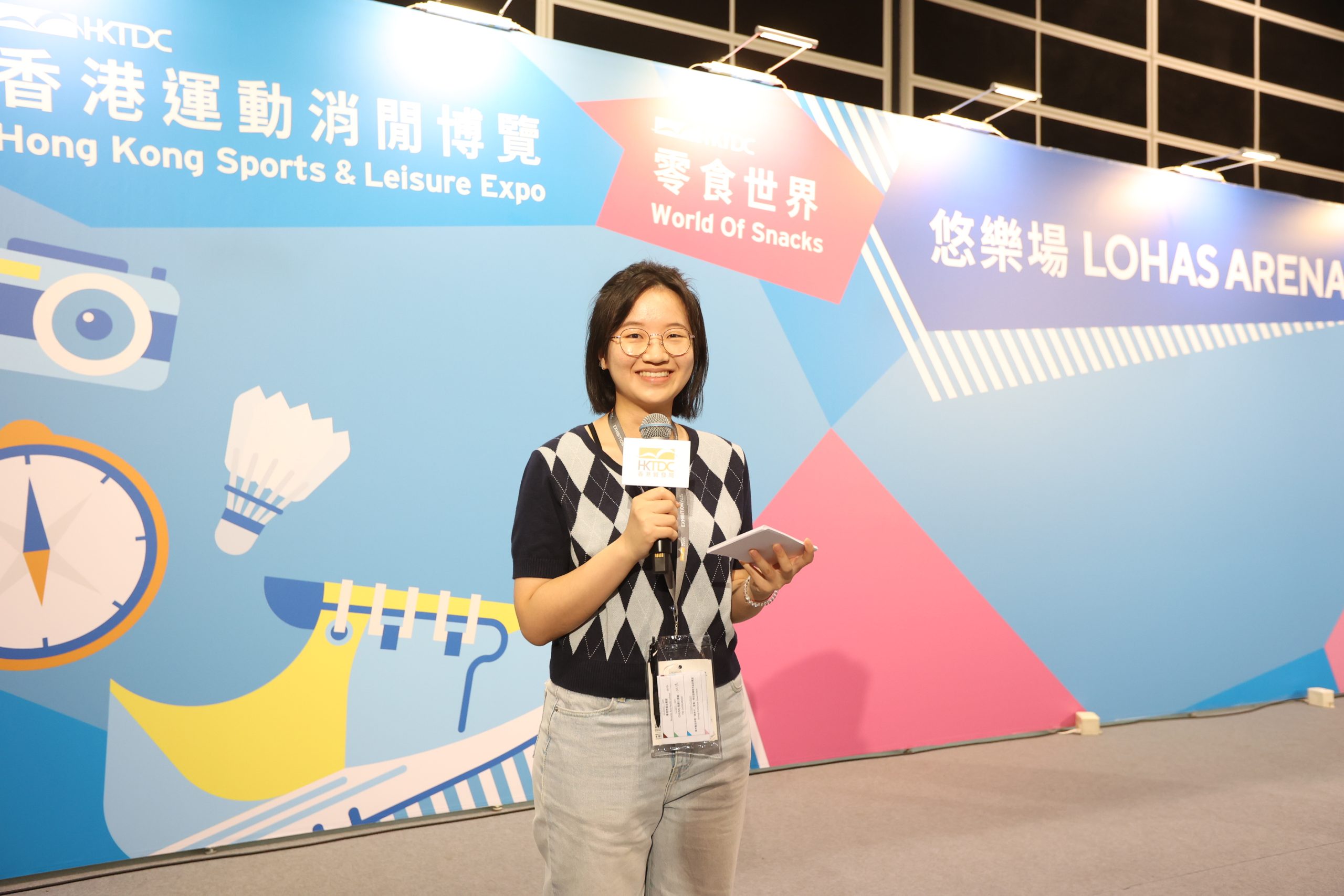
Working at an exhibition

Required skills and knowledge

This internship required a combination of soft and hard skills. On the soft-skills side, communication, teamwork, adaptability, and customer orientation were essential, as I interacted with colleagues from different units, exhibitors from diverse backgrounds, and a high volume of visitors within tight time constraints. On the hard skills side, I benefited from having a basic knowledge of marketing and event management, as well as an understanding of how trade fairs support business development and branding.

What I learned

During the internship, I learned how large exhibitions are structured from planning stages to on-site execution and post-event follow-up. I also gained confidence in handling operational issues under pressure, prioritising tasks and communicating clearly with stakeholders who have different expectations and constraints. Ultimately, the experience deepened my interest in marketing, events, and digital business by demonstrating how well-designed exhibitions can create value for both companies and the general public.

Business and economic concepts related to my internship

I present below three business and economic concepts related to my internship: market matching and platforms, experiential marketing, and capacity/operations management. Each helps to understand how HKTDC create value for participants and how my daily tasks are connected to broader economic mechanisms.

Market matching and platforms

HKTDC is a platform that facilitates matching between buyers and sellers, particularly for SMEs looking to reach new markets. Trade fairs reduce search and transaction costs by concentrating information, products and potential partners in one place. In my missions, supporting exhibitor coordination and visitor flow contributed to making this matching process smoother and more efficient.

Experiential marketing

The Hong Kong Book Fair, World of Snacks and the Hong Kong Sports & Leisure Expo are strong examples of experiential marketing in practice. These fairs are not only about selling products; they create immersive experiences through themed zones, demonstrations, workshops and special programmes that engage visitors emotionally and physically. By helping with on-site operations and visitor interactions, I saw how layout, signage, activities and staff behaviour influence the customer journey and can strengthen brand perception and purchase intention.

Capacity and operations management

Large exhibitions require careful capacity and operations management to handle fluctuating visitor numbers while maintaining safety and service quality. Concepts such as peak-load management, queuing, crowd control, and resource allocation are evident in the way entrances, halls, and activity zones are organised. My tasks related to monitoring visitor traffic, guiding flows and coordinating with different teams were directly linked to these operational decisions, which ultimately affect exhibitors’ satisfaction and the overall performance of the event.

Why should I be interested in this post?

For a business student interested in careers related to marketing, events, consulting or trade promotion, an internship at an organisation like HKTDC offers a unique combination of public and private sector exposure. You can observe how strategic objectives are translated into concrete event formats and marketing actions, while developing practical skills in project management, communication, and data-driven decision-making. This type of experience can be a strong asset when applying for roles in event management, business development, corporate marketing or international trade-related positions.

Related posts on the SimTrade blog

   ▶ All posts about Professional experiences

   ▶ William LONGIN My experience as a leisure tourism management assistant in the French Tourism Development Agency

Useful resources

Hong Kong Trade Development Council

HKTDC Hong Kong Book Fair

HKTDC World of Snacks

HKTDC Hong Kong Sports & Leisure Expo

About the author

The article was written in December 2025 by SHIU Lang Chin (ESSEC Business School, Global Bachelor in Business Administration (GBBA), 2024-2026).

   ▶ Read all articles by SHIU Lang Chin.