
Crypto ETP

Alberto BORGIA

In this article, Alberto BORGIA (ESSEC Business School, Global Bachelor in Business Administration (GBBA), Exchange student, Fall 2025) explains about ETPs on crypto.

Introduction

An Exchange-Traded Product (ETP) is a type of regulated financial instrument, which is traded on stock exchanges and allows exposure to the price movements of an underlying asset or a benchmark without requiring direct ownership of the asset.

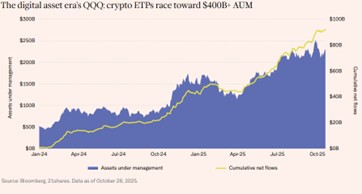
Crypto ETPs are instruments that provide regulated access to all market participants. Since their inception, they have become the main access point for traditional investors seeking exposure to digital assets. Every year, the value of assets in this category continues to grow and in their latest report, 21Shares analysts agree that by 2026 these assets will be able to surpass $400 billion globally.

The picture shows how rapidly crypto ETPs have scaled from early 2024 to late 2025. Assets under management (blue area) rise in successive waves, moving from roughly the tens of billions to just under the $300B range by late October 2025, while cumulative net inflows (yellow line) trend steadily upward toward ~$100B, signaling that growth has been supported by persistent new capital in addition to market performance.

As regulated access expands through mainstream distribution channels and more jurisdictions formalize frameworks for crypto investment vehicles, ETPs increasingly become the default wrapper for exposure. As the market deepens, secondary-market liquidity typically improves and execution costs compress, reducing short-term dislocations around the product and reinforcing further allocations.

Crypto ETP Asset under Management (AUM)
Crypto ETP AUM
Source: 21Shares.

This trend is driven not only by retail clients’ demand, but also by an increasing openness of traditional markets toward these types of products, meaning that established exchanges, broker-dealers, custodians and market-makers are increasingly willing to list, distribute and support crypto-linked ETPs within the same governance, disclosure and risk-management frameworks used for other exchange-traded instruments. In the US, more and more structural barriers are being removed thanks to new approval processes for crypto investment vehicles, as regulators and exchanges have been moving toward clearer, more standardized filing and review pathways and more predictable disclosure expectations.

By the end of 2025, more than 120 ETP applications were pending review in the USA, under assessment by the SEC and, where relevant, by the national securities exchanges seeking to list these products, positioning the market for significant inflows beyond Bitcoin and Ethereum in the new year.

We see this trend in other countries as well: the UK has removed the ban for retail investors, Luxembourg’s sovereign fund has invested as much as 1% of its portfolio in Bitcoin ETPs, while countries such as the Czech Republic and Pakistan have even started using such assets for national reserves. In Asia and Latin America, regulatory frameworks are also being formed, making crypto ETPs the global standard for regulated access.

This will lead to a virtuous cycle that will attract more and more capital: AUM growth enables a reduction in spreads, volatility decreases and liquidity increases, improving price efficiency and execution quality and reducing short-term dislocations, thereby supporting the growth of the asset class.

ETP o ETF

An Exchange-Traded Product is a broad category of regulated instruments that give investors transparent, tradable exposure to an underlying asset, index or a strategy. An Exchange-Traded Fund is a specific type of ETP that is legally structured as an investment fund, typically holding the underlying assets and calculating a net asset value. The key difference is therefore the legal form and the risk profile: ETFs are fund vehicles with segregated assets held for investors, whereas many non-ETF ETPs (such as ETNs) are debt instruments whose performance can also depend on the issuer’s creditworthiness. So, all ETFs are ETPs, but not all ETPs are ETFs.

Structure

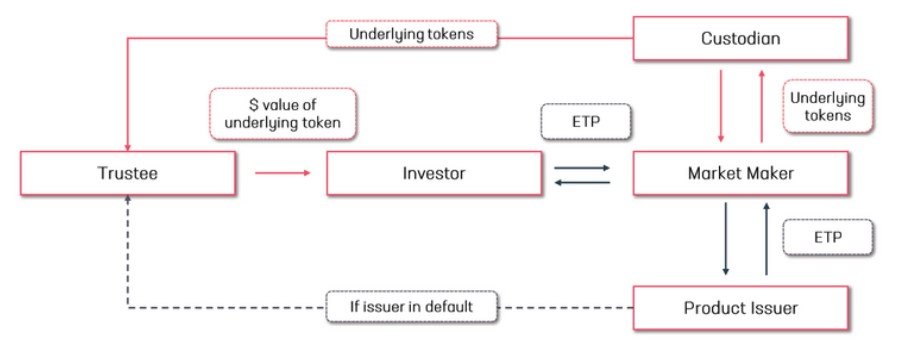
There are two methods for replicating the underlying: physical and synthetic. Physical ETPs are created through the purchase and holding of the asset by the issuing entity, thus allowing a replication directly linked to the performance of the underlying. As for synthetic ETPs instead, they are created from a SWAP contract with a counterparty, for example a bank, in order to provide the return of that asset. To protect the liquidity of the daily return, the counterparty is required to post liquid collateral with the issuer and the amount of this collateral then fluctuates based on the value of the underlying asset and its volatility profile. Based on the data shown by Vanguard’s discussion of physical vs. synthetic ETF structures and with industry evidence showing that physical replication dominates European ETF AUM, we can say that in recent years investors have generally preferred physical ETPs, thanks to their transparency, the absence of counterparty risk and their relative simplicity rather than synthetic structures. In particular with regard to crypto, given the simplicity of holding the asset and their liquidity, almost all of these derivatives on cryptocurrencies are physical.

For this reasons, when you purchase this type of financial asset, you do not directly own the physical cryptocurrency (the underlying), but rather a debt security of the issuer, backed by the crypto and with a guarantee provided by the relationship with the trustee (This entity’s task is to represent the interests of investors, receiving all rights over the physical assets that collateralize the ETP. It therefore acts as a third and independent party that protects the ETP’s assets and ensures that it is managed in accordance with the terms and conditions established beforehand.)

Structure of Exchange Traded Product
ETP’s structure
Source: Sygnum Bank.

Single or diversified

Depending on the exposure the investor wants to obtain, various types of these assets can be purchased:

  • Some may replicate a specific cryptocurrency by tracking the value of a single digital coin. Their task is therefore only to replicate the market of the underlying asset in a simple and efficient way.
  • Other ETPs can replicate a basket or an index of cryptocurrencies; this is done to gain exposure simultaneously to different markets, diversifying risk.
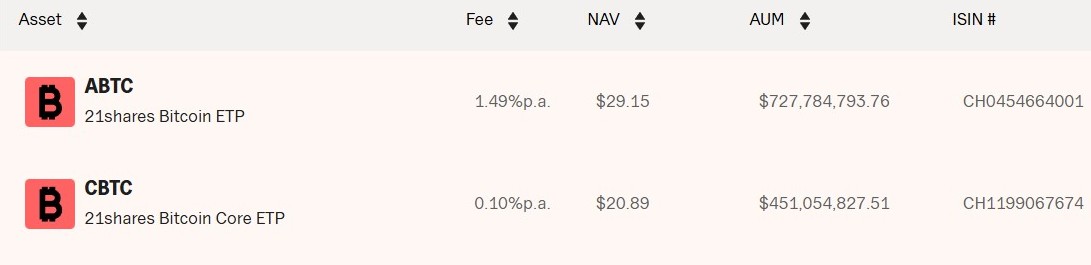
  • We can find an example of this in the products offered by 21Shares. Part of it is represented by diversified products, such as the 21Shares Crypto Basket Equal Weight ETP, where several cryptocurrencies make up the product. The majority, however, both in terms of AUM and number of products, is single-asset, with only one underlying. Examples include the 21Shares Bitcoin ETP or the 21Shares Bitcoin Core ETP.
  • When speaking specifically about these two products, there is a distinctive feature that makes 21Shares unique. The company was the first to bring these products to market and, for this reason, having a “monopoly” at the time, it was able to charge extremely high fees. With the arrival of new players, however, it was forced to reduce them and, thanks to its structure and competitive advantages, was able to offer extremely low fees, the lowest on the market, without delisting the previous products, as they remained profitable. In fact, the two products mentioned above have no differences of any kind, except for their costs.

BTC ETP
21Shares BTC ETP
Source: 21Shares.

Advantages compared to traditional crypto

The reasons that may lead to the purchase of this type of financial instrument can be multiple. First of all, navigating the world of cryptocurrencies can seem difficult, but ETPs remove much of the complexity. Instead of relying on unregulated platforms or paying extremely high fees to traditional funds that invest only marginally in cryptocurrencies, investors have the opportunity to buy this asset directly as they would with other securities. ETPs will then sit alongside all other investments in the portfolio, thus enabling a simpler analysis of it and also comparison with other products. Moreover, even if these intermediaries do not offer true financial advice, they provide investor support that is far higher than that of classic crypto platforms.

Another element in their favor is the security and transparency on which they are based. In particular in Europe, these instruments are subject to stringent financial regulations and are required to comply with accounting, disclosure, and transparency rules. Then, since they are predominantly physically collateralized, their structure makes it possible to protect the client and the asset itself in the event of bankruptcy or insolvency of the issuer, limiting exposure to the underlying.

Why should I be interested in this post?

The crypto market is a complex world and constantly changing. This article can be read by anyone who intends even just to deepen their understanding or discover concepts that nowadays are becoming increasingly important and fundamental in financial markets and in everyday life, not only by those who want to pursue a career in the cryptocurrency sector.

Related posts on the SimTrade blog

   ▶ Snehasish CHINARA Top 10 Cryptocurrencies by Market Capitalization

   ▶ Hugo MEYER The regulation of cryptocurrencies: what are we talking about

Useful resources

CoinShares

21Shares

Swem, N. and F. Carapella (28/03/2025) Crypto ETPs: An Examination of Liquidity and NAV Premium FEDS Notes.

sygnum

Vanguard: Replication methodology / ETF knowledge

About the author

The article was written in December 2025 by Alberto BORGIA (ESSEC Business School, Global Bachelor in Business Administration (GBBA), Exchange student, Fall 2025).

   ▶ Read all articles by Alberto BORGIA.
EBITDA: Uses, Benefits and Limitations

Alberto BORGIA

In this article, Alberto BORGIA (ESSEC Business School, Global Bachelor in Business Administration (GBBA), Exchange student, Fall 2025) explains about EBITDA, how it can be used, its advantages and disadvantages.

Introduction

Earning Before Interest, Taxes, Depreciation and Amortization (EBITDA) is ones of the most used financial metric and its goal is to understand a company’s operating performance before considering the effects of financial choices (interests), taxation and non-cash accounting charges related to long-lived asset and acquired intangibles.

So in intuition behind it is that if two or more firms sell similar products, the analyst should be able to compare their “core operating engine”, even if they differ from a debt (higher debt), tax (different tax jurisdiction) or asset base prospective.

Because EBITDA is a key component capable of influence valuation and decisions, it is crucial to understand both how it is obtained and what it does.

How it is obtained

To calculate this metric, we begin with the income statement and add back the expenses that are excluded by the EBITDA definition:

EBITDA = Net Income + Interest + Taxes + Depreciation + Amortization

Another way is to start from the EBIT:

EBITDA = EBIT + Depreciation + Amortization

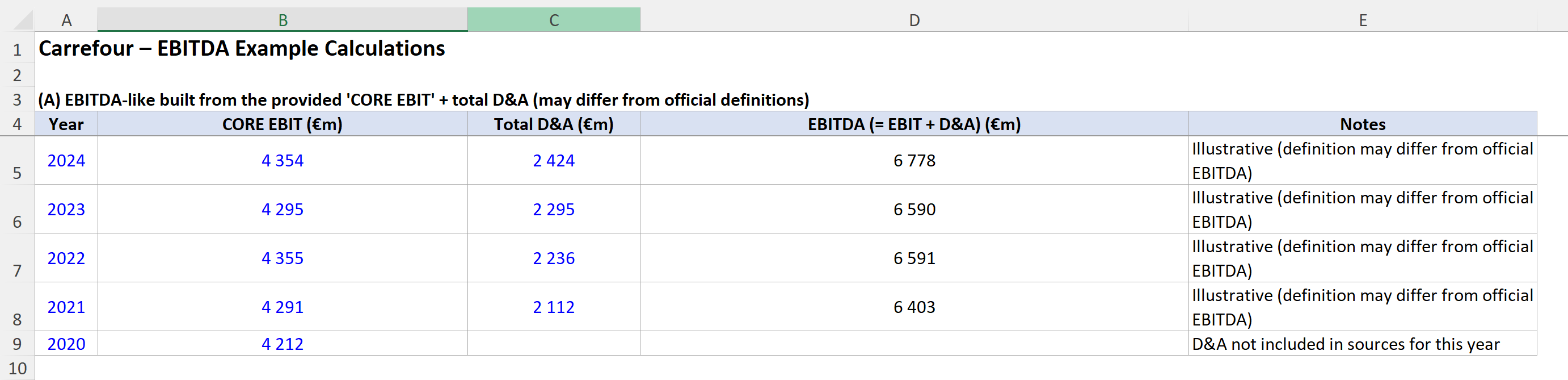
Using Carrefour as a real-case example, I calculated EBITDA starting from the company’s income-statement figures. First, I reproduced an “operating-style” EBITDA by taking Gross Margin and subtracting selling, general and administrative expenses, which gives a core operating profit measure before financing and taxes. Then, for a second approach, I computed EBITDA as Recurring Operating Income + Depreciation + Amortization. This shows how EBITDA is obtained in practice from published financial statement components.

These two formulae can look clean and easy, but the real computation is messier, depending on how the company structure his income statement and on what is included in the amortization and depreciation class. For these reasons EBITDA is usually accompanied by a set of clear definitions and reconciliations.

Another key factor is that the “earnings” are not always interpreted in the same way, that is why the SEC has decided that in the context of EBITDA and EBIT described in its adopting release, “earnings” means GAAP net income as presented in the statement of operations. So, if a measure is calculated differently, it should not be labeled EBITDA, but Adjusted EBITDA.

Adjusted EBITDA

For many documents we see the term Adjusted EBITDA, because it modifies the measure by excluding values that are considered by the management as “non-core” or “non-recurring”. These adjustments typically include items such as restructuring costs, acquisition-related expenses, unusual or non-recurring gains and losses, and stock-based compensation. The goal is to estimate a normalized operating result. This can however create risks when comparing different firms or the same one in different years.

What it is used for

The reasons why EBITDA is one of the metrics most taken into account by financial analysts are multiple as its ways of use. First of all, by excluding interest rates, it is suitable as a proxy for comparing companies from an operating perspective, even when they have different tax or capital structures. It is then used to compare various risk indicators or to limit leverage and protect lenders (in the debt market).

It is also used for company valuation and for the calculation of multiples, such as EV/EBITDA. Here, EV indicates the total value of the firm. According to the technical literature, the reasons why this multiple is particularly useful and widely used include, for example, the possibility of calculating it even when net income is negative, for this reason, it is extremely common in markets where significant infrastructure investments are present and in leveraged buyouts and naturally because it allows the comparison of companies with totally different levels of financial leverage.

They are also particularly useful (EBITDA and its variants) for communicating to investors and analysts, even though it is necessary to be especially careful about any modifications aimed at “inflating” the results.

Last it is considered by analysts as a starting point, pairing it with cash-flow measures, such as free cash flow, for a fuller view.

Advantages

There are several advantages to using EBITDA; for instance, it can be calculated quickly from publicly available financial statements or is often directly disclosed by companies. In industries where leverage varies a lot it is useful to analyze companies in it or when assessing a target in M&A where capital structure can change immediately after the acquisition. Finally operating results are less sensitive to life assigned to asset when we add back depreciation and amortization.

Disadvantages

However, EBITDA is also associated with several notable drawbacks. Even by adding back depreciation and amortization, the value does not take into account changes in working capital and capex needed to increase or maintain productive capacity, it is more like a “rough” measure of operating cash flows.

As previously noted, EBITDA is also susceptible to manipulation, as it is inherently open to interpretation. Consequently, it should be complemented with other financial metrics to provide a more comprehensive and balanced assessment, thereby reducing the risk of misinterpretation driven by management’s attempts to influence investors’ perceptions..

EBITDA Margin

To express the EBITDA relative to revenue, we can use EBITDA margin:

EBITDA Margin = EBITDA / Revenue

It is calculated to understand how much operating earnings the firm generates per unit of sales, in particular it can be used to compare a firm’s profitability with its peers or to track trends. Even though it is particularly useful in financial analysis, the EBITDA margin presents the same issues as the original metric. If the first value is defined incorrectly, then this one will also be wrong. Just like normal EBITDA, this metric can be used best when it is accompanied by Operating Cash Flow (OCF), which reflects the cash generated by a company’s core operating activities, and Free Cash Flow (FCF), which represents the cash available after capital expenditures necessary to maintain or expand the asset base, and by an industry context.

Example

I provide below an example for the computation of EBITDA based on Carrefour, a French firm operating in the retail sector, more precisely in mass-market distribution (retail grocery).

Example of EBITDA calculation: Carrefour

You can download the Excel file provided below, which contains the calculations of EBITDA for Carrefour.

Download the Excel file.

Why should I be interested in this post?

EBITDA represents a fundamental concept for anyone who wants to build their career in the financial field, but not only. Understanding how it works, as well as its weaknesses and strengths, is necessary in order to build the knowledge required to become a competent and respected professional. This article, in fact, starts from the basics in order to explain the principles behind this metric even to those who are not in the field, helping them understand it.

Related posts on the SimTrade blog

   ▶ Cornelius HEINTZE DCF vs. Multiples: Why Different Valuation Methods Lead to Different Results

   ▶ Dawn DENG Assessing a Company’s Creditworthiness: Understanding the 5C Framework and Its Practical Applications

Useful resources

Non-GAAP Financial Measures

Deloitte Accounting Research Tool (DART) 3.5 EBIT, EBITDA, and adjusted EBITDA

Damodaran EBITDA concept, margins, interpretation

Moody’s (202/11/2024) EBITDA: Used and Abused

Faria-e-Castro, M., Gopalan R., Pal, A, Sanchez J.M., and Yerramilli V. (2021) EBITDA Add-backs in Debt Contracting: A Step Too Far? Working paper.

Damodaran EBITDA vs cash flow logic; reinvestment/capex relevance

About the author

The article was written in December 2025 by Alberto BORGIA (ESSEC Business School, Global Bachelor in Business Administration (GBBA), Exchange student, Fall 2025).

   ▶ Read all articles by Alberto BORGIA.

My Experience as a Wealth Management Intern at Nextam Partners

Alberto BORGIA

In this article, Alberto BORGIA (ESSEC Business School, Global Bachelor in Business Administration (GBBA), Exchange student, Fall 2025) shares his professional experience as a Wealth Management Intern at Nextam Partners.

About the company

During the summer between my second and third year of my Bachelor’s degree, I had the opportunity to join the Nextam Partners team for two months. Founded in 2001 by a group of professionals with decades of experience behind them and billions under management, Nextam is currently a family office that also provides financial advisory and wealth management services for Ultra High Net Worth Individuals and private foundations, with over 6 billion in assets under management. The company used to operate in the asset management sector as well, before being acquired by Banca Generali and then was partly taken back over by the founding partners, with regard to the segments that are still active.

Logo of NEXTAM.
Logo of NEXTAM
Source: Nextam Partners.

My internship

I joined Nextam in June 2025 as a Summer Analyst in order to pursue my interest in wealth management and finally obtain a concrete experience that would allow me to learn first-hand both the more technical and the more practical concepts of the sector that are not covered in university lectures. and my role consisted mainly in supporting the various team members in their analysis and research functions for the development and modification of multi-asset portfolios through market screening, Bloomberg-based analysis and portfolio risk simulation using Windham.

My missions

During that months my duties as an intern were varied and I had the opportunity to work with almost all the member of the team.

I contributed to high-level asset allocation decisions as well as shorter-term portfolio repositioning, shaped by market movements, interest rates trends and specific requirement of each client. For example, since the clientele was made uo of foundations that required constant inflows of capital, I produced bond portfolios that would allow for a balanced and steady coupon return.

I also had the opportunity to participate on the buy side in IPOs of small and mid-cap companies, developing in-depth financial analyses for the firm’s clients. By taking part in various meetings with the sell side, I thus had the opportunity to fully understand how these types of transactions are really managed.

In addition to client-focused tasks, I took part in producing documents containing technical information about the asset in the portfolio, ensuring compliance with our customers’ regulatory requirements. This allowed me to work with assets of every type, understanding the risks and benefits of each of them.

Required skills and knowledge

The skills required were both technical and non-technical. It was necessary to have a deep knowledge of the various types of existing assets and of the concepts of strategic and tactical asset allocation, construction of multi asset portfolios, notion of portfolio theory and the ability to analyze and understand informational documents. However, the fundamental part was a strong familiarity with tools such as Excel and platforms like Bloomberg or FactSet, as well as internal ones. Bloomberg is the leading financial information platform in the world, allowing users to obtain any type of data on assets and companies in real time, while also integrating the opinions and forecasts of various financial analysts. FactSet offers a similar service; however, in my experience, it has mainly been used, together with internal datasets, for the analysis of asset data whose information is not available to all investors. It is therefore essential to understand how to make the best use of these platforms and the full range of their functionalities, including those features that are less well known to most analysts, in order to be as precise and reliable as possible. These tools formed the basis for a solid analysis and speed in completing tasks. An excellent knowledge of the regulations one works with is also necessary to ensure that one’s work is truly useful for the client and does not lead to further issues.

As for soft skills, it is instead extremely important to already possess and further improve one’s communication abilities, particularly with regard to simplifying complex concepts for the client, as well as precision and a high level of confidentiality. To be efficient you also need to be highly adaptable, adjusting your work to market conditions and changing client preferences. On a more operational level, strong organizational skills and effective time management are required to handle several tasks and projects at the same time to deliver results in a fast-paced environment.

The combination of these skills together with all the things that one will learn during working hours, makes for an excellent analyst in the Wealth Management sector.

What I learned

The “size” of the team and the firm was probably one of my main strokes of luck during the internship, in fact I had the opportunity to work closely with the partners and founders, learning as much as possible from people with decades of experience in the industry. The opportunity to be by their side taking notes during meeting or client appointments allowed me to find myself in contexts and situations that I would hardly have encountered in a large firm and from which I was able to truly understand and learn what it means to work in the Wealth Management industry and how to navigate it in order to become a recognized and respected professional. Understanding how a company operating in the sector today can be managed and improved, the tricks and the various “unwritten rules”, as well as its structure and organization, by exploring in depth the functions, objectives and issues that may rise in the back, middle and front office.

In addition to this I had the opportunity to delve into and revisit fundamental technical concepts, particularly with regard to the regulations one had to deal with and complex and uncommon financial valuation tools, understanding their real usefulness in various circumstances.

I strengthened my technical foundation in fund analysis by learning how to evaluate performance, risk exposure, and investment style. By studying portfolio allocations and reviewing managers’ communications, I became more confident in identifying the drivers behind results and in understanding the strategies applied across different products. Beyond improving my analytical approach, the experience gave me a clearer view of the mechanisms and interconnections that shape financial markets and guide investment decisions.

Also. I had the chance to further develop my skills with essential tools, such as excel, on a daily basis. I worked with data to structure and standardize information, run comparison across funds and benchmarks and support reporting activities. This helped me become quicker and more precise with formulas and efficient analytical workflows.

Overall, the internship expanded both my knowledge and my practical skill set, providing concrete exposure to the realities of operating in a complex and highly regulated industry.

Financial and business concepts related to my internship

I present below three financial concepts related to my internship: valuation multiples, Ultra-High-Net-Worth individual (UHNWI), and risk profiling & suitability.

Valuation multiples

The thing I worked on the most during the internship were valuation multiples, for the valuation of a company and its peers it is essential to be able to build them and understand them as well as possible, adapting to every context, using the right ones for each type of analysis and market under review. The multiples I came across most often are also the ones most widely used by all analysts in almost every area of finance, P/E and EV/EBITDA. As mentioned before, both are used for valuation and for estimating a company’s implied value, particularly in relation to its peers. However, EV/EBITDA values the company from an operating perspective before interest, depreciation and amortization and taxes, allowing companies with different capital structures to be compared. The P/E is used to understand whether the stock is overpriced or not relative to expected earnings and growth. They do, however, have some drawbacks: P/E is affected by accounting policies and leverage while EV/EBITDA can be misleading if EBITDA does not reflect capex or margin quality.

Ultra-High-Net-Worth Individual (UHNWI)

Investors are generally divided into various categories based on their investment capacity and each of these requires specific services. First, we find the mass affluent segment; this category represents a large portion of the population with significant investment capacity, controlling a substantial share of global wealth. Individuals belonging to this category have investable assets exceeding USD 100 k but below USD 1 million and they exhibit more advanced needs compared to traditional retail investors. According to the UBS Global Wealth Report 2024, this individuals represent a large and expanding segment of the global population, benefiting from rising incomes and asset appreciation. While precise figures vary by region, this group accounts for a significant share of global investable wealth and represents a key growth driver for wealth management services. Subsequently, we can find High Net Worth Individuals, subjects with assets exceeding USD 1 million, who are among the main clients of private banking and investment advisory services. According to Capgemini researcher the global population of this category is increasing each year, reaching 23 million individuals with a total wealth of 86 trillion. Individuals with an investment capacity above 30 million euros fall within the category of Ultra-High-Net-Worth Individuals. Despite been less than 1 million this fraction control an extremely high amount of the global wealth and that’s why this is the segment that wealth management refers to, providing complex and tailored services. Usually, these individuals do not limit themselves to needing simple portfolio management, but rather require services dedicated to them, such as estate planning, tax optimization and long-term wealth protection.

Risk profiling & suitability

In order for the client’s portfolio asset allocation to be as suitable as possible, it is necessary to assess the client’s risk profile and the suitability of the investments, with the aim of ensuring that the assets and the portfolio are consistent with the client’s objectives, time horizon, and risk aversion. To obtain the necessary information, firms are required to use a set of procedures known as the “Know Your Customer” (KYC) process, which make it possible to understand the client’s identity, personal and financial situation, as well as the origin of the funds and the client’s objectives. More broadly, the KYC process is a regulatory requirement designed to ensure transparency and integrity within the financial system. It is mandatory by law, because by requiring firms to verify clients’ identities and assess their financial backgrounds, KYC procedures can help prevent money laundering, terrorist financing and other types of illicit activities. Once the necessary information has been obtained, through internal tools the team is able to calculate the most efficient way to allocate the available resources. Such an assessment must then be updated continuously based on the individual’s needs and the various changes in their profile.

Why should I be interested in this post?

This post may be useful for anyone who wants to pursue a career in the wealth management sector or simply understand its structure. Today and in the near future, private banking represents a huge and constantly growing sector, capable of offering great opportunities to anyone who wants to dive into it. Just in Europe assets under management reach about €32.7 trillion by late 2024, supported by both market performances and new money inflows. This growth is also fueled by structural trends such as the constant rising share of passive investing and the increasing access to the private markets.

Related posts on the SimTrade blog

   ▶ All posts about Professional experiences

   ▶ Jules HERNANDEZ My internship experience in a Multi-Family Office

   ▶ Louis DETALLE A quick review of Wealth Management’s job…

   ▶ Tanguy TONEL My experience as an Investment Specialist at Amundi Asset Management

Useful resources

Nextam Partners S.I.M.

Klaus P. (2022) What matters most to ultra-high-net-worth individuals? Exploring the UHNWI luxury customer experience (ULCX) Journal of Product & Brand Management, 31(3):368-376.

Cap Gemini (2025) World Wealth Report

Altrata (2024) World Ultra Wealth Report 2024

Douglas Elliman (2024) 2024 Wealth Report: Global Number of Ultra-High-Net-Worth Individuals Up 4.2% in 2023

EY (2024) 2024 EY Global Wealth Management Industry Report

Pimco Education Understanding Asset Allocation and its Potential Benefits

About the author

The article was written in December 2025 by Alberto BORGIA (ESSEC Business School, Global Bachelor in Business Administration (GBBA), Exchange student, Fall 2025).

   ▶ Read all articles by Alberto BORGIA.
